How Bitcoin's P2P Network Operates: A Deep Dive into Decentralization
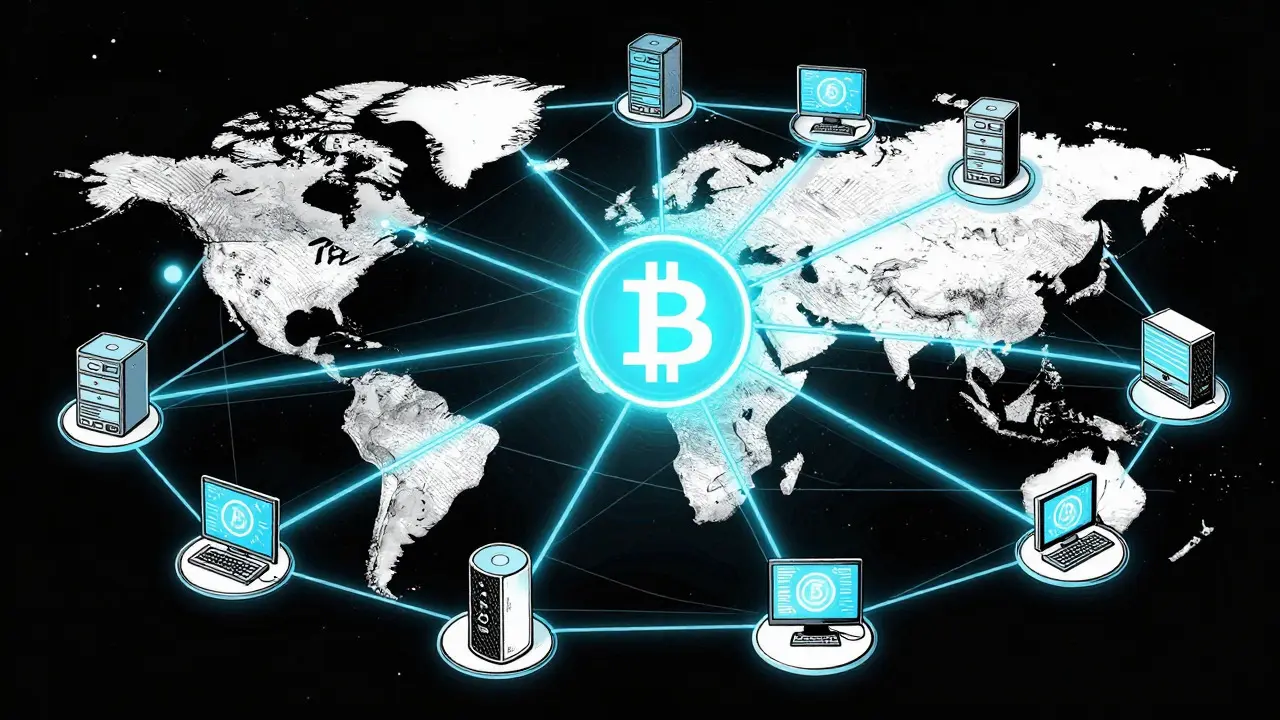
Imagine sending money without a bank. No middleman checking your balance, no fees for processing, and no central server that could go down or freeze your account. This isn't science fiction; it’s how Bitcoin is a decentralized digital currency that operates on a peer-to-peer network works every single day. But how does the system know who to trust when there is no boss in charge? The answer lies in its underlying structure: the Peer-to-Peer (P2P) Network is a decentralized architecture where computers connect directly to each other without a central server.
This network is the backbone of the entire cryptocurrency revolution. It replaces traditional client-server models with a mesh of equal participants. To understand Bitcoin, you have to understand this web of connections. Let’s break down exactly how these nodes talk to each other, how they find one another, and why this design makes the system nearly impossible to shut down.
The Mesh Topology: Everyone Is Equal
In most internet applications, you are a client, and a company owns the server. If Amazon goes down, you can’t buy shoes. If your bank’s server crashes, you can’t pay rent. These are centralized systems with single points of failure. Bitcoin flips this model entirely.
Bitcoin uses a flat hierarchy known as mesh topology. In this setup, every participant-called a node-is both a client and a server. When you run a full node on your computer, you download the entire history of transactions. You verify them yourself. Then, you share that verified data with other nodes. There is no "headquarters." There is no master list kept by a corporation. Instead, thousands of computers around the world hold identical copies of the ledger.
This equality is crucial for security. Because every node has equal status and privileges, no single entity can rewrite the rules or alter transaction histories without the consensus of the majority. If one node tries to cheat, the rest of the network rejects its data. This distributed fault tolerance means the network stays alive even if large chunks of it disappear. Lose a few hundred nodes? The remaining peers automatically pick up the slack. The system is designed to be resilient against attacks, censorship, and hardware failures alike.
How Nodes Find Each Other: Solving the Bootstrap Problem
Here is the tricky part. If there is no central directory listing all Bitcoin users, how does a new computer join the party? This is called the bootstrap problem. When you first install Bitcoin software, your machine knows nothing about the network. It needs to find at least one neighbor to start downloading blocks and syncing up.
The solution is elegant and multi-layered. First, the software attempts to contact a set of Domain Name System (DNS) seed servers. These aren’t just any servers; they are nine independent domains operated by different people and organizations. By splitting the responsibility among multiple entities, the network ensures that no single person can block new users from joining. If all nine DNS seeds were to fail simultaneously-a statistical near-impossibility-the system has a backup plan.
Fallback mechanisms include hard-coded IP addresses stored in the Bitcoin Core software itself. These are known as seed nodes. They are publicly reachable, well-maintained computers that act as emergency entry points. Additionally, advanced users can configure custom peer lists or use privacy networks like Tor or I2P to connect anonymously. This redundancy is why experts describe the Bitcoin bootstrap process as incredibly robust. Even under heavy censorship or attack, new nodes can almost always find a way in.
Full Nodes vs. Pruned Nodes: Storage Trade-offs
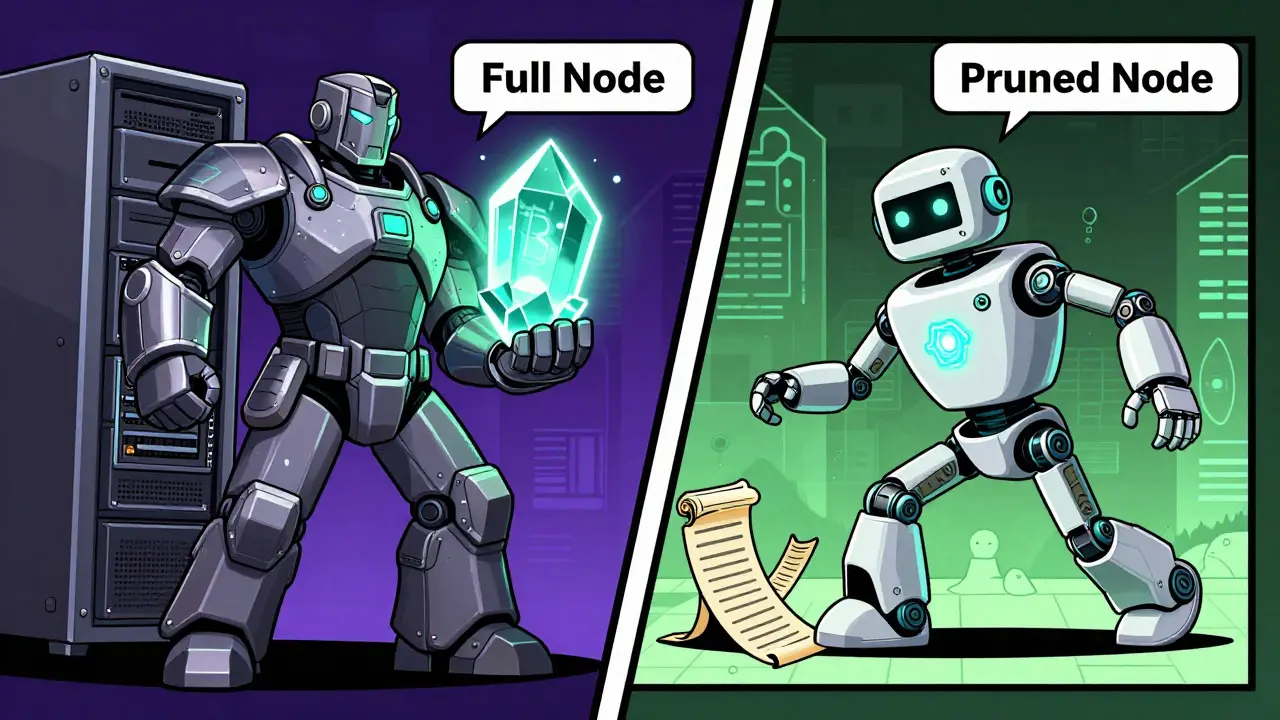
Not all nodes are created equal, though they all play a vital role. The two main types you’ll encounter are full nodes and pruned nodes.
A Full Node is a computer that stores the complete history of the Bitcoin blockchain. As of 2025, storing this entire history requires roughly 400 to 500 gigabytes of storage space. These nodes are the guardians of the network. They validate every transaction and every block since the genesis block in 2009. They serve historical data to other nodes and ensure that no invalid transactions slip through. Running a full node gives you maximum sovereignty over your funds because you don’t have to trust anyone else’s version of the truth.
However, 500 GB is a lot of space, and not everyone wants to dedicate an entire hard drive to Bitcoin. That’s where pruned nodes come in. A pruned node still validates every transaction in real-time, ensuring the network remains secure. But instead of keeping the entire history, it deletes old block data after verifying it. This allows users with limited storage to participate fully in the validation process without hoarding decades of data. While pruned nodes can’t serve historical blocks to others, they still contribute to the network’s immediate health and security.
| Feature | Full Node | Pruned Node | SPV Client |
|---|---|---|---|
| Storage Required | 400-500 GB+ | ~1-2 GB | Minimal |
| Validation Capability | Complete | Current Blocks Only | Limited (Trust-based) |
| Serves Historical Data | Yes | No | No |
| Privacy Level | High | Medium | Low |
The Role of SPV Clients for Everyday Users
Most people using Bitcoin wallets on their phones aren’t running full nodes. They are using Simplified Payment Verification (SPV) clients. An SPV client doesn’t download the whole blockchain. Instead, it connects to a few full nodes and asks them, "Did this transaction happen?"
This is convenient and lightweight, but it comes with a trade-off. You are trusting those full nodes to tell you the truth. If the full nodes you connect to are malicious or censored, your view of the network could be skewed. For high-value transactions or maximum security, running your own full node is recommended. For buying coffee, an SPV wallet is usually sufficient. Understanding this distinction helps you choose the right tool for your level of technical expertise and security needs.
Transaction Relay and Privacy Enhancements
When you send Bitcoin, your transaction doesn’t just fly straight to the recipient. It enters the P2P network. Your node broadcasts the transaction to its direct neighbors. Those neighbors check if it’s valid. If it is, they pass it along to their neighbors. Within seconds, the transaction ripples out across the globe, reaching thousands of nodes.
This gossip protocol is efficient, but it used to leak information. By analyzing which nodes received a transaction first, observers could sometimes guess where the transaction originated. To fix this, developers introduced Dandelion++. This protocol adds a "stem phase" where transactions are passed to only one neighbor initially, hiding the source. Once the transaction reaches a certain point, it enters a "fluff phase" and is broadcast widely. This simple change significantly improves user privacy without slowing down the network.

Scalability Challenges and Second-Layer Solutions
Despite its strengths, the P2P model has limits. Because every node must store and verify every transaction, the network can only process so many transactions per second before it becomes too slow or expensive to maintain. This is the scalability trilemma: balancing decentralization, security, and speed.
To address this, the community has developed second-layer solutions like the Lightning Network. The Lightning Network sits on top of the Bitcoin P2P network. It allows users to open channels between each other and conduct instant, low-cost micro-transactions off-chain. Only the final result is settled on the main Bitcoin blockchain. This preserves the security of the base layer while enabling the speed needed for everyday commerce. It’s a clever workaround that keeps the core P2P principles intact while solving practical usability issues.
Why Decentralization Matters in 2026
As we move further into 2026, the contrast between Bitcoin’s P2P network and emerging Central Bank Digital Currencies (CBDCs) is stark. CBDs rely on centralized databases controlled by governments. They offer convenience but sacrifice privacy and resilience. If the central server fails, the system stops. If the government decides to freeze accounts, they can. Bitcoin’s P2P architecture prevents this. No single point of control means no single point of failure or censorship.
This design choice makes Bitcoin unique. It’s not just a payment method; it’s a statement about autonomy. The network’s ability to survive fifteen years of market crashes, regulatory bans, and technical challenges proves that decentralized systems can work at scale. While newer blockchains may offer faster speeds, few match Bitcoin’s proven track record of security and decentralization.
What is a Bitcoin node?
A Bitcoin node is a computer running Bitcoin software that maintains a copy of the blockchain. It validates transactions and blocks, relays them to other nodes, and helps keep the network secure. Nodes can be full nodes, which store the entire history, or pruned nodes, which store only recent data.
How do new nodes find the Bitcoin network?
New nodes use DNS seed servers to find initial peers. If those fail, they fall back to hard-coded seed nodes included in the Bitcoin Core software. This multi-layered approach ensures that new participants can always join the network, even if some servers are blocked or offline.
Do I need to run a full node to use Bitcoin?
No, most users use lightweight wallets (SPV clients) that connect to full nodes. However, running a full node provides greater privacy and security because you verify transactions yourself rather than trusting third-party servers. It requires more storage and bandwidth but offers maximum sovereignty.
What is the difference between P2P and client-server networks?
In a client-server network, a central authority controls the data and services. If the server fails, the service stops. In a P2P network like Bitcoin, every participant acts as both client and server. There is no central point of failure, making the system more resilient and resistant to censorship.
How does the Lightning Network relate to the P2P network?
The Lightning Network is a second-layer solution built on top of Bitcoin’s P2P network. It allows for fast, cheap micro-transactions off-chain while relying on the main Bitcoin blockchain for final settlement. This improves scalability without compromising the security of the base layer.