What is Balls of Fate (BOF) crypto coin? Tokenomics, price, and market reality
When you hear about a cryptocurrency named Balls of Fate (BOF), it’s hard not to raise an eyebrow. The name sounds more like a meme or a joke than a serious digital asset. But behind the quirky branding and pitbull mascot, there’s a real token trading on multiple exchanges - and its story is more complicated than it looks.
What is Balls of Fate (BOF)?
Balls of Fate (BOF) is a cryptocurrency token that claims to fight injustice - not just in finance, but in politics, social systems, and institutional power. It doesn’t just want to be money. It wants to be a symbol. Its creators say BOF stands for those who speak up when others stay silent, especially in environments where honesty is punished and corruption is rewarded.
The token’s branding leans hard into this idea. The pitbull mascot isn’t random. It’s meant to represent relentless determination - a dog that won’t back down, even when the odds are stacked. That’s the story. Whether that story connects with real-world value is another question entirely.
Tokenomics: Almost All Supply Is Out There
BOF has a fixed maximum supply of 1 billion tokens. That’s not unusual. What is unusual is how close it is to hitting that limit. According to CoinGecko, the circulating supply is at 999,986,552 BOF. Coinbase says 999,993,011.595. Bybit reports 999.82 million. The numbers vary slightly across platforms, but they all point to one thing: nearly every single token has been released.
No more coins are being mined. No more are being reserved. The entire supply is already in circulation. That means the token’s price isn’t being driven by new supply - it’s all about demand. And right now, demand is extremely low.
Price Volatility: A Rollercoaster With No Riders
BOF had a moment. On September 23, 2024, it hit an all-time high of $0.04411. That’s over 700 times its current price. Since then, it’s been a steady decline. By June 27, 2025, it dropped to a low of $0.00005897. As of March 2026, prices hover between $0.000013 and $0.0007 - depending on which exchange you check.
Here’s where it gets messy:
- Coinbase says $0.000677
- Bybit, CoinMarketCap, and Crypto.com all show $0.00001333
- TradeSanta says $0.00001355
That’s a difference of over 50x between the highest and lowest prices. That doesn’t happen with healthy, liquid assets. It happens when a token trades on a handful of small exchanges with almost no buyers.
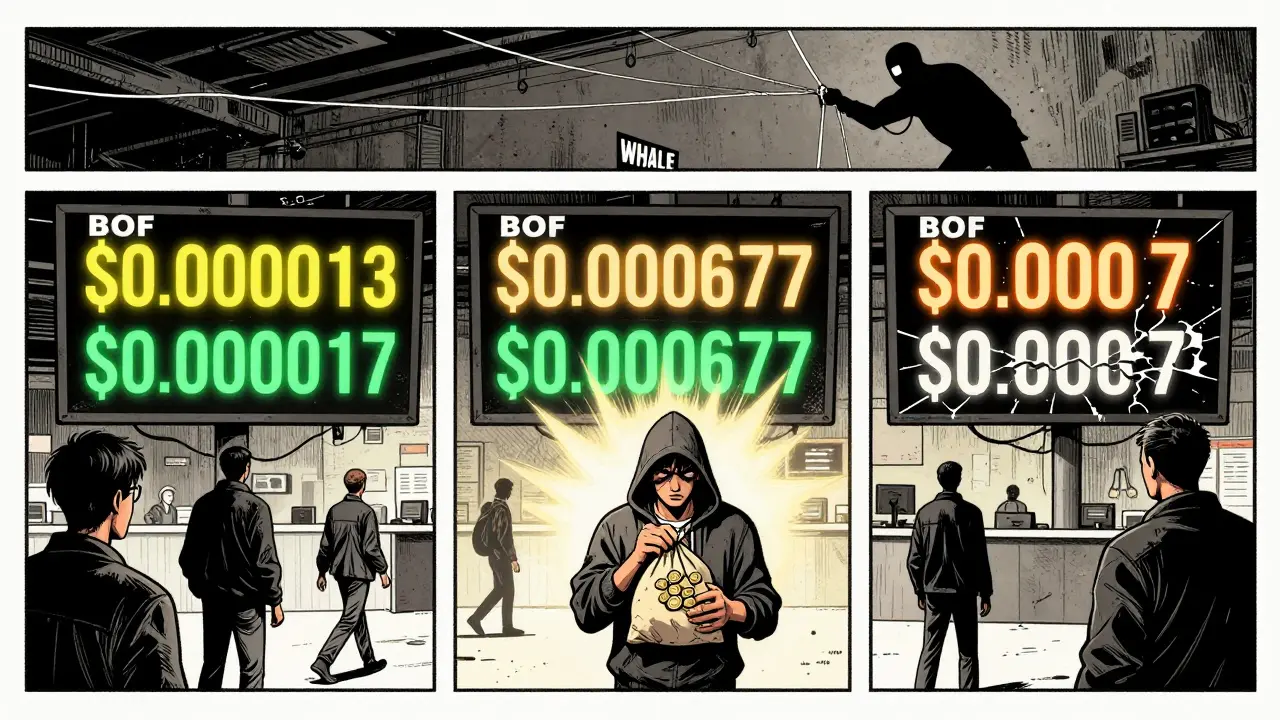
Market Cap Chaos: K or 7K? Which One’s Real?
Market cap is calculated by multiplying price by circulating supply. But with prices this inconsistent, market cap numbers are meaningless.
- CoinGecko: $108,490
- Coinbase: $677,481.32
- Bybit & CoinMarketCap: ~$13,330
- TradeSanta: $13,545.72
Why such a gap? One reason is data freshness. Some platforms update prices every few seconds. Others update once an hour - or not at all. Another reason: liquidity. If only $100 worth of BOF trades in a day, one small buy order can spike the price. That’s not a real market. That’s a glitch.
On CoinMarketCap, BOF ranks #7368. On CoinGecko, it’s #7007. These aren’t just low rankings - they’re near the bottom of the entire crypto list. Out of over 25,000 tokens, BOF is in the bottom 1%.
Trading Volume: Almost Nothing
Volume tells you how much people are actually trading. BOF’s numbers are all over the map:
- CoinGecko: $2.74 to $175.57 (in different reports)
- Coinbase: $96,520
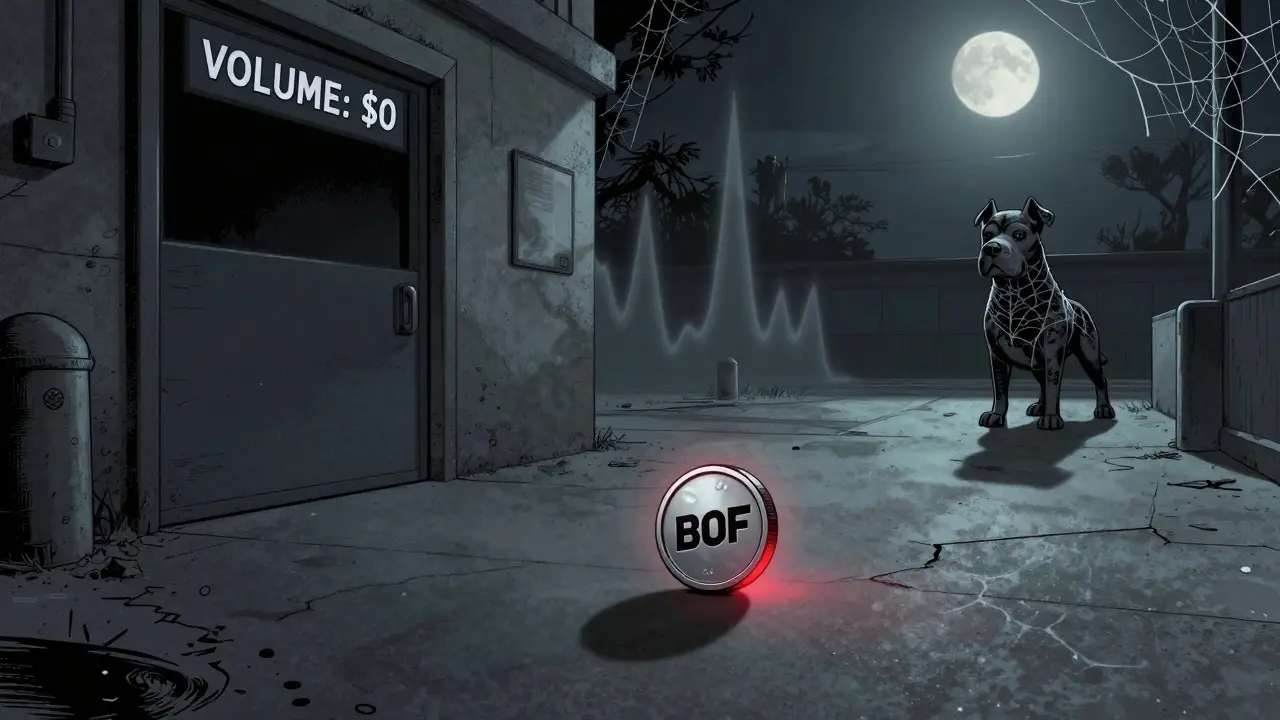
- CoinMarketCap: $0
- TradeSanta: $1.48
One exchange says it’s trading $96K a day. Another says it’s trading $0. That’s not a mistake. That’s a sign of broken data. It’s possible Coinbase’s volume includes trades from a single whale account. Or maybe CoinMarketCap just isn’t pulling data from the right sources.
Bottom line: there’s no reliable way to know how much BOF is actually moving. If you wanted to buy 1 million BOF right now, you might not find enough sellers - or you might accidentally spike the price 10x.
Why Does This Matter?
Most people don’t invest in BOF because they believe in its mission. They invest because they think it’s going to explode. That’s the classic pump-and-dump trap.
BOF’s story sounds powerful. Fighting injustice? A pitbull mascot? It’s emotionally appealing. But crypto isn’t built on emotion. It’s built on liquidity, demand, and real-world utility. BOF has none of that.
There’s no team, no whitepaper, no roadmap. No active development updates. No partnerships. No DApp. No DeFi protocol. Just a token with a name, a mascot, and a story that’s hard to verify.
And yet - it’s still trading. People are still buying and selling. Why? Because some believe the next big meme coin is hiding in plain sight. Others just got lucky during the 2024 spike.
Is BOF a Scam?
Not officially. There’s no evidence of fraud. No rug pull. No locked wallets suddenly drained. But that doesn’t make it safe.
It’s more like a ghost town. The buildings are still standing. The signs are still up. But no one lives there anymore. The last few residents are trading the same 500 tokens back and forth, pretending it’s a thriving market.
If you’re thinking of buying BOF, ask yourself: Are you betting on justice? Or are you betting on someone else buying it for more later?
What’s Next for BOF?
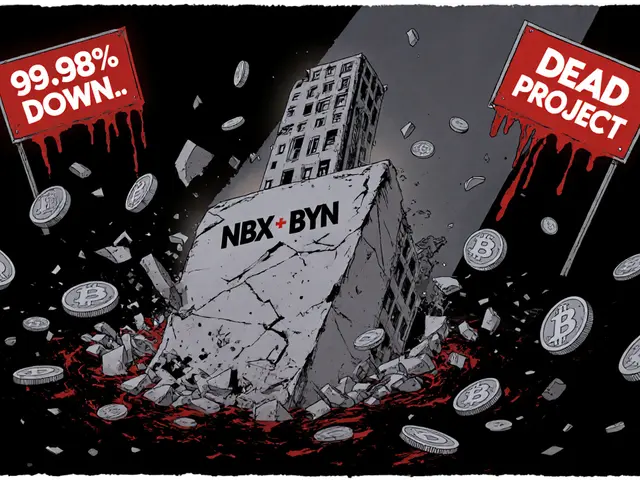
Without new development, partnerships, or a surge in real demand, BOF will likely continue drifting lower. Its price is already 99.9% below its peak. That’s not a correction. That’s a collapse.
It could bounce back - if a major exchange listed it, or if a viral meme campaign brought in thousands of new buyers. But that’s not happening now. The data shows a token stuck in slow motion, with almost no activity, and no clear path forward.
For now, BOF is a footnote in crypto history - a token that tried to be a movement but ended up as a cautionary tale.

16 Comments
Jackie Crusenberry
March 24 2026BOF is just a vibe. I don't care if it's worthless. Sometimes you just wanna root for the underdog. The pitbull says it all. No fancy whitepaper needed. Just grit.
And yeah, the price is trash. But so was Dogecoin at first. Who's laughing now?
Florence Pardo
March 26 2026I’ve been watching this token for months. It’s like watching a car slowly rust in an abandoned lot. Everyone who bought in at the peak is just waiting for someone else to take the loss.
There’s no team, no code updates, no community calls. Just a mascot and a dream. I get the symbolism, I really do. But crypto isn’t poetry. It’s math. And this math doesn’t add up.
It’s not even a scam. It’s just… forgotten. Like a forgotten birthday card you find years later. Cute, but useless.
Mansoor ahamed
March 27 2026BOF is a meme with zero utility. In India, we’ve seen 100+ tokens like this. All die. No exception.
Price differences between exchanges? That’s because no one trades it. One bot buys 100k, price spikes. Then it sells. Repeat.
Don’t waste time.
Nicolette Lutzi
March 27 2026They’re lying. All of them. CoinGecko, CoinMarketCap - they’re all owned by the same shadow group. BOF is being suppressed because it’s too dangerous. The pitbull isn’t a mascot. It’s a warning.
They don’t want you to know how much power this token has. They’re hiding the real supply. The 999 million? Fake. There’s billions locked in offshore wallets.
Wake up. This isn’t crypto. It’s resistance.
Domenic Dawson
March 28 2026Hey, I get why you’re skeptical. I was too. But look - there’s something beautiful about a token that doesn’t care about your spreadsheets.
It’s not trying to be Bitcoin. It’s trying to be a middle finger to the system. And honestly? That’s kinda cool.
Maybe it won’t make you rich. But maybe it reminds you that not everything has to be quantified to matter.
Just saying.
Pradip Solanki
March 30 2026BOF is a liquidity trap with a mascot. No dev team no audit no roadmap no governance. Zero utility. Just narrative. The price variance? That’s not data discrepancy. That’s market manipulation via wash trading.
Exchange reporting is garbage. Coinbase’s volume is inflated. CoinMarketCap is asleep.
Bottom line - it’s a ghost. Don’t touch it.
Brad Zenner
March 31 2026Interesting breakdown. I’ve seen this pattern before with other meme coins. The emotional hook is strong - fighting injustice, pitbull symbolism - but without real utility, it’s just theater.
The fact that the supply is nearly fully circulated is actually a red flag. No reserve means no mechanism to stabilize or support price.
It’s not a scam, but it’s not an investment either. More like a digital art piece with a ticker symbol.
Tony Phillips
April 2 2026Some people see BOF as a joke. I see it as a spark. Maybe it’s not going to change the world. But maybe it’s the kind of thing that lets someone who feels powerless say: ‘I believe in something even if no one else does.’
That’s worth something.
Not as an investment. But as a symbol. And sometimes… symbols matter more than spreadsheets.
Abhishek Thakur
April 3 2026Price differences between exchanges are normal for low-cap tokens. Liquidity is thin. One trade moves price. That’s why volume is meaningless.
But the real issue is no one is building anything. No wallet integration. No staking. No partnerships.
Just a name and a dog. That’s not enough. Not even close.
YANG YUE
April 4 2026BOF is the punk rock of crypto. No record label. No producer. Just a basement, a guitar, and a scream.
The market wants polished, packaged, vetted, audited, VC-backed tokens. BOF says: fuck that.
It doesn’t need to be valuable. It just needs to exist.
And it does. Loudly. Oddly. Unapologetically.
Maybe that’s the point.
Anna Lee
April 6 2026OMG I love BOF so much!! I bought 10k when it was at $0.00005 and now it’s up to $0.00006!!! I’m so happy!!
It’s not about the money it’s about the vibe!! The pitbull is my spirit animal!!
Y’all are too serious!! Just chill and believe!! 💪🐶✨
Alice Clancy
April 7 2026This is a psyop. The whole thing. The 'injustice' narrative? Designed to attract the gullible. The price gaps? Controlled by insiders. The pitbull? A distraction.
They want you to think it’s a meme so you don’t look deeper.
Trust me - this is a front. For something bigger.
And you’re all being played.
Shana Brown
April 8 2026I don’t care if BOF crashes to zero tomorrow. I bought it because it made me feel like I was part of something real.
Not a profit. Not a trade. Just… meaning.
And if that’s all it ever is? Then it’s already won.
Love the pitbull. Stay wild.
Marie Mapilar
April 8 2026I’ve been reading through this thread and I just wanted to say - the emotional resonance here is fascinating. Some people see a scam. Others see a movement.
Maybe the truth is somewhere in between.
BOF doesn’t have utility, but it has community. And maybe… that’s the new utility?
Just a thought. Not trying to sell anything. Just wondering.
Dominic Taylor
April 10 2026There’s a structural flaw in how decentralized exchanges report data for low-liquidity assets. The price variance isn’t fraud - it’s systemic noise.
When order book depth is under $100, any single trade becomes a price signal.
Volume metrics are statistically meaningless below $1M MC.
BOF isn’t unique - it’s symptomatic.
Jackie Crusenberry
April 11 2026So you’re saying BOF is just a mirror? Reflecting our desperation for meaning in a world that only values ROI?
…I kinda love that.