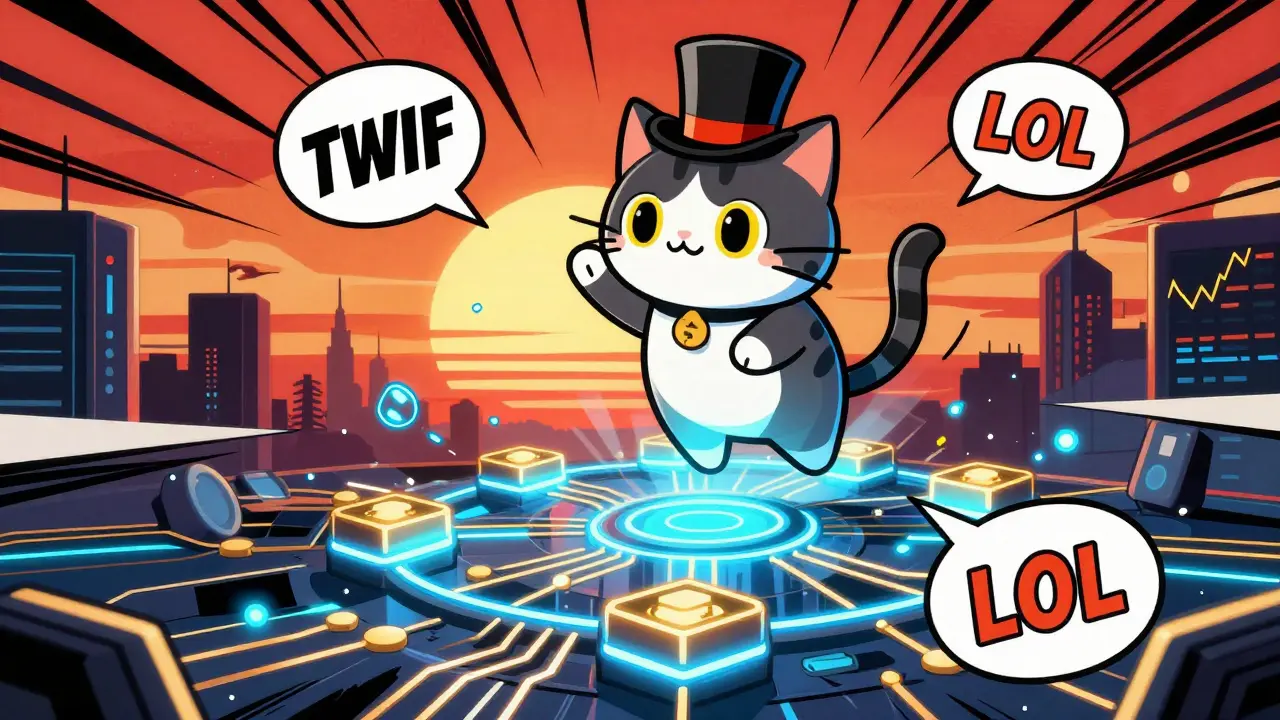
What is Tomwifhat (TWIF) crypto coin? All you need to know about the cat-themed meme token
Tomwifhat (TWIF) isn’t your typical cryptocurrency. It doesn’t solve global payments, power smart contracts, or back itself with real-world assets. Instead, it’s built on laughter, memes, and a very specific kind of internet culture - cats wearing hats. Yes, you read that right. TWIF is a meme coin that turned a silly image into a blockchain project, and for better or worse, it’s still trading today.
What exactly is Tomwifhat (TWIF)?
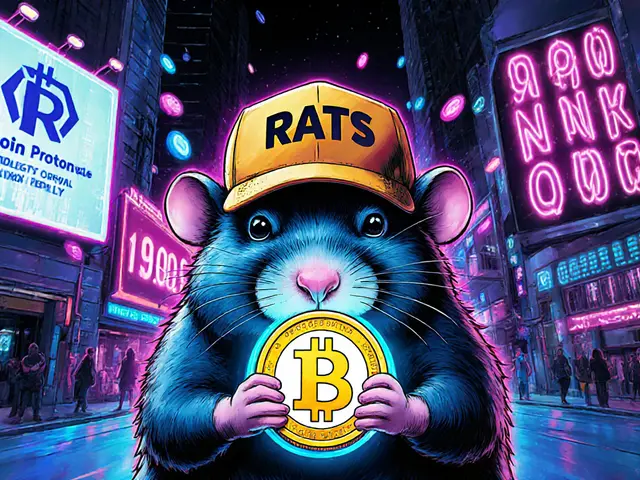
Tomwifhat (TWIF) is a cryptocurrency token created as a fun, community-driven project. It doesn’t have a whitepaper full of complex economics or a team of engineers building DeFi protocols. Its whole identity is wrapped up in the idea of a cat named Tom wearing a hat - a visual gag that somehow caught fire in 2024. The project calls itself a blend of cryptocurrency innovation and feline-themed entertainment. In plain terms: it’s a joke that got a blockchain.
What makes TWIF stand out from other meme coins like Dogecoin or Shiba Inu? For one, it leans hard into cat culture instead of dog culture. While Dogecoin has a Shiba Inu on its logo, TWIF’s branding is all about cats - the kind you see in viral TikToks or Instagram reels, lounging with tiny hats. It’s not trying to be serious. It’s trying to be cute, shareable, and a little bit absurd.
How does TWIF work technically?
Tomwifhat runs on two major blockchains: Binance Smart Chain (a fast, low-cost blockchain developed by Binance) as a BEP-20 token, and Ethereum (the original smart contract platform powering most decentralized apps) as an ERC-20 token. This dual-chain approach means users can trade TWIF on exchanges that support either network.
On Binance Smart Chain, transactions are cheaper and faster. On Ethereum, you get more liquidity and access to bigger DeFi platforms. This gives TWIF flexibility - you can choose where to hold or trade based on what matters most to you: cost or access.
The total supply of TWIF is fixed at 1 billion tokens. That’s a lot. But here’s the twist: only 200 million are currently in circulation. The rest are locked in wallets, possibly for future community rewards, marketing, or just sitting idle. This is common with meme coins - they launch with a big number, but only a fraction gets distributed at first.
Price history: From peak to near-zero
TWIF had its moment. On May 20, 2024, it hit an all-time high of $0.02679. At that price, with 200 million tokens circulating, its market cap was over $53 million. That’s not Bitcoin-level money, but for a cat-themed coin with no utility? That’s a wild ride.
Fast forward to March 2026, and things look very different. The price has crashed. Across different exchanges, TWIF trades between $0.000079 and $0.00073. That’s a drop of more than 97% from its peak. Its lowest point came on March 31, 2025, when it hit $0.0002917 - a sign that many early buyers had given up and sold off.
Why the crash? Simple: meme coins live and die by hype. When the 2024 crypto rally ended, so did the money flowing into obscure tokens like TWIF. No real product. No team. No roadmap. Just a cat with a hat. When the crowd left, so did the price.
Current market stats: What’s going on right now?
As of March 2026, TWIF’s numbers tell a story of extreme fragility:
- Circulating supply: 200,000,000 TWIF
- Maximum supply: 1,000,000,000 TWIF
- Market cap: Between $15,852 and $146,920 (depending on price source)
- Fully diluted valuation (FDV): $734,297 (if all 1 billion tokens were traded at current price)
- 24-hour trading volume: Around $50,000-$70,000 - tiny compared to even mid-tier coins
- Exchange ranking: #48,376 by market cap among all cryptocurrencies
That last number - #48,376 - says it all. There are over 48,000 cryptocurrencies tracked by major platforms. TWIF is near the bottom. It’s not even in the top 10,000. It’s a micro-cap so small it barely registers on most radar screens.

Technical indicators: Is it oversold or just dying?
Some traders look at charts to guess where a price might go next. TWIF’s technical data is a mess - and that’s typical for meme coins.
As of early 2026:
- RSI (14-day): 24.28 - below 30, which means it’s technically oversold. Some say this means a bounce could happen.
- 21-day EMA: $0.0004340
- 50-day EMA: $0.0003666 - both above current price, signaling a bearish trend.
- ADX: 34.49 - shows strong downward momentum.
- Williams Percent Range: -100 - suggests a potential buying opportunity.
So one indicator says “buy,” another says “sell,” and the rest say “wait and see.” That’s not confusion - it’s chaos. And that’s exactly what you get with a coin that has no fundamentals behind it.
Price predictions: What do the models say?
Algorithmic tools like CoinCodex have tried to forecast TWIF’s future. Their models suggest it’s not going up.
As of January 2026, they predicted a 25% drop to $0.00005938 by February 2, 2026 - and that’s exactly what happened. Now, they’re projecting TWIF will trade between $0.00005446 and $0.0002172 for the rest of 2026 and into 2027. That’s a range of extreme weakness.
The Fear & Greed Index for TWIF sits at 29 - firmly in “Fear” territory. That means most traders are either holding onto losses or avoiding it entirely. No one’s excited. No one’s buying. Just a few holding on, hoping for a miracle.
Where can you buy TWIF?
You won’t find TWIF on Coinbase or Binance’s main exchange. It’s listed on smaller platforms like MEXC and other exchanges that specialize in meme coins and micro-cap tokens. These platforms have less security, fewer users, and higher slippage. Buying TWIF means accepting higher risk.
If you want to trade it, you’ll likely need to:
- Buy BNB or ETH on a major exchange like Binance or Coinbase.
- Transfer it to a wallet like MetaMask.
- Connect your wallet to a decentralized exchange (DEX) like PancakeSwap (for BSC) or Uniswap (for Ethereum).
- Swap your BNB or ETH for TWIF.
That’s not simple. And if you mess up a transaction? You could lose your money. No customer support. No refunds.
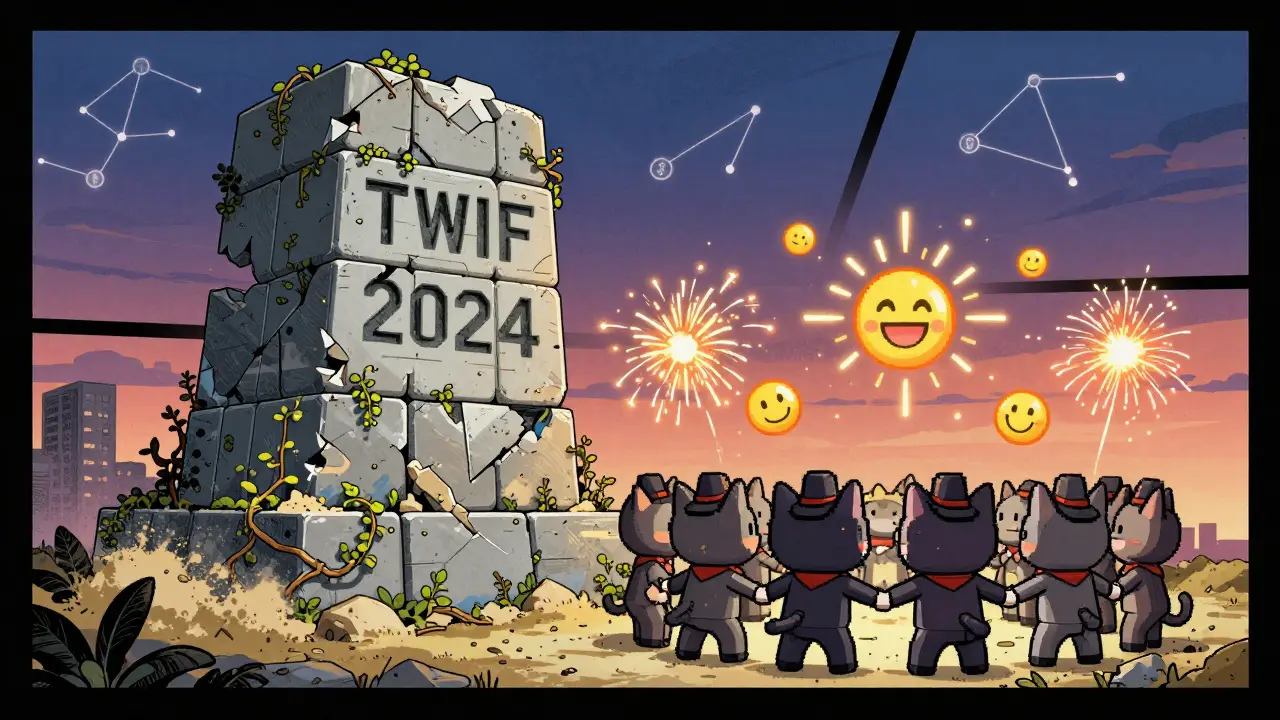
Why does TWIF still exist?
It’s not because it’s valuable. It’s not because it’s useful. It exists because some people still believe in it - or at least, in the idea of it.
There’s a small but stubborn community of cat lovers, meme enthusiasts, and speculative traders who keep the token alive. They post memes. They chat on Discord. They trade on weekends when volume spikes. They’re not trying to get rich. They’re just having fun.
That’s the real story of TWIF. It’s not an investment. It’s a hobby. A digital inside joke. A sticker you can own on the blockchain.
Should you invest in TWIF?
If you’re looking for steady growth? No. TWIF has no business model. No revenue. No product. No team. Just a name and a cat.
If you’re okay with gambling $10 or $20 on a joke? Maybe. Treat it like buying a lottery ticket. Don’t expect returns. Don’t count on it. If the price goes up? Great. If it drops to zero? Don’t cry.
Most importantly: never invest more than you can afford to lose. Meme coins like TWIF have wiped out entire portfolios. They’re not crypto. They’re casino chips with a blockchain logo.
What’s next for Tomwifhat?
Without a clear roadmap, active development, or new partnerships, TWIF’s future looks dim. The community is quiet. Trading volume is low. The price is stuck near its all-time low.
It could vanish overnight. Or it could get a surprise boost from a viral meme, a celebrity tweet, or a pump-and-dump scheme. But those are long shots.
Right now, TWIF is a ghost of its former self. A relic of 2024’s meme coin frenzy. A digital artifact that reminds us: not every coin needs to change the world. Some just need to make people smile.
Is Tomwifhat (TWIF) a good investment?
No, TWIF is not a good investment in the traditional sense. It has no underlying value, no team, no product, and no revenue. It’s a meme coin built on internet humor, not economic fundamentals. If you buy it, treat it as entertainment - not a financial strategy. Only risk money you’re okay losing completely.
Can TWIF reach $0.01 again?
It’s extremely unlikely. TWIF’s all-time high was $0.02679, and it’s now trading below $0.0008. To reach $0.01, it would need to increase over 12 times from its current price. That would require massive new buying pressure, viral attention, and a complete shift in market sentiment - none of which are visible right now. The odds are stacked against it.
Is TWIF available on major exchanges like Binance or Coinbase?
No, TWIF is not listed on major exchanges like Binance or Coinbase. It’s only available on smaller platforms such as MEXC and other decentralized exchanges (DEXs) that support BEP-20 or ERC-20 tokens. This limits liquidity and increases risk for buyers.
Why does TWIF have two blockchain versions?
TWIF runs on both Binance Smart Chain (BSC) and Ethereum to give users flexibility. BSC offers lower transaction fees and faster speeds, while Ethereum has deeper liquidity and more DeFi integration. This dual-chain setup lets traders choose based on cost or access - but it also splits the community and makes tracking the token harder.
How many TWIF tokens are in circulation?
According to project data and CoinMarketCap, 200 million out of the 1 billion total TWIF tokens are currently in circulation. The remaining 800 million are either locked, reserved for future use, or not yet released. This means the market cap could change dramatically if more tokens enter circulation.
What’s the difference between TWIF and Dogecoin?
Dogecoin started as a joke too, but it gained real adoption over time - used for tipping, small payments, and even charity. TWIF has no such utility. Dogecoin has a large, active community and is listed on major exchanges. TWIF is a niche, low-volume token with almost no real-world use. Dogecoin is a cultural phenomenon. TWIF is a passing trend.
13 Comments
Heather James
March 18 2026This is the most honest take on meme coins I've read all year. Just buy it if you want to laugh. Don't buy it if you want to retire.
Christopher Hoar
March 19 2026lol who even made this coin?? some 14yo with a photoshop habit?? TWIF?? like... tom wif hat?? lmao
Sarah Hammon
March 21 2026I still have a few hundred TWIF from 2024. Not because I thought it'd go up... but because I liked the cat meme. I check it once a month. It's like a digital pet. RIP my $20.
Anastasia Danavath
March 23 2026this is why i dont trust crypto 😅📉 cats in hats = no future. but hey at least its cute 🐱🎩
Katrina Smith
March 23 2026Wow. A whole article about a cat with a hat. And you’re telling me this has a 21-day EMA? I thought we were past pretending nonsense has technical analysis.
anshika garg
March 24 2026There’s something beautiful about a community that keeps something alive just because it made them smile once. TWIF isn’t money. It’s a memory. A tiny digital sticker on the blockchain of absurdity. I’m not sad it’s down. I’m grateful it ever existed.
Robert Kunze
March 26 2026i just bought 50k twif yesterday bc rsi was 24 and william was -100 lol i mean come on this is the sign to go all in right?? my crypto guru said so on tiktok 🤡
Sarah Zakareckis
March 27 2026Let’s reframe this: TWIF isn’t a failed investment - it’s a successful emotional experiment. It proved that humans will rally around absurdity if it’s cute enough. That’s not dumb. That’s human. And honestly? We need more of that. 🌈🐾
Shreya Baid
March 29 2026I come from a country where children draw cats wearing hats on their school notebooks. This token, in its ridiculousness, captured a universal joy. The fact that it’s worth pennies now doesn’t diminish the warmth it brought. I’m not invested in the price. I’m invested in the feeling.
Jerry Panson
March 30 2026The market cap of TWIF is less than the cost of a single Ethereum transaction fee. This is not a failure of technology. This is a triumph of human whimsy. The blockchain is not meant to be serious. Sometimes, it’s meant to be a cat.
Dionne van Diepenbeek
March 31 2026I read the whole thing and I still dont get why this exists but i like it somehow like its the crypto version of a doodle on a napkin that somehow became a museum piece
iam jacob
April 1 2026you guys are all so dramatic. i just want someone to tell me if i should sell or hold. like... come on. this is why i hate crypto communities. nobody gives a straight answer. i just want to know if im a dumbass or not.
Ann Liu
April 1 2026The dual-chain architecture of TWIF is actually a clever decentralization strategy, despite its meme status. By maintaining BEP-20 and ERC-20 liquidity, it ensures cross-platform accessibility - a rare trait among micro-cap tokens. This is not incompetence. It’s intentional fragmentation.