Are Crypto Payments Allowed in India? What You Can and Can't Do in 2026
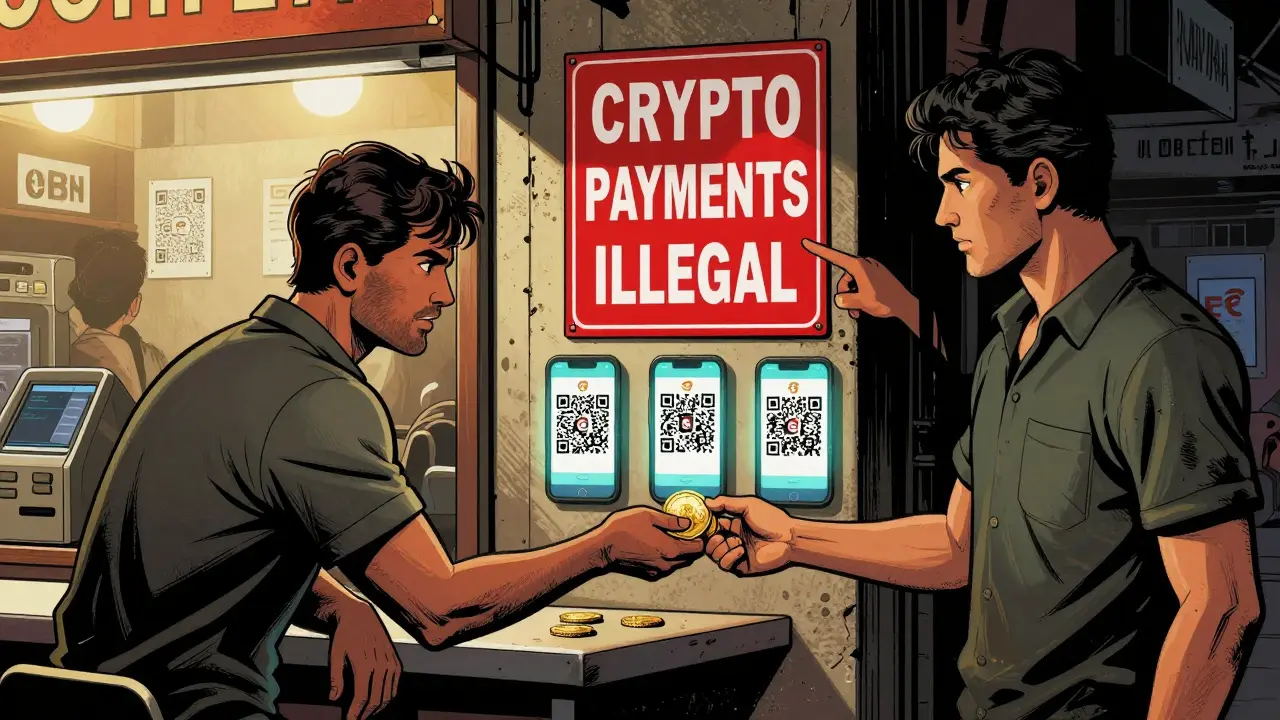
Can you use Bitcoin or Ethereum to buy coffee in Mumbai? Or pay your rent in Delhi with Dogecoin? The short answer is no - and it’s not because the technology doesn’t work. It’s because the law says you can’t.
India doesn’t ban cryptocurrency. You can still buy, sell, and hold Bitcoin, Ethereum, Solana, and dozens of other coins. Millions of Indians do it every day. But using those coins to pay for goods or services? That’s illegal. The government drew a clear line: cryptocurrencies are investment assets, not money.
Why Can’t You Pay With Crypto in India?
The Reserve Bank of India (RBI) and the Ministry of Finance have been consistent: cryptocurrencies are not legal tender. That means they can’t replace the Indian Rupee (INR) in any transaction - not at grocery stores, not at online marketplaces, not even for freelance gigs paid in crypto.
This isn’t about distrust in blockchain. It’s about control. The government worries that if people start paying with Bitcoin, it could weaken the rupee’s role in the economy. It could make tax collection harder. It could let criminals move money without oversight. So they banned crypto payments outright, even while allowing trading.
Think of it like owning gold bars. You can buy them, store them, sell them for rupees - but you can’t walk into a store and hand over a gold bar to pay for your phone. That’s how India treats crypto now: an asset, not a currency.
What You CAN Do With Crypto in India
Even though you can’t pay with crypto, you can still trade it - and you’re not alone. India has one of the largest crypto user bases in the world, with over 15 million active traders as of 2025.
Here’s what’s legal:
- Buying and selling cryptocurrencies on registered exchanges like WazirX, CoinDCX, or ZebPay
- Holding crypto in your wallet - whether it’s on an exchange or a hardware wallet
- Trading on international platforms like Binance or Bybit, as long as they’re registered with FIU-IND
- Reporting your crypto gains and paying taxes
There’s one catch: every trade you make is tracked. Since 2022, all crypto transactions above ₹50,000 attract a 1% Tax Deducted at Source (TDS). That’s automatically taken out by the exchange. And if you make a profit? You pay 30% tax on it - no deductions, no loss offsets, no exceptions.
Plus, there’s an 18% GST on platform fees. So if you pay ₹100 to trade on an app, ₹18 of that goes to the government. It’s expensive, but it’s the price of staying legal.
The Tax Trap: How the Government Tracks Every Trade
India doesn’t just tax crypto - it demands proof. Every crypto trader must file Schedule VDA in their income tax return. That’s a special form where you list every buy, every sell, every transfer, and every gain.
Here’s how it works in practice:
- You bought 0.1 BTC for ₹3,00,000 in January 2024
- You sold it for ₹5,00,000 in March 2025
- Your profit: ₹2,00,000
- Tax due: ₹60,000 (30%) + ₹2,400 (4% cess) = ₹62,400
No matter how many losses you had in other trades, you can’t use them to reduce this tax. That’s different from stocks or real estate. Crypto gains are taxed like lottery winnings - pure profit, no offsets.
And if you don’t report? The Income Tax Department has tools to match your exchange data with your tax filings. Miss a transaction, and you could get a notice - or worse, have your return rejected.

What Happens if You Try to Pay With Crypto?
Some small businesses and freelancers tried to accept crypto payments anyway. They’d list prices in Bitcoin, then convert it to rupees instantly. That’s a red flag.
The Financial Intelligence Unit of India (FIU-IND) has cracked down hard. In 2024, they fined Binance ₹18.82 crore and Bybit ₹9.27 crore for not reporting customer transactions. Both platforms were operating without proper registration. After fines, they complied - and now they’re registered.
But what about individuals? If you pay your landlord in ETH, and he deposits it into his exchange account, the system flags it. The exchange reports the deposit. The tax department sees the income. You didn’t report it? Now you’re under scrutiny.
There’s no jail time for using crypto as payment - yet. But you can face heavy penalties, frozen accounts, or even criminal investigation if the transaction is linked to money laundering.
The Digital Rupee: India’s Answer to Crypto
While private crypto is restricted, the government is pushing its own digital currency: the Digital Rupee (e₹). Launched in 2022 as a pilot, it’s now expanding across cities and banks.
The Digital Rupee is different from Bitcoin. It’s issued by the RBI. It’s legal tender. It’s backed by the full faith of the government. And it’s designed to replace cash, not compete with crypto.
Here’s why it matters:
- You can send e₹ instantly between phones - no bank account needed
- It’s traceable, so the government can monitor fraud and tax evasion
- It’s safe - no volatility, no hacking risks like on decentralized networks
- It’s already accepted by major banks and payment apps
The government’s message is clear: we want digital money - but we want it under our control. The Digital Rupee isn’t just a tech upgrade. It’s a power move.

Is the Law Likely to Change?
There’s been talk of a new crypto bill since 2023. Some lawmakers want to legalize crypto payments with strict limits. Others want to ban all private crypto entirely. Nothing has passed yet.
But here’s what’s clear: the RBI and Finance Ministry still see private cryptocurrencies as a threat. The CBDC is their priority. Crypto trading is tolerated, but only because shutting it down would anger millions of investors and hurt tech startups.
Don’t expect a sudden shift. Even if the law changes, it’ll likely be slow - and still restrictive. Crypto as a payment tool? Probably never. Crypto as an investment? Maybe, but always under heavy oversight.
What Should You Do in 2026?
If you’re holding crypto in India, here’s your roadmap:
- Only trade on FIU-IND registered exchanges (WazirX, CoinDCX, ZebPay, etc.)
- Keep full records of every buy, sell, transfer, and fee
- Pay your 30% tax on profits - no exceptions
- Report everything in Schedule VDA
- Never use crypto to pay for goods or services
- Watch for updates on the Digital Rupee - it’s the future of digital payments in India
If you’re thinking of starting a business that accepts crypto? Don’t. It’s not worth the risk. The penalties aren’t just financial - they’re reputational. Banks may freeze your account. Payment processors may cut you off. You’ll spend more time explaining yourself than making sales.
India’s crypto scene is growing - but it’s growing in the shadows. The rules are strict, the taxes are high, and the government isn’t backing down. The only safe path is to treat crypto like stocks: invest, track, pay taxes, and never use it to buy anything.
Is it illegal to hold cryptocurrency in India?
No, holding cryptocurrency is completely legal in India. You can buy, store, and sell Bitcoin, Ethereum, and other coins without breaking any laws. The government classifies them as Virtual Digital Assets (VDAs), which means they’re treated like investments, not currency. Just make sure you report gains and pay the required taxes.
Can I use crypto to pay for online services like Netflix or Amazon?
No. Neither Netflix, Amazon, nor any other Indian or international company can legally accept cryptocurrency as payment within India. Even if a platform allows crypto payments globally, doing so in India violates the government’s ban on crypto as a payment method. Using it for such transactions puts you at risk of tax notices or regulatory scrutiny.
What happens if I don’t pay crypto taxes in India?
If you don’t report crypto gains or pay the 30% tax, the Income Tax Department can issue a notice, freeze your bank accounts, or even reject your entire tax return. The department cross-checks data from exchanges and FIU-IND reports. Missing even one transaction can trigger an audit. Penalties can reach up to 200% of the tax evaded, plus interest.
Are crypto-to-crypto trades taxable in India?
Yes. Swapping Bitcoin for Ethereum, or Solana for Dogecoin, counts as a taxable event. Each trade is treated as a sale of the first asset and a purchase of the second. You must calculate the gain or loss in rupees at the time of the trade and pay 30% tax on any profit. Exchanges report these trades to FIU-IND, so hiding them isn’t possible.
Can I use international crypto exchanges like Binance in India?
Yes - but only if they’re registered with FIU-IND. Binance and Bybit were fined in 2024 for operating without registration, but both have since complied and are now approved. Unregistered platforms are risky. Your funds could be frozen, and you won’t have legal recourse if something goes wrong. Always check if your exchange is on FIU-IND’s public registry.
Will the Digital Rupee replace Bitcoin and other cryptocurrencies?
Not replace - but overshadow. The Digital Rupee is designed to be India’s official digital currency, backed by the RBI. It’s faster, safer, and fully regulated. While private cryptocurrencies will still be allowed for trading, the government is pushing the Digital Rupee as the future of digital payments. Over time, most everyday transactions will likely shift to e₹, leaving crypto as a niche investment asset.
Final Thoughts
India’s crypto rules are confusing because they’re contradictory. You can own crypto. You can trade it. But you can’t use it. That’s not a loophole - it’s a policy choice. The government wants control, not chaos.
If you’re in it for the long term, play by the rules. Track every trade. Pay your taxes. Don’t try to use crypto as money. And keep an eye on the Digital Rupee - it’s the real future of digital payments in India.



24 Comments
Jessie X
January 14 2026I get why India's doing this but honestly it feels like they're trying to control the future instead of adapting to it
People are gonna find ways to use crypto anyway, whether it's legal or not
Just saying
Veronica Mead
January 15 2026The regulatory framework enacted by the Reserve Bank of India, in conjunction with the Ministry of Finance, constitutes a prudent and legally defensible approach to safeguarding monetary sovereignty and fiscal integrity. The imposition of stringent taxation and mandatory reporting protocols is not merely administrative-it is a necessary bulwark against systemic financial destabilization.
Surendra Chopde
January 17 2026I live in Delhi and I’ve seen people try to pay with crypto at small shops-always ends in a mess. The guy who took it got a notice from the tax department within weeks. No one’s stupid enough to do it anymore. The Digital Rupee app is way easier anyway.
Tiffani Frey
January 18 2026I think it's fascinating how India has drawn such a clear line between asset and currency-this is actually one of the most rational crypto policies I've seen. Most countries are either too lax or too panicked. India's approach is nuanced: you can own it, you can trade it, but you can't weaponize it as a payment tool to bypass the financial system. The 30% tax is brutal, yes, but at least it's transparent. And the TDS? Brilliant enforcement mechanism. They're not trying to kill crypto-they're trying to domesticate it.
Gideon Kavali
January 19 2026This is what happens when you let anarchists with laptops run wild! India’s doing the RIGHT thing-protecting its currency, its economy, its people! Any country that lets crypto be used as payment is just handing over control to crypto bros and Russian oligarchs. The Digital Rupee? Finally, a government that’s not afraid to lead! If you’re mad about this, you’re mad because you want to dodge taxes and fund shady stuff. Wake up!
Allen Dometita
January 20 2026Bro, just buy your coffee with rupees. Crypto’s not money, it’s a gamble with extra steps. I’ve got friends who lost everything on Dogecoin. The government’s not the enemy here-FOMO is.
greg greg
January 22 2026It's interesting to consider the broader geopolitical implications of India's stance, particularly when juxtaposed against the trajectory of other emerging economies such as Nigeria or Vietnam, where informal crypto adoption has outpaced regulatory frameworks entirely; whereas India, despite its massive youth population and tech-savvy demographics, has opted for a top-down, state-controlled model that prioritizes fiscal surveillance over decentralization-a choice that reflects not merely economic policy but a deep-seated cultural preference for hierarchical authority and institutional trust, even at the expense of innovation velocity. The Digital Rupee, therefore, isn't just a currency-it's a symbol of state continuity in an age of fragmentation.
LeeAnn Herker
January 23 2026Oh please. 'Crypto isn't money'-right, and the Federal Reserve isn't a private bank owned by Wall Street. The real reason they banned crypto payments? So they can track every rupee you spend. The Digital Rupee? It's not a currency, it's a surveillance tool with a better UI. They don't want you to have freedom-they want you to have a digital leash. And don't even get me started on that 30% tax... you're literally being taxed on paper gains you never cashed out. Classic.
Sherry Giles
January 24 2026They're scared. Scared that if people start using crypto, they'll realize the rupee's value is built on lies. The Digital Rupee? It's the same old central bank control, just with blockchain glitter. They don't want you to be free. They want you to be obedient. And the tax? That's not revenue-that's punishment for daring to think differently.
Andy Schichter
January 25 2026So let me get this straight. You can own Bitcoin, but you can't buy a samosa with it? That's not a policy, that's a sitcom. Who thought this up? 'Hey, let's make crypto a tax nightmare but still let people trade it for fun!' Brilliant. I'm filing for asylum in El Salvador.
Kelley Ramsey
January 26 2026I know it feels restrictive, but honestly? This is the healthiest crypto environment I’ve seen in a while. People aren’t gambling with rent money because they can’t spend it. Taxes are high, yes-but at least you know where you stand. Keep tracking, keep paying, and don’t let the noise distract you. You’re doing better than most.
Michael Richardson
January 27 2026India’s not banning crypto. They’re banning idiots who think it’s a payment system. Good.
Sabbra Ziro
January 29 2026I appreciate how this post doesn’t demonize crypto users-it just lays out the rules clearly. So many people get angry about the tax, but if you’re making profits, you should pay. And the Digital Rupee? It’s not the enemy. It’s the next step. Let’s not confuse control with oppression. This is just how governments evolve.
Krista Hoefle
January 31 2026Lmao 30% tax on crypto gains? Bro that’s just stealing. And the TDS? Who even came up with this? I’m out. I’m moving to Switzerland.
Emily Hipps
February 1 2026If you're holding crypto in India, you're already ahead of the curve. The fact that you're even thinking about taxes and compliance means you're not just chasing hype. Keep doing it right. The Digital Rupee might be the future, but your discipline is what’s going to keep you safe now.
Kip Metcalf
February 2 2026Honestly? I’m glad they drew the line. I’ve seen too many people blow their rent money on Shiba Inu. Crypto as an investment? Fine. Crypto as a wallet? No thanks. Let’s keep it simple.
Natalie Kershaw
February 2 2026Just a heads-up for anyone new: the 1% TDS is taken at the time of sale, so if you’re swapping BTC for ETH, the exchange automatically deducts it from your sell side. Don’t be surprised when your ETH amount is less than expected. Also-save your trade receipts. The tax software doesn’t auto-import everything. Manual tracking is non-negotiable.
Jacob Clark
February 3 2026I can’t believe people are still arguing about this. The government isn’t ‘anti-crypto’-they’re pro-rupee. And let’s be real: if you’re using crypto to pay for stuff, you’re probably trying to avoid taxes. That’s not innovation-that’s evasion. The Digital Rupee is the future. Get on board or get left behind. And stop whining about the 30% tax. You’re not poor-you’re just greedy.
Mujibur Rahman
February 4 2026India’s approach is textbook CBDC strategy-control the medium, not the message. What’s fascinating is how they’ve turned compliance into a cultural norm. No one talks about it, but every trader knows the drill: track, report, pay. It’s not sexy, but it works. The Digital Rupee will dominate everyday transactions. Crypto? It’ll be the dark horse of wealth storage. Two tracks, one system. Very smart.
Danyelle Ostrye
February 4 2026I used to be mad about the tax, but after I got my first notice from the IT dept for missing a trade? I changed my mind. It’s not about punishment-it’s about clarity. I’d rather pay 30% than get my account frozen.
Jennah Grant
February 5 2026The 30% tax on crypto gains is a structural flaw-it ignores basis, ignores inflation, ignores loss harvesting. It treats crypto like gambling, not investment. But India’s government isn’t here to be fair. It’s here to be predictable. And predictability? That’s the real gift here.
Dennis Mbuthia
February 6 2026Let me tell you something, people. The government doesn’t care if you’re a crypto millionaire. They care if you’re a tax cheat. And if you think you can slip through the cracks by using Binance or sending ETH to your cousin’s wallet? You’re not smart-you’re just lucky. And luck runs out. I’ve seen people lose everything. Don’t be one of them. Pay your taxes. Keep your records. Stay legal. That’s the only way to win.
Dave Lite
February 8 2026Just want to say-this is the most balanced take on crypto in India I’ve read. The Digital Rupee isn’t the enemy. It’s the upgrade. And yeah, the tax is brutal, but at least you know where you stand. No gray areas. No surprises. If you’re trading, treat it like stocks. That’s the smart move.
Veronica Mead
February 9 2026The assertion that crypto is merely an 'investment asset' and not a medium of exchange is not merely a regulatory distinction-it is a philosophical imperative. To conflate speculative digital tokens with the sovereign currency is to invite economic anarchy. The Indian state, in its wisdom, has chosen order over chaos. Those who decry the 30% tax fail to recognize that taxation is not oppression-it is the social contract made manifest.