Blockchain Forensics Tools: Chainalysis and Elliptic for Crypto Tracing
When cryptocurrency transactions go bad-whether it’s ransomware payments, darknet market sales, or stolen funds-the trail doesn’t disappear just because it’s digital. That’s where blockchain forensics tools come in. Two names dominate this space: Chainalysis and Elliptic. They don’t just track coins. They connect the dots between wallets, exchanges, and criminals. And for law enforcement, banks, and regulators, that’s not optional-it’s essential.
How Blockchain Forensics Actually Works
Blockchain ledgers are public. Every Bitcoin, Ethereum, or Solana transaction is recorded forever. But that doesn’t mean you can just look up who owns what. Wallets don’t have names. Addresses are random strings. That’s where analytics platforms step in. Chainalysis and Elliptic use machine learning and massive databases to cluster addresses. If 10 different wallets send funds to the same exchange, they’re likely controlled by the same person. If a wallet receives money from a known darknet marketplace, it gets flagged. These tools don’t magically reveal identities-they find patterns humans can’t see in millions of transactions. The real power? Real-time monitoring. A bank using these tools can stop a transaction before it completes if it detects a high-risk pattern. That’s not theory. It’s happening daily in compliance departments from New York to Singapore.Chainalysis: The Investigator’s Toolkit
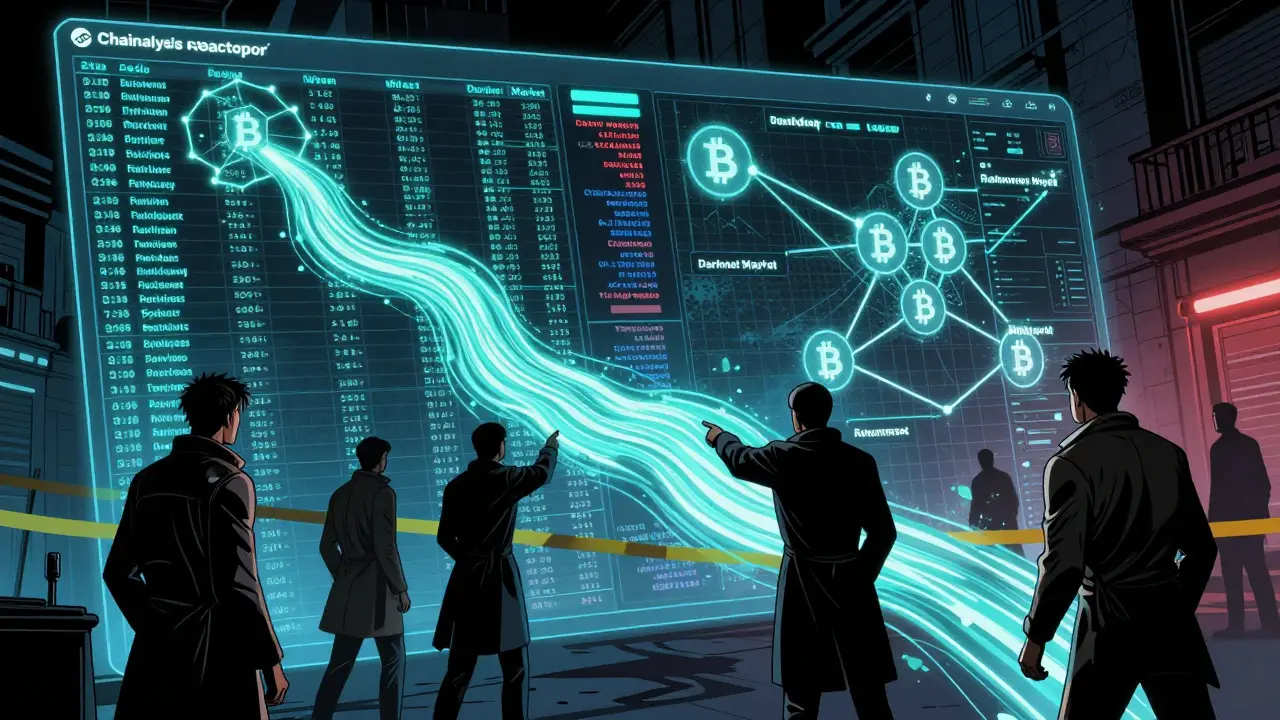
Chainalysis built its reputation on solving big cases. In 2016, they helped the FBI trace $1 billion in Bitcoin stolen from Silk Road. That money was recovered. That case made them the go-to for federal agencies. Their main product, Chainalysis Reactor, is built for investigators. It shows transaction networks as visual maps. You can click a wallet and see every coin that ever flowed in or out. It links addresses to exchanges, mixers, and known criminal entities. The interface is clean, intuitive, and designed for people who aren’t coders. Then there’s Chainalysis KYT (Know Your Transaction). This is for businesses that need to screen transactions in real time. It scores each transaction on a risk scale-from low to high-based on where the money came from and where it’s going. If a user sends crypto to a mixer, KYT flags it immediately. Banks use this to meet AML rules without slowing down legitimate users. Chainalysis supports 85% of the total cryptocurrency market value. That includes Bitcoin, Ethereum, and the top 20 coins. They’ve added support for newer chains like Solana and Polygon as they grew. But they don’t cover every privacy coin. That’s a gap-and Elliptic exploits it.Elliptic: The Predictive Edge
Elliptic doesn’t just react. It predicts. Where Chainalysis focuses on what happened, Elliptic tries to answer: what’s about to happen? Their platform analyzes transaction behavior before it even hits the blockchain. That’s possible because they monitor peer-to-peer networks and mempools-the temporary holding areas for unconfirmed transactions. Elliptic covers 100+ digital assets, including privacy coins like Zcash (ZEC) and Horizen (ZEN). Most tools ignore these because they’re designed to hide transactions. Elliptic doesn’t. They’ve built models to detect when Zcash is being used in money laundering patterns, even when the shielded transactions are encrypted. They also track decentralized exchanges (DEXs) and crypto mixers better than anyone. If someone uses Tornado Cash or Wasabi Wallet, Elliptic knows. And they assign risk scores based on how often those tools are used with flagged addresses. Their API is built for integration. Financial firms plug it directly into their compliance systems. It doesn’t require manual reviews. If a transaction triggers a rule-say, “block any transfer over $10,000 from a mixer”-it gets blocked automatically. That’s compliance at scale.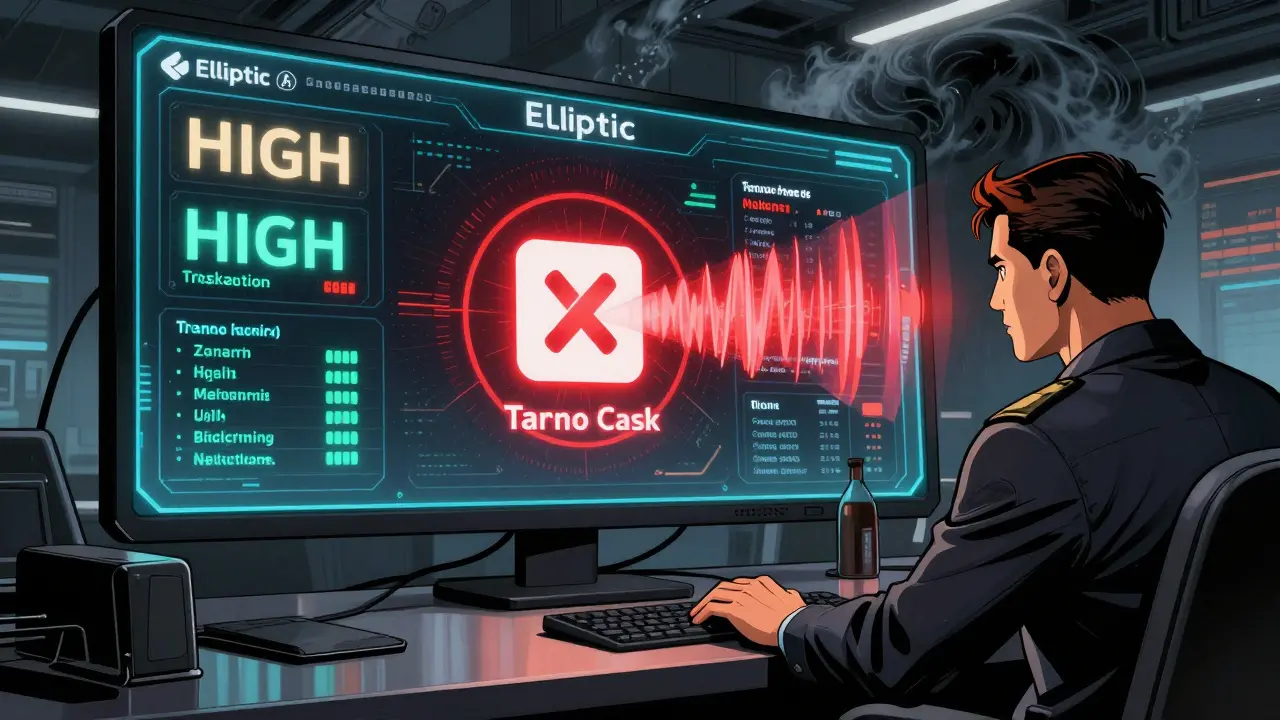
Side-by-Side: What Each Tool Does Best
| Feature | Chainalysis | Elliptic |
|---|---|---|
| Market Coverage | 85% of crypto market cap | 97% of crypto market cap |
| Privacy Coin Support | Limited | Strong (ZEC, ZEN, Monero) |
| Real-Time Monitoring | Yes (KYT) | Yes (with pre-blockchain analysis) |
| Visualization Tools | Best-in-class (Reactor) | Good, but less detailed |
| Predictive Risk Scoring | Basic | Industry-leading |
| Government Adoption | Widespread (FBI, Europol, IRS) | Strong, but fewer high-profile cases |
| Training & Certification | Extensive, but complex | Comprehensive on-site programs |
So who wins? It depends on what you need.
If you’re a federal agent chasing down a darknet vendor, Chainalysis Reactor is your best friend. The visual maps, the historical data, the courtroom-ready reports-it’s built for proof.
If you’re a crypto exchange with 50 different tokens and worried about Zcash being used to launder funds, Elliptic gives you the coverage and predictive power Chainalysis doesn’t.
Who Uses These Tools?
It’s not just cops. Banks like Barclays, MUFG, and JPMorgan use them. Crypto exchanges like Coinbase and Kraken rely on them to stay licensed. Insurance companies use them to verify claims after hacks. Even asset managers check wallet histories before investing in tokenized funds. Regulators are pushing harder than ever. The EU’s MiCA law requires all crypto service providers to have AML tools in place by 2026. The U.S. Treasury is tightening rules on unhosted wallets. In Australia, AUSTRAC has mandated blockchain monitoring for all licensed exchanges. These tools aren’t luxury items anymore. They’re compliance necessities. Skip them, and you risk fines, license revocation, or worse-being used as a conduit for criminal activity.
Challenges and Limitations
These tools aren’t magic. They have blind spots. First, they can’t trace everything. If someone uses a non-custodial wallet, moves funds through multiple layers of DeFi protocols, and swaps across chains, even the best tools struggle. Cross-chain analysis is still evolving. Second, false positives are common. A legitimate user might send funds to a mixer to protect privacy-not to hide crime. Without context, the system flags them. That’s why human review is still needed. Third, training matters. One bank in New Zealand spent six months training their team just to use Chainalysis Reactor effectively. Elliptic’s training programs are better, but they still require dedicated staff. You can’t just install the software and walk away. And then there’s cost. Enterprise licenses run tens of thousands of dollars a year. Smaller firms often can’t afford them. That’s why some turn to cheaper alternatives like TRM Labs or CipherTrace-but those tools don’t have the same depth of data or case history.The Future of Crypto Tracing
Both companies are investing heavily in AI. Chainalysis is building tools to track DeFi exploits and flash loan attacks. Elliptic is refining its predictive engine to flag new types of洗钱 patterns before they become widespread. As more blockchains emerge-like Solana, Avalanche, and new Layer 2s-coverage will expand. But so will the arms race. Criminals are using more advanced obfuscation techniques. Private blockchains, zero-knowledge proofs, and cross-chain bridges are making tracing harder. The winners won’t be the ones with the most data. They’ll be the ones who understand context. Who can tell the difference between a criminal and a privacy-conscious user. Who can adapt faster than the bad guys.What You Should Do
If you’re a crypto business: don’t wait for regulation to force your hand. Start evaluating tools now. Ask vendors for live demos. Test how they handle your specific tokens. Check if they support your jurisdiction’s compliance rules. If you’re a regulator: push for standardization. Right now, every exchange uses a different tool. That makes cross-border investigations messy. Shared data protocols and open standards are the next frontier. If you’re just curious: understand this. Blockchain isn’t anonymous. It’s pseudonymous. And tools like Chainalysis and Elliptic are turning pseudonyms into identities-slowly, carefully, and legally.Can blockchain forensics tools trace Bitcoin transactions completely?
They can trace most Bitcoin transactions with high accuracy, especially when they involve exchanges, mixers, or known criminal addresses. But if funds move through multiple privacy layers, decentralized protocols, or cross-chain bridges, tracing becomes harder. No tool can guarantee 100% traceability, but Chainalysis and Elliptic come close for the majority of cases.
Are Chainalysis and Elliptic used by law enforcement?
Yes. Chainalysis is used by the FBI, IRS, Europol, and over 800 government agencies worldwide. Elliptic works with regulators in the UK, EU, and Australia. Both have provided evidence used in criminal prosecutions, including cases involving ransomware, darknet markets, and terrorist financing.
Can these tools track Monero or Zcash?
Chainalysis has limited ability to track privacy coins like Monero and Zcash. Elliptic, however, specializes in them. They use behavioral analysis-like timing, volume, and transaction patterns-to identify when these coins are being used in suspicious ways, even if the transaction details are hidden.
Do I need to be a tech expert to use these tools?
No, but you need training. Chainalysis Reactor has a user-friendly interface designed for investigators without coding skills. Elliptic’s API is for technical teams, but their compliance dashboards are visual and intuitive. Both offer certification programs to help users get up to speed.
How much do these tools cost?
Pricing isn’t public, but enterprise licenses start at $50,000-$150,000 per year, depending on usage, number of users, and features. Smaller firms may pay less for basic monitoring, but full investigative access costs more. Most clients are institutions, not individuals.




16 Comments
Alison Fenske
December 27 2025I used to think crypto was all about freedom and anonymity, but after seeing how these tools track every move like a digital bloodhound, it's kind of beautiful in a creepy way. Like, yeah, you're not signing your name, but your money has a story now. And that story? It's got footprints everywhere.
It’s not magic-it’s math, patterns, and sheer stubbornness from devs who refuse to let criminals win. I respect that.
Grace Simmons
December 27 2025These tools are not optional. They are national security infrastructure. If we allow anonymous financial flows to proliferate unchecked, we are inviting chaos into our financial systems. The United States must lead in enforcing traceability-not because we hate privacy, but because we value order.
Collin Crawford
December 27 2025Let me correct something fundamental here: Chainalysis doesn't 'connect the dots.' They buy data from exchanges, pay insiders for metadata, and then spin it into a narrative that fits their corporate pitch. The so-called 'patterns' are often statistical noise dressed up as evidence. And Elliptic? They're just copying Chainalysis's UI and slapping on buzzwords like 'predictive.' Real blockchain analysis requires on-chain node monitoring-not third-party black boxes.
Jayakanth Kesan
December 28 2025Honestly, this is one of those topics where the tech is way ahead of the conversation. People act like blockchain is either totally anonymous or totally exposed. Truth is, it's a gray zone-and these tools are just helping us see the shades. Good stuff, really.
Aaron Heaps
December 30 2025These tools are a scam. They flag 80% of legitimate users as 'high risk' just to justify their $100K licenses. Real criminals use Monero. Or cash. Or physical gold. These companies sell fear, not security.
Tristan Bertles
December 30 2025I’ve seen teams go from zero to hero using these tools. One compliance officer told me she went from manually checking 200 transactions a day to letting the system auto-flag the 5% that matter. That’s not just efficiency-that’s sanity saved. Don’t knock it till you’ve tried it.
Steve B
December 31 2025One wonders whether the pursuit of traceability is not merely a form of digital colonialism-imposing Western surveillance paradigms onto decentralized, global networks. Are we securing systems, or are we eroding the very ethos that made crypto revolutionary?
Sophia Wade
December 31 2025There’s a quiet tragedy here: we built a system meant to liberate finance from centralized control, and now we’ve weaponized its transparency to recreate the very surveillance state we sought to escape. The irony is not lost on those who remember the cypherpunk manifestos. We didn’t just lose anonymity-we traded it for a false sense of safety.
Brian Martitsch
January 1 2026LOL. Chainalysis is just a glorified Excel sheet with a fancy UI. 🤡 Elliptic? Cute. They think they're doing AI but they're just rerunning the same 2018 heuristics. You're all being played.
Rebecca F
January 3 2026This is how control begins. First they track the criminals. Then they track the 'suspicious' behavior. Then they track the people who use mixers for privacy. Then they track you. Welcome to the new normal.
Ashley Lewis
January 3 2026The fact that you're even discussing these tools as if they're neutral is proof of your ideological blindness. These are corporate surveillance engines masquerading as compliance tools. They exist to serve banks and governments-not users.
vaibhav pushilkar
January 4 2026For Indian exchanges, Elliptic’s support for Zcash and DEXs is a game-changer. We were stuck with tools that didn’t understand DeFi flows. Now we’re compliant without hiring 10 analysts. Worth every rupee.
SHEFFIN ANTONY
January 5 2026You think Chainalysis is the gold standard? Try using it on a chain like Binance Chain or Solana. Half the data is missing. They’re playing catch-up. Meanwhile, open-source tools like TRM or Nansen are faster, cheaper, and more accurate. The real innovation isn’t in these two giants-it’s in the open ecosystem.
Vyas Koduvayur
January 7 2026Let’s be real-these platforms are built on a foundation of compromised data. Most of their wallet clustering is based on exchange KYC leaks, not on-chain analysis. They don’t 'trace' coins-they correlate addresses with identities stolen from compliance forms. That’s not forensics. That’s data brokerage. And the worst part? They sell this as 'privacy-preserving.'
And don’t get me started on their training programs. I sat through a 6-hour webinar where they showed us how to click 'investigate' and then spent 3 hours explaining why we shouldn’t question their risk scores. It’s not education. It’s indoctrination.
Meanwhile, real analysts use open-source tools like Blockchair, Etherscan, and custom Python scripts. They don’t need $150K/year software to spot a mixer pattern. They just need curiosity and a decent GPU.
Lloyd Yang
January 8 2026I work in crypto compliance and I’ve used both tools for years. I get why people are skeptical-but here’s what nobody talks about: these tools save lives. Not just money. Lives.
Last year, we flagged a transaction that led us to a ransomware gang targeting pediatric hospitals. The money was moving through 17 wallets, 3 mixers, and a DeFi bridge. Without Reactor’s visualization, we’d have been lost for months. With it? We shut it down in 72 hours.
Yes, false positives happen. Yes, the cost is insane. But when your job is to stop people from holding kids for ransom, you don’t complain about the price of a scalpel.
These tools aren’t perfect. But they’re the best we’ve got. And if you think we should go back to the wild west of crypto, you’ve never had to explain to a parent why their child’s life support got cut off because the hospital’s funds were frozen by hackers.
Jake Mepham
January 9 2026As someone who’s helped onboard crypto startups in Southeast Asia, I’ve seen how these tools level the playing field. A small exchange in Jakarta can now compete with Wall Street firms because they can prove they’re not laundering money. That’s not surveillance-that’s inclusion. These tools let honest players thrive. Don’t let the cynics scare you off.