
Content Monetization Smart Contracts: A Practical Guide for Creators
Imagine publishing a song, an article, or a video and knowing exactly who bought it, how much they paid, and that your cut arrived instantly-without waiting for a monthly invoice from a label or publisher. That is the promise of content monetization smart contracts, automated agreements on a blockchain that handle licensing, revenue sharing, and payments without middlemen. For creators tired of opaque royalty statements and slow settlements, this technology offers a transparent way to earn directly from fans and buyers.
How Content Monetization Smart Contracts Work
At their core, these contracts are code that executes when specific conditions are met. Think of them as self-executing vending machines for digital rights. When a user buys access to your content, the contract automatically splits the payment according to pre-set rules. You might receive 70%, while a co-writer gets 30%. No lawyer needs to chase invoices; the blockchain handles it in seconds.
The process involves several key steps:
- Define Terms: You set the price, duration of access, and revenue split percentages.
- Code the Logic: Developers write the contract using languages like Solidity (for Ethereum) or Rust (for Solana).
- Deploy to Blockchain: The code is uploaded to a decentralized network where it becomes immutable.
- Execute Transactions: When a buyer pays, the contract validates the transaction and distributes funds automatically.
- Record History: Every sale is logged on the public ledger, creating an unalterable audit trail.
This structure eliminates the need for traditional intermediaries like record labels, publishers, or ad networks, which typically take a significant cut of revenue. By removing these layers, creators retain a larger portion of their earnings.
Key Revenue Models Enabled by Smart Contracts
Smart contracts aren't just one-size-fits-all. They support various business models tailored to different types of content and audiences. Here’s how creators can apply them:
| Model | Description | Best For | Example Use Case |
|---|---|---|---|
| Subscription Access | Recurring fees for exclusive content or premium features. | Newsletters, video series, podcasts | A filmmaker charging $10/month for behind-the-scenes footage. |
| Micropayments | Small, one-time fees for individual pieces of content. | Blogs, articles, short videos | Paying $0.50 to unlock a single in-depth industry report. |
| NFT Licensing | Selling ownership or usage rights via Non-Fungible Tokens. | Digital art, music, collectibles | An artist selling a digital painting with a 5% royalty on secondary sales. |
| Tokenized Revenue Shares | Selling fractional ownership of future income streams. | High-growth IP, franchises | Investors buying tokens that pay out a share of box office receipts. |
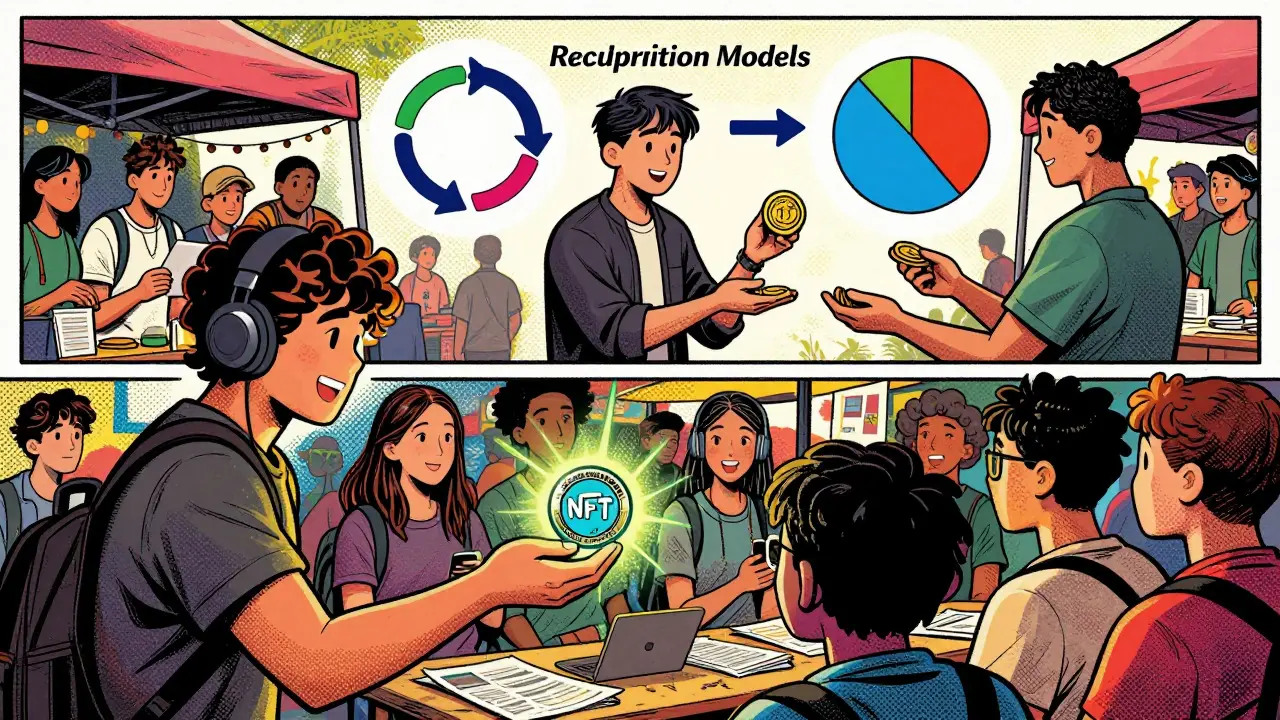
The subscription model is particularly effective for building recurring revenue. Unlike traditional platforms that may charge high processing fees, smart contracts allow creators to keep more of each monthly payment. Micropayments, on the other hand, lower the barrier for casual users. Instead of committing to a full subscription, a reader can pay a few cents to access a specific article. This works well for high-traffic sites where not every visitor wants a full membership.
Technical Implementation: What Creators Need to Know
You don’t necessarily need to be a coder to use these tools, but understanding the basics helps you avoid pitfalls. Most creators interact with front-end platforms that abstract away the complex coding. However, knowing what happens under the hood is crucial for managing costs and security.
One major consideration is gas fees. On networks like Ethereum, every transaction incurs a fee paid to miners or validators. If your micropayment is only $0.10, a gas fee of $0.05 could eat half your profit. To mitigate this, many creators choose Layer 2 solutions (like Arbitrum or Optimism) or alternative chains like Polygon, which offer significantly lower transaction costs.
Another technical aspect is wallet integration. Users need a crypto wallet to make payments. While this adds a step compared to credit card checkout, modern platforms often support "gasless" transactions where the creator pays the network fee upfront. This improves user experience by allowing fans to pay with stablecoins or even fiat currency that is automatically converted on-chain.
Benefits for Creators and Fans
Why switch to blockchain-based monetization? The benefits extend beyond just cutting out middlemen.
- Instant Settlement: Funds arrive in minutes, not weeks or months. This improves cash flow for independent creators.
- Transparency: Both creator and fan can verify the terms of the agreement on the blockchain. There are no hidden fees or surprise deductions.
- Global Reach: Crypto payments work across borders without currency conversion delays or high international transfer fees.
- Direct Relationship: Creators own their customer data. They know who bought what and can engage directly without relying on platform algorithms.
For fans, the benefit is trust. When you buy a digital asset, you know exactly what you’re getting. If it’s an NFT, you have proof of ownership. If it’s a license, the terms are clear and enforced by code, not by a company’s legal department that might change policies overnight.

Challenges and Limitations
Despite the advantages, adopting smart contracts isn’t without hurdles. User adoption remains the biggest barrier. Not everyone has a crypto wallet, and setting one up can feel intimidating. Platforms are working to solve this by offering seamless onboarding experiences, but friction still exists.
Regulatory uncertainty is another factor. Depending on your jurisdiction, selling tokenized revenue shares might be considered a securities offering, requiring compliance with financial regulations. Creators should consult legal experts before launching complex token structures.
Finally, scalability issues can affect performance during peak traffic times. If thousands of people try to buy tickets to a virtual event simultaneously, the network might get congested. Choosing a robust blockchain infrastructure is critical for large-scale launches.
Future Trends in Content Monetization
The landscape is evolving rapidly. One emerging trend is the integration of Artificial Intelligence (AI) with smart contracts. AI can analyze viewer behavior to dynamically adjust pricing or recommend content, while smart contracts execute the transactions. This creates a personalized monetization engine that adapts in real-time.
Another trend is the rise of DeFi (Decentralized Finance) mechanisms in content ecosystems. Creators can stake their digital assets to earn yield, or fans can lend money to fund new productions in exchange for a share of the profits. This blurs the line between consumer and investor, creating deeper engagement.
As these technologies mature, we expect to see hybrid models where traditional payment methods coexist with blockchain options. The goal isn’t to replace all existing systems but to offer creators more tools to maximize their earnings and control their destiny.
Do I need to know how to code to use content monetization smart contracts?
No, most creators use no-code platforms that handle the deployment and management of smart contracts. These interfaces allow you to set prices, revenue splits, and access rules through simple forms. However, having basic knowledge of blockchain concepts helps you understand costs and security implications.
Are smart contract transactions expensive?
It depends on the blockchain network used. Mainnet Ethereum transactions can be costly due to high gas fees, making them unsuitable for small micropayments. However, Layer 2 solutions and alternative chains like Polygon or Solana offer fractions of a cent per transaction, making them viable for most content monetization scenarios.
Can fans pay with regular credit cards?
Yes, many platforms integrate payment processors that convert fiat currency (like USD or EUR) into cryptocurrency automatically. The fan sees a standard credit card checkout, but the settlement happens on the blockchain. This reduces friction for non-crypto-native users.
What happens if I want to change my pricing after deploying a smart contract?
Most modern smart contracts are designed to be upgradeable or modular. You can deploy a new version of the contract with updated terms and migrate users to it. Alternatively, some contracts allow the owner to update certain parameters (like price) without redeploying the entire code, provided this feature was included during initial design.
Is there a risk of losing control over my content?
Generally, no. Smart contracts enforce the terms you set, but they don’t strip you of ownership unless you explicitly code it that way. You remain the administrator of the contract. However, because the code is immutable once deployed, it’s crucial to test thoroughly before going live to avoid locking in errors.


24 Comments
Leah Humphrey
August 19 2026Another day, another whitepaper dressed up as a blog post. The "disintermediation" narrative is stale; the friction of onboarding remains the primary bottleneck for user acquisition metrics.
Rod Sidoroff
August 20 2026You are all missing the forest for the trees again. The true value proposition here is not the 'tech' but the immutable audit trail. Most creators don't trust their labels, and this solves that specific pain point with zero ambiguity. It is the only logical step forward for serious IP holders who understand asset management.
Jay Johhnston
August 20 2026I see a lot of potential in this for cross-border collaborations. In my experience working with international teams, payment delays kill momentum. Having instant settlement could really change how we budget for joint projects.
Niall O'Rourke
August 20 2026yeah its just a database with extra steps. why do we need to pay gas fees to buy an article? sounds like a solution looking for a problem to me
Jillian Groskreutz
August 21 2026Oh, look! More buzzwords! "Synergistic blockchain utility" is just what they call it when they want you to lose your seed phrase! The regulatory risk alone should scare off any sane person, yet here we are, applauding the clowns! Who is paying for the infrastructure costs? You are! And if the contract has a bug, good luck getting a refund from a ghost!
Jade Brown
August 23 2026The tokenized revenue share model is basically a decentralized hedge fund for your favorite band's next album. If you think their catalog will appreciate, you're not just a fan, you're an investor. This shifts the dynamic from passive consumption to active portfolio management, which is fascinating but also terrifyingly complex for the average listener.
Stephanie Millar
August 24 2026It is quite interesting to see how this technology is evolving beyond just music. I have been following the development of these platforms for some time now, and the integration with traditional payment methods seems to be the key to wider adoption. Without that bridge, it remains a niche tool for tech enthusiasts only.
Nikki keller
August 26 2026There is a philosophical tension here between ownership and access. We have spent decades moving toward subscription models where we rent content rather than own it. Smart contracts might reverse this by giving us verifiable proof of purchase, but does that actually matter to the consumer? Or is it just a new layer of complexity we didn't ask for?
Kiran Jayaram
August 27 2026this is all theory no one has tested at scale. i tried setting up a wallet last week and lost 2 hours just finding the right browser extension. dont expect grandma to do this. the UX is still terrible and the fees on mainnet are ridiculous for small payments
Uday N M
August 27 2026India needs this more than anyone. Our royalty distribution system is a mess. Artists wait months for payments while labels keep the cash flow. If this works, it will empower local artists significantly.
Melissa G
August 28 2026The concept of 'programmable scarcity' is intriguing. By limiting the number of licenses or access passes via code, creators can create genuine exclusivity without relying on physical media or arbitrary platform rules. It aligns supply with demand in a way that feels organic and fair to both parties involved in the transaction.
Patrick Pat
August 30 2026Sure, 'instant settlement' is great until the network is congested and your transaction is stuck in limbo for three days. Have you actually tried deploying anything during peak hours on Ethereum? It's a nightmare. Layer 2 solutions help, but they add another layer of trust assumptions that people seem to conveniently ignore.
Claudio Perrone
August 31 2026so basically its just a vending machine right? but instead of chips you get... data? i dont get it. why would i use crypto to buy a podcast episode? its so much easier to just hit subscribe on spotify. this feels like overkill for something so simple
Aaron Morrissey
September 1 2026One must consider the profound implications of decentralizing cultural exchange. When barriers to entry are lowered through technological innovation, we witness a democratization of artistic expression that was previously stifled by gatekeepers. This is not merely a financial tool; it is a social revolution in waiting, a testament to human ingenuity in the digital age.
Patrick Quairoli
September 2 2026its all a scam anyway. the big tech companies are just waiting to buy these chains and shut them down. remember nft mania? everyone got burned. same thing will happen here. the smart money knows better and stays away from this hype cycle
Zothana Pachuau
September 3 2026Look, if you are a developer, this is cool. But for the rest of us, just keep using Patreon. Why complicate things? The tech is nice, but the reality is boring. Just make sure your invoice arrives on time, that is all we care about.
Linda Leeuwesteijn
September 4 2026This is such a game changer for independent creators! 🚀 Imagine being able to pay your fans directly without losing 30% to a middleman. It’s finally time to take control of our own destiny! 💪✨
Shawn Schaerer
September 6 2026The question is not whether this technology works, but whether the market will bear the weight of its implementation costs. We must aggressively pursue efficiency in transaction throughput to ensure viability. The stakes are high, and hesitation is not an option for those who wish to lead this paradigm shift.
Alexander Scheel
September 8 2026How quaint. We are going back to bartering with digital tokens. The moral hazard of unregulated securities is glaring, yet no one seems to care. Let us hope the regulators step in before everyone loses their shirts in this speculative bubble.
Evelyn Kula
September 9 2026Finally, some sense! The US needs to lead this charge. Europe is too bureaucratic, Asia is too competitive. We need American innovation to dominate this space. If we don't adopt this, we'll be left behind by foreign entities who don't care about our laws.
manish jha
September 9 2026In my humble opinion, the technical barriers are overstated. The real challenge is behavioral. People are used to free content. Changing that mindset is harder than writing Solidity code. Education is key here, not just technology.
Ashley Snyder
September 11 2026I guess it depends on who you are. If you are already into crypto, it makes sense. If you are just trying to sell a few ebooks, maybe stick to Amazon for now. No need to reinvent the wheel if you are happy with your current setup.
Dianne Ritter
September 11 2026Meh. Another trend that will fade. I have seen too many 'revolutionary' techs come and go. Let's wait and see if anyone actually uses this in five years.
Kate Staab
September 12 2026Truly a disaster waiting to happen. The lack of regulation is terrifying. Who is responsible when a contract fails? The coder? The miner? The creator? It is a legal vacuum that will swallow whole industries. We need strict oversight immediately or chaos will ensue.