Future Applications of Merkle Trees: Beyond Blockchain to Verkle and AI
Imagine trying to verify that a specific page exists in a library containing millions of books. You could carry the entire library with you, or you could trust a librarian who hands you a single receipt proving that page is there. That receipt is essentially what a Merkle Tree is a cryptographic data structure that allows efficient verification of large datasets by condensing them into a single hash value known as the Merkle Root. Developed by Ralph Merkle in the late 1970s, this concept has quietly become the backbone of digital trust. Today, it’s not just about Bitcoin blocks; it’s about how we will verify reality in an age of massive data, artificial intelligence, and quantum threats.
We often think of Merkle Trees as static tools locked inside blockchain ledgers. But the landscape is shifting rapidly. As data grows from gigabytes to petabytes, the old ways of verifying integrity are hitting walls. The future isn’t just about using Merkle Trees more-it’s about evolving them. From shrinking proof sizes to enabling stateless networks, these structures are undergoing a radical transformation. Let’s look at where they are heading and why it matters for your digital life.
The Evolution: From Merkle to Verkle Trees
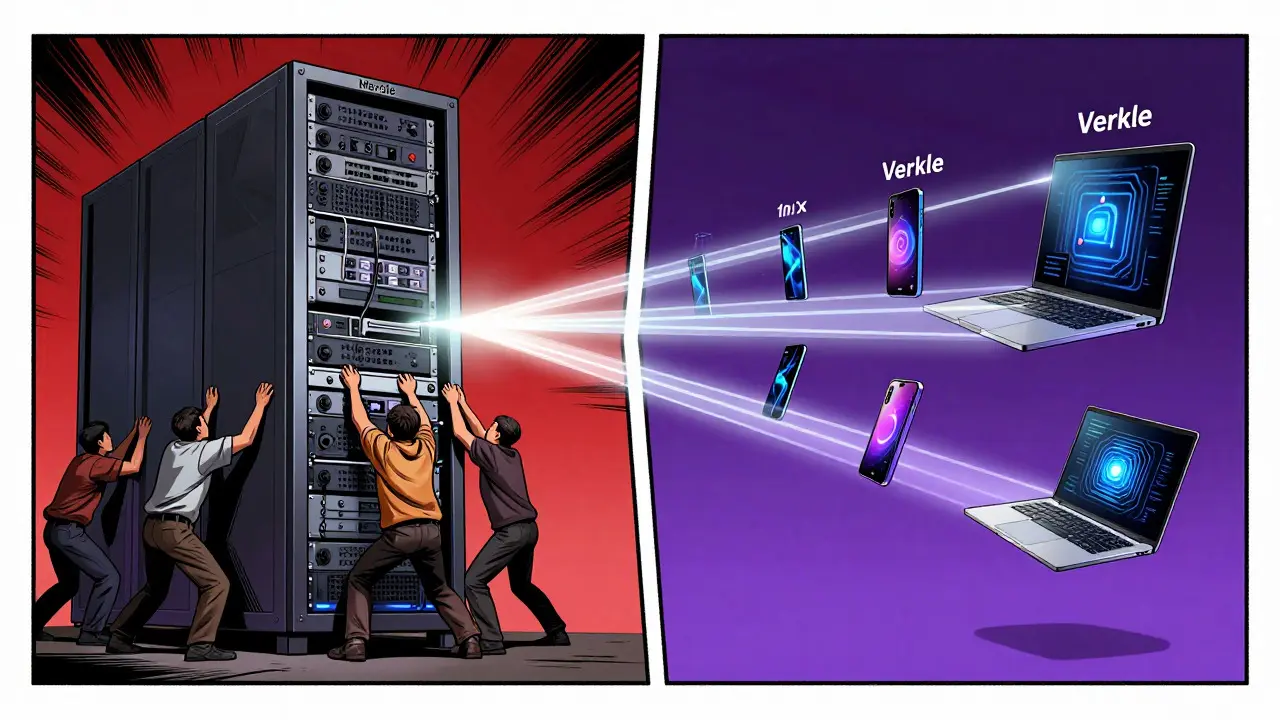
The biggest change on the horizon is the shift toward Verkle Trees are an advanced cryptographic structure that uses polynomial commitments instead of hashes to drastically reduce proof sizes and enable stateless client architectures. Traditional Merkle Trees rely on hashing functions like SHA-256. While secure, they have a flaw: the proof size grows logarithmically with the dataset. If you have a billion transactions, the proof (or witness) needed to verify one can still be around 4KB. That might sound small, but multiply that by millions of users, and bandwidth becomes a bottleneck.
Verkle Trees solve this by using a different mathematical approach. Instead of hashing child nodes together, they use polynomial commitments. The result? Proof sizes drop from 4KB to under 150 bytes-a reduction of up to 30 times. This isn’t just a minor tweak; it’s a game-changer for scalability. Ethereum’s planned transition to Verkle Trees aims to reduce node storage requirements by 99%, allowing lightweight devices to participate in network validation without storing terabytes of history.
| Feature | Merkle Trees | Verkle Trees |
|---|---|---|
| Cryptographic Basis | Hash Functions (e.g., SHA-256) | Polynomial Commitments |
| Proof Size (Billion Items) | ~4 KB | < 150 Bytes |
| Bandwidth Efficiency | Standard | 96.25% Reduction |
| Implementation Complexity | Low (Widely Adopted) | High (Requires Advanced Crypto) |
| Stateless Client Support | Limited | Native Enablement |
This shift means that by 2026, we’ll see a hybrid era. Legacy systems will stick with Merkle Trees due to their simplicity and widespread adoption, while high-throughput networks will migrate to Verkle. For developers, this means learning new cryptographic primitives. For users, it means faster sync times and lower hardware costs.
Stateless Clients and the Democratization of Nodes
One of the most exciting applications of evolved Merkle structures is the rise of Stateless Clients are lightweight blockchain nodes that can validate transactions without storing the full historical state of the network, relying instead on small cryptographic proofs. Currently, running a full Ethereum node requires storing over 1.2TB of data, costing thousands of dollars in enterprise-grade servers. This centralizes power among wealthy institutions.
With Verkle Trees, validators can prove transaction validity using tiny witnesses. A consumer laptop or even a smartphone could theoretically verify the network state. Dr. Vitalik Buterin has highlighted this as critical for decentralization. If anyone can run a node on a $300 device, censorship resistance improves dramatically. We’re already seeing prototypes where mobile wallets sync 30-40% faster using optimized Merkle Mountain Range structures. Imagine checking your crypto balance or verifying a smart contract execution instantly, without downloading gigabytes of data.
This also opens doors for IoT devices. Smart contracts embedded in sensors, cars, or medical devices need to verify data integrity but lack storage space. Stateless clients powered by compact Merkle proofs allow these devices to participate in distributed systems securely. It’s not just about finance; it’s about connecting the physical world to the digital ledger efficiently.
Financial Integrity: Real-Time Auditing and Proof-of-Reserves
Beyond public blockchains, traditional finance is waking up to the power of Merkle Trees. Banks and exchanges are moving away from opaque audits to real-time, cryptographic verification. JPMorgan’s Onyx division, for instance, is implementing Merkle-based proof-of-reserves systems. These allow customers to verify that $150 billion in digital assets are backed by real reserves through a single hash comparison.
Here’s how it works: The bank hashes all its liabilities and assets into a Merkle Tree. It publishes the root hash. Users can then check if their specific deposit is included in that tree without revealing other users’ data. This provides privacy-preserving transparency. By 2025, regulatory bodies like the SEC are pushing for mandatory Merkle-based proofs for cryptocurrency exchanges, affecting over $1.2 trillion in customer assets.
This trend extends to interbank settlements. Instead of waiting days for reconciliations, banks can use Merkle proofs to instantly verify that both sides agree on the transaction state. It reduces friction, cuts costs, and eliminates disputes. For everyday users, this means faster transfers and greater confidence that their money is actually there.
Supply Chain and Digital Identity Verification
Supply chains are notoriously complex, with goods passing through dozens of hands. Ensuring authenticity is a nightmare. Merkle Trees offer a solution by creating an immutable record of each step. Each event-manufacturing, shipping, customs clearance-is hashed into the tree. The final Merkle Root represents the entire journey.
If a product is counterfeit, the hash won’t match the expected root. Consumers can scan a QR code and verify the item’s origin instantly. This is particularly valuable for pharmaceuticals, luxury goods, and organic food. Companies like Walmart and Maersk are already piloting such systems. As the market for Merkle technology grows to $8.7 billion by 2027, expect to see these verifications become standard on packaging.
Digital identity is another frontier. Your credentials-passport, driver’s license, university degree-can be hashed into a personal Merkle Tree. You share only the necessary proofs with third parties. Want to prove you’re over 18? Share a proof derived from your age leaf, without revealing your birthdate or name. This zero-knowledge capability, combined with Merkle structures, enhances privacy while maintaining trust.
AI Optimization and Quantum Resistance
The intersection of AI and cryptography is emerging as a powerful tool. Experimental systems are using machine learning to optimize Merkle tree construction in real-time. AI algorithms analyze network conditions and dynamically adjust branching factors, reducing average proof sizes by nearly 19%. This adaptability is crucial for volatile environments where latency varies wildly.
However, the looming threat is quantum computing. Current hash functions like SHA-256 may fall to quantum attacks within the next decade. Researchers are developing quantum-resistant Merkle variants using lattice-based cryptography. These new structures aim to maintain security against quantum computers while preserving 95% of current efficiency. NIST is actively evaluating these standards. By 2030, we may see a gradual migration to post-quantum Merkle Trees, ensuring long-term viability for digital infrastructure.
For developers, this means staying agile. Libraries like Bitcoin Core and Ethereum’s mpt.js are updated regularly, but understanding the underlying principles helps when new standards emerge. Debugging proof paths remains a common challenge, so investing time in mastering tree balancing and odd-node handling pays off.

Practical Implementation Challenges
Despite the benefits, implementing Merkle Trees isn’t trivial. Developers often struggle with incorrect proof generation, which accounts for 34% of related bugs. Balancing the tree correctly is essential for performance; unbalanced trees increase verification time. Handling odd numbers of leaf nodes requires careful padding strategies to avoid errors.
Documentation quality varies widely. Established projects like Bitcoin Core score high on comprehensiveness, while newer implementations lag behind. This creates barriers for newcomers. However, resources are improving. Online courses and community forums provide support, and open-source libraries simplify integration. Start with well-tested frameworks before building custom solutions.
Testing is critical. Simulate large datasets to ensure proof sizes remain manageable. Monitor collision probabilities, especially if increasing hash lengths for enhanced security. Remember, every additional byte adds overhead, so find the right balance between security and efficiency.
Looking Ahead: A Foundation for Trust
Merkle Trees are far from obsolete. They are evolving. From Verkle Trees enabling stateless networks to AI optimizing performance and quantum-resistant designs securing the future, these structures will remain central to digital trust. Whether you’re a developer building scalable apps, a business ensuring supply chain integrity, or a user demanding financial transparency, understanding Merkle Trees is key.
The next decade will see these technologies move from niche blockchain tools to mainstream infrastructure. Keep an eye on regulatory changes, technological advancements, and industry adoption. The future of verification is here, and it’s rooted in mathematics.
What is the main difference between Merkle Trees and Verkle Trees?
Merkle Trees use cryptographic hashes to create proofs, resulting in larger proof sizes (around 4KB for billion-item datasets). Verkle Trees use polynomial commitments, reducing proof sizes to under 150 bytes. This makes Verkle Trees significantly more efficient for bandwidth and storage, enabling stateless clients.
How do Merkle Trees help with blockchain scalability?
They allow light clients to verify transactions without downloading the entire blockchain. By providing a small cryptographic proof (the Merkle Path), users can confirm data integrity quickly. This reduces bandwidth usage and enables faster synchronization, supporting higher transaction throughput.
Are Merkle Trees secure against quantum computers?
Current implementations using SHA-256 are vulnerable to future quantum attacks. However, researchers are developing quantum-resistant variants using lattice-based cryptography. These new structures aim to maintain security while preserving efficiency, with potential deployment by 2030.
What industries are adopting Merkle Trees outside of cryptocurrency?
Banking uses them for proof-of-reserves and real-time auditing. Supply chains use them for tracking product authenticity. Digital identity systems use them for privacy-preserving credential verification. Even online gambling platforms use them for provably fair games.
How difficult is it to implement a Merkle Tree?
It has a moderate learning curve. Developers typically need 2-3 weeks to master implementation. Common challenges include balancing the tree and handling odd-numbered leaves. Using established libraries like Bitcoin Core or Ethereum’s mpt.js simplifies the process and reduces bugs.