Iceland Crypto Mining Restrictions by National Power Company
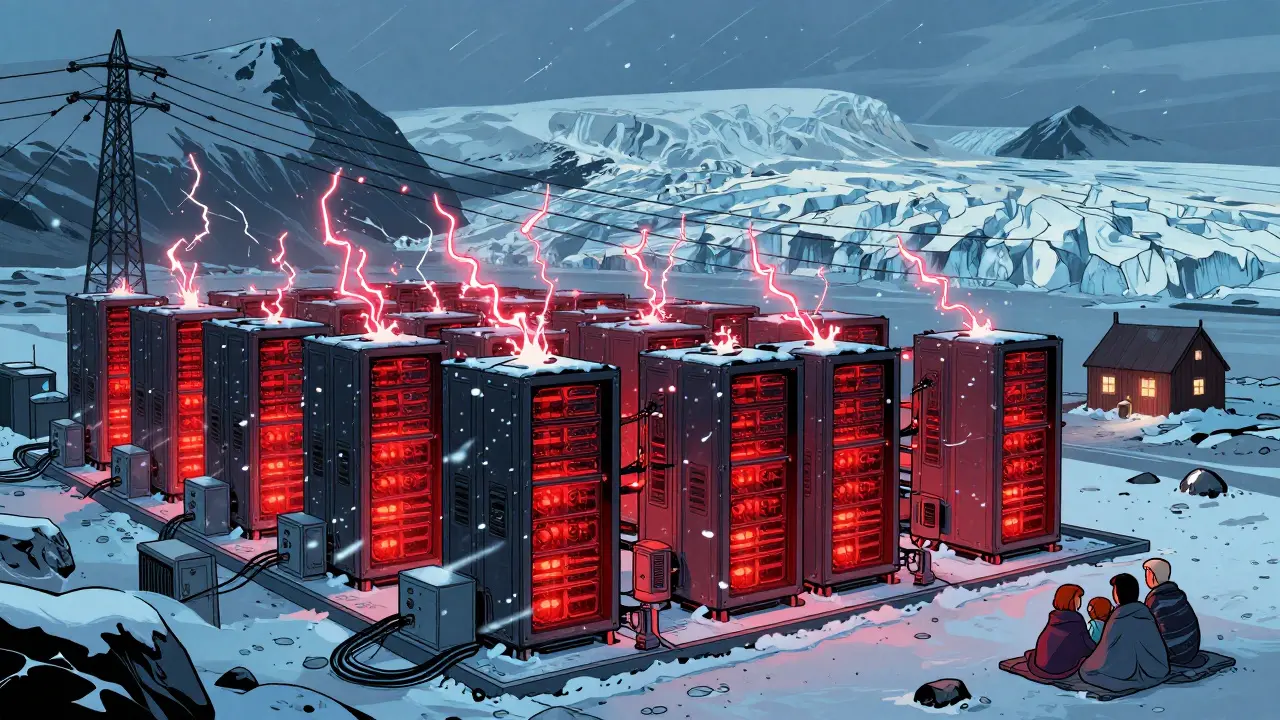
When you think of Iceland, you probably picture glaciers, waterfalls, and Northern Lights. But for the last decade, it’s also been one of the world’s biggest hubs for cryptocurrency mining. The reason? Cheap, clean energy. Iceland’s geothermal and hydroelectric power runs at a fraction of the cost of fossil-fuel-based grids elsewhere. Add in freezing air that naturally cools massive server farms, and it’s no surprise miners flocked there. But things have changed.
Energy use hit a breaking point
By 2023, cryptocurrency mining in Iceland was using more electricity than the entire country’s households combined. That’s not a typo. Bitcoin, Ethereum, and other proof-of-work networks were pulling in over 1.2 terawatt-hours of power annually-enough to power 300,000 homes. And it kept growing. Mining rigs, often imported from China and the U.S., were popping up in abandoned factories, warehouses, and even repurposed data centers. The problem wasn’t just scale. It was timing. Iceland’s power grid wasn’t built to handle sudden, massive spikes in demand. Winter storms, volcanic activity, and aging transmission lines made the system fragile. When mining operations ramped up during peak energy seasons, there wasn’t enough left for hospitals, schools, or heating homes. People started noticing their electricity bills creeping up. Local businesses complained about blackouts. And the government? They had to act.Who controls the power? It’s not just the government
Iceland doesn’t have a private utility monopoly. Its national power company, Landsvirkjun, is state-owned and runs the country’s largest hydroelectric and geothermal plants. It doesn’t just sell power-it manages the entire grid. And when mining companies started demanding more than 10% of the country’s total output, Landsvirkjun didn’t wait for politicians to make a move. They started setting limits. In late 2024, Landsvirkjun quietly began enforcing a new policy: no new mining operations could connect to the grid without a detailed energy impact assessment. Existing miners? They got notices. Their contracts were reviewed. Some were told their power allocation would be cut by 20% over the next 18 months. Others were given a choice: upgrade to more efficient hardware or lose power. This wasn’t a law passed by parliament. It was a utility making a business decision. Landsvirkjun’s job isn’t to ban Bitcoin. It’s to keep the lights on for everyone else. And when 90% of your data center load comes from one industry, you don’t have much room to negotiate.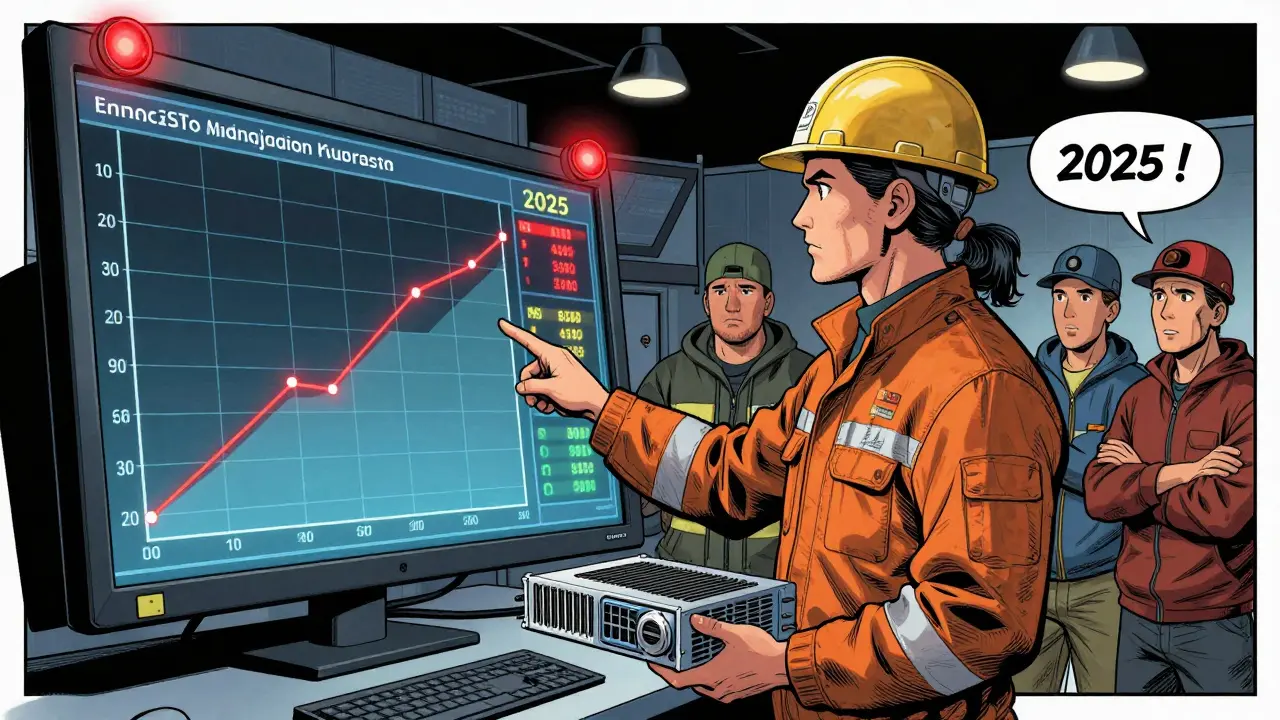
What the restrictions actually look like
The rules aren’t flashy, but they’re effective:- New mining facilities must prove they use at least 85% renewable energy-no exceptions.
- Existing miners must install real-time power monitors and report usage daily.
- Power allocation is now tied to efficiency ratings. A miner using outdated ASICs gets less juice than one using 2025-model rigs.
- Miners can’t sign long-term contracts. All agreements expire after 24 months and are up for renegotiation.
- Any miner that exceeds its allocated power for three consecutive months gets shut off until next year’s allocation is reviewed.
Why miners are still hanging on
Despite the restrictions, mining hasn’t disappeared. Why? Because Iceland still has the best combo on Earth: renewable energy + cold air + political stability. Companies like Bitfury and Genesis Mining aren’t leaving. They’re adapting. Some are building new facilities powered entirely by geothermal steam-directly tapping into volcanic heat instead of drawing from the grid. Others are partnering with local farms to use waste heat from servers to warm greenhouses. One startup even turned a decommissioned data center into a hydrogen production plant, using excess power to split water and store energy for later. It’s not about fighting the rules. It’s about working around them. And that’s exactly what the smartest players are doing.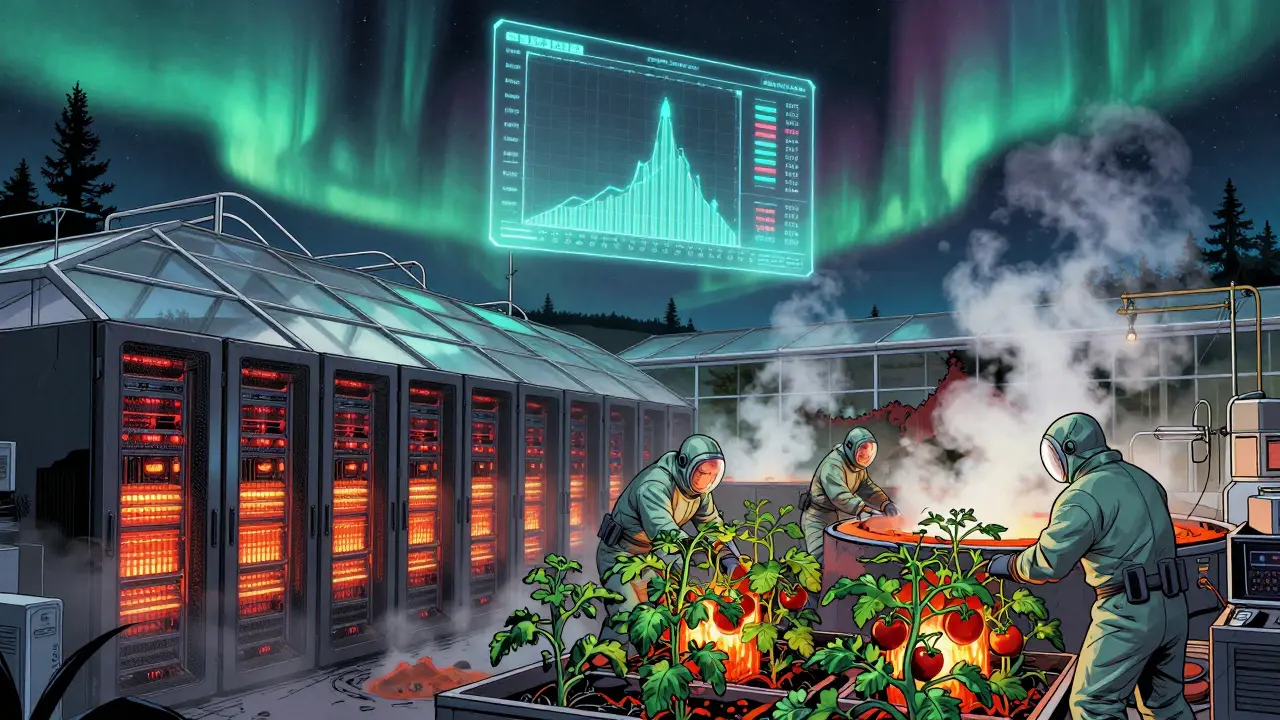
The bigger picture: It’s not just about Bitcoin
Iceland’s move isn’t just about stopping crypto mining. It’s about redefining what energy is for. The government is now pushing hard for blockchain applications that don’t waste power-like supply chain tracking, land registry systems, and digital identity verification. The Central Bank of Iceland is testing its own digital currency, the e-krona, which uses far less energy than proof-of-work mining. And the country’s universities are training engineers in low-power consensus algorithms, not just mining hardware. The message is clear: Iceland doesn’t hate crypto. It hates waste.What’s next?
By mid-2026, Iceland plans to publish a public dashboard showing real-time energy use by sector-mining, industry, homes, and more. Anyone with internet access can see exactly how much power Bitcoin is using right now. Transparency is the new tool. Miners who comply? They’ll get priority access to future renewable projects. Those who don’t? They’ll be phased out. No fines. No lawsuits. Just a quiet, calculated shift in who gets to use the power. Iceland’s approach might be the model other countries follow. Not by banning mining. But by making it pay its fair share.Are cryptocurrency mining operations illegal in Iceland?
No, cryptocurrency mining is not illegal in Iceland. It remains legal to operate mining facilities, trade digital assets, and invest in blockchain projects. However, mining operations are now subject to strict energy usage regulations enforced by Landsvirkjun, the national power company. Miners must comply with efficiency standards, power allocation limits, and real-time monitoring requirements.
Why did Iceland start restricting crypto mining?
Iceland started restricting crypto mining because the energy demand from mining rigs began consuming more power than the entire residential sector. By 2023, Bitcoin mining alone used over 1.2 terawatt-hours annually-enough to power 300,000 homes. With winter energy demands already high and grid infrastructure aging, officials feared blackouts and rising electricity costs for citizens. Landsvirkjun stepped in to prioritize essential services and renewable energy sustainability.
Which companies are still mining in Iceland?
Major companies still operating in Iceland include Hive Blockchain Technologies, Bitfury Holding, and Genesis Mining. These firms have adapted by upgrading to more energy-efficient hardware, investing in direct geothermal connections, and reducing their overall power footprint. Some have even shifted focus from mining to building blockchain infrastructure for public services, like digital identity systems and supply chain verification.
Can new mining companies set up in Iceland today?
New mining companies can apply to set up operations, but they must pass a rigorous energy impact review. Landsvirkjun requires proof that the facility will use at least 85% renewable energy, deploy modern, efficient mining hardware, and connect to the grid with real-time monitoring. Approval is not guaranteed, and power allocation is capped based on efficiency, not demand.
Is Iceland shutting down all crypto mining?
No, Iceland is not shutting down all crypto mining. The goal isn’t elimination-it’s optimization. The country wants to keep its role as a leader in blockchain technology, but only if it’s done sustainably. Miners using outdated, inefficient equipment are being phased out. Those using cutting-edge tech and renewable sources are being encouraged to expand. The shift is from quantity to quality.



23 Comments
Will Lum
February 10 2026Iceland's move makes sense. Power isn't infinite, and when crypto rigs are using more than homes, something's gotta give. No one's saying ban it-just make it efficient. The fact that companies like Hive cut usage by 42% just by upgrading hardware? That's the win.
Holly Perkins
February 10 2026i think this is bs honestly. why should i care if some company uses power to mine bitcoin? they're paying for it right? lol
Ben Pintilie
February 12 2026this is why i hate crypto bros 😤 they think the planet owes them free electricity. also i saw a tweet that said 'but what about the whales?' like... bro the whales are already rich. chill.
Sanchita Nahar
February 12 2026Iceland is smart. Energy is for people not for machines that do nothing. If you mine, you pay the price. Simple.
bala murali
February 13 2026The systemic prioritization of grid stability over speculative computation is a necessary recalibration. The ontological framing of energy as a public good, rather than a commodified resource for speculative arbitrage, aligns with post-neoliberal infrastructural ethics.
Kaz Selbie
February 13 2026so let me get this straight-miners are getting cut off because they’re too lazy to upgrade? what a joke. they’re not even trying. if you’re still running 2020 ASICs in 2025, you deserve to get kicked off. stop pretending you’re pioneers.
Keturah Hudson
February 13 2026I’ve been to Reykjavik. The air is so cold you can hear your breath crack. I saw a miner’s warehouse with steam vents puffing out like dragons. That’s not waste-that’s innovation. They’re turning heat into greenhouses. That’s next-level.
Ace Crystal
February 15 2026This is the future. Not bans. Not outrage. Just smart rules. Iceland’s not stopping crypto. They’re upgrading it. If you’re not evolving, you’re obsolete. Time to level up or get off the grid.
Brittany Meadows
February 17 2026soooooo... who REALLY owns the grid? 🤔 hint: it’s not the government. it’s not the miners. it’s the volcanoes. and the glaciers. and the ancient lava flows. this whole thing is just a power play by Earth itself. we’re all just pawns in the Great Icelandic Energy Game. 🌋❄️💎
krista muzer
February 18 2026i mean i get why people are mad but honestly i think its kinda fair? like if your house is freezing because some guy in a warehouse is running 10k rigs, that’s just not right. i’m not anti-crypto, i just think energy should go to people first. also i think the dashboard idea is cool. i’d check it every day.
Tammy Chew
February 19 2026This is not a policy. This is a philosophical revolution. Iceland is not regulating energy. It is redefining civilization’s relationship with utility. The mining rigs are not merely consuming power-they are challenging the very notion of progress. And Iceland? It’s the only one brave enough to say: 'No. Not anymore.'
Santosh kumar
February 21 2026Good step. Energy is life. Mining can wait. People can’t. Hope more countries follow.
Claire Sannen
February 22 2026The real win here is the transparency. A public dashboard showing real-time usage? That’s leadership. It turns abstract energy debates into something tangible. People can see the trade-offs. That builds trust. And trust is what makes sustainable change possible.
Christopher Wardle
February 23 2026The grid is a shared resource. When one group uses 10% of the nation’s output, it’s not a market failure-it’s a social contract breach. Iceland isn’t punishing miners. It’s restoring balance.
blake blackner
February 24 2026i love how they just quietly cut power like its no big deal. no drama. no press releases. just 'you got 3 months to upgrade or goodbye'. that’s how you handle a problem. no politics. just facts. respect.
Andrea Atzori
February 25 2026The integration of geothermal steam directly into mining infrastructure represents a paradigm shift in energy symbiosis. This isn’t mitigation-it’s co-evolution. Iceland is not merely adapting to crypto; it is catalyzing a new industrial ecology.
Joe Osowski
February 25 2026America’s got 100 coal plants and they’re still running. But Iceland? They shut down crypto because it’s using too much power? What a joke. This is woke environmentalism. We need to stop letting tiny countries dictate what’s 'ethical'.
Gaurav Mathur
February 25 2026they say no new mining but what if you buy an old one? loophole? or is the whole thing just a scam to push out foreigners? i think this is just protectionism dressed up as green energy
Jeremy Lim
February 26 2026I just... I don’t understand why people are so mad? Like, if you’re mining and you’re not using the newest hardware, you’re just being lazy. And if you’re using old rigs and complaining about cuts? You’re not a pioneer. You’re a relic. And honestly? The grid’s got more important things to do.
Grace Mugambi
February 26 2026I think this is one of those rare moments where a country didn’t react out of fear or anger, but out of clarity. They didn’t say 'no'. They said 'prove you belong here.' And that’s actually beautiful. It’s not about stopping innovation-it’s about making sure innovation serves everyone.
Crystal McCoun
February 28 2026The real story here isn’t the restrictions-it’s the innovation they’re forcing. Companies turning mining heat into greenhouses? Building hydrogen plants? That’s not just survival. That’s evolution. This isn’t a crackdown. It’s a catalyst.
Donna Patters
March 2 2026Iceland has always been a land of extremes. Glaciers. Volcanoes. And now, a quiet, unyielding moral authority over energy. They didn’t need laws. They didn’t need protests. They simply said: 'This power is not yours to waste.' And the world listened.
Michelle Cochran
March 2 2026I’m tired of people acting like crypto mining is some noble frontier. It’s not. It’s a power-hungry casino with servers. And Iceland? They’re the only ones with the guts to say: 'No. We’re not your battery.'