Koinim Crypto Exchange Review: Is It Safe for Turkish Traders in 2026?
Buying Bitcoin with Turkish Lira shouldn't feel like solving a puzzle. Yet, for many investors in Istanbul or Ankara, the options are limited to either massive global giants that don't speak your language or smaller local platforms with questionable track records. Koinim sits squarely in that second category. Founded in 2013 by Çagatay Yüksel, it was one of the first exchanges to cater specifically to Turkish users. But does its decade-long history make it a safe harbor in 2026, or is it just holding on to past glory?
This review cuts through the noise. We aren't here to tell you if crypto is good or bad. We are here to tell you if Koinim is right for you. If you are outside Turkey, stop reading now-this platform is not for you. If you are inside Turkey and want to trade BTC/TRY without dealing with complex international banking rails, keep reading. Here is what you need to know before you deposit a single Lira.
Who Actually Uses Koinim? (And Who Should Avoid It)
Let's get the elephant in the room out of the way immediately. Koinim is built exclusively for Turkish residents. The interface is in Turkish. The customer support responds in Turkish. The only fiat currency you can deposit and withdraw is the Turkish Lira (TRY).
If you are an expat living in Istanbul who doesn't speak fluent Turkish, this exchange will be a nightmare for you. You won't find English documentation. You won't find English support agents. This isn't a slight oversight; it's their core business model. They serve a niche market that larger exchanges like Binance or Coinbase often ignore due to regulatory complexity.
For native Turkish speakers, however, this localization is a feature, not a bug. You don't have to worry about confusing fee structures denominated in USD or EUR. You see prices in Lira. You pay with Lira. The friction is lower. But that convenience comes with significant trade-offs regarding asset variety and advanced features.
| Feature | Koinim | Binance / Coinbase |
|---|---|---|
| Fiat Support | Turkish Lira (TRY) only | USD, EUR, GBP, etc. (50+ currencies) |
| Cryptocurrencies | 7 coins (BTC, ETH, LTC, BCH, etc.) | 350+ coins |
| Language | Turkish only | English + 30+ languages |
| Advanced Trading | Spot trading only | Spot, Margin, Futures, Options |
| Regulation | Unregulated / Self-regulated | Varies (Often regulated in EU/US) |
The Asset List: Why "Less" Might Be "More" (Or Less)
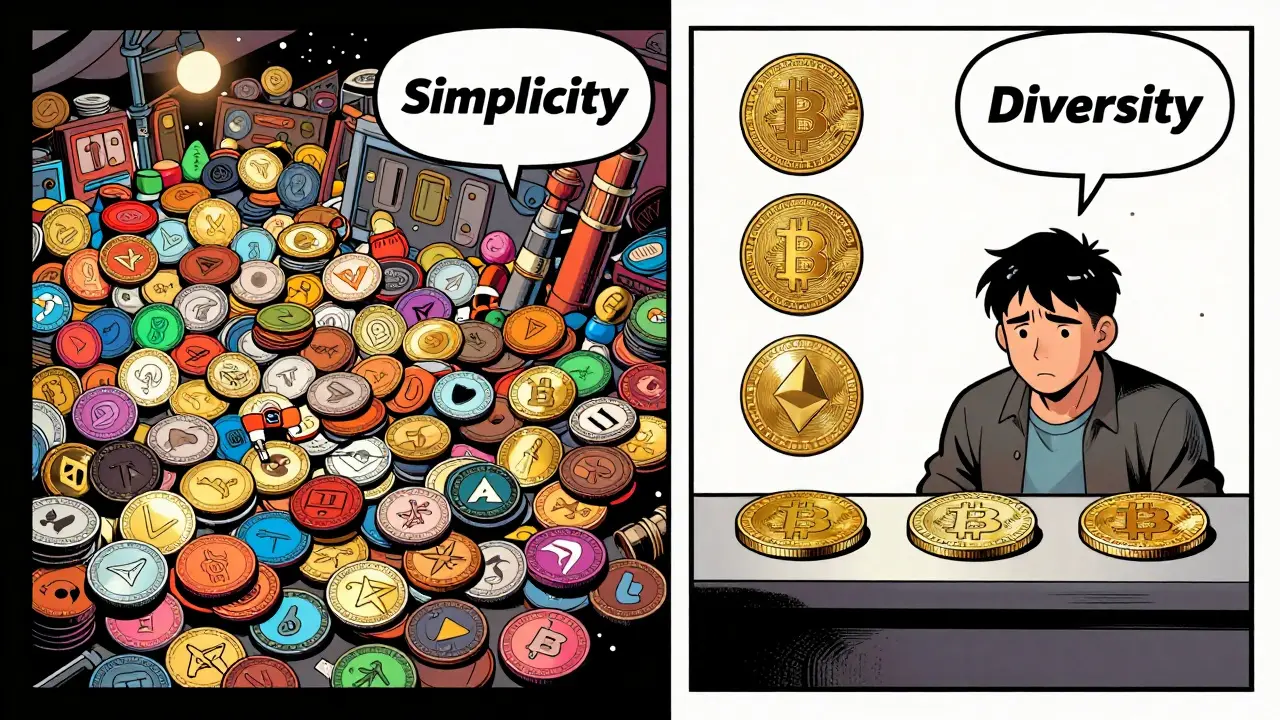
In 2026, having access to hundreds of cryptocurrencies is standard. On Koinim, you are looking at a very short list. According to recent data from Wikibit, the platform supports only seven cryptocurrencies. The heavy hitters are there: Bitcoin (BTC), Ethereum (ETH), Litecoin (LTC), and Bitcoin Cash (BCH). There are also a few others, but the selection is thin.
Is this a problem? It depends on your strategy.
If you are a "Bitcoin Maximalist" who believes only in storing value in BTC and maybe some ETH, Koinim is perfectly adequate. You don't need to scroll through a list of 400 meme coins to find what you want. The interface remains clean and uncluttered because there is less to clutter it.
However, if you like diversification, Koinim will frustrate you. You cannot buy Solana, Cardano, or Polkadot here. You cannot explore new DeFi tokens. If you want those assets, you will have to use a different exchange, which means moving funds around and paying more fees. For pure simplicity, Koinim wins. For portfolio diversity, it fails completely.
Technology Behind the Scenes: Built on Django
You might wonder how a small exchange handles traffic spikes during bull markets. The answer lies in its tech stack. Koinim’s infrastructure is built using the Python Django framework, combined with Celery for background task processing and Angular for the user interface.
This isn't just random coding choices. Django is known for security and rapid development. In fact, STX Next, a software development partner, worked with Koinim to optimize their performance. During peak crypto booms, they implemented changes that increased the platform's daily capacity by 300%. That means Koinim could handle four times as many user sessions as before crashing or slowing down.
Why does this matter to you? Because when Bitcoin price jumps 10% in an hour, exchanges often freeze. Users can't buy, can't sell, and can't withdraw. Koinim’s technical upgrades suggest they have put effort into preventing this specific pain point. Their ability to deploy production releases quickly (sometimes in under a month) shows a responsive engineering team, which is rare for older, legacy platforms.
Fees and Payment Methods: How Much Does It Cost?
Money talks, and on crypto exchanges, fees scream. Koinim uses a flat fee structure for trading and withdrawals. While exact percentages fluctuate, they are generally competitive within the Turkish market, though slightly higher than the ultra-low rates offered by Binance.
Here is where it gets tricky for deposits. You cannot simply swipe a credit card to buy crypto instantly on Koinim. The primary method for funding your account is via bank transfer (wire transfer) in Turkish Lira. This adds a step to the process. You initiate a transfer from your Turkish bank account, wait for it to clear (usually same-day or next-business-day depending on the bank), and then your balance updates.
No credit card deposits mean no instant gratification, but it also means fewer chargeback risks for the exchange, which keeps the platform safer for everyone. Withdrawals follow a similar path-you send your crypto to an external wallet or request a TRY withdrawal to your linked bank account. Keep in mind that network fees for crypto withdrawals apply, so sending small amounts of Bitcoin can eat up your profits.
Safety and Regulation: The Big Question
This is the section that keeps traders awake at night. Is Koinim safe? Let's look at the facts.
First, Koinim requires full identity verification (KYC) for all users. You cannot trade anonymously. You must provide ID documents and proof of address. This is a good sign. It means they are trying to comply with anti-money laundering standards, even if the regulatory landscape in Turkey is murky.
Second, and more importantly, Koinim operates without specific oversight from a major international financial authority like the SEC (USA) or FCA (UK). Turkey's own cryptocurrency regulations have been volatile. The government has cracked down on crypto payments while allowing trading. Koinim exists in this gray area. They are not banned, but they are not heavily protected by a government insurance fund either.
User reviews highlight this tension. Many appreciate the 24/7 customer support, which helps resolve issues quickly. However, consistent complaints mention the lack of regulatory transparency. If Koinim were to face a catastrophic hack or insolvency, there is no guarantee you would get your money back.
My advice? Treat Koinim as a hot wallet for active trading, not a cold storage vault for long-term savings. Buy your BTC on Koinim, trade it, but move large holdings to a hardware wallet (like Ledger or Trezor) once you've accumulated significant value. Never leave life-changing amounts of money on any exchange, especially one without strict regulatory backing.
User Experience: Simple, But Dated?
When you log in, the dashboard is straightforward. You see your balances, your open orders, and the current market price. It’s not flashy. It doesn’t have the neon graphics and complex charting tools of professional trading terminals. For beginners, this is actually helpful. There are no hidden buttons or confusing leverage sliders.
However, "simple" can sometimes feel "outdated." The design hasn't changed drastically since its early days. Mobile users should note that while there is a mobile-responsive website, the experience is best on a desktop computer. If you plan to trade frequently from your phone, you might find the navigation clunky compared to dedicated apps from competitors.
Customer support is a bright spot. Because the team is local, they understand the cultural context and banking quirks of Turkish users. If you have a problem with a bank transfer, they can likely guide you through it in real-time. This human touch is something you rarely get from automated bots on global platforms.
Verdict: Who Should Use Koinim in 2026?
Koinim is not for everyone. In fact, it’s for very few people. But for those specific people, it is indispensable.
Use Koinim if:
- You live in Turkey and want to buy/sell crypto using Turkish Lira directly.
- You prefer trading only major coins like Bitcoin, Ethereum, and Litecoin.
- You want a simple, no-frills interface without the complexity of futures or margin trading.
- You value local customer support in Turkish.
Avoid Koinim if:
- You live outside of Turkey.
- You want to trade altcoins, NFTs, or new token launches.
- You require advanced trading tools like stop-loss automation or leveraged positions.
- You demand strict regulatory oversight and insurance guarantees.
In a world dominated by global giants, Koinim survives by being hyper-local. It’s a specialist shop in a mall of department stores. It won’t sell you everything, but for the things it does sell, it knows exactly how to serve its neighborhood.
Is Koinim available for users outside of Turkey?
No. Koinim is designed exclusively for Turkish residents. The platform only accepts Turkish Lira (TRY) for deposits and withdrawals, and the entire interface and support system are in Turkish. International users will face significant barriers and are advised to use global exchanges like Binance or Coinbase instead.
What cryptocurrencies can I trade on Koinim?
As of 2026, Koinim supports a limited selection of approximately seven cryptocurrencies. The main pairs include Bitcoin (BTC), Ethereum (ETH), Litecoin (LTC), and Bitcoin Cash (BCH). The platform focuses on established assets rather than offering a wide variety of altcoins.
How do I deposit money into Koinim?
The primary method for depositing funds on Koinim is via bank wire transfer in Turkish Lira. Credit card deposits are generally not supported for direct crypto purchases on the platform. You must link your Turkish bank account and initiate a transfer, which typically clears within one business day.
Is Koinim regulated by financial authorities?
Koinim operates without oversight from major international financial regulators like the SEC or FCA. While it complies with local Turkish KYC (Know Your Customer) requirements, the regulatory environment for crypto in Turkey is evolving and currently lacks the robust consumer protection frameworks found in the EU or US. Users should exercise caution and not store large sums long-term.
Does Koinim offer margin trading or futures?
No. Koinim offers only spot trading services. This means you buy and sell cryptocurrencies at their current market price. There are no leverage options, margin loans, or derivative contracts available on the platform. This makes it safer for beginners but less attractive for professional traders seeking advanced strategies.



15 Comments
Skm Shubham
June 11 2026Unsurprisingly, another review of a legacy platform that refuses to adapt. The fact that they still rely on Django for the frontend logic in 2026 is pathetic. It’s not 'security,' it’s stagnation. If you can’t even support Solana or Cardano, you’re not an exchange, you’re a digital museum exhibit. Stop pretending this is viable for anyone who actually understands market dynamics.
Kwon Bill
June 12 2026I think Skm Shubham is being a bit harsh regarding the tech stack. Django is actually quite robust for backend security when implemented correctly, especially with Celery for async tasks. The limitation isn't the framework; it's the business model. Koinim serves a specific demographic in Turkey where regulatory compliance and local banking integration are more critical than having access to every new meme coin launched on Ethereum. For Turkish residents, the friction of using Binance due to KYC hurdles or payment gateway blocks is real. Koinim solves the liquidity problem for TRY pairs, which is their primary value proposition. It’s niche, yes, but niches survive by serving unmet needs.
Danna Charris
June 14 2026Precisely. Niche markets thrive on specialization. Generalists fail at everything.
Fede Faith
June 15 2026Hey everyone, let’s keep it constructive. While I agree that the asset list is limited, we have to look at the context. For someone in Istanbul who just wants to buy Bitcoin with Lira without dealing with international wire transfer fees or complex forex conversions, Koinim is actually pretty convenient. The flat fee structure is transparent, which is rare. My advice? Use it for small, frequent trades if you’re local, but definitely move your holdings to a cold wallet like Ledger once you’ve accumulated anything significant. Don’t leave your life savings on any exchange, regulated or not. Safety first, always.
Josh Dodson
June 16 2026totally agree with fede! its super important to not trust exchanges with ur long term stash. i made that mistake back in 2021 and lost so much time trying to recover funds from a frozen account. koinim seems ok for quick swaps but yeah, hardware wallet is the only way to go for real security. dont be lazy about it lol
Kumaran sowkarpet
June 17 2026Yeah Josh u r right. I used to use local P2P groups but they were risky. Koinim at least has KYC so there is some accountability. But honestly the UI looks like it was designed in 2015. Very clunky on mobile. :/
Mauricio Contreras Loredo
June 17 2026Oh, great. Another 'review' that tells you exactly what you already know. 'It's safe if you don't put too much money in it.' Groundbreaking insight. I suppose we should all thank them for not robbing us blind while they slowly degrade our purchasing power with inflation-adjusted fees. Just kidding, nothing here is funny except the idea that this is a 'safe harbor.' It’s a speedboat in a hurricane.
Grace Newman
June 19 2026The lack of regulatory oversight is not merely a 'gray area'; it is a glaring red flag that indicates potential systemic risk. One must consider the implications of operating without the stringent protections afforded by entities such as the SEC or FCA. In the event of insolvency, users are left entirely exposed. This is not a matter of opinion but of financial prudence. The absence of insurance guarantees means that your assets are effectively held in trust by a private entity with no legal obligation to return them in a crisis. Proceed with extreme caution.
Annemarie Fitzgerald
June 19 2026its almost poetic really how these platforms exist in the shadows. they dance on the edge of legality because thats where the profit is. i feel like we are all just pawns in a larger game played by people who understand the code better than the law. its terrifyingly beautiful in a way. do we trust the machine or the man? neither. thats the answer. but oh well, gotta buy my bitcoin somehow right? lol
Abby Sivertsen
June 21 2026Grace makes a valid point about the risk, but Annemarie is overthinking it. Look, if you live in Turkey, your options are limited. You either use Koinim and accept the risks, or you try to navigate the messy world of P2P trading which has its own scams. I’ve been using Koinim for years. The support team is actually helpful when things go wrong with bank transfers. That human element matters. Yes, move your coins to a cold wallet. No, it’s not perfect. But it works for what it is.
Benjamin Eisen
June 22 2026i hear you abby. its tough out there for turkish traders. the whole ecosystem is kinda broken. i wonder if koinim will ever expand beyond just the big 4 coins? feels like they are stuck in the past. maybe they should listen to their users more?
Kenneth Riley
June 23 2026they wont expand because they cant handle the load. django is fine for a blog not for high frequency trading. its a joke. everyone knows this. why are we still talking about it? its dead weight. stop wasting your time reading reviews of obsolete tech. go learn solidity or something useful.
Rob Aronson
June 23 2026Kenneth, while your frustration is palpable, dismissing the entire platform based on its tech stack is reductive. 📉 The choice of Django is often deliberate for rapid iteration and security patches, not just laziness. Furthermore, the 300% capacity increase mentioned in the post suggests they are actively scaling. 🚀 It’s interesting to see how different regions prioritize different features. In the US, we might want leverage and futures, but in emerging markets, simple spot trading with local fiat on-ramps is king. 💰 It’s not about being 'obsolete'; it’s about market fit. 🌍
Suman Patil
June 24 2026Let's keep the vibe positive here guys! 🙌 Kenneth, chill out. Rob is right, different strokes for different folks. If you are in Turkey and need to buy BTC with TRY, Koinim does the job. It’s not Binance, sure, but it’s reliable for what it offers. Let’s appreciate the diversity in the crypto space instead of tearing each other down. We are all on this journey together! 🚀✨
sreeja boora
June 24 2026This discussion highlights the disparity between global financial infrastructure and local realities. For Indian users, similar challenges exist with RBI regulations. However, comparing Koinim to Indian platforms is flawed due to differing legal frameworks. The emphasis should remain on strict adherence to local laws. Unregulated entities pose a threat to national economic stability. Users must prioritize compliance over convenience. The informal nature of some comments here undermines the seriousness of financial regulation.