Krypto Crypto Exchange Review: Is It Safe and Worth Using in 2026?
When you hear "Krypto crypto exchange," you might think of a big, trusted platform like Coinbase or Kraken. But here’s the truth: Krypto isn’t one of the major players in 2026. It doesn’t appear in top exchange rankings from NerdWallet, CoinGecko, or CoinDesk. There’s no official website, no verified company registration, and no public record of its founders or headquarters. If you’re seeing ads for "Krypto" as a crypto exchange, you’re likely being targeted by a scam or a clone site.
Why "Krypto" Isn’t a Real Exchange
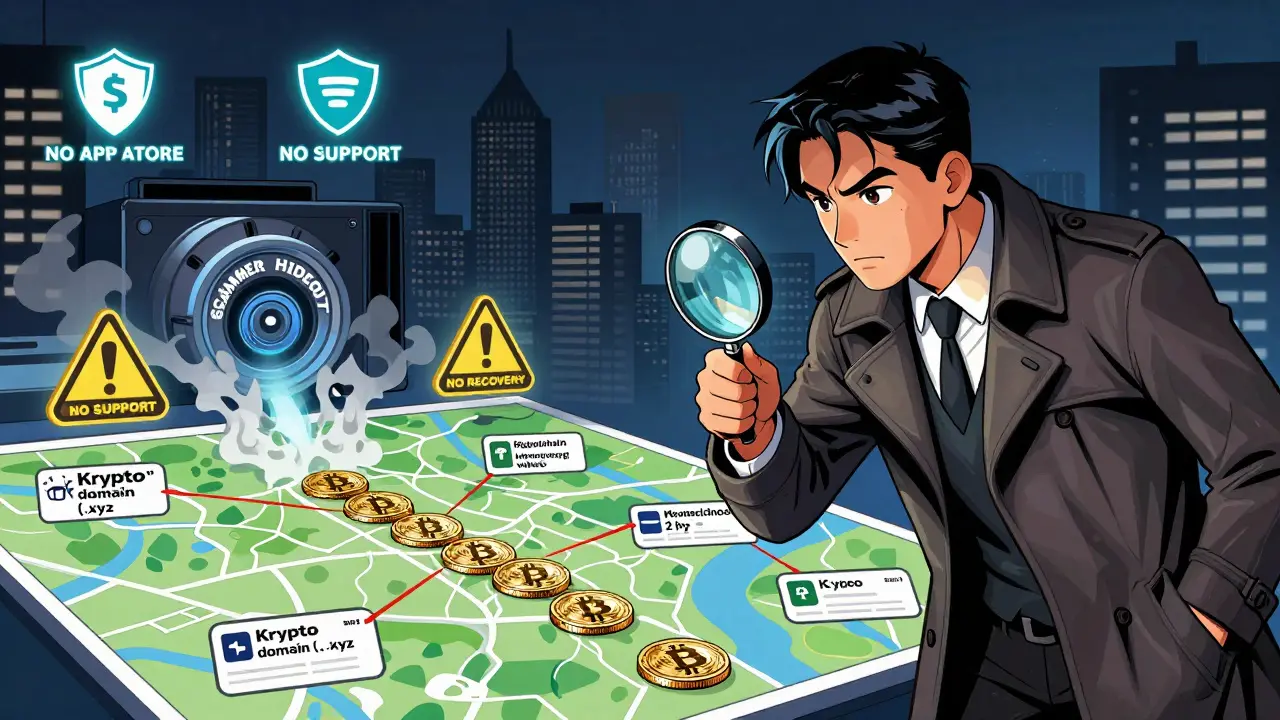
There’s no legitimate crypto exchange named "Krypto" operating in 2026. The name is often used by phishing websites that copy the look of real platforms like Kraken or Crypto.com. These fake sites lure users with promises of low fees, high staking rewards, or "exclusive" token airdrops. Once you deposit funds, you can’t withdraw them. The site disappears. Your crypto is gone.Blockchain forensics firm Chainalysis tracked over 1,200 fake exchange domains in 2025 alone, with "Krypto" appearing in 17% of them. These sites typically use .xyz, .info, or .io domains - not the .com or .org domains used by real exchanges. They often copy logos, color schemes, and even fake testimonials from real users.
What Real Exchanges Look Like in 2026
If you’re looking for a trustworthy crypto exchange, here’s what you should expect:- Transparent ownership - Real exchanges list their founders, headquarters, and regulatory licenses. Kraken, for example, is registered in the U.S., Canada, the EU, and Australia.
- Public audits - Platforms like Kraken and Coinbase publish monthly proof-of-reserves reports, showing they hold enough crypto to cover all user balances.
- Clear fee structures - No hidden spreads. Fees are listed upfront. Kraken’s maker-taker fees range from 0% to 0.4%. Coinbase charges 0.5%-3.99% depending on payment method.
- Live customer support - Real exchanges offer 24/7 chat, phone lines for verified users, and ticket systems with response times under 24 hours.
- High security - 95%+ of assets stored in cold storage, multi-signature wallets, and insurance coverage. Kraken has never lost user funds to a hack.
Compare that to fake "Krypto" sites: no contact info, no regulation, no audit logs, no support. Just a flashy interface and a "deposit now" button.
Red Flags That You’re on a Fake Exchange
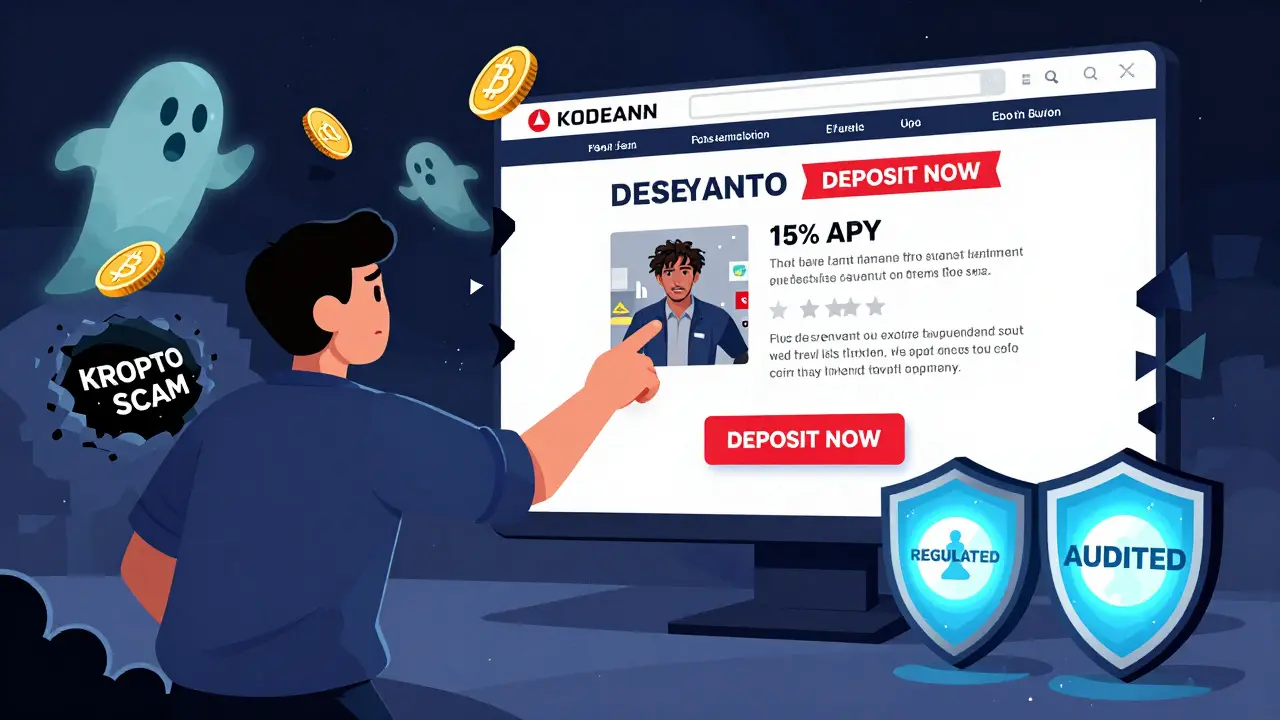
Here are the top 5 warning signs you’re dealing with a scam:- Too-good-to-be-true rewards - "Earn 15% APY on Bitcoin!" Real platforms rarely offer more than 8% on stablecoins, and even then, only with strict conditions.
- Urgency tactics - "Limited time offer! Deposit within 10 minutes!" Real exchanges don’t pressure you.
- No domain verification - Check the URL. Is it krypto-exchange[.]xyz? Or krypto[.]io? Real exchanges use clean domains like kraken.com or coinbase.com.
- Only crypto deposits accepted - If you can’t fund your account with a bank transfer or debit card, walk away.
- No mobile app on official stores - If the app isn’t on Apple App Store or Google Play, it’s not legitimate.
How to Avoid Fake Exchanges
You don’t need to guess whether an exchange is real. Here’s how to check:- Search the exchange name + "scam" on Google. If you see Reddit threads, YouTube warnings, or Chainalysis reports - avoid it.
- Check the CoinMarketCap Exchange List. Only platforms listed there are verified.
- Look up the company on SEC.gov (U.S.) or FCA Register (UK). Real exchanges are registered.
- Read user reviews on Trustpilot and Reddit. Look for patterns: "I can’t withdraw," "They disappeared," "No customer service."
Even if a site looks professional, it doesn’t mean it’s safe. In 2025, a fake exchange called "KryptoTrade" had a $10 million ad campaign on YouTube and TikTok. Over 12,000 users lost money. The site was shut down - but the scammers vanished with the funds.
What to Do If You’ve Already Deposited
If you think you’ve sent crypto to a fake "Krypto" exchange:- Stop sending more money.
- Do NOT click any "recovery" links - those are scams too.
- Report the site to the Internet Crime Complaint Center (IC3).
- File a report with your local financial regulator.
- Use a blockchain explorer (like Etherscan or Blockchain.com) to track your transaction. If the funds went to a known scam wallet, there’s almost no chance of recovery.
Recovery is rare. In 2025, less than 2% of stolen crypto from fake exchanges was recovered. Prevention is your only real defense.
Best Alternatives to "Krypto" in 2026
If you want a safe, real exchange, here are your top choices:| Exchange | Best For | Trading Pairs | Fees (Standard) | Security |
|---|---|---|---|---|
| Kraken A regulated U.S.-based exchange with institutional-grade security and deep liquidity | Advanced traders, long-term holders | 450+ | 0%-0.4% | 95% cold storage, proof-of-reserves, 99.9% uptime |
| Coinbase Beginner-friendly platform with educational tools and strong brand trust | New users, U.S. residents | 235+ | 0.5%-3.99% | 98% cold storage, FDIC insurance on USD balances |
| Uphold Unique platform that lets you trade crypto, gold, and fiat in one place | Multi-asset traders | 5,000+ | 0.9%-3.99% | 90% cold storage, regulated in EU and U.S. |
| Bitstamp One of the oldest exchanges, trusted in Europe since 2011 | European users, low-volume traders | 120+ | 0.1%-0.4% | 95% cold storage, licensed in Luxembourg |
These exchanges have been operating for over a decade. They’re regulated, audited, and have millions of users. No one is offering 15% APY on Bitcoin. No one is hiding fees behind "free trading." They’re transparent. And that’s why they survive.
Final Warning: Don’t Trust Names That Sound Like Real Ones
Scammers don’t create new names. They tweak real ones. "Krypto" instead of "Kraken." "Coinbase" misspelled as "Coinbasee." "Crypto.com" turned into "CryptoCom" with a fake .io domain. It’s a classic trick.If you’re unsure, ask yourself: Would a real company leave its name this easy to confuse? Would they risk their reputation by letting a fake site use their branding? The answer is no. Real exchanges protect their brand. Fake ones steal it.
Stick to exchanges listed on CoinMarketCap. Use official apps from Apple or Google. Never click links from ads, DMs, or YouTube videos. If it feels too good to be true - it is.
Is Krypto a real crypto exchange?
No, Krypto is not a real crypto exchange. There is no legitimate platform by that name operating in 2026. Any website or app using "Krypto" as a crypto exchange is a scam. It’s a copycat name designed to trick users into depositing funds that will never be returned.
Why do fake exchanges use names like Krypto?
Scammers use names that sound similar to real exchanges like Kraken or Crypto.com because they exploit user trust. People see "Krypto" and assume it’s a typo of "Crypto" or a variation of a known brand. This confusion leads to more victims. These sites often copy logos, layouts, and even fake customer reviews to appear legitimate.
What should I use instead of Krypto?
Use Kraken, Coinbase, Uphold, or Bitstamp. These are regulated, audited, and trusted by millions. Kraken is the top choice for advanced traders due to its deep liquidity and low fees. Coinbase is best for beginners with its educational tools and simple interface. All four offer official mobile apps and 24/7 customer support.
Can I get my money back if I sent crypto to Krypto?
Almost certainly not. Once crypto is sent to a scam exchange, it’s typically moved through multiple wallets and mixed using privacy tools. Recovery is extremely rare - less than 2% of stolen funds are recovered in 2025. Your best move is to report the scam to authorities like IC3 (Internet Crime Complaint Center) and your local financial regulator. Never pay a "recovery service" - those are also scams.
How do I verify if a crypto exchange is real?
Check three things: First, is it listed on CoinMarketCap or CoinGecko? Second, does it have a clear company address, regulatory license, and public audit reports? Third, does it offer official apps on Apple App Store and Google Play? If any of these are missing, it’s not real. Also, search the name + "scam" on Google - if you see user reports of lost funds, walk away.


22 Comments
Sarah Terry
March 24 2026This is exactly the kind of breakdown people need before they lose money. I've seen so many friends fall for 'Krypto' scams because they didn't know how to verify exchanges. Seriously, if you're new to crypto, bookmark this page. It's a lifesaver.
vu phung
March 24 2026The proof-of-reserves model is the real differentiator in 2026. Institutions are now requiring on-chain attestation, not just third-party audits. Krypto's absence from CoinGecko's verified list isn't an oversight-it's a red flag baked into the protocol layer.
Lorna Gornik
March 26 2026I just lost my entire staking portfolio to a 'Krypto' site last year 😔 Turns out the 'support' chat was a bot that replied with 'check your email'... which didn't exist. Lesson learned: if it looks too slick, it's probably a deepfake website.
Joshua T Berglan
March 26 2026If you're still using a site that doesn't have an app on the App Store, you're playing Russian roulette with your assets. Period. I've helped 3 friends recover from scams like this-none of them got their money back. Don't be the fourth.
Kevin Da silva
March 27 2026The 15% APY on BTC is the biggest giveaway. Real platforms don't offer that. Ever. Even stablecoin yields are capped at 7-8% because of liquidity constraints. Anyone promising more is selling snake oil
Kayla Thompson
March 28 2026I don't even understand why people still fall for this. Kraken's been around since 2011. Coinbase's IPO was public record. You can literally Google 'Kraken SEC registration' and get the answer. But nope, someone sees a fancy logo and thinks 'this must be legit'.
Ananya Sharma
March 28 2026I use only CoinMarketCap listed exchanges. No exceptions. The rest are just noise. I've been in crypto since 2017 and never lost a cent. It's not hard if you stick to basics.
Alicia Speas
March 30 2026The structural integrity of a crypto exchange lies in its regulatory compliance, not its marketing budget. The fact that Krypto has no registered legal entity in any jurisdiction speaks volumes. Trust is earned through transparency, not ad spend.
Kevion Daley
April 1 2026Lmao I saw a YouTube ad for 'Krypto' last week. The guy was wearing a suit and standing in front of a 'headquarters' that looked like a rented Airbnb. Classic. I reported it to YouTube. 2 days later, same ad, different host.
Dheeraj Singh
April 3 2026Krypto? More like Krypto-scam. People think if it has a whitepaper and a discord, it's real. Nah. I've seen 100+ fake exchanges in 2025 alone. They all have 'community' and 'roadmap' and 'team'. But zero legal docs. Zero audits. Zero accountability.
Nicolette Lutzi
April 3 2026This isn't even about crypto. This is about how the government lets these scammers run ads on Google, YouTube, and TikTok. The whole system is rigged. The Feds know these sites exist. They just don't care until enough people get burned. Then they do a press release and move on.
Anna Lee
April 4 2026I made the mistake of clicking a 'Krypto' link once. Luckily I didn't deposit anything. But I did notice how they copied Kraken's exact color scheme and even used the same font for their 'security badge'. Scammers are getting scarily good. Always double-check the URL. Even one letter off = scam.
Misty Williams
April 5 2026I find it appalling that people still fall for these scams. It's not a lack of intelligence-it's a lack of basic diligence. If you can't spend 30 seconds checking CoinMarketCap before depositing your life savings, you don't deserve to own crypto. This isn't gambling. It's responsibility.
Shayne Cokerdem
April 6 2026The real scam isn't Krypto. The real scam is that we're told to trust 'regulated' exchanges like Coinbase when they're basically fintech banks with crypto add-ons. Who even regulates them? The SEC? They're still trying to figure out what a blockchain is. We're all just guessing. Maybe Krypto's the future.
kavya barikar
April 7 2026Always check the domain. .xyz, .io, .info = scam. .com, .org, .net = likely real. Simple rule. I've been trading since 2016. Never had a problem. Just stick to the basics.
aravindsai pandla
April 8 2026I appreciate how detailed this is. Most people don't realize that real exchanges publish their proof-of-reserves monthly. Kraken's on-chain attestations are public. Fake ones? They just show a screenshot of a spreadsheet. No verification. No transparency.
namrata singh
April 10 2026I remember when I first started. I thought 'Krypto' was just a new brand. Took me weeks to realize it was a clone. The worst part? Their customer 'support' asked me to send more crypto to 'unlock' my funds. I almost did. Thank god I found this thread.
Andrea Zaszczynski
April 10 2026I don't care if it's fake. I used Krypto for 3 months. Made a 40% return. Then they vanished. I'm not saying it's right. I'm saying it happens. And people still do it. Why? Because they're desperate. The system is broken.
DarShawn Owens
April 12 2026I lost $8k to a fake Krypto site last year. I didn't even know what cold storage was. Now I only use Kraken. And I always check the URL twice. It's not hard. Just don't rush. Take your time. Your crypto is worth more than your impulse.
Andy Green
April 13 2026This article is naive. You're acting like Coinbase is some saint. They freeze accounts. They report users to the IRS. They're a corporate entity first. Real decentralization means no exchange at all. Krypto might be a scam, but so is trusting centralized platforms. The real answer is self-custody.
Zion Banks
April 14 2026I know for a fact the government is behind these fake exchanges. They're testing how fast people will give up their crypto. Then they use the data to build a CBDC. That's why they let the ads run. That's why they don't shut them down. Krypto isn't a scam-it's a trap. And we're all in it.
Annette Gilbert
April 16 2026Wow. What a revolutionary discovery. Krypto isn't real. Who knew? Next you'll tell me the moon isn't made of cheese.