Node Requirements for Bitcoin, Ethereum, and Solana: A 2026 Hardware Guide
Running your own blockchain node isn't just a technical hobby anymore. It is the backbone of trust in decentralized networks. But here is the catch: the hardware you need depends entirely on which network you choose to join. In 2026, the gap between running a simple Bitcoin node and powering a high-performance Solana validator is wider than ever. One fits on a Raspberry Pi; the other demands a server rack.
If you are looking to participate in network consensus, verify transactions yourself, or simply support decentralization, you need to know exactly what your computer can handle. The days of vague "good internet connection" advice are over. Today, we break down the specific CPU, RAM, storage, and bandwidth requirements for the major blockchain networks, so you don't waste money on hardware that can't keep up.
Why Node Types Matter More Than Ever
Before diving into specific networks, you have to understand that not all nodes are created equal. The term "node" covers a spectrum of participation levels, each with different resource costs.
Full Nodes are the gold standard. They download every transaction since the network's genesis block. They validate everything independently. This makes them heavy on storage and bandwidth but essential for security. If you want true sovereignty-verifying transactions without trusting anyone else-you run a full node.
Light Nodes (or SPV nodes) are the lightweight alternative. They only download block headers. They rely on full nodes to provide proofs that a transaction exists. These are perfect for mobile wallets or low-power devices because they use minimal storage. However, they sacrifice some independence because they assume the majority of the network is honest.
Pruned Nodes sit in the middle. They store recent data to stay current but delete older historical blocks to save disk space. This is a smart compromise if you have limited storage but still want to validate new transactions.
Understanding these types helps you decide if you are building a personal verification tool or joining a professional validator pool. The requirements below focus on Full Nodes and Validators, as these represent the significant infrastructure commitments most users ask about.
Bitcoin: The Storage Heavyweight
Bitcoin is the original proof-of-work network, and its node requirements reflect its age and size. By 2026, the Bitcoin blockchain has grown significantly since its inception in 2009. Running a Bitcoin Core full node is less about raw processing power and more about persistent storage capacity.
- Disk Space: You need several hundred gigabytes of solid-state drive (SSD) space. The blockchain grows by roughly 100-150 GB per year. An SSD is non-negotiable for performance; a traditional hard drive will struggle to keep up with initial sync and peak load times.
- CPU: A modest dual-core processor is sufficient. Bitcoin’s SHA-256 hashing algorithm is efficient for validation purposes. You don’t need a gaming rig.
- RAM: 4GB to 8GB is plenty. The node software doesn’t consume much memory during normal operation.
- Bandwidth: Expect consistent usage. Syncing the chain initially requires downloading hundreds of gigabytes. Ongoing maintenance involves relaying valid blocks and transactions to peers. Unlimited home internet plans are ideal.
The barrier to entry here is manageable for enthusiasts. Many people run Bitcoin nodes on old laptops or dedicated mini-PCs. The key takeaway is that Bitcoin prioritizes immutability and history. Your node stores the entire truth of the network, which takes up physical space but doesn’t demand intense computational cycles.
Ethereum: The Memory Intensive Validator
Ethereum transitioned to Proof-of-Stake (PoS) in 2022, fundamentally changing what it means to run a node. As of 2026, there are over one million validators securing the network. This shift moved the bottleneck from CPU hashing power to memory management and network synchronization speed.
Running an Ethereum execution client (like Geth or Nethermind) requires careful hardware selection. The state of the Ethereum network-the account balances, contract codes, and storage slots-is massive and changes constantly.
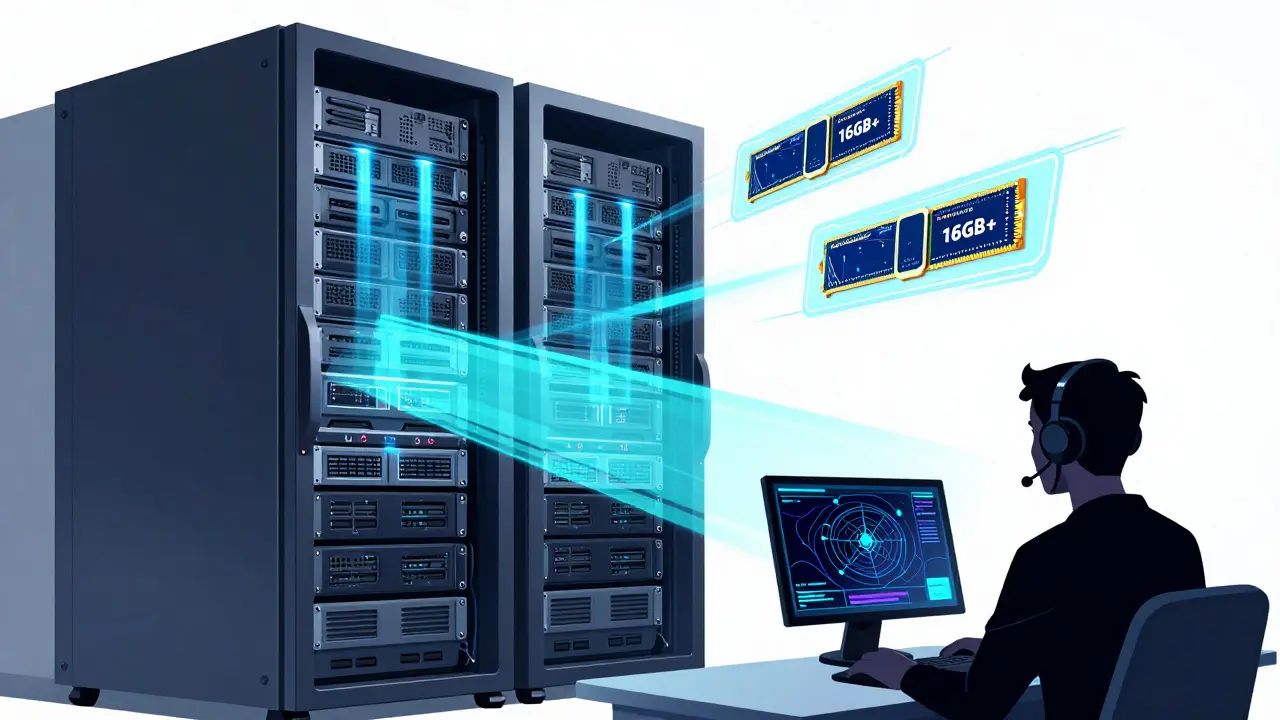
- RAM: Minimum 16GB is the baseline for a smooth experience. During peak network activity or reorganizations, memory spikes can occur. 32GB is recommended for stability.
- Storage: Fast NVMe SSDs are critical. The state trie must be read and written frequently. Latency matters here more than total capacity, though you should expect to store 1-2 TB of data depending on whether you prune or archive.
- CPU: Multi-core processors help. Modern CPUs with 4-8 cores handle the EVM (Ethereum Virtual Machine) execution efficiently.
- Bandwidth: High upload speeds are crucial. With millions of validators communicating in committees, your node must broadcast attestations quickly. Packet loss can lead to slashing risks for validators.
A major concern in 2026 is sustainability. The Ethereum Foundation is actively developing Stateless Ethereum solutions. These aim to reduce the storage burden by allowing nodes to verify transactions using zero-knowledge proofs rather than storing the entire state. Until then, the 16GB+ RAM requirement remains a moderate barrier for casual participants, pushing many toward specialized hosting providers.
Solana: The Enterprise-Grade Challenge
If Bitcoin is about storage and Ethereum is about memory, Solana is about sheer throughput. Solana aims to process thousands of transactions per second, and this ambition comes at a steep hardware cost. As of early 2026, the requirements for running a Solana validator are so high that they effectively limit participation to professional data centers and well-funded entities.
This has led to a concerning trend: centralization. Between 2023 and 2025, the number of active Solana validators dropped by approximately 68%, falling to around 1,700 or fewer. Why? Because smaller operators couldn't afford the hardware or electricity bills.
- RAM: A minimum of 128GB is required. Many top validators use 256GB or more. The network processes transactions in parallel, requiring massive amounts of memory to hold temporary states.
- CPU: High-end server-grade CPUs with many cores (e.g., AMD EPYC or Intel Xeon) are necessary. You need high clock speeds and core counts to produce blocks every 400 milliseconds.
- Storage: Ultra-fast NVMe SSDs with high endurance ratings. The write amplification on Solana nodes is extreme due to the frequency of slot updates.
- Network: Low-latency, high-bandwidth connections are mandatory. Any jitter or delay can cause your validator to fall behind the leader schedule, resulting in missed rewards.
For the average user, running a Solana validator is not feasible at home. The energy consumption and hardware costs rival small enterprise setups. This highlights a fundamental trade-off in blockchain design: higher performance often requires higher barriers to entry, which can undermine the decentralization principles the technology was built on.
Comparing Consensus Mechanisms and Node Needs
The type of consensus mechanism a blockchain uses dictates its node architecture. Beyond the public giants like Bitcoin and Ethereum, private and consortium chains use different models with distinct requirements.
| Network/Type | Consensus | Min RAM | Storage Focus | Barrier to Entry |
|---|---|---|---|---|
| Bitcoin | Proof-of-Work | 4-8 GB | High (TBs) | Low-Medium |
| Ethereum | Proof-of-Stake | 16 GB+ | Medium-High (Fast I/O) | Medium |
| Solana | PoS (High Perf) | 128 GB+ | Extreme (NVMe Speed) | Very High |
| Private (IBFT) | Istanbul BFT | 4-8 GB | Low | Low |
In permissioned environments, such as those using Istanbul Byzantine Fault Tolerant (IBFT) consensus, the requirements drop dramatically. IBFT typically requires a minimum of three user nodes plus a monitor node to ensure fault tolerance. Since the participant list is known and fixed, there is no need for massive storage or competitive hashing. These nodes prioritize reliability and quick finality over global scale.
Similarly, Raft consensus, used in some distributed systems, relies on leader election and requires an odd number of nodes (minimum two user nodes plus a monitor) to prevent split votes. These architectures are common in enterprise blockchain solutions where speed and low cost outweigh the need for anonymous, open participation.
Specialized Nodes: Miners, Super Nodes, and Lightning
Beyond standard full nodes, specific roles emerge based on network needs.
Miner Nodes are exclusive to Proof-of-Work chains like Bitcoin. They don't just validate; they compete to solve cryptographic puzzles. This requires specialized hardware called ASICs (Application-Specific Integrated Circuits) and consumes vast amounts of electricity. For the average person, mining Bitcoin is no longer profitable without industrial-scale operations.
Super Nodes (or listening nodes) are powerful computers that maintain complete ledger copies and broadcast validated transactions. They act as hubs in the peer-to-peer network, enhancing propagation speed and security. While not always a formal role in all protocols, super nodes naturally emerge when operators invest in superior hardware to serve more peers.
Lightning Nodes operate off-chain to solve congestion. They enable instant, low-fee microtransactions by creating payment channels between parties. Running a Lightning node requires minimal hardware-often just a laptop-but demands constant uptime and liquidity management. It complements the main chain by handling daily commerce while the base layer secures large settlements.
Production Best Practices and Future Trends
If you are deploying nodes for a production environment, such as an enterprise blockchain solution, the rules change slightly. Infrastructure providers like Kaleido recommend adding extra user nodes to distribute the load. For instance, separating the monitor node from signer responsibilities allows the monitor to focus on analytics, backups, and service management without risking consensus delays.
Also, avoid using Raft consensus for Enterprise Ethereum production networks unless absolutely necessary. Its limitations in handling complex smart contract logic make it less suitable for general-purpose blockchains compared to IBFT or PoS variants.
Looking ahead, the industry is moving toward statelessness. Projects aiming to reduce node requirements recognize that high barriers kill decentralization. If you can't run a node on a consumer device, you aren't truly verifying the network-you're trusting someone else who can. Technologies like zero-knowledge proofs and data availability sampling promise to lower these hurdles, potentially bringing Solana-like performance with Bitcoin-like accessibility in the coming years.
Final Thoughts on Choosing Your Path
Your choice of node depends on your goals. Want to learn and support Bitcoin? Buy an SSD and spin up a Core node. Interested in DeFi and willing to stake ETH? Invest in a beefy server with 16GB+ RAM. Looking to validate Solana? Be prepared for enterprise-level costs and competition.
Remember, the value of a blockchain lies in its distribution. Every node you run adds resilience to the network. Even if you start small with a light node or a pruned setup, you are participating in the most important experiment in digital trust.
Can I run a Bitcoin node on a Raspberry Pi?
Yes, you can run a Bitcoin node on a Raspberry Pi, especially newer models like the Pi 4 or 5. However, you will need a fast external SSD connected via USB 3.0 because the internal SD card cannot handle the read/write speeds required for syncing and maintaining the blockchain. Expect the initial sync to take several days.
How much does it cost to run an Ethereum validator in 2026?
The primary cost is the 32 ETH stake required to become a validator. Hardware costs range from $500 to $2,000 for a dedicated machine with 16GB+ RAM and an NVMe SSD. Electricity costs vary by location but are generally low for PoS nodes compared to mining. Monthly operational costs are typically under $50 for a well-configured home setup.
Why are there so few Solana validators?
Solana validators require extremely high-end hardware, including 128GB+ RAM and top-tier CPUs, along with low-latency network connections. These costs create a high barrier to entry, leading to consolidation among professional operators. Between 2023 and 2025, the validator count dropped significantly as smaller operators exited due to economic pressure.
What is the difference between a full node and a light node?
A full node downloads and verifies the entire blockchain history, providing maximum security and independence. A light node only downloads block headers and relies on full nodes for transaction proofs. Light nodes use far less storage and bandwidth but offer less individual verification power.
Do I need a GPU to run a blockchain node?
No, you do not need a GPU for running standard Bitcoin, Ethereum, or Solana nodes. These tasks are primarily CPU and RAM intensive. GPUs are only relevant if you are mining certain cryptocurrencies (like Monero or Ravencoin) or training AI models, not for validating blockchain transactions.
What is stateless Ethereum and how does it help?
Stateless Ethereum is a proposed upgrade that allows nodes to verify transactions without storing the entire network state. By using zero-knowledge proofs, nodes can check validity with minimal storage. This aims to reduce the high RAM and storage requirements, making it easier for more people to run nodes and improving long-term decentralization.




18 Comments
JEVON HALL
June 8 2026honestly this is a great breakdown but people forget about the electricity bill especially in california 🌞 running a solana node at home would literally burn my house down lol
Lee Paige
June 8 2026The whole premise of decentralization is a lie designed to keep you poor while the elites consolidate power. Solana validators dropping by 68%? That's not a hardware issue, that's centralization by design. They want you dependent on their servers. Wake up.
Karthikeyan S
June 10 2026u guys are so obsessed with specs 😒 its just code why do we need enterprise grade stuff for digital coins?? i run bitcoin on a pi and im fine stop trying to scare ppl 💀
Dinesh Pattigilli
June 11 2026Oh please. You think a Raspberry Pi is enough? Only an amateur would suggest such a pathetic setup for anything other than a light node. If you cant afford proper NVMe storage you dont deserve to participate in the network. It is that simple. The barrier exists to filter out the incompetent masses who clutter the bandwidth.
Caralee Robertson
June 12 2026i feel like this article is kinda intimidating tbh. i just want to support eth but 16gb ram feels like a lot for my old laptop. maybe ill just stick to a light node for now so i dont break anything :)
Steven Jacobowitz
June 13 2026Listen here! You need to understand the EVM execution context properly! It is not just RAM it is IOPS! If your disk latency is high you will get slashed! Stop asking stupid questions and read the whitepaper! The jargon is there for a reason!
Brad Ranks
June 14 2026I tried running a Solana validator once and my computer sounded like a jet engine taking off. My neighbors called the cops thinking I was manufacturing drugs. Never again. The drama was too much for me.
Madhu Menon
June 15 2026In the grand scheme of things, the hardware requirements reflect our collective desire for truth versus convenience. To verify is to exist. But when verification requires a data center, does the truth become exclusive? Perhaps we must question if speed is worth the loss of soul in these networks 🤔
Narendra Kulkarni
June 15 2026great info thanks for sharing. i was planning to buy a new ssd for my bitcoin node anyway. seems like a good investment. hope everyone has a nice day!
verna kennedy
June 16 2026You are all missing the point. Running a node is not a hobby. It is a duty. If you cannot provide the resources then you are leeching off those who can. Simple as that. Do not come here with your excuses about cost.
Kelly Tenney
June 17 2026Hey everyone! Let's remember that every step counts towards decentralization. Even if you can only run a pruned node, you are still contributing. Don't let the big numbers discourage you. We are in this together! 💪
Greg Lewis
June 19 2026why do you care what other people have in their houses? it's none of your business really but yeah solana is expensive because they want to be fast and you can't have everything. stop complaining and buy more ram or whatever
Dr Lynea LaVoy
June 21 2026As someone who manages infrastructure for several protocols, I can confirm that the bottleneck for Ethereum is indeed state growth. Stateless clients are coming but until then, ensure your NVMe drive has high endurance ratings. Consumer drives will fail under the write load of a full archive node. Please prioritize hardware longevity over initial cost savings.
Matthew Malone
June 23 2026American miners dominate the hash rate for a reason. We have the energy. We have the grid. Europe and Asia can try to catch up but they lack the industrial backbone. This guide confirms what we already know: serious blockchain infrastructure happens where the power is cheap and reliable. Make America Compute Again.
aaliyah zahid
June 23 2026Sarcasm aside, the comparison table is actually quite useful. I never realized how low the barrier is for private chains using IBFT. Maybe for my small community project I should look into that instead of trying to compete with Bitcoin.
Erik Kirana
June 25 2026This article is lazy journalism. It fails to mention the specific CPU architectures that perform best for SHA-256 validation. Also, the emoji usage in some comments below is embarrassing. Get educated before you comment. I demand better content from this platform. 🙄
dan kaffeman
June 25 2026You weaklings complain about hardware costs while I mine Bitcoin in my basement with zero issues. The system is rigged against the unprepared. If you can't handle the heat get out of the kitchen. This is America and we work hard for our crypto. Stop whining.
Meg Gran
June 26 2026oh wow another article telling us we need to spend thousands to participate in freedom. typical. the irony is lost on everyone here. meanwhile the banks are just printing money with no hardware required at all. laughable.