PureFi Protocol (UFI) Airdrop: Complete Guide, Risks & Details
Trying to find free PureFi Protocol tokens? You are not alone. The project promises to bridge traditional finance and decentralized finance using privacy tech, but the path to actually receiving an airdrop is murkier than most people expect. While big-name DeFi projects drop millions in tokens with clear rules, PureFi’s program has been characterized by fragmented communication, strict identity checks, and a history of unfulfilled promises. Before you spend hours on quests or risk your wallet security, you need to know exactly what is real, what is a scam, and whether the effort is worth the reward.
What Is PureFi Protocol and Why Does It Matter?
PureFi Protocol is a decentralized finance compliance protocol that uses Zero-Knowledge Proofs to verify user identity without revealing personal data. Launched in July 2021, the project aims to solve a major pain point in crypto: how to meet legal requirements like Anti-Money Laundering (AML) and Know Your Customer (KYC) without giving up privacy. Unlike standard DeFi platforms where anyone can interact anonymously, PureFi requires users to hold Verifiable Credentials, which act as digital IDs. This makes it attractive to institutions but creates a higher barrier for casual retail investors who just want to farm points for tokens.
The native token, UFI, serves as the utility asset for these compliance services. However, its market performance has been modest. As of late 2023, the market cap hovered around $721,660, with trading volumes often dipping below $5,000 daily. This low liquidity means that even if you receive an airdrop, selling those tokens might be difficult without moving the price significantly. Understanding this context is crucial because it changes the value proposition of participating in their distribution events.
How the PureFi Airdrop Program Works
Unlike permissionless airdrops where you simply connect your wallet and claim tokens, PureFi’s model is tied to its compliance architecture. Historically, participation required completing specific challenges rather than just holding a certain amount of assets. These tasks typically included:
- Completing quizzes via Telegram bots to test knowledge of the protocol.
- Following official social media accounts on Twitter and LinkedIn.
- Referring friends to boost community engagement.
- Undergoing basic KYC verification through their Self-Sovereign Identity system.
When distributions did occur between August 2021 and March 2022, participants received anywhere from 25 to 100 UFI per person. These amounts were verified through Etherscan transaction records, proving that the drops were real but small. Currently, the mechanics are less clear. The official website’s airdrop page redirects to the main site, and recent tweets about "community rewards" lack specific dates or eligibility criteria. This ambiguity is a red flag for many experienced airdrop hunters who prefer transparent rulebooks.
Vesting Schedules and Tokenomics Reality Check
Receiving tokens is only half the battle; being able to sell them is the other. PureFi’s tokenomics include complex vesting schedules that apply to various allocations. For instance, some team and advisor tokens had five-month cliffs followed by ten-month linear vesting periods. If future airdrops follow similar patterns, you might receive tokens that are locked for months before they become tradable. Always check the specific smart contract details before assuming immediate liquidity.
The total supply is 1 billion UFI, with approximately 4.9 billion reported in circulation at one point, though this figure fluctuates based on reporting sources. The distribution breakdown includes 33% for ecosystem development, 25% for strategic partnerships, and 7% specifically for marketing initiatives, which likely funds these airdrops. Given the current market cap of under $1 million, the treasury reserves available for large-scale distributions are limited compared to giants like Aave or Yearn.finance. This suggests that any future drops will likely be modest in size unless new institutional funding comes online.
| Feature | PureFi Protocol (UFI) | Typical Major DeFi Project |
|---|---|---|
| Identity Requirement | KYC / Verifiable Credentials often required | Permissionless (Wallet connection only) |
| Airdrop Size (Historical) | 25 - 100 UFI per participant | Often thousands to tens of thousands of USD value |
| Liquidity | Low (DEX only, <$5k daily volume) | High (CEX + DEX listings) |
| Vesting | Potential cliffs and linear vesting | Varies, often shorter or none for retroactive drops |
| Primary Risk | Scam imposters, unclear rules, low exit liquidity | High competition, snapshot timing risks |
Major Risks: Scams and Dormancy
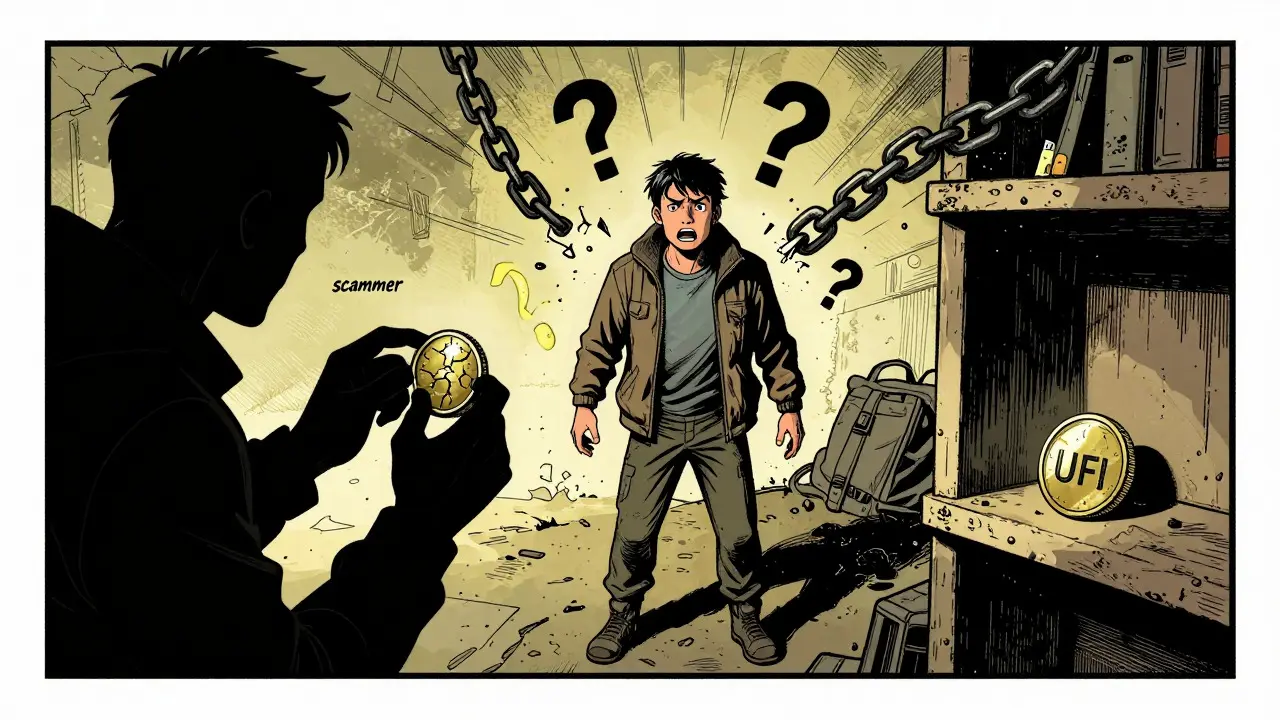
The biggest risk with PureFi isn’t necessarily the protocol itself, but the noise surrounding it. Because the project lacks a massive social following (only ~12,800 Twitter followers), scammers frequently create fake airdrop campaigns. Community members on Reddit have reported dead links and phishing attempts disguised as official quests. Always verify any link against the official @Purefi_Protocol account. If a site asks for your seed phrase or requests high gas fees for a "free" token, it is almost certainly a scam.
Another significant concern is developer activity. GitHub commits related to airdrop smart contracts have been dormant since April 2022. By Q3 2023, active contributors dropped to just two, down from seven in early 2022. This decline raises questions about whether the team has the bandwidth to execute new distribution campaigns effectively. Analysts from Delphi Digital categorized the project as "high risk" for token distribution due to insufficient treasury reserves. If you are considering investing time into farming these rewards, factor in the probability that the next drop may be delayed indefinitely or canceled entirely.

Is Participating Worth It? A Practical Assessment
To decide if PureFi is worth your time, compare the potential reward against the effort and risk. In previous cycles, early participants received tokens valued between $0.015 and $0.025 each during initial phases. With the current price hovering around $0.00695, the dollar value of a 100 UFI drop is roughly $0.70. Unless you are already interacting with the platform for compliance needs, the ROI on manual quest completion is very low.
However, there is a long-term angle. If PureFi successfully secures institutional partnerships-such as their announced collaboration with EU-based fintech firm RegTech Solutions-their compliance-focused airdrop model could gain traction in regulated markets. Dr. Elena Rodriguez from Stanford noted that while mandatory KYC limits retail participation, it is necessary for institutional adoption. If you believe in the future of compliant DeFi, accumulating UFI now might be a better strategy than chasing scattered micro-airdrops. For pure speculators, though, the current environment offers poor odds compared to more liquid, high-volume DeFi protocols.
How to Stay Safe and Informed
If you still want to keep an eye on PureFi opportunities, follow these steps to minimize risk:
- Only use links from the verified official Twitter account (@Purefi_Protocol).
- Check the GitHub repository for recent smart contract updates before connecting your wallet.
- Use a burner wallet (a separate wallet with minimal funds) for any interactions to protect your main assets.
- Verify token contracts on CoinMarketCap or CoinGecko to ensure you are swapping the correct UFI pair.
- Monitor the r/Purefi subreddit for community alerts on scams or delays.
Does PureFi airdrop require KYC?
Yes, unlike many standard DeFi airdrops, PureFi often requires users to undergo verification through their Self-Sovereign Identity system. This involves obtaining Verifiable Credentials to prove identity while maintaining privacy via Zero-Knowledge Proofs. This requirement aligns with their mission to bridge TradFi and DeFi compliance standards.
Where can I buy or sell UFI tokens?
UFI is primarily traded on decentralized exchanges (DEXs) such as Uniswap v2, Uniswap v3, and PancakeSwap v2. There are currently no major centralized exchange (CEX) listings, which means liquidity is lower and spreads might be wider compared to top-tier tokens. Always check the official contract address to avoid buying fake tokens.
Is the PureFi airdrop still active in 2026?
As of the latest available data, there is no single ongoing, clearly defined airdrop campaign. The project has hinted at "community rewards" but lacks specific mechanics. Users should monitor official channels for announcements, but be aware that developer activity has slowed, making large-scale future drops uncertain.
How much is the UFI token worth?
The price of UFI fluctuates significantly due to low trading volume. Recent data shows prices hovering around $0.00695 USD. Given the low market cap of approximately $721,660, the token is considered a high-risk, low-liquidity asset. Always check real-time prices on aggregators like CoinMarketCap before transacting.
What is the difference between PureFi and other DeFi compliance projects?
PureFi focuses heavily on Zero-Knowledge Proof technology to allow anonymous yet compliant transactions. While competitors like Chainalysis focus on analytics and tracking, PureFi provides the infrastructure for users to hold verifiable credentials directly on-chain. This positions it as a tool for user empowerment rather than just regulatory oversight.



14 Comments
Teri W
August 21 2026It is truly disgusting how these projects treat us like we are stupid! They demand our KYC, our privacy, and our time, only to give us tokens worth less than a coffee. The moral hazard here is off the charts!
If you are going to do this, at least use a burner wallet because their security is a joke. Do not let them drain your main portfolio for pennies on the dollar.
Leah Humphrey
August 21 2026From a liquidity perspective, the exit ramp is practically non-existent. With sub-$5k daily volume, any meaningful sell order creates massive slippage, rendering the 'airdrop' value theoretical rather than realized. It's just another low-float token play with high friction costs.
Niall O'Rourke
August 23 2026you guys are overthinking it. its just crypto. nobody cares about kyc or zkp proofs anymore. everyone just wants the bag. stop being so precious about your data and grab the free money before its gone. simple as that.
Jillian Groskreutz
August 23 2026You clearly haven't read the whitepaper, have you? The Zero-Knowledge Proof architecture is the entire point of the protocol; without it, there is no compliance layer, and thus, no institutional adoption potential. Ignoring the tech in favor of 'bag holding' is intellectually lazy and financially short-sighted, frankly speaking.
Carmene Jackson
August 24 2026I feel like we're all just waiting around for a ghost though... 🥀
Like, does anyone actually know if the devs are still alive? Or are we just farming points for a project that died in 2022? It feels so empty when you check their GitHub and see nothing new...
Jade Brown
August 25 2026Let’s dissect this carcass properly, shall we? The treasury allocation is a bloated mess, with 33% earmarked for 'ecosystem development' which is code for 'unspent funds.' Meanwhile, the marketing budget is bleeding out on Twitter bots. The alpha here isn't the token, it's realizing the team is running on fumes. Don't be the exit liquidity for their failed venture capital round.
Uday N M
August 26 2026In India, we prefer projects with actual utility and clear roadmaps. This one looks like a Western experiment that lost its way. Better to focus on stablecoins or established L1s where the regulatory clarity is higher and the community is more active. Less risk, more reward.
Ashley Snyder
August 27 2026I think it's worth keeping an eye on just in case they partner with that EU firm mentioned in the article. Compliance is becoming a huge deal in DeFi, so maybe they'll find their niche. No harm in following along quietly.
Sarah Hafner
August 29 2026Just a gentle reminder to everyone: always double-check the contract address on CoinGecko before swapping! 😊 I've seen too many people lose funds to fake UFI tokens recently. Stay safe out there, friends!
Susan Kiley
August 29 2026Oh, the audacity of small-cap coins to think they can compete with giants! 💅 But honestly, if you're in it for the long game, this could be the sleeper hit of the year. Who doesn't love a good underdog story with a touch of drama?
Gary Straiton
August 30 2026This is exactly why American innovation is failing! We allow these half-baked, unregulated schemes to clutter the market while real companies struggle. If it wasn't for our strong dollar backing, these tokens would be worthless dust by now. Wake up people!
alex fordy
August 31 2026There is a philosophical beauty in the tension between privacy and compliance that PureFi tries to solve. 🌟 While the current execution is flawed, the question of how to maintain anonymity in a regulated world is one of the most important challenges of our digital age. Let's hope they get it right eventually.
Nia Franklin
September 2 2026love the color of this space!! 🎨 i think the branding is super unique compared to the usual blue/purple defi stuff. also, dont forget to check the r/Purefi subreddit, its full of cool people sharing tips!!! (sorry for typos, typing fast)
Mohamed Shoaeb
September 4 2026chill vibes only. i am just observing from the sidelines for now. if they drop something big later i might jump in but for now the effort to reward ratio seems low. keep it positive everyone 🙏