What is BNB BUNNY (BNBBUNNY)? A Deep Dive Into This Micro-Cap Token
If you've stumbled across BNB BUNNY is a low-market-cap cryptocurrency token designed with deflationary mechanics. Also known as BNBBUNNY, it is a speculative asset that operates on blockchain networks, though it has no official connection to the massive Binance ecosystem., you might be wondering if it's the next big thing or just another name in a crowded market. Before you put any money into it, you need to know that this is not the same thing as the well-known BNB coin used by the Binance exchange.
The Big Confusion: BNB BUNNY vs. Binance Coin
One of the biggest traps in the crypto world is naming. BNB BUNNY uses a name that sounds like it belongs to the Binance Coin (BNB) ecosystem. In reality, there is no partnership, no shared development, and no official endorsement from Binance. While BNB is a top-tier asset powering a global ecosystem with a market cap in the billions, BNBBUNNY is what we call a "micro-cap" token.
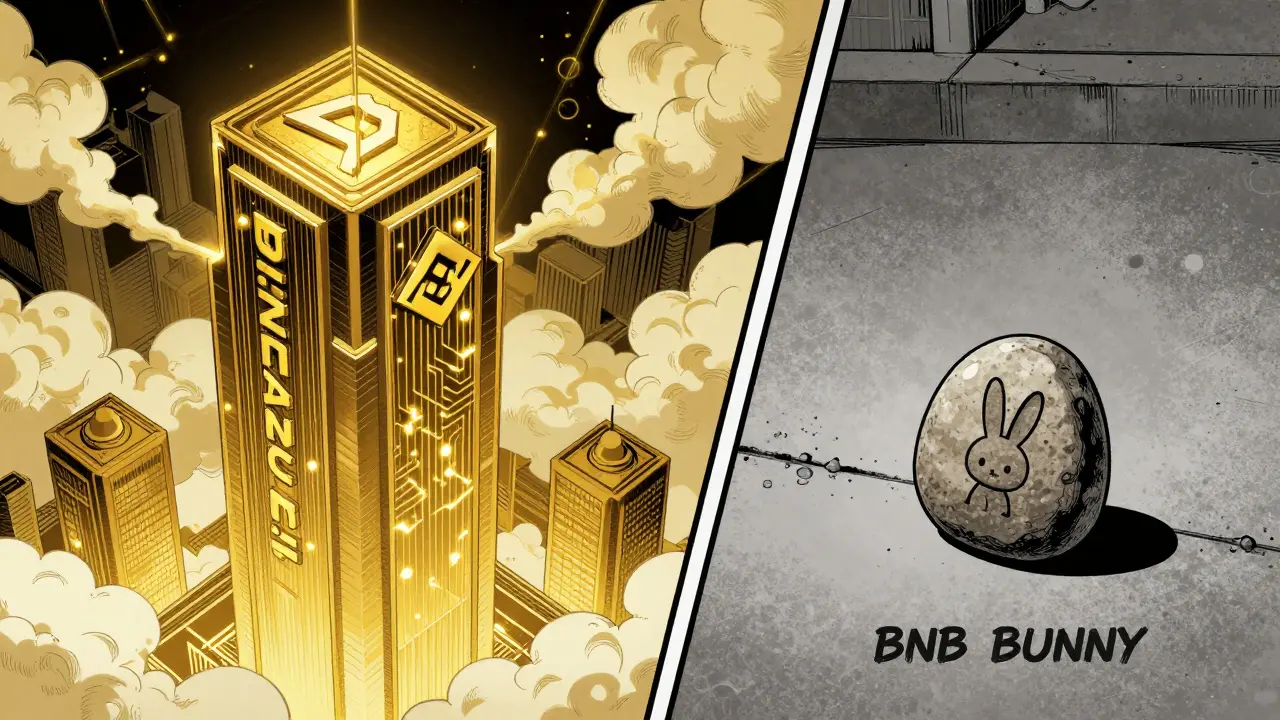
To put the scale into perspective, the valuation of BNBBUNNY is a tiny fraction of a percent of BNB's value. If BNB is a skyscraper, BNBBUNNY is a pebble on the sidewalk. It doesn't offer the same utility-like paying for transaction fees on a network-that the legitimate BNB coin provides. It is primarily a speculative tool.
How BNBBUNNY Works: The Burn Mechanism
The core "selling point" of this token is its deflationary model. The project uses a 2% automatic burn on every transaction. This means whenever someone sends or sells the token, 2% of that amount is permanently removed from circulation. The theory here is simple: less supply equals higher value, provided demand stays the same.
However, a burn mechanism only works if people are actually trading the token. If there's no trading volume, nothing gets burned, and the scarcity argument falls apart. The project also claims that the Liquidity Pool is locked forever and that the developers hold no tokens. In the DeFi world, this is a move intended to prevent a "rug pull," where creators suddenly drain all the funds and vanish.
| Feature | BNB BUNNY (BNBBUNNY) | Binance Coin (BNB) |
|---|---|---|
| Market Cap | Extremely Low (~$11K) | Very High (Billions) |
| Utility | Speculative/Deflationary | Network Fees, Staking, Ecosystem |
| Exchange Availability | Decentralized Exchanges (DEX) | Major Global Exchanges (CEX) |
| Developer Transparency | Anonymous/None | Public/Corporate Structure |
Analyzing the Numbers: Is it a Dead Coin?
When you look at the hard data, the picture for BNBBUNNY is quite bleak. As of late 2023, the token held a rank around #8047 on CoinMarketCap. With a market capitalization of only about $11,050, it sits in the bottom 0.5% of all tracked cryptocurrencies. Even more concerning is the 24-hour trading volume, which has frequently hit $0. When no one is buying or selling, the token becomes effectively illiquid.
The token's history shows extreme volatility. It hit an all-time high in May 2023, but then plummeted. While some charts might show a percentage increase from its absolute lowest point, this is often misleading in micro-caps. A 1000% increase on a token worth almost nothing still leaves you with a token worth almost nothing. With only a few hundred holders, the community is virtually non-existent.
The Risks of Buying Micro-Cap Tokens
Buying a token like BNBBUNNY isn't like buying a stock or a major coin. Because it isn't on big exchanges like Coinbase or Phemex, you have to use a Decentralized Exchange (DEX) and a wallet like MetaMask. This requires you to manually enter a contract address (0x8E2D...f661Ea). If you paste the wrong address, your money is gone forever.
Beyond the technical risk, there's the "brand impersonation" risk. Many small tokens use names like "BUNNY," "ELON," or "BINANCE" to trick beginners into thinking they are associated with a successful project. Without a clear roadmap, a visible development team, or a whitepaper explaining what the token actually *does* for the world, it's essentially a gamble on whether someone else will buy it from you for a higher price.

Verdict: Should You Invest?
For most people, the answer is a firm no. The lack of trading volume suggests the token may have been abandoned by its creators. Academic studies on token longevity indicate that nearly 99% of tokens with market caps under $50,000 fail within 18 months. BNBBUNNY fits this profile perfectly.
If you enjoy high-risk gambling with money you can afford to lose completely, that's one thing. But from a fundamental investment perspective, BNBBUNNY lacks the three pillars of a healthy project: utility, transparency, and liquidity. It provides no service, has no known team, and is nearly impossible to sell once you've bought it if there are no active buyers.
Is BNB BUNNY endorsed by Binance?
No. Despite the similar naming, BNB BUNNY has no official connection to the Binance exchange or the BNB Chain ecosystem. It is an independent, micro-cap token.
What does the 2% burn in BNBBUNNY do?
The burn mechanism automatically destroys 2% of the tokens involved in every transaction. This is intended to reduce the total supply over time, theoretically making the remaining tokens more scarce and valuable.
Where can I buy BNB BUNNY?
BNBBUNNY is not available on major centralized exchanges. You must use a decentralized exchange (DEX) and connect a compatible wallet, providing the correct token contract address.
Is BNBBUNNY a safe investment?
It is considered extremely high-risk. Due to its very low market cap, lack of trading volume, and absence of a known development team, it carries a high probability of losing all its value.
What is the total supply of BNB BUNNY?
The total supply is approximately 99.98 petatokens. Because the token is deflationary, this number decreases slightly whenever a transaction occurs.
19 Comments
Abhishek Verma
April 27 2026Oh wow, imagine actually believing a token called "Bunny" is a legit investment. Pure genius right there. 🙄
Lex Harley
April 28 2026the slipage on these low cap gems is usually insane... probly a honeypot since the liquidity is low and there's no real volume on the dex. total red flag for anyone not used to the degens side of crypto
Bevon Findley
April 28 2026Simply a gamble. :)
Kristi Swartz
April 29 2026promoting these kinds of scams is wrong and people who buy them deserve to lose money because they are greedy
Barbara Jones
April 30 2026glad someone pointed out the naming trick. so many new peple get caught up in that stuff and lose their savins
Gabrielle Danis
May 1 2026To provide further technical context, a 2% burn is a common tactic in inflationary tokens to create a false sense of scarcity. Without a functional use case or a legitimate roadmap, the token lacks any fundamental value, making it a purely speculative instrument prone to extreme volatility and total capital loss.
Brendan Thraxton
May 2 2026just remember that its okay to make mistakes when learning crypto but always double check the contract address before hitting swap
Janis Naglis
May 2 2026Stay positive everyone!!! Just keep researching the whitepapers... and checking the liquidity locks... it's all about the DYOR process!!!
Tracy McBurney
May 4 2026The market cap of $11k is a joke. It's essentially a ghost chain with zero organic growth. If you're holding this, you're not an investor, you're a victim of a low-effort marketing ploy.
edie rosa
May 5 2026I can't believe people still fall for this. It's morally bankrupt to create these tokens just to prey on the desperate. My soul hurts for the people who probably put their rent money into a bunny coin.
Michael Repak
May 5 2026I totally agree with the warnings here... it's so important to look out for each other in this space... let's keep sharing the red flags!!
Livvy Cooper
May 7 2026Who cares if it's a scam? Most of these coins are boring anyway. Why bother reading a whole guide on a coin that's already dead.
Rain Richardsson
May 8 2026Seems pretty clear. Hard pass.
Iestyn Lloyd
May 8 2026It is a standard example of a micro-cap pitfall. The lack of exchange availability is the primary indicator of its instability.
April D Thompson
May 10 2026Oh, the tragedy of the digital age! We chase these shimmering ghosts of wealth, these little digital rabbits, only to find our pockets empty and our hearts heavy! It's a cosmic dance of greed and disappointment, really!
Kara Spadone
May 11 2026Your aura is completely misaligned if you think this is an investment 🙄 ✨
Arun Prabhu
May 11 2026The sheer audacity of the developers to name this "BNB" is a masterclass in mediocrity. A truly pedestrian attempt at deception that only appeals to the most intellectually impoverished strata of traders. Pathetic.
Jehan ZA
May 12 2026The provided analysis is quite thorough and objective. It is prudent to avoid assets lacking transparency.
Tony Phan
May 14 2026LITERALLY a rug waiting to happen! I've seen ten of these this week! Just a bunch of moonboys chasing a pump that'll never come! My portfolio is bleeding just looking at this garbage!