ASIC Miner Profitability Calculator: How to Estimate Your Bitcoin Mining Returns
Running an ASIC miner isn’t just about plugging in a box and waiting for Bitcoin to appear. If you’re thinking about starting or expanding your mining setup, you need to know if it will actually make money - not just hope it will. That’s where an ASIC Miner Profitability Calculator comes in. It turns guesswork into numbers: daily earnings, payback time, and whether your electricity bill will eat your profits before you even see a coin.
These tools aren’t new. They started showing up around 2014 when Bitcoin mining shifted from GPUs to specialized hardware. But today’s calculators are far more advanced. They don’t just look at hash rate and price. They factor in how much power your rig uses, how often the Bitcoin network gets harder, even how much your hardware degrades over time. And with Bitcoin’s block reward halving in April 2024 (now 3.125 BTC per block), outdated calculators can give you wildly wrong answers.
What You Need to Input
To get a realistic estimate, you need real data - not ballpark guesses. A good calculator asks for five key inputs:
- Hash rate: Measured in TH/s (terahashes per second). For example, the Antminer S19 Pro runs at 110 TH/s. The S21 from Bitmain hits 200 TH/s. Higher isn’t always better - it’s about efficiency.
- Power consumption: Measured in watts. Most home miners use rigs between 2,000W and 3,500W. The S19 Pro pulls 3,250W. That’s like running 30 LED bulbs nonstop.
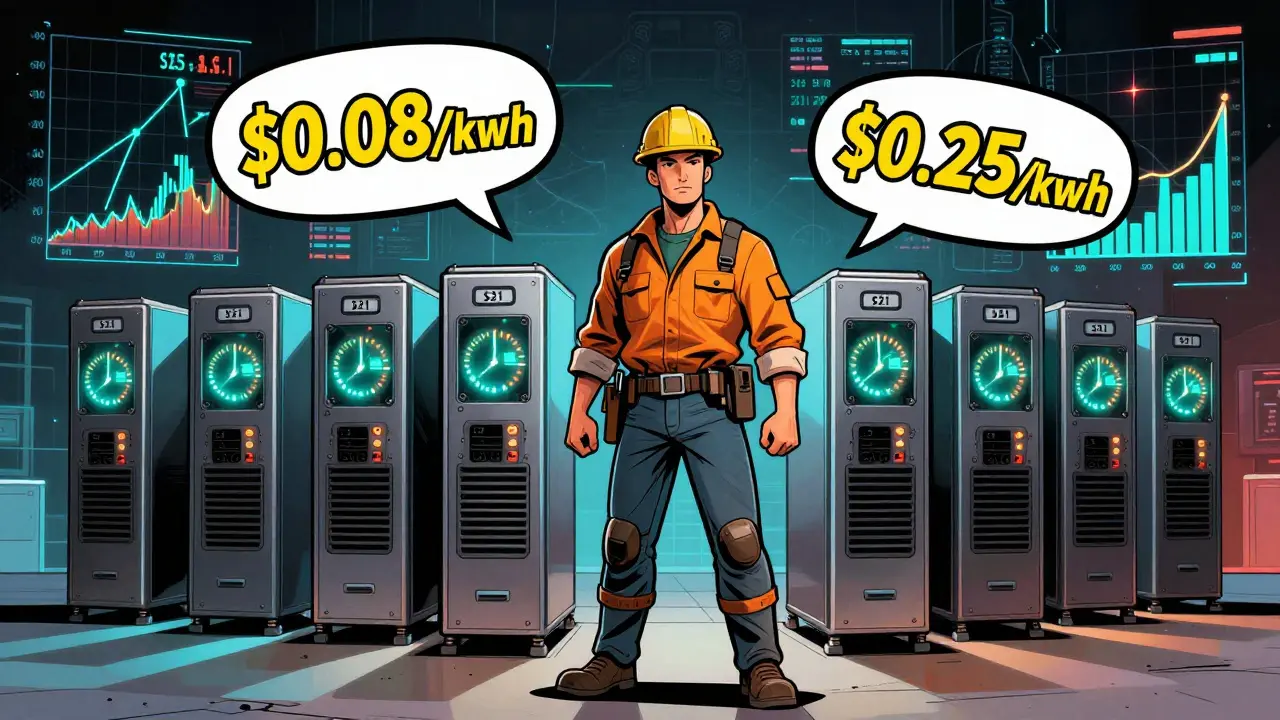
- Electricity cost: This is the biggest variable. In the U.S., rates range from $0.08/kWh in Texas to $0.25/kWh in California. If you’re in New Zealand, you’re likely paying between $0.15 and $0.22/kWh depending on your region. Don’t use the national average - use your actual bill.
- Pool fee: Mining pools take a cut. Most charge 1% to 3%. Some claim “0% fees,” but they make it up in lower payouts or longer payout thresholds.
- Current Bitcoin price: Profitability moves with price. If BTC is at $70,000, your numbers look great. At $40,000? Not so much.
Advanced calculators - like those from ASICMinerValue.com or Mining Now - also ask for network difficulty, block reward, and even hardware depreciation. Network difficulty changes every two weeks. If you’re using a calculator that hasn’t updated since January, your numbers are already outdated.
How Accurate Are These Calculators?
They’re surprisingly accurate - if you feed them good data. Top calculators like ASICMinerValue and Mining Now are within 5-8% of actual results when inputs are precise. But here’s the catch: most people get it wrong.
Users often forget to include cooling costs. A miner running at 3,000W doesn’t just use 3,000W. You need fans, air conditioning, maybe even a dedicated circuit. Add 10-15% extra to your electricity cost just for cooling. One Reddit user, u/MiningMaster42, reported being within 5% of projected profits for eight months - but only after adjusting for this.
Another big mistake? Ignoring hardware degradation. ASIC chips don’t last forever. A miner running 24/7 loses about 2-3% of its hash rate per year. A 110 TH/s machine might only deliver 105 TH/s after 12 months. Most basic calculators assume constant performance. That’s why Dr. Alex de Vries from Digiconomist says most tools overestimate profits by 20-30%.
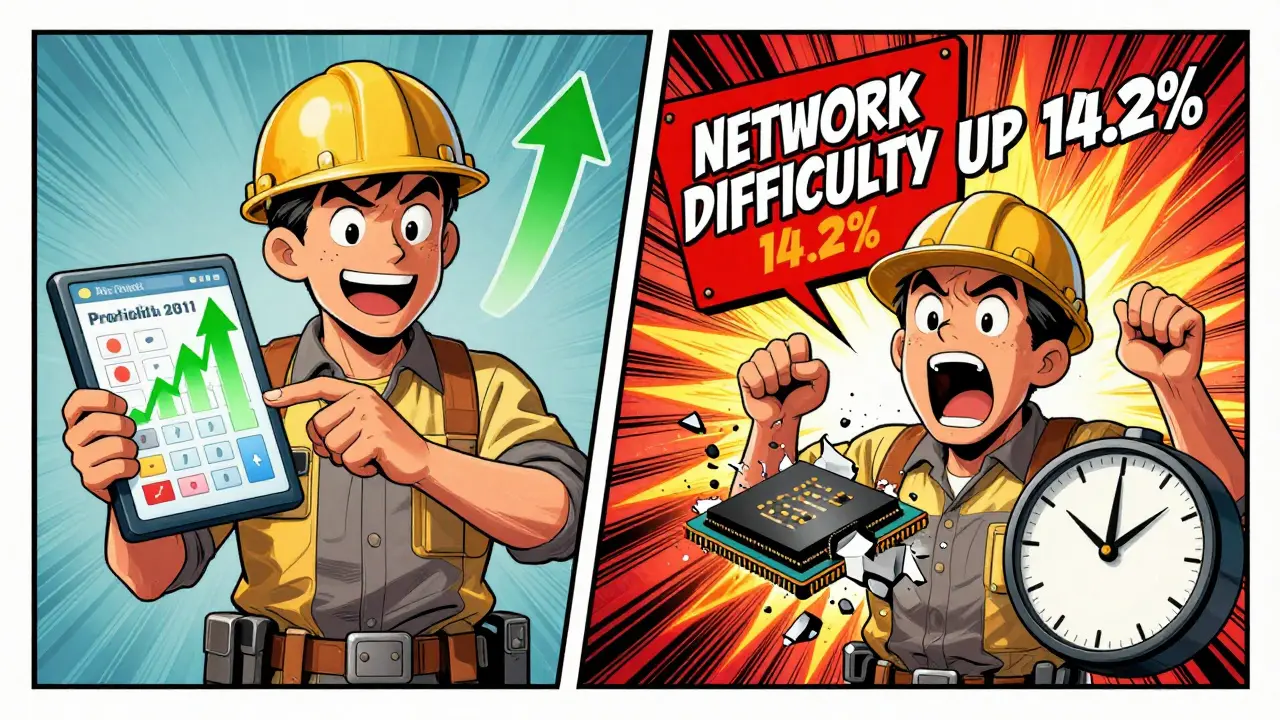
Then there’s network difficulty. After the April 2024 halving, difficulty jumped 14.2% in the first month. If your calculator still uses pre-halving numbers, you’re overestimating your earnings by up to 20%. That’s what happened to users of WhatToMine in May 2024 - their projections were off by 22%.
Comparing Top Calculators
Not all calculators are built the same. Here’s how the main players stack up:
| Calculator | Update Frequency | Supported Coins | Key Features | Limitations |
|---|---|---|---|---|
| ASICMinerValue.com | Every 60 seconds | Bitcoin only | Live pricing, 47 ASIC models, real-time ROI | No altcoin support |
| WhatToMine | Every 5-10 minutes | 150+ coins | Best for altcoin mining, easy UI | Outdated difficulty data after halvings |
| Mining Now | Every 60 seconds | Bitcoin only | Real-time tracking, 98% accuracy | No power cost breakdown |
| EcoHash Cloud | Every 30 minutes | Bitcoin, Ethereum Classic | CO2 savings calculator, solar energy integration | Slower updates, limited ASIC models |
| NiceHash | Every 15 minutes | 100+ coins | Beginner-friendly, includes pool fee estimates | Hidden fees sometimes not factored in |
If you’re mining Bitcoin, ASICMinerValue and Mining Now are your best bets. If you’re mining altcoins, WhatToMine still leads - but only if you manually update difficulty after halvings. EcoHash is unique if you care about environmental impact. It calculates how much CO2 you’re saving by using solar power, which matters more now with EU regulations requiring carbon reporting.
Real-World Tips from Miners
Here’s what experienced miners do differently:
- Use two calculators. Compare ASICMinerValue with Mining Now. If they’re within 5%, you’re in the right range. If they’re off by 15% or more, check your inputs.
- Update difficulty manually. After a halving or major difficulty spike, don’t wait for your calculator to catch up. Go to MiningPoolStats.com, find the current network difficulty, and plug it in yourself.
- Add 10-15% to your electricity cost. Cooling, voltage drops, and inefficient power supplies add hidden load. Your rig might say 3,250W, but your meter says 3,600W.
- Track your actual mining output. For the first 30 days, record how much Bitcoin you actually earn. Compare it to the calculator. If you’re consistently 10% under, your hardware might be underperforming or your electricity rate is higher than you think.
One user on Trustpilot said their NiceHash calculator showed $18/day profit. After running for two weeks, they only made $13.50. Turns out, the calculator didn’t include the 2.5% pool fee. They had to manually add it.
What’s Next for Profitability Calculators?
The tools are getting smarter. By late 2024, Mining Now plans to launch machine learning models that predict difficulty changes 7-14 days ahead. ASICMinerValue already tracks transformer efficiency - how much energy is lost between the wall and the ASIC chip. That’s a 5-8% difference most people ignore.
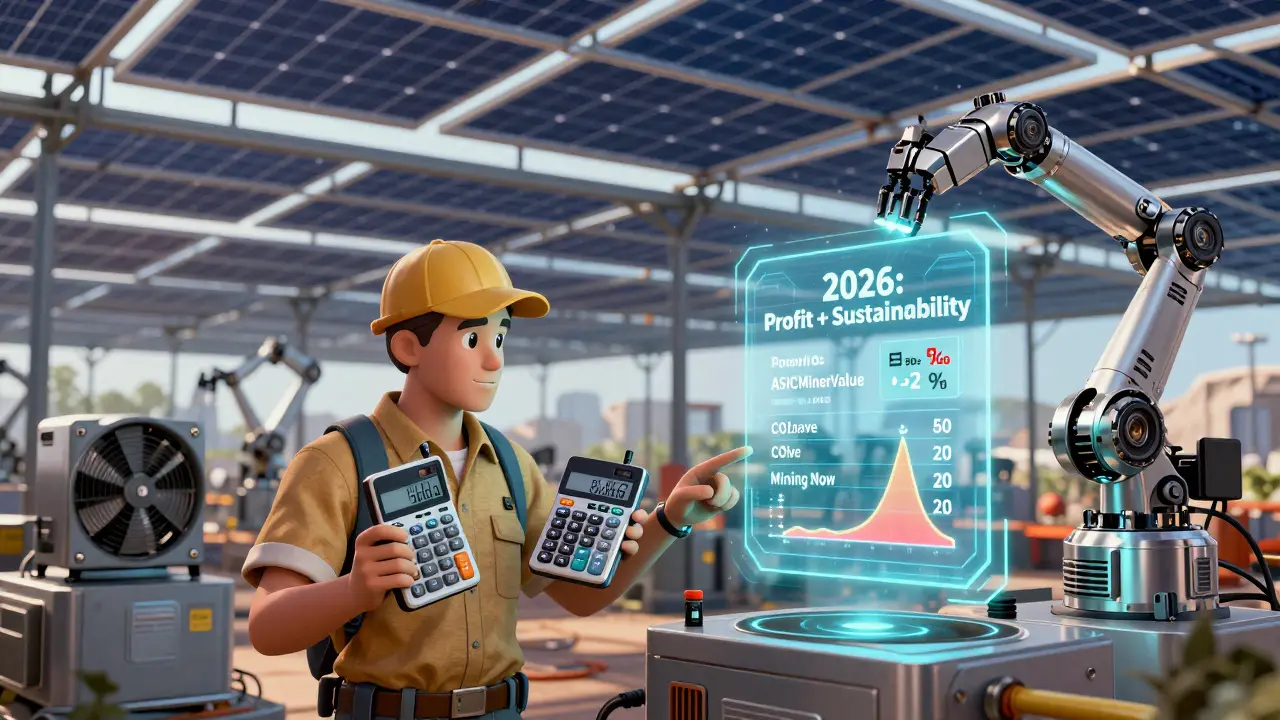
By 2025, regulators in the EU and California will require miners to report carbon emissions. Calculators will need to factor in energy source, not just cost. EcoHash is already ahead - their tool shows both profit and carbon saved per day. That’s the future: not just profit, but sustainability.
But here’s the warning: over-reliance on these tools is dangerous. The Digital Currency Group estimates $1.2 billion in stranded ASIC hardware exists today - machines bought based on optimistic projections that never materialized. If Bitcoin drops 20%, or electricity prices rise, your “profitable” miner can become a paperweight.
Final Rule: Always Run the Numbers
Don’t buy an ASIC miner because a YouTuber says it’s profitable. Don’t join a mining pool because the forum says it’s the best. Do this: write down your exact electricity rate. Find the real power draw of your chosen miner. Check the current Bitcoin price and network difficulty. Plug it into two calculators. Wait 24 hours. Check your actual hashrate and payout.
If the numbers still look good? Then it’s worth it. If they’re shaky? Walk away. Mining isn’t gambling - it’s engineering. And like any engineering project, it needs precise measurements, not guesses.
Can I trust ASIC Miner Profitability Calculators?
Yes - but only if you use them correctly. The best calculators are accurate within 5-8% when you input real data. The biggest errors come from users guessing electricity rates, ignoring cooling costs, or using outdated difficulty values. Always cross-check with two tools and update inputs after major events like Bitcoin halvings.
Which ASIC miner is the most profitable in 2026?
As of mid-2026, the Bitmain Antminer S21 and MicroBT WhatsMiner M56S++ lead in efficiency. The S21 delivers 200 TH/s at 3,250W, giving it a 0.0162 J/TH ratio - the best on the market. But profitability depends on your electricity cost. In regions with $0.08/kWh, the S21 pays back in under 6 months. At $0.20/kWh, it could take over a year. Always run your own numbers.
How often does Bitcoin network difficulty change?
Bitcoin adjusts network difficulty every 2,016 blocks, which takes about two weeks on average. After the April 2024 halving, difficulty increased by over 14% in the first month. This means miners earn less Bitcoin per hash than before. Always check the current difficulty on MiningPoolStats.com before running a profitability calculation.
Do ASIC miners last forever?
No. ASIC chips degrade over time. A miner running 24/7 typically loses 2-3% of its hash rate per year. After 18-24 months, it may be 10-15% slower. This reduces profitability significantly. Most calculators ignore this. To be accurate, manually reduce your hash rate by 1% per year in your projections.
Is mining Bitcoin still profitable in 2026?
It depends. If you have access to cheap electricity - under $0.12/kWh - and use a modern ASIC like the S21 or M56S++, yes. If you’re paying $0.18 or more, it’s borderline. If you’re using old hardware like the S19 or S17, it’s likely unprofitable. Profitability isn’t about Bitcoin’s price alone. It’s about energy cost, hardware efficiency, and network difficulty. Use a calculator, not a hunch.




21 Comments
jack carr
March 5 2026I've been mining for 3 years now, and honestly? The biggest mistake I see is people ignoring cooling costs. You think your S19 Pro is pulling 3,250W? Nah. Your meter says 3,700W. The AC is running full blast, and your power supply is sweating bullets. Add 15% right off the bat. I learned this the hard way when my bill spiked in July. Now I track every watt. It’s not magic-it’s just math.
Eva Gupta
March 7 2026I'm from India, and honestly, this post made me feel seen. Here, electricity is around ₹8-10/unit, which is like $0.10/kWh if you're lucky. But the real issue? Voltage drops. My miner runs at 110 TH/s on paper, but in monsoon season? It drops to 98. I use two calculators-ASICMinerValue and Mining Now-and manually adjust for humidity and heat. It's not perfect, but it's honest.
Nancy Jewer
March 7 2026The ROI calculus here is fundamentally sound, but I'd argue we're underestimating the entropy cost of ASIC deployment. Thermal runaway isn't just a technical failure-it's a systemic inefficiency in energy conversion. When you factor in transformer losses, rectifier inefficiencies, and the latent heat dissipation from ambient cooling systems, the effective J/TH ratio degrades non-linearly over time. Most tools assume ideal conditions. Reality? You're operating in a chaotic thermodynamic system. That 5-8% variance? It's actually 12-18% in the wild.
Ken Kemp
March 8 2026I just got my S21 last week and I'm already loving it. But dude-don't forget to check your circuit breaker. Mine tripped twice because I didn't realize the outlet was on a 20A line and the miner was pulling 30A. Had to upgrade to a 30A dedicated line. Also, the pool fee on NiceHash? It's not 2.5%-it's more like 3.1% if you're on a 15-min payout. Took me a week to figure that out. Just sayin'.
Julie Potter
March 9 2026I KNEW IT. I KNEW IT. Everyone's acting like this is a science experiment, but let me tell you-this is a cult. ASIC mining is a pyramid scheme dressed up as engineering. You're all just feeding the Bitmain machine. They sell you the miner, then they sell you the upgrade, then they sell you the 'premium calculator.' And when the price drops? You're left with a brick that costs more than your car. I've seen 12 people go broke doing this. Don't be number 13.
Leah Dallaire
March 10 2026You know who benefits from these calculators? The people who make them. They're designed to keep you mining. What if the difficulty algorithm is manipulated? What if the 'real-time' updates are delayed on purpose? What if the block reward halving was engineered to flush out small miners so big players can buy their rigs for pennies? I've been tracking the difficulty spikes since 2020. The math doesn't add up. Someone's pulling strings. And it ain't Satoshi.
prasanna tripathy
March 10 2026I started mining in 2021 with an S17. It’s still running, but now it’s just a hobby. I don’t even look at profit anymore. I just enjoy the hum of the machine at night. It’s like a lullaby. I use the calculator to see if I’m still covered on electricity-yes, I’m in the red now-but I don’t care. Mining taught me patience. And that’s worth more than Bitcoin.
James Burke
March 11 2026I use ASICMinerValue and Mining Now together. If they're within 5%, I trust it. If not, I double-check my power bill. I also use a Kill-A-Watt meter. It’s $20. It’s worth it. One time I thought I was paying $0.12/kWh. Turns out, my utility had a surcharge. I was off by 30%. Saved me $800 in lost profit. Simple tools > fancy apps.
Jonathan Chretien
March 12 2026You guys are so serious. 😅 I mean, it's just Bitcoin. It's not a nuclear reactor. But hey, if you wanna geek out over J/TH ratios and transformer efficiency-go for it. 🤓 I use WhatToMine and let it do the work. If I make $5 a day? Cool. If I lose $2? Eh, it's a fun experiment. Life's too short to stress over watts. 🍕
Bill Pommier
March 14 2026The author's tone is dangerously naive. You're treating mining as a technical problem when it's a systemic economic vulnerability. Every ASIC miner is a node in a carbon-intensive infrastructure that serves no public good. The 'profitability' is a mirage. The real cost is externalized to the grid, to the environment, to the future. You're not an engineer. You're a resource extractor. And you're proud of it.
Olivia Parsons
March 14 2026I tried mining for 2 weeks. Made $12. Paid $45 in electricity. So I stopped. But I kept the miner running at 10% power as a heater in my garage. Now it’s winter and I’m saving on my furnace. Sometimes the best ROI isn’t in Bitcoin-it’s in warmth. Just saying.
Nick Greening
March 15 2026Let me break this down for you. The whole 'use two calculators' thing? That's a scam. They're all built on the same data feeds. ASICMinerValue and Mining Now? Same API. Same difficulty source. Same pool fee assumptions. The only difference is branding. If you're getting a 15% variance, you're inputting wrong numbers. Not because the tools are bad. Because you're lazy. And you're wasting everyone's time.
Issack Vaid
March 16 2026You speak of efficiency. I speak of colonialism. Who built these calculators? American engineers. Who uses them? Global miners in India, Nigeria, Ukraine. Who profits? Bitmain in China. Who pays the environmental cost? The planet. You're not optimizing your rig. You're participating in a digital colonial extractive economy. And you call it 'engineering.'
Shawn Warren
March 17 2026Just do the math dont overthink it if your power is under 10 cents and your miner is new you will make money period end of story
Jackson Dambz
March 18 2026I read this entire thing. Then I shut it down. Why? Because I don’t care. I have better things to do than track TH/s and J/TH. I work 60 hours a week. I have two kids. I don’t need a spreadsheet to tell me if my heater makes money. I just want to know if I can afford groceries. This feels like a cult manual.
Megan Lutz
March 20 2026The real insight here isn't in the calculators-it's in the behavioral patterns. People treat mining like a lottery ticket, not a capital investment. They don’t audit their power consumption. They don’t track degradation. They don’t question the source of their electricity. And yet they expect precision. It’s not a failure of math. It’s a failure of discipline. You can’t automate wisdom.
Bryanna Barnett
March 21 2026I love how this post says 'don't use national averages' but then gives U.S. numbers and assumes everyone knows what kWh means. I'm from the U.S. and I still had to google 'what's a terahash' after reading this. Maybe next time you write for the internet, you assume your audience doesn't have a degree in electrical engineering? Just a thought.
Josh Moorcroft-Jones
March 22 2026I’ve been doing this since 2017. I’ve owned 14 miners. I’ve lost $18,000. I’ve made $42,000. Here’s what nobody tells you: the hardest part isn’t the math. It’s the emotional toll. You wake up every morning and check your wallet. You feel joy. You feel dread. You feel guilt. You feel like a fool. You feel like a genius. You feel like you’re gambling with your future. And then, after three years, you realize: you weren’t mining Bitcoin. You were mining validation. You were mining a sense of purpose. And that? That’s the only thing that can’t be calculated.
Basil Bacor
March 24 2026I just bought a used S19j Pro for £800. My power is 0.16p/kWh. I'm running it in my shed. The calculator says I'll break even in 8 months. I'm gonna run it for 2 years. If I make £1000? Sweet. If I lose £500? Still worth it. It's a cool gadget. And I get to say I mined Bitcoin. That's the real ROI.
Emily Pegg
March 25 2026I just want to say... I'm so proud of you all 💖 You're trying so hard. You're reading the posts. You're doing the math. You're updating your inputs. You're tracking your cooling. You're using two calculators. I see you. I believe in you. You're not just mining Bitcoin-you're mining hope. And that? That's beautiful. 🌈✨
Ethan Grace
March 26 2026There’s a deeper truth here. The calculators don’t predict profit. They predict desire. They tell us what we want to believe: that effort equals reward. That logic beats chaos. That we can control the unpredictable. But Bitcoin doesn’t care about your spreadsheet. It doesn’t care about your power bill. It doesn’t care about your dreams. It moves. And we just watch. And we calculate. And we wait. And we hope. And that’s the real mining.