
What is Sui (SUI)? A Deep Dive into the High-Speed Layer 1 Blockchain
Imagine a world where blockchain apps feel as snappy as the apps on your phone, without the agonizing wait for a transaction to "confirm." Most of us are used to the lag of older networks, but Sui is a high-performance Layer 1 blockchain designed to handle massive scale and provide a seamless user experience. Developed by Mysten Labs-a team of former Meta (Facebook) architects-Sui isn't just another copy of Ethereum. It fundamentally changes how data is stored and processed to eliminate the bottlenecks that plague traditional crypto networks.
The Secret Sauce: An Object-Centric Model
To understand why Sui is different, you have to look at how it views data. Most blockchains use an "account-based" model. Think of it like a giant ledger: if you send money, the network checks your account balance, subtracts the amount, and adds it to the receiver. This creates a queue; transactions must happen one after another.
Sui flips this script with an object-centric model. Instead of a ledger of accounts, everything on the network-a token, an NFT, or a piece of game data-is treated as an object. When you move an asset, you aren't just updating a balance; you're moving a specific object from one place to another. Because these objects are independent, the network can process thousands of them at the exact same time. This is called parallel execution, and it's the reason Sui can feel nearly instantaneous.
The Power of the Move Programming Language
Sui is built using Move, a programming language originally created by Meta for blockchain applications. Move is designed specifically to handle digital assets safely. In many other languages, it's surprisingly easy for a developer to accidentally create a bug that allows tokens to be duplicated or lost. Move treats assets as "resources" that cannot be copied or accidentally deleted, making smart contracts significantly more secure from the ground up.
Speed That Defies Logic: Mysticeti and Beyond
If you've ever waited 15 seconds for an Ethereum transaction to clear, Sui's speed will shock you. The network uses a specialized consensus engine called Mysticeti. Launched in 2024, this engine slashed latency by roughly 80%. We're talking about finality in about 39 milliseconds. For context, that's faster than you can blink.
But it's not just about the speed of one transaction; it's about the volume. While some high-speed networks struggle under pressure, Sui can theoretically handle up to 297,000 transactions per second (TPS). By using a DAG-based (Directed Acyclic Graph) approach, it avoids the strict linear ordering that slows down older blockchains.
| Feature | Sui | Solana | Ethereum |
|---|---|---|---|
| Data Model | Object-Centric | Account-Based | Account-Based |
| Theoretical TPS | ~297,000 | ~65,000 | ~15-30 (L1) |
| Finality Time | ~39ms | ~400ms | 12-15 seconds |
| Programming Language | Move | Rust/C++ | Solidity |

What Does the SUI Token Actually Do?
The SUI token is the fuel that keeps the ecosystem running. It's not just a speculative asset; it has several concrete jobs to do:
- Gas Fees: Every time you interact with a smart contract or send a token, you pay a small amount of SUI to cover the computing power used.
- Staking: By locking up your SUI tokens with validators, you help secure the network. In return, you earn staking rewards.
- Governance: SUI holders can vote on protocol upgrades and changes, giving them a say in how the network evolves.
In terms of supply, the total cap is 10 billion tokens. By early 2025, the circulating supply had grown to about 3.09 billion as planned token unlocks occurred, moving away from the initial 528 million seen in 2023.
Making Crypto "Invisible" for Normal People
Let's be honest: crypto is usually a nightmare for new users. Seed phrases, gas fees, and complex wallets scare most people away. Sui is trying to fix this with a few clever features:
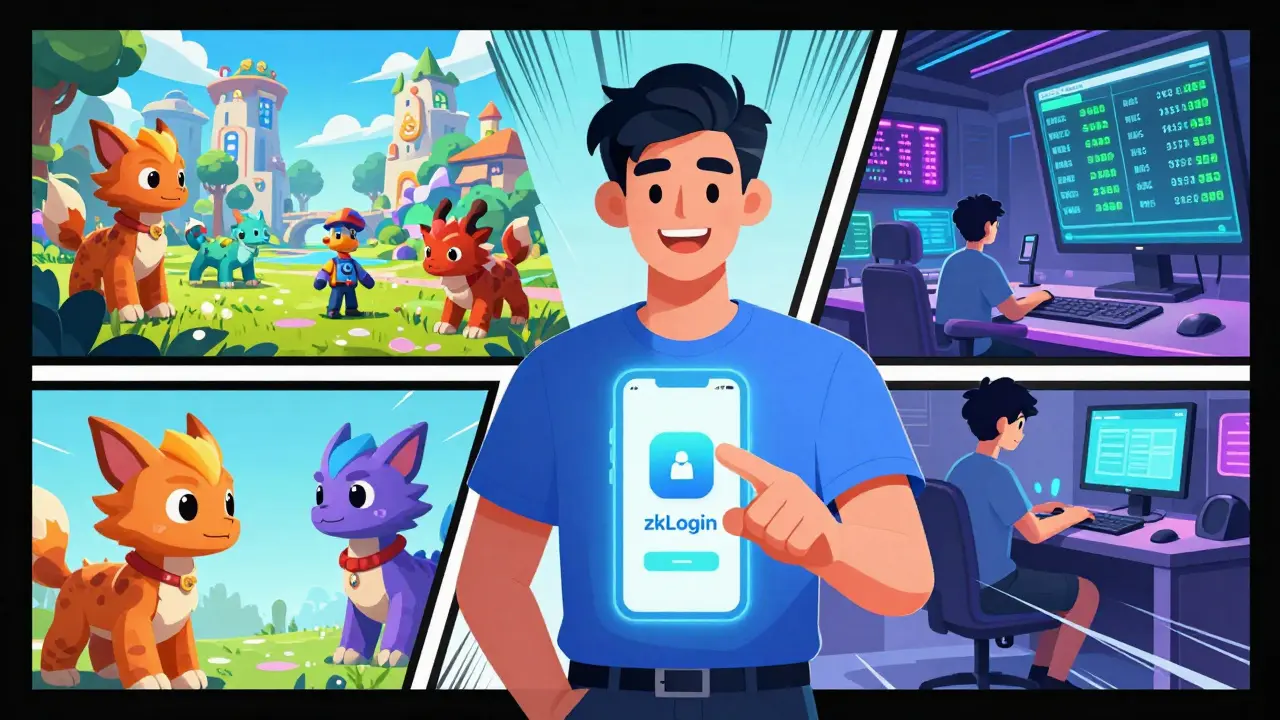
First, there's zkLogin, a system that allows users to create blockchain accounts using their existing Google or Twitch logins. No more writing 12 words on a piece of paper and hiding it under a mattress. Second, sponsored transactions allow app developers to pay the gas fees for their users. This means a gamer can play a Web3 game without even knowing they are using a blockchain.
Real-World Use Cases: Gaming and DeFi
Where does this tech actually matter? Gaming is the biggest winner. Take a project like BIRDS. Because Sui handles objects so well, the game can easily manage NFT eggs and battle pets that evolve in real-time. With a market cap that hit $38 million by late 2024, it proves that when you remove the "crypto friction," people actually enjoy these games.
DeFi (Decentralized Finance) also thrives here. Rapid settlement means less risk for traders and faster execution for automated protocols. Whether it's a memecoin community or a complex lending platform, the sub-second finality makes the experience feel like using a centralized exchange rather than a clunky blockchain.
The Trade-Offs and Competition
Is Sui a guaranteed winner? Not necessarily. It's fighting an uphill battle against giants. Ethereum has a massive head start in terms of developers and liquidity. Solana already has a huge, loyal community and a proven track record of attracting users. Sui's advantage is purely technical-it is faster and more flexible. However, technical superiority only matters if developers actually build on it and users show up.
The network is currently supported by about 2,000 full nodes, which provides a decent level of decentralization, though it is generally more streamlined than Ethereum's vast node network. The challenge for Sui moving forward isn't the code; it's the ecosystem growth.
Is SUI better than Solana?
Technically, Sui boasts higher theoretical transactions per second (TPS) and faster finality thanks to the Mysticeti engine. However, Solana has a much larger ecosystem and more active users. Whether it's "better" depends on if you value raw technical specs or existing network effects.
What is the Move language?
Move is a resource-oriented programming language developed by Meta. Unlike Solidity, which treats assets as entries in a map, Move treats assets as distinct objects that cannot be accidentally copied or deleted, significantly reducing the risk of smart contract hacks.
How do I use SUI tokens?
You can use SUI to pay for transaction fees (gas), stake them with validators to earn rewards, or participate in network governance votes to decide the future of the protocol.
What is zkLogin?
zkLogin is a feature that allows users to log into Sui-based apps using familiar OAuth providers like Google or Facebook. It uses zero-knowledge proofs to keep the user's identity private while still providing the convenience of a traditional web login.
Can Sui handle 297,000 TPS?
That is the theoretical maximum capacity. In real-world scenarios, throughput depends on the complexity of the transactions, but its parallel execution model allows it to scale far beyond the limits of traditional sequential blockchains.


17 Comments
Adedamola Oyebo
April 15 2026Move is a game changer!! The resource-oriented model fixes a lot of the flaws we saw in early EVM contracts!!
Joshua Salwen
April 17 2026Omg please tell me why everyone is acting like 297k TPS is actually realy possible in a desentralized way!! It's literally a joke to say it's better than Solna when the actual usage is a ghost town!! I've seen this movie before and it always ends with a crash and burn!! Absolutely ridiculuous!!
Jeff Barlett
April 17 2026Actually, raw speed is a distraction. Who cares about 39ms if there are no apps to use? I'd take a slower chain with a real economy over a fast chain with no users any day.
Kim Smith
April 18 2026it's kinda wild how we just assume more speed is always the answer to everything in the digital realm... like maybe the slowess of etherum is actually a feature that lets us breathe and think about the value of a transaction instead of just treatin crypto like a high frequency trading bot gone wild in a neon city where no one knows their neighbor anymore and we're all just objects in a big cosmic ledger anyway lol
Abhinav Chaubey
April 20 2026The theoretical TPS figures are merely marketing fluff. Anyone with a basic understanding of network latency knows that theoretical maximums are rarely hit in production. India is already leading in blockchain implementation, and we don't need Meta-designed toys to realize that ecosystem depth beats technical benchmarks every single time.
siddharth narula
April 21 2026One must ponder if the pursuit of absolute speed is a reflection of our own spiritual decay. ॐ We seek instant gratification in our transactions, yet we fail to find stillness in our hearts. The technology is impressive, but is it ethical to accelerate the pace of greed? 😌
Yuhan Mo
April 22 2026The object-centric model is a significant departure from the traditional UTXO or account-based state transitions. By decoupling the state from a linear sequence, they've effectively minimized the contention for the global lock, which is where the real throughput gains are coming from.
Michelle Stanish
April 24 2026Too complex.
Tracy Sperandio
April 26 2026zkLogin is an absolute powerhouse for onboarding! We need to stop gatekeeping the blockchain with scary seed phrases and start bringing in the masses with tools that actually make sense for a normal human being. Let's turn this technical wizardry into something everyone can use!
Shannon Kelly Smith
April 26 2026Spot on with the onboarding point! 🚀 The biggest hurdle in Web3 has always been the UX, and if Sui can actually make the blockchain "invisible," they've already won half the battle. Let's keep pushing for a more inclusive ecosystem! 💎
nathan jones
April 28 2026Sui seems alright. Just another L1 in a sea of L1s.
Saurav Bhattarai
April 30 2026Oh, look at these adorable little 'theoretical' numbers. How precious. I'm sure the developers are very proud of their fancy DAG while the rest of the world uses networks that actually work. It's almost cute that people think a Meta spin-off is revolutionary. Truly a peak example of delusional hype.
Karen Mogollon Gutierrez
May 1 2026It is simply an outrage that we are expected to trust a system built by former Meta architects! Given their track record with user data, the irony of promising 'privacy' through zkLogin is absolutely staggering. One cannot possibly ignore the blatant contradiction here!
Gillian Kent
May 1 2026I think its cool how they let developers pay for gas, that makes it so much easier for people who dont have cryptto yet to try things out. Hope it works out for them!
Mike Kempenich
May 1 2026It's a bold move and it could really pay off if the dev community migrates. I'm optimistic that this kind of performance will attract a new wave of gaming apps that were previously impossible on Ethereum.
Chintu Parikh
May 2 2026I wholeheartedly agree with the sentiment regarding ecosystem growth! While the technical specifications are indeed formidable, the true measure of success shall be the organic adoption by developers across the globe. It would be a magnificent achievement to see a harmonious blend of speed and utility. I am eager to see how the community evolves in the coming years!
Kaitlyn Wu
May 4 2026Let's keep the discussion focused on the actual utility of the object-model and avoid the typical tribalism between chain supporters. It is possible to acknowledge the technical merit of Sui without dismissing the established strengths of Solana or Ethereum. We should be mentoring new users on how to evaluate these projects based on data, not hype.