
7 Critical Use Cases Where Blockchain Immutability Is Non-Negotiable
Imagine signing a contract, only to have the other party quietly change the terms three days later. In the physical world, this is fraud. In the traditional digital world, it’s often just a database edit that leaves no trace. This vulnerability-the ability for someone with enough access to rewrite history-is the single biggest flaw in centralized data systems.
Blockchain technology fixes this by introducing immutability. Once data is recorded on a blockchain, it is cryptographically locked into place. It cannot be altered, deleted, or tampered with without breaking the entire chain and alerting every participant in the network. For most everyday apps, this level of security might seem like overkill. But for specific high-stakes industries, it isn’t just a feature; it is the foundation of trust.
1. Healthcare Records and Drug Supply Chains
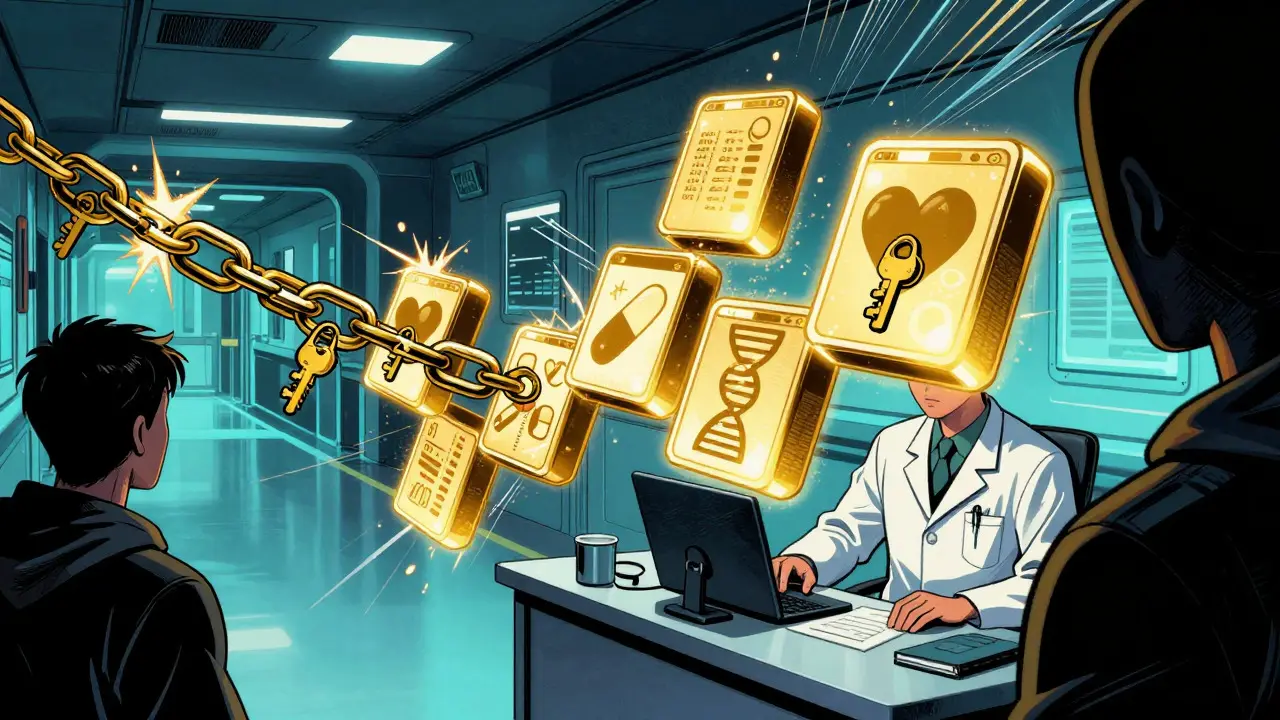
In healthcare, accuracy is literally a matter of life and death. Traditional Electronic Medical Records (EMRs) are stored in centralized servers. If a hacker breaches these servers, they can alter dosage histories or erase critical allergies. With blockchain-based EMRs, every update to a patient’s record creates a new, time-stamped block linked to the previous one.
No single hospital or insurance company controls the data. Instead, it sits on a decentralized ledger. This means if a doctor tries to backdate a prescription or an admin accidentally deletes a lab result, the system flags it as invalid because it doesn’t match the cryptographic hash of the original entry. Patients gain true ownership of their health data, and providers reduce the massive administrative costs associated with reconciling conflicting records.
This immutability extends beyond patient files to the drugs themselves. Counterfeit pharmaceuticals cost the global industry billions annually and kill thousands of people. By using blockchain to track medicines from the factory floor to the pharmacy shelf, every transfer of custody is recorded permanently. If a batch of insulin is swapped for a fake version in transit, the immutable record reveals exactly where the break in the chain occurred, allowing for immediate recalls and preventing further harm.
2. Unbreakable Audit Trails for Finance and Compliance
Regulators love paper trails, but they hate forged ones. In finance, banking, and corporate governance, creating an audit trail that stands up to scrutiny is expensive and slow. Auditors spend months verifying transactions against bank statements and internal logs, all while relying on the honesty of the entity being audited.
Blockchain changes this dynamic by providing a shared, single source of truth. When a transaction occurs-whether it’s a cross-border payment or a stock trade-it is hashed and added to the ledger. Because the ledger is distributed across thousands of nodes, altering a past transaction would require hacking more than 51% of the entire network simultaneously, which is computationally impossible for major networks like Bitcoin or Ethereum.
This creates a "forensic-grade" audit trail. Financial institutions can use this for Know Your Customer (KYC) and Anti-Money Laundering (AML) checks. Instead of repeating the same identity verification process for every new service a client uses, a user’s verified identity can be stored immutably on-chain. Banks can then verify this identity instantly without storing sensitive personal data themselves, reducing breach risks and speeding up onboarding.
3. Supply Chain Transparency and Food Safety
We’ve all heard horror stories about contaminated food outbreaks where it took weeks to identify the source farm. During those weeks, millions of dollars of safe produce were thrown away out of caution, and sick consumers went untreated. The problem wasn’t lack of effort; it was lack of transparent, tamper-proof data.
Platforms like IBM Food Trust leverage blockchain immutability to solve this. Every step of a product’s journey-from planting, harvesting, processing, shipping, to stocking-is recorded on the blockchain. These records are immutable. A supplier cannot retroactively claim that lettuce was stored at the correct temperature if the IoT sensors recorded otherwise.
This transparency builds consumer trust. Imagine scanning a QR code on a luxury handbag or a bottle of wine and seeing its entire history: who made it, where the materials came from, and proof that it hasn’t been counterfeited. For high-value goods, this prevents fraud. For perishable goods, it ensures safety. The data is concrete, verifiable, and unchangeable.
4. Self-Sovereign Digital Identity
Currently, your digital identity is fragmented and vulnerable. You have passwords with Google, Facebook, your bank, and your government portal. If any of these centralized databases are breached, your identity is compromised. Worse, you have little control over how your data is used once you sign up.
Blockchain enables SSI by providing a decentralized registry. Instead of storing your actual password or ID number on the blockchain (which would be public), the network stores a cryptographic hash of your credentials. When you need to prove you are over 18 or a citizen of a certain country, you generate a zero-knowledge proof. The verifier checks this proof against the immutable ledger. The ledger confirms the credential is valid and issued by a trusted authority, without revealing your underlying private data.
This shifts power back to the individual. Companies like Civic are building infrastructure around this concept. It reduces identity theft because there is no central honey pot of data for hackers to steal. It also simplifies bureaucracy, as users can carry their verified identities across borders and services seamlessly.
5. Intellectual Property and Content Rights
For artists, musicians, and writers, proving when you created something is crucial. Traditionally, this required registering copyrights, which is costly and slow. In the digital age, content is copied and modified instantly, making attribution difficult.
Blockchain provides a timestamped, immutable proof of existence. An artist can upload a hash of their work to the blockchain. This doesn’t store the image or song itself (saving storage space) but proves that the file existed in that exact form at that specific time. Since the record is immutable, no one can later claim they created it first.
This extends to licensing and royalties. Smart contracts can automate payments based on usage. If a song is streamed, the smart contract executes automatically, sending a percentage to the artist. The transaction record is permanent. Labels or intermediaries cannot hide streams or delay payments because the ledger shows exactly what happened. This ensures fair compensation and clear ownership chains.
6. Decentralized Autonomous Organizations (DAOs)
A Decentralized Autonomous Organization (DAO) is a company without a CEO. Its rules are written into code and deployed on a blockchain. Members vote on proposals, and if approved, the code executes automatically.
Immutability is critical here for governance. In a traditional corporation, a board of directors can secretly change bylaws or override votes. In a DAO, the governance rules are part of the smart contract. Once deployed, they cannot be changed unless the community votes to upgrade them, and even then, the history of the vote remains visible and unalterable.
Projects like MakerDAO rely on this transparency. Millions of dollars are managed by these organizations. If the rules could be tweaked silently by developers, investors would flee. The immutable nature of the blockchain ensures that the treasury movements and voting outcomes are honest, fostering trust among anonymous global participants.

7. Clinical Trials and Research Integrity
Pharmaceutical companies face immense pressure to show positive results for new drugs. There have been historical instances where negative data points were omitted from clinical trial reports. This compromises scientific integrity and patient safety.
By recording clinical trial data on a blockchain, researchers create an immutable timeline of events. Patient recruitment, consent forms, dosage administration, and outcome measurements are all logged. If a researcher tries to exclude unfavorable data later, the discrepancy between the raw on-chain data and the published report becomes obvious.
This enhances reproducibility in science. Other researchers can verify the data trail without needing direct access to proprietary internal databases. It accelerates funding because investors and regulators can trust the validity of the preliminary results.
Comparison of Immutability Applications
| Industry | Core Problem | Immutable Solution | Key Benefit |
|---|---|---|---|
| Healthcare | Fraudulent records, counterfeit drugs | Tamper-proof EMRs and supply chain tracking | Patient safety, reduced liability |
| Finance | Audit complexity, money laundering | Shared ledger, real-time verification | Lower compliance costs, faster audits |
| Supply Chain | Lack of visibility, counterfeiting | End-to-end traceability logs | Consumer trust, rapid recall capability |
| Identity | Data breaches, loss of control | Self-sovereign identity hashes | Privacy, reduced identity theft |
| Intellectual Property | Theft, unclear ownership | Timestamped creation proofs | Automated royalties, legal protection |
| Governance (DAOs) | Bureaucracy, hidden agendas | Codified, unchangeable rules | Transparency, automated execution |
Common Misconceptions About Immutability
It is important to clarify that blockchain immutability does not mean data is perfect. It means data is unchangeable. If you input incorrect data into a blockchain, that incorrect data stays there forever. This is known as the "garbage in, garbage out" problem. Therefore, the mechanisms for entering data (oracles, IoT sensors, human input) must be secure and accurate before the data hits the chain.
Additionally, immutability does not equal anonymity. While some blockchains offer privacy features, most enterprise solutions prioritize auditability. The goal is not to hide actions, but to make them undeniable.
Can blockchain data ever be changed?
Technically, yes, but it is extremely difficult. To change a past record, attackers would need to control more than 50% of the network's computing power (a 51% attack) and redo all the work for subsequent blocks. For large networks like Bitcoin or Ethereum, this is economically and computationally prohibitive. In practice, errors are corrected by adding a new transaction that references and voids the old one, leaving a permanent record of the correction.
Is blockchain immutability GDPR compliant?
This is a complex issue. The GDPR includes a "right to be forgotten," which conflicts with immutability. However, solutions exist. Instead of storing personal data directly on the blockchain, companies store only a hash or pointer to the data located off-chain. If deletion is required, the off-chain data is removed, rendering the on-chain hash useless. This balances regulatory compliance with blockchain integrity.
What is the difference between permissioned and permissionless blockchains?
Permissionless blockchains (like Bitcoin) allow anyone to join and validate transactions. Permissioned blockchains (like Hyperledger Fabric) restrict access to approved participants. Both offer immutability, but permissioned chains are often preferred by enterprises for speed and privacy, while permissionless chains offer greater decentralization and censorship resistance.
How does immutability help prevent fraud in supply chains?
Fraud often relies on altering documents after the fact. With blockchain, every handoff of a product is recorded with a timestamp and digital signature. If a supplier claims a shipment arrived safely but the recipient says it was damaged, the immutable log provides an unbiased record of the state of the goods at each checkpoint, making it nearly impossible to lie about the history of the item.
Are smart contracts truly immutable?
Once deployed, the code of a standard smart contract is immutable. However, developers can build "upgradeable" contracts that delegate logic to a separate address. While the main contract remains fixed, the logic it points to can change. This introduces a trust element, so pure immutability requires careful coding and often involves community governance for any changes.

13 Comments
Joshua Hofford
August 4 2026Man, this really hits home when you think about how much trust we blindly give to centralized servers every single day. It's wild that for years we just accepted the idea that a database admin could tweak numbers behind the scenes without anyone noticing. Blockchain feels like putting a lock on history itself. I love the part about healthcare records because my own family has had issues with conflicting medical data between different providers. Imagine if all that confusion was solved by one immutable ledger. It gives me hope that technology can actually fix broken systems instead of just making them faster. The drug supply chain point is also huge since counterfeit meds are such a silent killer. We need more of this transparency in everyday life.
Ed Mitchell
August 4 2026Oh please, spare me the technocratic fairy tales. You think these 'immutable' ledgers are safe? They're just another layer of bureaucracy controlled by Silicon Valley elites who want to track your every move under the guise of 'security.' The government doesn't need blockchain to spy on you; they already have the NSA and Five Eyes. This whole decentralization hype is a smokescreen for deeper financial control. Mark my words, once they roll out CBDCs linked to these chains, your money will be frozen if you dissent. It's not freedom; it's digital leashing. Wake up sheeple before the smart contracts enforce your obedience.
Marcia Albert
August 6 2026I mean, Ed is definitely living in his own little doom-scrolling bubble, but the tech itself is kinda fascinating? Like, the idea of scanning a wine bottle and seeing its entire journey from vineyard to shelf is super cool. It adds this whole new layer of romance to consumption. Plus, who doesn't love the thought of never having to worry about fake designer bags again? It’s like a digital certificate of authenticity that actually means something. Though I guess if you’re paranoid enough, even the hash function looks like a surveillance tool. But hey, at least the lettuce won’t lie to you about its temperature!
Emma Smith
August 6 2026u/ed_mitchell is projecting hard here lol. the real issue is epistemological. how do we know the oracle feeding the data isn't corrupted? garbage in garbage out right? so immutability just preserves the error forever which is worse than mutable databases where you can patch things. but yeah maybe the philosophical shift towards distributed trust is interesting. i think people underestimate the psychological impact of knowing nothing can be erased. it changes how we value truth. or does it? probably depends on who controls the nodes. deep stuff.
Erica Johnson
August 7 2026Sigh. Another thread ignoring the elephant in the room: scalability. :/ Sure, Bitcoin is secure, but try processing Visa-level transactions on Ethereum without burning through your wallet in gas fees. And don't get me started on the environmental cost of PoW. Until we solve the trilemma of security, decentralization, and scalability, this is just a nice-to-have for niche use cases. The article glosses over the fact that most enterprise blockchains are permissioned, which basically defeats the purpose of 'decentralized trust.' It's just a fancy distributed database with extra steps. But sure, keep dreaming about DAOs replacing corporations while the network congests.
Ken G
August 9 2026the problem is people are too stupid to manage their own keys. self sovereign identity sounds great until you lose your seed phrase and then what? game over. no customer support. no reset button. just gone. so really this tech is only for the elite who understand cryptography. everyone else gets locked out or scammed. typical tech solution looking for a problem that creates more problems. moral hazard is high here.
Alex Di Mango
August 9 2026I think Ken has a point about usability, but let's not throw the baby out with the bathwater. The UX is improving rapidly with social recovery wallets and biometric integrations. We shouldn't judge emerging tech by today's steep learning curve. Remember when online banking required complex passwords and call centers? Now it's face ID. Blockchain will follow suit. The core benefit of removing intermediaries is worth the initial friction. We just need better education and design. Let's encourage innovation rather than shutting it down because it's not perfect yet. Progress takes time.
Amor Jordan
August 9 2026It breaks my heart to think about how many artists are still being exploited by labels because there's no transparent way to track streams. The IP section of this post gave me chills. Imagine if every musician got paid instantly and fairly for every play. That would change the cultural landscape entirely. We deserve art that is valued correctly. The current system is broken and greedy. Blockchain offers a sliver of hope for creative justice. Please let this happen. 🎨🎶
Nick Darring
August 11 2026Okay, okay, settle down everyone with your utopian visions. Look, I'm not saying blockchain is useless, but let's be real about the 'immutability' claim. If the code has a bug, it's immutable. If someone hacks the bridge, the funds are gone, immutably. Remember The DAO hack? Millions stolen because the rules were technically followed but logically flawed. So yes, it's immutable, but that doesn't mean it's correct or fair. It just means the mistake is permanent. Also, who maintains the hardware? Someone has to plug in the server. Centralization creeps back in at the physical layer. It's not magic, it's just engineering with marketing. But hey, if it makes you feel safer tracking your lettuce, go for it. Just don't bet the farm on it.
Michael Mostyn
August 12 2026The distinction between permissioned and permissionless chains is crucial here. Most enterprise applications discussed in the article, like supply chain tracking, utilize permissioned networks like Hyperledger Fabric. This allows for higher throughput and privacy but sacrifices the censorship resistance of public chains. Is this a compromise worth making? For a pharmaceutical company, perhaps. For a citizen trying to prove identity without state interference, likely not. The article conflates these two models slightly, suggesting that the benefits of Bitcoin-style immutability apply equally to corporate ledgers. They do not. One is a shared database; the other is a trust protocol. Understanding this nuance is vital for evaluating the actual impact on society versus corporate efficiency.
Lorraine Surringer
August 13 2026i totally agree with michael! the nuance is everything. but also like... who cares if its corporate or public as long as it works? i just want my coffee beans to be ethically sourced and verified. if a big corp uses blockchain to show me that, im happy. dont overthink it guys. lets just enjoy the tech. :) also typos happen so deal with it lol
Eric Zehr
August 14 2026Great points all around. I particularly appreciated the breakdown of clinical trials. As a researcher, the pressure to publish positive results is immense. Having an immutable record of raw data would revolutionize reproducibility in science. It removes the ability to cherry-pick outcomes. This isn't just about tech; it's about the integrity of human knowledge. We need this level of accountability in academia and medicine. The future of evidence-based practice relies on trust, and blockchain provides the mathematical foundation for that trust. Well written article.
Eden Tadesse
August 15 2026this is soo true eric! science needs help badley.