CAKEBANK Airdrop: What We Know (and What You Should Be Wary Of)
Fake Airdrop Verification Tool
Check if a crypto airdrop is legitimate by verifying key project indicators. Based on the CAKEBANK scam warning article.
The name CAKEBANK is popping up in crypto forums, but nobody seems to know what’s really going on. You’ve seen the tweets, the Discord whispers, maybe even a shady Telegram group promising free tokens. But here’s the truth: there’s no official, verifiable CAKEBANK airdrop from Cake Bank. Not yet. Not in any form that’s transparent, safe, or trustworthy.
If you’re hoping to claim free CAKEBANK tokens, you’re walking into a minefield. The token’s current price is $0.00000207 - that’s less than a fraction of a cent. That kind of value doesn’t come from a well-funded project. It comes from low liquidity, zero community trust, and often, outright scams. And when airdrops are tied to tokens this cheap, they’re rarely gifts. They’re traps.
What Is CAKEBANK, Really?
CAKEBANK is a token on the BNB Chain, but beyond that, there’s almost nothing. No whitepaper. No team bio. No roadmap. No official website with verifiable contact info. Compare that to real projects like PancakeSwap’s CAKE token, which has been around since 2020, has a public team, and runs transparent airdrops with clear rules. CAKEBANK? It’s a blank page with a ticker symbol.
Some sites list it as a “decentralized finance” project, but there’s no DeFi protocol attached to it. No staking, no liquidity pools, no yield farming. Just a token on a blockchain with no utility. That’s not innovation - that’s a placeholder waiting for someone to pump it and dump it.
Why You Won’t Find an Official CAKEBANK Airdrop
Airdrops don’t happen in a vacuum. Legit projects announce them months in advance. They use official channels: Twitter, Discord, Medium, GitHub. They explain eligibility. They list timelines. They even publish smart contract addresses for verification.
CAKEBANK does none of this. There are no announcements from Cake Bank - and that’s a red flag right there. Cake Bank is not a known entity in crypto. It doesn’t have a verified presence on any major platform. The name might be trying to ride off PancakeSwap’s CAKE, but they’re not connected. Not legally. Not technically. Not financially.
Even major players like Binance run massive, structured airdrops - like their Megadrop with KERNEL tokens - with clear rules, participation requirements, and official timelines. CAKEBANK? Zero public documentation. Zero community engagement. Zero credibility.
What the “Airdrop” Scams Look Like
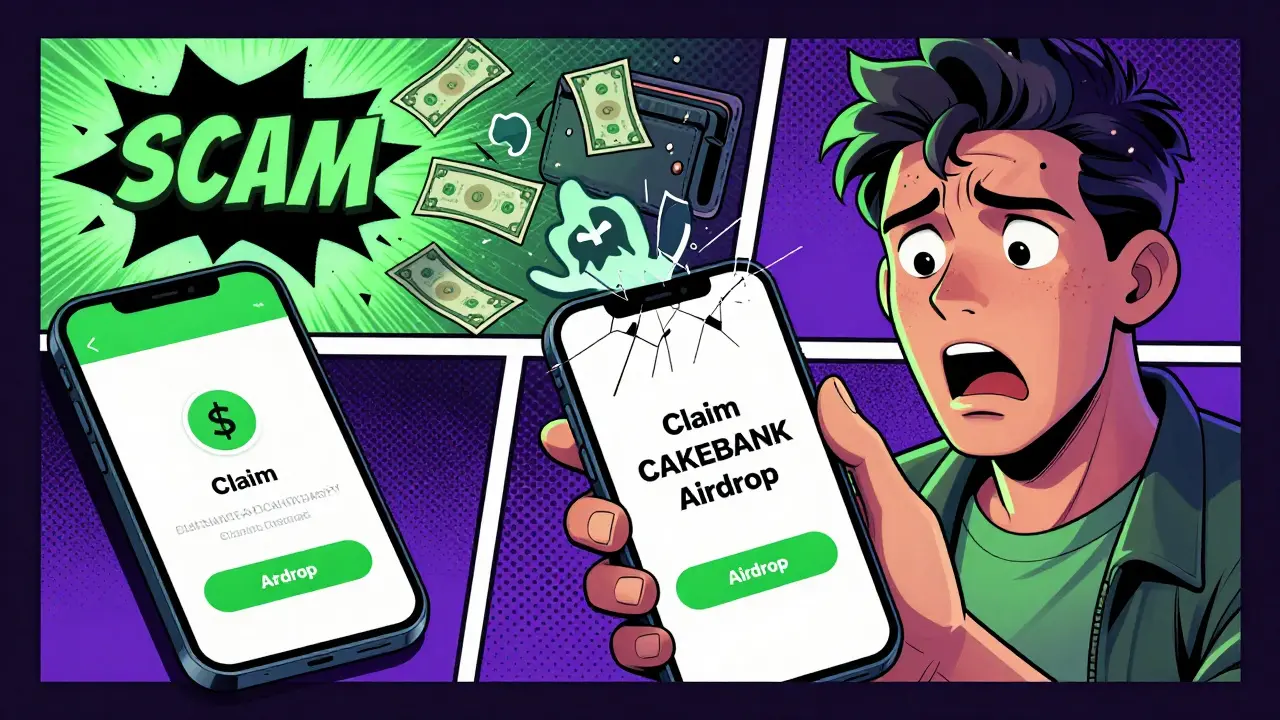
If you’ve seen a link saying “Claim your CAKEBANK airdrop now!” - don’t click it. It’s not a giveaway. It’s a phishing page.
Here’s how these scams work:
- You’re told to connect your wallet to a website to “claim” free CAKEBANK tokens.
- You approve a transaction - thinking it’s just for token receipt.
- Instead, you’re authorizing the site to drain your entire wallet - all your ETH, BNB, stablecoins, NFTs.
There are real cases from 2025 where users lost over $15,000 in a single click because they trusted a fake airdrop page. The CAKEBANK name is being used as bait because it sounds familiar - like PancakeSwap’s CAKE. But that’s the whole point. It’s designed to trick you into thinking it’s legit.
Even worse, some groups are selling “CAKEBANK airdrop guides” on Gumroad or Etsy for $20. These are just recycled templates from 2023 airdrops. They don’t work. They’re useless. And they’re stealing money from people who are already desperate to get something for free.
How to Spot a Fake Crypto Airdrop
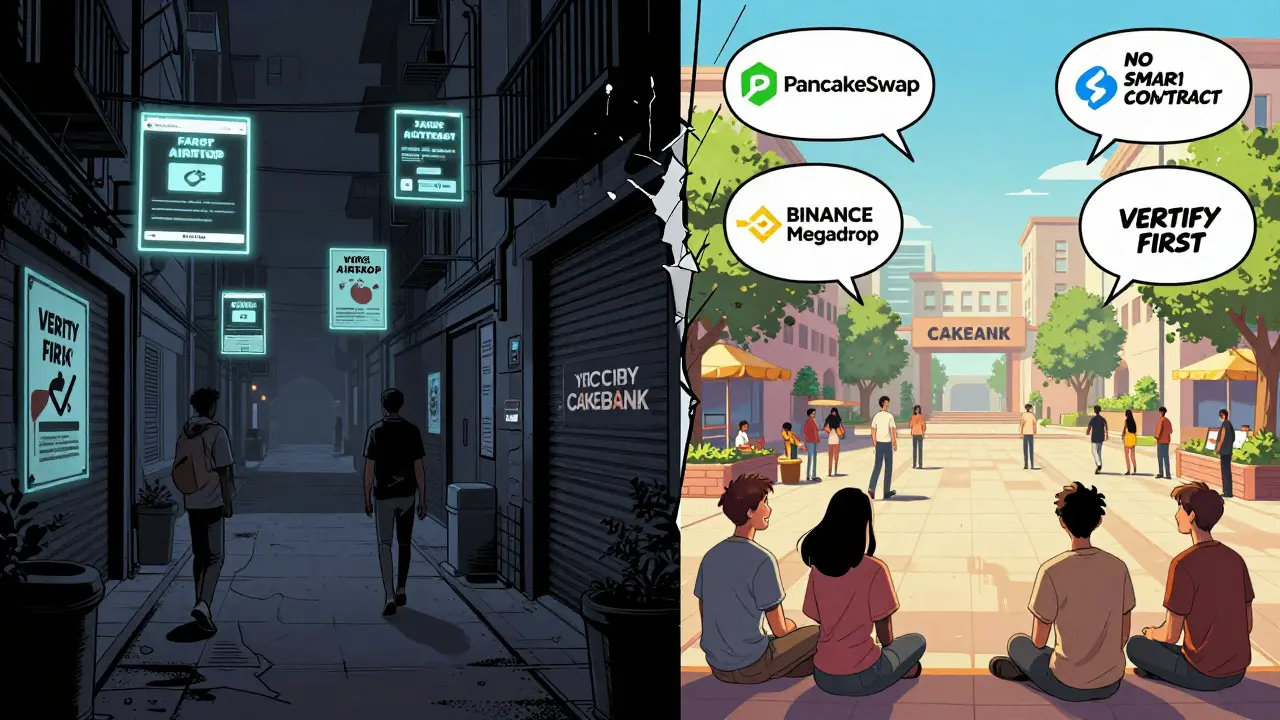
If you’re ever unsure whether an airdrop is real, ask yourself these five questions:
- Is there an official website with HTTPS and contact info? (CAKEBANK’s doesn’t.)
- Are the social media accounts verified (blue check)? (They’re not.)
- Is the smart contract address published on Etherscan or BscScan? (It’s not.)
- Is there a team with real names and LinkedIn profiles? (Nope.)
- Has it been covered by CoinDesk, Cointelegraph, or The Block? (It hasn’t.)
If the answer to any of these is no - walk away. That’s not a project. That’s a countdown to lost funds.
What You Should Do Instead
Instead of chasing CAKEBANK, focus on real opportunities. If you want airdrops, track projects with actual traction:
- PancakeSwap (CAKE) - runs regular airdrops for active traders on BNB Chain.
- Meteora - upcoming airdrop with clear participation mechanics.
- Abstract - building real DeFi tools, with a planned token distribution.
- Binance Megadrop - structured, regulated, and transparent.
These projects don’t hide. They announce. They explain. They reward users who contribute real value - not just those who click random links.
If you’re serious about airdrops, spend your time learning how to use wallets safely, how to read smart contracts, and how to verify official announcements. That’s the real skill - not chasing phantom tokens.
The Bigger Picture: Why This Matters
The crypto space is full of noise. Airdrops were once a way to reward early adopters and build communities. Now, they’re often weapons of deception. Projects like CAKEBANK exploit the hope of free money to steal from people who don’t know better.
Regulators are starting to crack down. In the U.S., the IRS is treating crypto airdrops like taxable income - but only if you can prove you received them. If you got scammed? You still owe taxes on the fake tokens you never actually got. The IRS doesn’t care if it was a scam. You’re on the hook.
And here’s the hard truth: the more you chase low-value tokens like CAKEBANK, the more you feed the ecosystem that makes these scams profitable. Every person who falls for it makes it easier for the next one to happen.
Final Warning: Don’t Get Greedy
Free tokens sound amazing. But in crypto, if something sounds too good to be true - it’s because it is. CAKEBANK isn’t a project. It’s a ghost. And the “airdrop” is just the bait.
Protect your wallet. Protect your time. Protect your money. Walk away from anything that doesn’t have a clear, public, verifiable trail. If you can’t find it on BscScan, Twitter, or a reputable news site - it doesn’t exist. And if it does exist, it’s not worth your risk.
There are real airdrops out there. They just require patience, research, and discipline. Don’t trade those for a tweet that says “Claim CAKEBANK now.”


13 Comments
Tara Marshall
December 6 2025CAKEBANK is a ghost token. Zero team, zero docs, zero utility. If you're connecting your wallet to claim it, you're already scammed. Walk away.
Richard T
December 6 2025I've seen this pattern before. The name's too close to PancakeSwap's CAKE on purpose. They're banking on people getting lazy and clicking first, asking questions later. Always check BscScan first. If the contract has no history or liquidity, it's a trap.
jonathan dunlow
December 7 2025Look, I get it - free crypto sounds like magic, right? Like finding a $20 bill in an old jacket. But here’s the thing: in crypto, the magic is always a trick. CAKEBANK isn’t a project, it’s a carnival booth with a fake prize. You think you’re winning tokens, but you’re handing over your keys to a stranger who’s already got your wallet’s PIN. I’ve watched people lose six figures because they trusted a Discord DM that said ‘claim now or lose your spot.’ There’s no spot. There’s no countdown. There’s just a phishing link dressed up like a gift.
Mariam Almatrook
December 7 2025One must lament the erosion of epistemological rigor within the decentralized finance sphere. The proliferation of such ephemeral, non-verifiable instruments as CAKEBANK constitutes not merely an economic anomaly, but a semiotic collapse - where signifiers of legitimacy (e.g., token ticker, Discord server, Telegram group) are deployed as performative simulacra, devoid of referential substance. One is compelled to ask: when does the imitation become the reality? And further, when does the victim become complicit through willful ignorance?
rita linda
December 9 2025Americans are too gullible. You think you’re getting free money but you’re just giving your private keys to some guy in a basement in Manila. We don’t do this in India. We know better. If it’s not on Binance or Coinbase, it’s trash. You people need to stop clicking random links and go back to your 9-to-5 jobs.
Annette LeRoux
December 9 2025It’s sad, really 🥲. We all want to believe in the dream - free tokens, life-changing gains, the next big thing. But sometimes the dream is just a mirror reflecting our own desperation. CAKEBANK isn’t evil. It’s just the symptom of a system where hope is the most exploited currency. Maybe the real airdrop is learning to say no.
Jerry Perisho
December 10 2025If you’re looking for real airdrops, focus on projects with active GitHub commits and verified Twitter accounts. CAKEBANK has none. Also, never trust a link that says 'claim now' - real airdrops give you a window, not a countdown. Check BscScan. Look at the contract. If it’s not been audited or has zero transactions, it’s not real.
Manish Yadav
December 11 2025This is why crypto is dying. People want something for nothing. No work. No effort. Just click and get rich. I told my cousin not to touch it. He lost $800 last month on a fake airdrop. Now he thinks blockchain is a scam. It’s not the tech. It’s the people.
ronald dayrit
December 12 2025There’s a deeper layer here that most people miss. The CAKEBANK phenomenon isn’t just about scams - it’s about the collapse of trust in institutions. When you can’t tell the difference between a real project and a fake one because both use the same language, the same logos, the same Discord servers, then the problem isn’t the scammer - it’s the system that allows the mimicry to thrive. We’ve outsourced verification to algorithms and memes, and now we’re paying the price. The real airdrop should be a lesson in critical thinking, not tokens.
Joe West
December 13 2025Biggest tip? Never click a link from a DM or random tweet. Always go to the project’s official site by typing it yourself. And if you’re not sure, just wait. Real airdrops don’t vanish if you don’t claim them in 10 minutes.
Brooke Schmalbach
December 15 2025Let’s be brutally honest - anyone who falls for CAKEBANK shouldn’t be allowed near a wallet. You’re not just losing money, you’re validating the entire scam ecosystem. This isn’t ignorance. It’s negligence. And now you’re part of the problem. The IRS doesn’t care if you were tricked. You’ll still owe taxes on phantom tokens. Congratulations.
Sandra Lee Beagan
December 15 2025I’m from Canada and I’ve seen this play out before with fake Dogecoin airdrops back in 2021 😔. The emotional manipulation is the same: urgency + FOMO + fake legitimacy. The real lesson? Trust your gut. If something feels off, it is. And if you’re not 100% sure, ask someone who’s been in crypto longer than you’ve had a smartphone. I’ve helped 3 friends avoid this exact trap. You’re not alone.
sonia sifflet
December 15 2025You people are so naive. If you don’t know CAKEBANK is fake, you shouldn’t be in crypto. Go back to trading meme coins on TikTok. This is why crypto is a joke. No one in real finance takes this seriously. And now you’re dragging the whole industry down with your stupidity.