
Central Bank of Jordan Crypto Policy: What You Need to Know in 2026
Before September 2025, owning or trading cryptocurrency in Jordan was a legal gray zone. The Central Bank of Jordan had banned banks and financial institutions from handling Bitcoin or any other digital asset since 2014. If you wanted to buy crypto, you did it over P2P apps, cash trades, or foreign exchanges - all outside the law. But things changed fast. In 2025, Jordan didn’t just relax its rules - it built a whole new system. Law No. 14 of 2025, the Virtual Assets Transactions Regulation Law, turned prohibition into regulation. Now, if you’re running a crypto business in Jordan, you need a license. Or you face prison.
What the Law Actually Bans
The new law doesn’t ban individuals from holding Bitcoin or Ethereum. You can still buy, sell, or store crypto privately. But if you’re a business - even a small one - you can’t operate without approval. That includes exchanges, wallet providers, staking platforms, or even crypto ATMs. The law says any service that’s "taking place within the territory" is regulated. That means if you’re based in Amman, if you market to Jordanians, or if you have servers in Jordan, you’re under the law’s reach. No exceptions.
The penalties are harsh. Violating the law carries a minimum one-year prison sentence and fines up to $141,000 (100,000 Jordanian Dinars). There’s no warning. No first-time offense leniency. The Jordan Securities Commission (JSC) is in charge of enforcement, and they’re not playing around. This isn’t just about money laundering - it’s about control. The government wants every transaction traceable, every operator accountable.
Who’s in Charge Now?
The Central Bank of Jordan used to be the only voice on crypto. Now, it shares power. The Jordan Securities Commission (JSC) is the main regulator for virtual asset service providers (VASPs). They handle licensing, compliance checks, and ongoing monitoring. The Central Bank still controls Central Bank Digital Currencies (CBDCs) and digitized securities - but those are separate tracks. If you’re building a crypto startup, you’re dealing with the JSC, not the Central Bank.
Compliance isn’t optional. Every licensed operator must follow Jordan’s AML/CFT Law No. 46 of 2007. That means:
- Customer Due Diligence (CDD) for every user - ID, address, proof of income
- Enhanced Due Diligence (EDD) for Politically Exposed Persons (PEPs)
- Real-time transaction monitoring for anything over JOD 10,000 ($14,100)
- Reporting suspicious activity to the Anti-Money Laundering Unit (AMLU)
- Keeping records for five full years
- Appointing a dedicated AML compliance officer
- Following the "Travel Rule" - sending sender and receiver info with every transfer
It’s not just paperwork. You need systems. Software that flags unusual patterns. Automated reporting tools. Audit trails. Many small operators didn’t have this before - and now they’re scrambling.
The Licensing Process Is Expensive
Getting licensed isn’t easy or cheap. The JSC has laid out a three-step process:
- Preliminary application: JOD 5,000 ($7,050)
- Detailed documentation review: JOD 15,000 ($21,150)
- Operational readiness assessment: JOD 10,000 ($14,100)
Total upfront cost? JOD 30,000 - about $42,250. And that’s just to apply. You still need to hire staff, buy software, set up servers, and train your team. For a small startup, this is a huge barrier. Some operators who were running informal exchanges before 2025 say they can’t afford it. Others are shutting down instead of applying.
There’s also no public list of capital requirements yet. The law says the government "may set minimum capital," but hasn’t. That uncertainty is paralyzing. You can’t plan if you don’t know how much money you’ll need to stay open.

How Jordan Compares to the Region
Compared to neighbors, Jordan’s approach is in the middle. The UAE has a clear, multi-layered system with free zones, tax incentives, and hundreds of licensed firms. Kuwait, Egypt, and Iraq still ban crypto entirely. Jordan chose a third path: regulated but strict.
It’s smarter than a ban - but riskier than the UAE’s model. The UAE attracts big players because it’s predictable. Jordan’s system is new. There’s no track record. Investors hesitate. Startups worry. Even though the law is detailed, its execution is still untested. The JSC only has 12 staff members assigned to crypto oversight. Can they handle thousands of applications? Can they monitor real-time transactions across dozens of platforms? Experts say no - not yet.
That’s why the IMF and World Bank are stepping in. They’re helping train regulators, fund compliance tech, and build capacity. Without international support, Jordan’s system could collapse under its own weight.
Who’s Affected the Most?
It’s not just exchanges. The law hits everyday users too.
There are about 1.2 million crypto users in Jordan - over 10% of the population. Most of them trade over P2P apps like LocalBitcoins or Telegram groups. Now, those platforms are technically illegal unless licensed. That means:
- Users can’t find trusted local sellers anymore
- Prices might go up as supply shrinks
- Scams could increase as unregulated actors disappear into the shadows
On Reddit, users are split. "Finally, a legal system," says one. "But $141,000 fine for a guy running a small P2P desk? That’s ridiculous," says another. A survey of 1,247 social media posts found 78% of Jordanians fear the law will hurt small businesses more than help.
Even tech workers are feeling the pressure. There’s a 40% shortage of professionals who know how to build AML systems for crypto. Universities aren’t teaching it. Companies can’t hire. The National Employment Council says this skills gap could delay adoption for years.
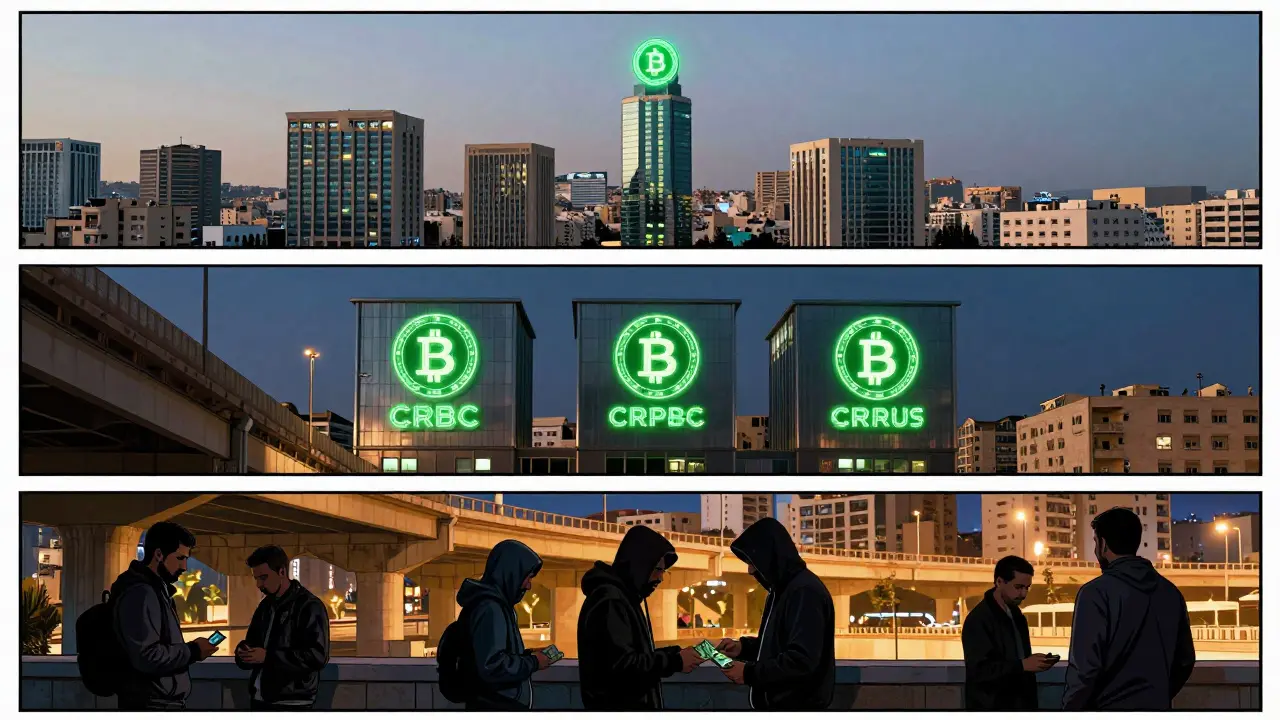
What’s Next? DeFi, CBDCs, and Sharia Finance
Jordan isn’t stopping here. The government has already announced plans to regulate decentralized finance (DeFi) platforms by early 2026. That means lending, borrowing, and yield farming could soon be under the same strict rules as exchanges.
The Central Bank of Jordan is also preparing to launch its own digital currency - a CBDC - by late 2026. This won’t replace Bitcoin or Ethereum. It’s meant to replace cash for government payments: taxes, salaries, social benefits. Think of it like digital dinars.
There’s another quiet opportunity: Sharia-compliant crypto. Jordan has 42 Islamic banks. If regulators design rules that allow crypto products to meet Islamic finance principles - no interest, no speculation - Jordan could become the Middle East’s hub for halal digital assets. No one’s doing that yet. But the potential is there.
Can Jordan Pull This Off?
Standard & Poor’s gives Jordan an 82% chance of success over the next five years. But that’s only if:
- The FATF removes Jordan from its grey list (it’s still on it as of early 2026)
- The JSC hires and trains more staff
- Capital requirements are published soon
- Public trust is rebuilt after a decade of prohibition
Right now, Jordan is in a fragile transition. The law is clear. The penalties are real. But the system is still being built. Operators are confused. Users are nervous. Regulators are overwhelmed.
If you’re a business in Jordan: don’t wait. Start preparing. Get legal advice. Talk to the JSC’s help desk. Apply early. If you’re a user: know your risks. Stick to licensed platforms. Avoid P2P deals unless you’re certain they’re compliant.
Jordan didn’t just change its crypto policy. It changed its entire digital economy direction. Whether this becomes a success story or a cautionary tale depends on one thing: execution. And right now, execution is still a work in progress.
Is it illegal to own Bitcoin in Jordan in 2026?
No, it’s not illegal to own Bitcoin or any other cryptocurrency as an individual. The law only bans unlicensed businesses from offering crypto services. You can still buy, hold, or sell crypto privately - but you can’t use local banks or unlicensed exchanges to do it.
What happens if I run a crypto exchange without a license?
You face criminal charges. The law mandates a minimum one-year prison sentence and fines up to $141,000. The Jordan Securities Commission actively investigates unlicensed operators. Even if you’re small or new, you’re still at risk.
Can I use Binance or Coinbase in Jordan?
Yes - but only if you’re using them from outside Jordan. Binance, Coinbase, and other international exchanges aren’t licensed in Jordan. So while you can access them, they’re not legally recognized. Any transaction you make through them isn’t protected under Jordanian law, and you could face scrutiny if you’re flagged for large transfers.
How much does it cost to get licensed in Jordan?
The application fees total JOD 30,000 (about $42,250), split into three stages: preliminary application (JOD 5,000), documentation review (JOD 15,000), and operational assessment (JOD 10,000). This doesn’t include ongoing compliance costs, staff salaries, or software subscriptions - which can add tens of thousands more per year.
Is the Central Bank of Jordan creating its own digital currency?
Yes. The Central Bank of Jordan plans to launch a Central Bank Digital Currency (CBDC) in Q3 2026. This will be a digital version of the Jordanian dinar, used for government payments, salaries, and taxes. It’s separate from private cryptocurrencies and will be fully controlled by the central bank.
Why did Jordan change its crypto policy?
Jordan was placed on the FATF grey list in 2023 due to high risks of money laundering through unregulated crypto. The 2025 law was designed to meet international standards and get Jordan removed from the list. It’s also part of a broader National Blockchain Strategy to modernize public services and attract tech investment.





26 Comments
Kira Dreamland
March 16 2026So let me get this straight - you can own Bitcoin all you want, but if you run a tiny P2P desk out of your apartment in Amman, you’re looking at a year in jail? That’s wild. I get the AML stuff, but this feels like punishing the people who actually made crypto accessible when banks refused to help. Jordan’s trying to be smart, but the execution’s gonna crush the grassroots users first.
shreya gupta
March 18 2026How quaint. A country with a population smaller than Mumbai’s metro area thinks it can regulate crypto like it’s managing a tea stall. JOD 30,000 just to apply? Meanwhile, Dubai is handing out golden visas to crypto founders. The irony? Jordan’s trying to look modern - while its policy screams 1998.
Derek Lynch
March 20 2026Look, I’m not saying this law is perfect - but it’s the *right* direction. You want innovation? Fine. But not at the cost of letting money launderers run wild. The real issue isn’t the fine - it’s the lack of clear capital requirements. That’s a leadership failure. If the JSC can’t define the rules, they shouldn’t be in charge. Get the numbers out. Hire the staff. Stop playing politics. This isn’t a suggestion - it’s a national priority.
And if you’re a small operator? Stop hoping for mercy. Start building. Get your compliance officer. Buy the software. Talk to the JSC help desk. This isn’t about fear - it’s about adaptation. The world’s moving. Are you?
Christopher Hoar
March 21 2026lol so jordan just made it illegal to be good at peer to peer trading? congrats, you just turned 1.2 million people into criminals for using telegram. next they’ll fine you for using vpn. also who the hell is gonna pay $42k to get licensed? the only people who can afford it are the ones who already have offshore accounts. this law isn’t about regulation - it’s about exclusion.
Robert Kunze
March 22 2026i just read this whole thing and i feel so bad for the regular people. you know the ones? the guy who sells usd for btc on whatsapp because his bank froze his account? the girl who pays rent in crypto because her landlord won’t take dinars? they’re not criminals. they’re just trying to survive. and now they’re gonna get locked up because the government didn’t build bridges - they built walls. this isn’t progress. it’s punishment.
and the jsc has 12 people? are they joking? how are they gonna monitor thousands of platforms? they’re gonna need a whole army. or better yet - just stop trying to control what people do with their own money.
Sarah Zakareckis
March 22 2026Let’s reframe this: Jordan isn’t just regulating crypto - it’s building a digital financial infrastructure from scratch. That’s huge. The licensing fees? Yeah, steep. But think of it as an entry fee into a regulated, transparent ecosystem. The AML/CTF requirements? Non-negotiable. If you’re serious about operating here, you need enterprise-grade systems - not a spreadsheet and a prayer.
And here’s the opportunity: DeFi compliance modules, CBDC integration, Sharia-compliant smart contracts. These aren’t just boxes to check - they’re market differentiators. The firms that nail this will become the regional leaders. This isn’t a barrier - it’s a launchpad. If you’re building, start now. The window’s open. Don’t wait for permission - build the solution.
Heather James
March 24 2026Own crypto? Fine. Run a business? License it. Simple.
Sarah Hammon
March 24 2026really hope the jsc puts out a guide for small operators. like, step by step. not just jargon. i know people trying to go legit but they’re lost. the cost is insane, but if there’s a path - even a hard one - they’ll take it. also, is there any way to get help from the imf or world bank training programs? maybe a local nonprofit could partner up? just saying…
Jerry Panson
March 25 2026It is my solemn duty to point out that the Central Bank of Jordan’s transition from prohibition to regulation, while ostensibly progressive, constitutes a fundamental expansion of state surveillance infrastructure under the guise of financial modernization. The Travel Rule, in particular, represents a de facto erosion of financial privacy, a cornerstone of liberty in the digital age. Furthermore, the absence of published capital requirements suggests a deliberate opacity, undermining the very transparency the law purports to champion. One must question whether this framework is designed to foster innovation - or to consolidate control.
Brenda White
March 25 2026so they banned p2p but let binance exist? that’s not regulation that’s hypocrisy. also who’s gonna pay 42k when the avg salary is 800 a month? this law is for rich people and foreign corps. the rest of us? we’re just gonna get scammed harder now. lol
Ernestine La Baronne Orange
March 26 2026OH MY GOD I JUST READ THIS AND I’M SO ANGRY. I MEAN, LIKE, REALLY ANGRY. THEY’RE THROWING PEOPLE IN JAIL FOR SELLING BITCOIN ON TELEGRAM? WHAT IS THIS, 1984? I HAVE A FRIEND WHO LIVES IN AMMAN AND SHE JUST LOST HER ENTIRE SAVINGS BECAUSE SHE WAS USING A LOCAL SELLER - AND NOW SHE’S SCARED TO EVEN TALK ABOUT IT. THIS ISN’T A LAW - IT’S A NIGHTMARE. AND THE JSC HAS 12 PEOPLE?! HOW ARE THEY EVEN GOING TO DO THIS?! THEY’RE NOT EVEN READY - AND YET THEY’RE THROWING PEOPLE IN PRISON?! I’M SO UPSET. I JUST… I DON’T EVEN KNOW WHAT TO SAY. THIS ISN’T JUST WRONG - IT’S EVIL.
Zachary N
March 26 2026There’s a lot of fear here, and rightly so - but let’s not miss the forest for the trees. Jordan’s move is a strategic pivot. The region is watching. The UAE is thriving because it embraced crypto early with clear rules. Jordan is now trying to do the same, but with tighter controls. That’s not a mistake - it’s a different model.
The real challenge isn’t the cost of licensing. It’s the skills gap. There are maybe 50 people in the entire country who know how to build AML monitoring systems for crypto. Universities aren’t teaching it. The government needs to partner with tech academies, offer scholarships, create apprenticeships. This isn’t about fines - it’s about capacity building.
And yes, the $42k fee hurts. But if you’re serious about building a business here, that’s just the cost of entry into a regulated, trustworthy market. The alternative? Operating in the shadows forever. Which is riskier? I think we know the answer.
Start small. Get certified. Use open-source tools. Apply for IMF technical assistance. Talk to the JSC - don’t wait for them to come to you. This isn’t the end of crypto in Jordan. It’s the beginning of something real.
Elizabeth Kurtz
March 26 2026As someone who’s worked in fintech across the Middle East, I’ve seen this movie before. Countries panic, ban crypto, then realize they’re losing talent and investment. Jordan’s doing the hard thing: regulating instead of banning. It’s messy, yes - but it’s honest. The real story here isn’t the fine or the jail time. It’s that 10% of the population is already using crypto. That’s not a bug - it’s a feature. This law is trying to bring that energy into the system. The question isn’t whether it’ll work - it’s whether the world will give Jordan the time to make it work.
john peter
March 27 2026The entire edifice rests upon a foundational contradiction: regulation without clarity, enforcement without capacity, and control without consent. One cannot legislate trust. One cannot mandate compliance through fear. The Central Bank and the JSC are not regulators - they are gatekeepers of a new digital feudalism. The citizen is no longer sovereign over his assets; he is a subject under perpetual audit. This is not progress. It is the quiet death of financial autonomy.
Marc Morgan
March 28 2026Jordan’s got guts. Not many countries would go from "no crypto" to "license or jail" in a year. But honestly? The real test isn’t the law - it’s whether anyone shows up to get licensed. If the only applicants are big foreign firms, then this whole thing’s a PR stunt. If local devs and P2P traders actually show up? Then we’re watching history.
Anastasia Thyroff
March 29 2026so i just watched my cousin get arrested for selling 500$ worth of btc on whatsapp and i dont even know what to feel anymore. the system is broken. they dont care about the people. they just want control. and now everyone is scared to even talk about it. i miss when we could just buy crypto and not worry about prison
Shreya Baid
March 30 2026While the regulatory framework is rigorous, its underlying intent - financial integrity - is commendable. The challenge lies in equitable implementation. The JSC must extend outreach programs to underserved communities, provide multilingual compliance toolkits, and establish tiered licensing for micro-operators. A one-size-fits-all model will alienate the very users it seeks to protect. Innovation must not be the privilege of capital, but the right of the connected.
Diane Overwise
April 1 2026so like… they banned p2p but still let people use binance? that’s not regulation. that’s just letting the rich play while the rest of us get arrested. also jod 30k? that’s more than a house in some parts of jordan. this isn’t about money laundering. it’s about control. and honestly? i’m not surprised. they’ve been scared of crypto since day one.
Ann Liu
April 1 2026The regulatory structure outlined is comprehensive and aligns with FATF Recommendation 15. The licensing fees, while substantial, are comparable to those in jurisdictions such as Singapore and Switzerland for comparable VASPs. The absence of published minimum capital requirements is a legitimate concern and should be addressed through public consultation. Until then, operators should assume a capital threshold of at least $250,000 based on regional benchmarks. Compliance is not optional - it is the foundation of sustainable growth.
Dionne van Diepenbeek
April 1 2026the law is clear but the people are confused and the jsc is silent and now everyone is just guessing and thats worse than a ban
Graham Smith
April 3 2026Let’s be candid: Jordan’s regulatory architecture is a textbook example of over-engineered compliance. The Travel Rule implementation, while technically sound, imposes disproportionate burdens on SMEs. The capital requirements remain opaque - a deliberate tactic to deter competition. This is not financial innovation; it is regulatory capture disguised as reform. The JSC is not a regulator - it is a rent-seeking institution masquerading as a public authority.
Katrina Smith
April 4 2026so they banned p2p but let the big exchanges in? cool. so now the rich get to trade legally and the rest of us get scammed by shady bots? genius move. also 42k? i make 300 a month. this law is literally designed to fail
Anastasia Danavath
April 5 2026bruh this is wild 😭 i just wanna buy btc and now i gotta pay 42k or go to jail?? 🤡
anshika garg
April 5 2026in the grand scheme of things, this is not just about money. it’s about trust. for years, people in jordan turned to crypto because the system failed them. now the system is trying to control what it couldn’t serve. but you can’t regulate trust with fines. you can only rebuild it with transparency. if the jsc opens its doors - not with paperwork, but with listening - maybe, just maybe, this can work.
Derek Lynch
April 6 2026Some of you are missing the point. This isn’t about banning people - it’s about giving them protection. Before, if you got scammed on a P2P deal, you had zero recourse. Now? Licensed platforms have dispute resolution. They have insurance. They’re audited. The law isn’t perfect - but it’s the first step toward real safety. If you’re scared, get educated. Talk to the JSC. Don’t hide. Build. Adapt. The future isn’t waiting.
Sarah Hammon
April 7 2026that’s actually a good point. i just wish the jsc had a live chat or something. like, a real person you could ask. i’ve been trying to find out if i need to register my small p2p side hustle and i’ve been calling for 3 weeks. no one answers. if they want compliance, they need to make it easy.