What is BlastUP (BLASTUP) Crypto Coin? A Real-World Breakdown
The crypto world is full of launchpads-platforms that help new blockchain projects raise money and get off the ground. But few are as tightly tied to their home network as BlastUP (BLASTUP). Launched in January 2024, this token isn’t just another coin you buy and hold. It’s a key that unlocks access to early-stage projects on the Blast Layer 2 network, a fast-growing Ethereum scaling solution that’s now handling over $2.5 billion in total value locked as of Q3 2025.
If you’ve heard of Blast, you know it’s not just another sidechain. It’s built for yield. Projects on Blast earn native rewards just by being active. BlastUP takes that idea and turns it into a token economy. Hold BLASTUP, stake it, and you get priority access to token sales (IDOs) for projects launching on Blast. But here’s the catch: this isn’t a passive investment. You need to actively participate.
How BlastUP Works: More Than Just a Token
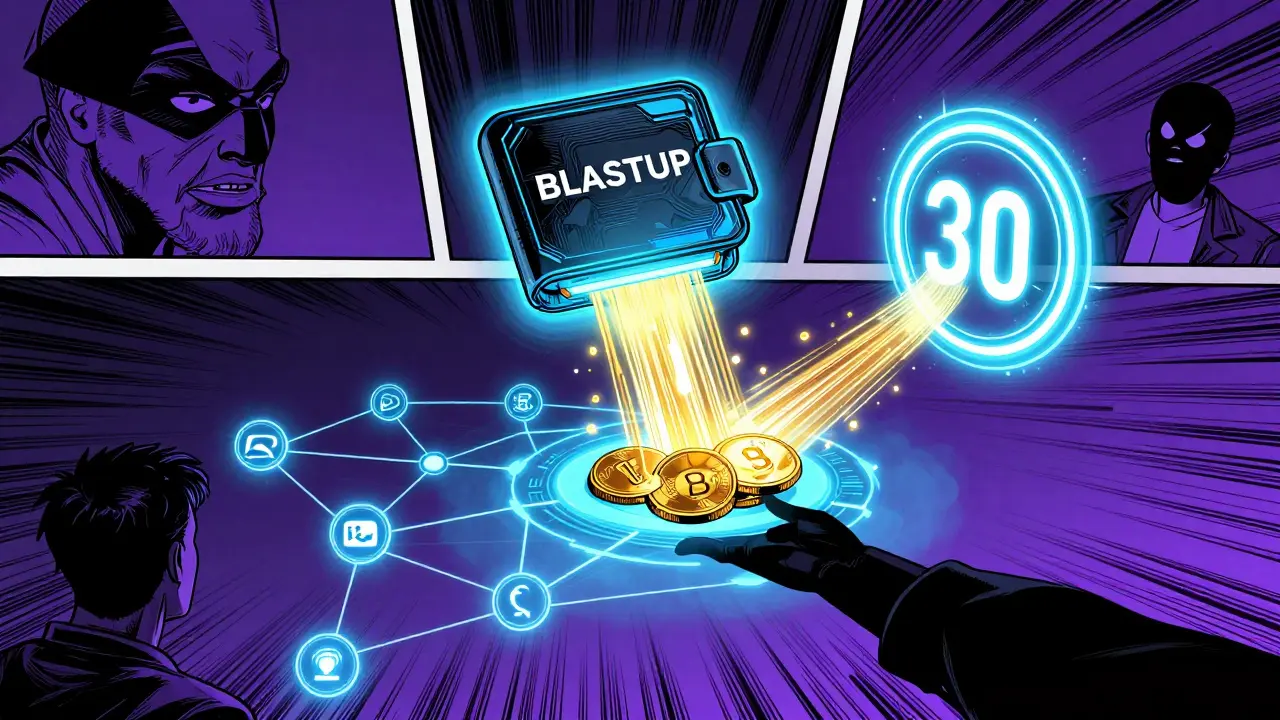
BlastUP isn’t a currency you spend on coffee. It’s a membership card to the Blast ecosystem. To get into early IDOs, you need to stake your BLASTUP tokens for at least 30 days. That’s not optional. It’s built into the system. The longer you stake, the better your chances of getting a spot in high-demand token sales.
There’s also the Community Incentives Program-called "Expansion"-which rewards users for completing simple tasks like following social media, joining Telegram, or referring friends. These aren’t just busywork. They’re designed to build a real community. As of December 2025, over 43,852 people were actively doing missions on the platform. Some users report earning enough rewards to cover their staking costs and still profit from early project allocations.
But it’s not all smooth sailing. Many users complain about the complexity. One Trustpilot reviewer called it a "time sink," saying the rewards didn’t match the effort. Others say the interface is clean and intuitive-especially compared to older launchpads like Polkastarter. That split in feedback is common for early-stage platforms trying to balance simplicity with depth.
Tokenomics: Confusion in the Numbers
Here’s where things get messy. Different data sites give wildly different numbers for BLASTUP’s supply and price.
- CoinMarketCap says the total supply is 700 million tokens, with only 70 million in circulation.
- CryptoRank claims it’s 1 billion total, with 145 million already sold in pre-sales.
Price data is even more inconsistent. CoinGecko lists BLASTUP at around $0.00019, while Coinpedia shows it at $0.0036-over 18 times higher. Why? Because liquidity is split across exchanges. BitMart handles nearly 60% of trading volume, while Uniswap V3 takes the rest. That fragmentation means price swings depend on which exchange you’re looking at.
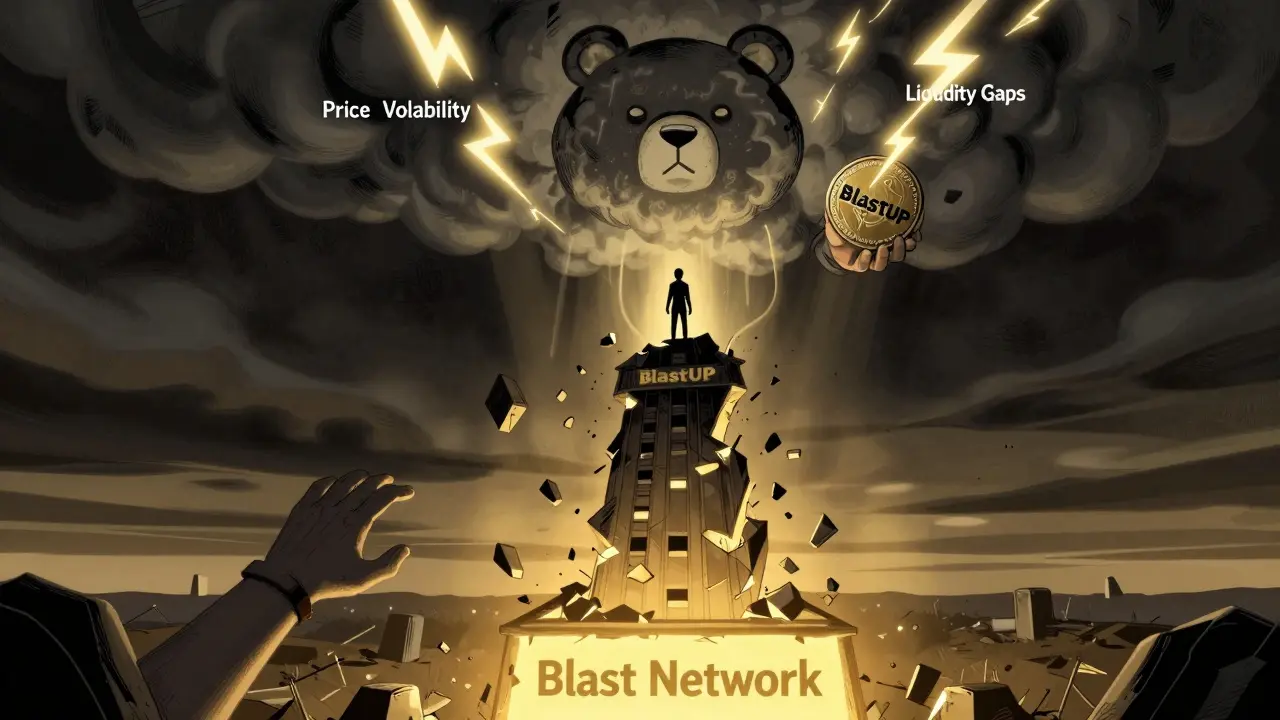
The token hit an all-time high of $0.06291 in mid-2024. Today, it’s trading at roughly 97% below that peak. That’s brutal. But here’s something interesting: it’s also up 32% from its lowest point of $0.002781. That suggests some stability is forming-not a recovery, but maybe a bottom.

Who’s Behind BlastUP? And Why Does It Matter?
The team behind BlastUP hasn’t revealed much. No whitepaper with names, no LinkedIn profiles. That’s not unusual in crypto, but it’s a red flag for some. What we do know is that the platform was built specifically for Blast. It’s not trying to be the next Binance Launchpad. It’s focused on one thing: giving early users access to projects within the Blast ecosystem.
And that’s its strength. The top three projects launched on BlastUP in Q2 2025 returned an average of 347% at listing. That’s not luck. It’s because they were built on Blast from day one. They had native yield mechanisms, low fees, and deep integration with the network. If you believe Blast will keep growing, then BlastUP gives you front-row access.
But it’s also its weakness. Only 12% of projects launched on BlastUP went multi-chain. Compare that to Polkastarter, where 78% of projects launched on multiple networks. If Blast’s growth slows, BlastUP has nowhere else to go. Its fate is locked to Blast’s.
Market Position: Tiny but Tied to a Giant
BlastUP’s market cap hovers around $12 million. That’s tiny compared to giants like Binance Launchpad, which raised over $240 million in a single quarter. But BlastUP isn’t competing with them. It’s competing with niche players like zkSync’s ZKPad-which hasn’t even launched yet.
The Blast network itself has exploded. From 120,000 daily users in Q1 2025 to over 840,000 in Q4 2025. That’s 42% growth every three months. BlastUP is the only launchpad built just for this network. That gives it a monopoly on early access. If Blast keeps growing, BlastUP could become essential.
But if Blast stalls? BlastUP could fade into obscurity. Analysts at Messari give it a 65% chance of surviving through 2026. CryptoQuant gives it a 4.2 out of 10 on sustainability. Those aren’t great odds-but they’re not zero, either.
What You Need to Get Started
If you want to try BlastUP, here’s the real-world setup:
- Get a wallet that supports Blast-MetaMask is the most common. You’ll need to manually add the Blast network (RPC details are on blastup.io).
- Buy ETH and swap it for BLASTUP on Uniswap V3 or BitMart. Be ready for slippage-trades over $500 often have over 15% price impact.
- Stake your BLASTUP in the BlastUP dApp. Minimum 30 days. No exceptions.
- Join the Expansion program and complete missions to boost your allocation chances.
Gas fees on Blast are usually $0.07 per transaction. But during big IDOs, they spike to over $1.20. Plan for that. And don’t expect quick support. Reddit users report 58-hour wait times for help tickets. The Telegram group has 12,450 members, and the Twitter account has strong engagement-but it’s not a customer service line.
Is BlastUP Worth It?
There’s no easy answer.
If you’re looking for a safe, steady investment-walk away. This isn’t Bitcoin. It’s not even Ethereum. It’s a high-risk bet on a specific ecosystem.
If you believe Blast is going to be the next big Layer 2, and you’re willing to put in the work to stake, complete missions, and monitor IDOs-then BlastUP might be one of the few ways to get in early. The returns so far have been strong for early participants. But they’ve also been volatile, and the token’s price is still in freefall from its peak.
Most users who succeed are those who treat it like a job: checking missions daily, tracking new project announcements, and understanding the network’s behavior. It’s not a get-rich-quick scheme. It’s a participation economy.
And that’s the real story of BlastUP. It’s not about the coin. It’s about being part of something that’s still being built.
Is BlastUP (BLASTUP) a good investment?
BlastUP isn’t a traditional investment. It’s a participation token tied to the Blast network’s growth. If Blast keeps growing, BLASTUP could gain value through increased demand for IDO access. But if Blast slows down, the token could lose most of its value. It’s high-risk, high-reward. Only invest what you can afford to lose.
How do I buy BLASTUP tokens?
You can buy BLASTUP on decentralized exchanges like Uniswap V3 or centralized exchanges like BitMart. You’ll need an Ethereum-compatible wallet (like MetaMask) configured for the Blast network. Swap ETH for BLASTUP directly on these platforms. Avoid buying from unknown sources-there are many fake tokens out there.
Do I need to stake BLASTUP to participate in IDOs?
Yes. To get whitelisted for Initial DEX Offerings on BlastUP, you must stake your BLASTUP tokens for a minimum of 30 days. The longer you stake, the higher your allocation priority. Staking is mandatory-it’s not optional.
Why is the price of BLASTUP so different across platforms?
BLASTUP trades on multiple exchanges with very different liquidity levels. BitMart and Uniswap V3 handle most volume, but neither has deep order books. That causes price gaps. CoinMarketCap, CoinGecko, and Coinpedia pull data from different sources, so their prices vary. Always check the trading pair and exchange before making a trade.
Can I use BLASTUP on other blockchains?
No. BLASTUP is an ERC-20 token built exclusively on the Blast Layer 2 network. It doesn’t work on Ethereum mainnet, Polygon, or Solana. You need to be on the Blast network to use it. This limits its utility but also keeps it tightly integrated with Blast’s ecosystem.
What happens if the Blast network shuts down?
If Blast stops operating, BlastUP loses its entire purpose. The token has no value outside of Blast’s ecosystem. There’s no backup plan, no cross-chain migration, and no fallback. Your BLASTUP tokens would become worthless. That’s why analysts call it a "high-risk ecosystem play." You’re betting on Blast’s survival.
Is BlastUP regulated by any government?
As of late 2025, BlastUP’s model avoids being classified as a security because BLASTUP doesn’t grant ownership, equity, or profit-sharing rights. It’s purely an access and incentive token. Legal analysis from Perkins Coie suggests it falls outside the U.S. SEC’s current definition of a security. But regulations can change, and future rules could impact its status.
How do I join the BlastUP Expansion airdrop?
Go to the official BlastUP website, connect your wallet, and navigate to the "Expansion" section. Complete missions like following their Twitter, joining Telegram, or referring friends. Rewards are distributed based on your staking amount and engagement level. Check the platform weekly-missions update regularly.
Are there any fees to use BlastUP?
There are no direct fees to stake or join the airdrop. But you pay gas fees on the Blast network for every transaction-staking, claiming rewards, or participating in IDOs. These are usually $0.07 but can spike to over $1 during high-demand events. Always keep a small amount of ETH in your wallet for gas.
What’s next for BlastUP in 2026?
The official roadmap mentions plans to migrate to a governance token and expand to Ethereum mainnet in Q1 2026. But these are unconfirmed. No technical details or timelines have been released. Until independent sources verify these updates, treat them as speculative. The platform’s future depends more on Blast’s growth than its own roadmap.
Bottom line: BlastUP is not for everyone. It’s for those who want to be part of something new, who don’t mind doing the work, and who believe in the long-term potential of the Blast network. If that sounds like you, it’s worth exploring. If not, there are plenty of other ways to invest in crypto.


24 Comments
Nadia Shalaby
February 27 2026I've been staking BLASTUP for 45 days now. Not gonna lie, the interface is clunky but the IDO access has been worth it. Got into two projects that already 3x'd. Still waiting on the third one. Just keep checking missions daily - the rewards add up faster than you think.
Fiona Monroe
February 28 2026The discrepancies in tokenomics are alarming. CoinMarketCap's figures suggest a 90% dilution risk, whereas CryptoRank's data implies a significantly lower circulating supply. This lack of transparency undermines credibility. A proper whitepaper with audited token distribution is non-negotiable for any serious project.
Daisy Boliaan
March 1 2026OMG I JUST LOST MY ENTIRE PORTFOLIO ON THIS THING. I thought I was getting in early but then the price dropped 97% and now my wallet is just sad pixels. WHY DIDN'T ANYONE WARN ME?!?!? I'm crying into my coffee. This is why I never trust 'community-driven' stuff. 😭
Nicki Casey
March 3 2026This whole Blast ecosystem is a Fed-backed crypto shell game. They're using 'native yield' as a distraction while quietly preparing to dump on retail investors. The fact that the team is anonymous? Classic. The 12% multi-chain adoption rate proves they're deliberately locking users in. This isn't innovation-it's a controlled demolition disguised as DeFi.
maya keta
March 5 2026Look, if you're not staking at least 100k BLASTUP and doing all the Expansion missions, you're basically throwing gas money into the void. The real alpha is in the top 5% of stakers. Everyone else is just paying for the privilege of being a spectator. Also, BitMart volume? That's not liquidity-that's pump-and-dump bait. Don't say I didn't warn you.
Curtis Dunnett-Jones
March 6 2026BlastUP represents a paradigm shift in how early-stage ecosystem participation is structured. The mandatory staking mechanism ensures alignment between token holders and network growth. Unlike traditional launchpads that prioritize short-term fundraising, BlastUP incentivizes long-term commitment. This is the future of community-driven infrastructure.
bella gonzales
March 7 2026I tried it. Did the missions. Got 0.003 ETH in rewards. Spent 3 hours a day for two weeks. Then the gas fees spiked during an IDO and I lost 0.02 ETH just to click 'confirm'. I'm done. This isn't a project. It's a time-suck with a token attached.
Paul Reinhart
March 8 2026There's something poetic about how BlastUP ties value directly to participation. It's not just a token-it's a digital handshake with a community building something new. I know the price looks terrible, but I look at it like holding shares in a startup before it's even got office furniture. The real metric isn't price-it's how many people are still showing up every day. And they are.
Samantha Stultz
March 10 2026If you're not using MetaMask with custom RPC for Blast, you're doing it wrong. And don't even think about buying BLASTUP on centralized exchanges unless you're okay with 15% slippage. The real action is on Uniswap V3. Also, the Expansion missions? They're not busywork-they're your ticket to being in the inner circle. The top 100 stakers get early access to project audits. That's the real game.
Robert Conmy
March 12 2026People who think this is a good idea are naive. You're essentially betting your money on a team that won't even put their names online. That's not innovation-that's cowardice. And now you're supposed to do chores for rewards? This isn't Web3. This is Web2 with a blockchain sticker on it. I'm embarrassed for anyone who's still in this.
Lilly Markou
March 12 2026The psychological toll of monitoring BlastUP's ecosystem is not discussed enough. The constant need to check missions, track price discrepancies across exchanges, and wait for IDO allocations creates a low-grade anxiety that never fully dissipates. It's not a financial decision-it's a mental endurance test.
McKenna Becker
March 13 2026Value isn't created by price. It's created by utility. BLASTUP doesn't promise returns-it promises access. And access to a growing ecosystem with native yield? That's rarer than any ICO ever was.
precious Ncube
March 15 2026If you're still holding BLASTUP after its 97% drop, you're either delusional or a degenerate. This isn't a 'high-risk' play-it's a trap. Real investors don't stake for missions. They buy blue-chips and sleep. Period.
Amita Pandey
March 16 2026The absence of a formal governance structure renders the entire tokenomics framework ethically precarious. Without a clear roadmap for decentralization or community voting rights, BLASTUP functions as a centralized access key, contradicting the foundational principles of blockchain technology.
Tracy Peterson
March 17 2026I've seen 100s of these launchpads come and go. Most die. But Blast? It's different. The TVL growth is insane. The user numbers? Unreal. And BlastUP? It's the key. You think it's trash now? Wait until the next big project launches and everyone's scrambling to stake. The bottom is forming. This isn't a crash-it's a consolidation.
George Suggs
March 18 2026Staked 50k. Got into a project that went 5x. Gas fees were wild but worth it. Keep it simple. Stake. Do missions. Wait. Don't overthink it.
Dianna Bethea
March 18 2026If you're new to this, don't panic about the price swings. Focus on the ecosystem. Blast has over 840k daily users-that’s more than most Layer 1s. BLASTUP isn’t a coin, it’s a passport. The more you engage, the more doors open. I’ve seen people go from zero to earning $200/month just from missions and staking. It’s not glamorous, but it’s real.
KingDesigners &Co
March 19 2026The fact that CoinGecko and Coinpedia have price differences over 18x is a red flag. Either the data is garbage or someone’s manipulating volume. I checked the order books-BitMart has 300% more buy walls than sell orders. That’s not organic. That’s a pump. Stay away unless you’re ready to play the game.
Felicia Eriksson
March 19 2026I started with $200. Did the missions. Staked for 30 days. Got into one IDO. Made back my $200 in 12 days. Then I just kept staking. Now I’m in three more projects. It’s not a lottery. It’s a system. And if you show up, it works.
aaron marp
March 21 2026The real genius of BlastUP is that it turns passive holders into active participants. You’re not just buying a token-you’re becoming part of the network’s growth engine. Most people miss that. They see price charts. I see engagement graphs. And those are climbing.
Patrick Streeb
March 22 2026The structural integrity of the Blast network provides a compelling foundation for BLASTUP's utility. Given the consistent growth metrics and the absence of regulatory intervention to date, this represents one of the more coherent ecosystem-specific token models currently in operation.
Phillip Marson
March 23 2026This ain't crypto. This is a cult with a wallet. You gotta follow Twitter. Join Telegram. Do missions. Pray to the Blast gods. And if you don't? You're just a peasant with no access. I'm out. I'd rather rug pull my own dog coin than be this dependent on some invisible team's whims.
Tracy Whetsel
March 24 2026I used to think this was too much work. Then I realized-this is the future. No more 'buy and hope'. This is 'build and earn'. I do my missions while watching Netflix. I stake while scrolling. It’s not hard. It’s just different. And honestly? It feels better than just buying a coin and hoping it goes up. I’m in for the long haul.
Kenneth Genodiala
March 26 2026The notion that BLASTUP is a 'membership card' is a marketing fantasy. True decentralization does not require you to complete social media tasks to gain access to investment opportunities. This model is a regression to centralized gatekeeping, dressed in blockchain aesthetics. I find it profoundly disappointing.