
Cryptocurrency Tax Guide: How to Report Crypto Gains and Avoid IRS Audits
Ever wonder why your exchange suddenly started sending you tax forms that look like a puzzle? If you've traded, staked, or mined digital assets, you're now in the crosshairs of a much more aggressive tax enforcement era. The IRS has shifted from "asking nicely" to a high-tech data-matching game, with cryptocurrency-related audit letters jumping over 200% in early 2025. If you think your private wallet keeps you invisible, think again-centralized exchanges are now reporting your gross proceeds directly to the government.
Quick Guide: What You Need to Know Now
The New Era of Reporting: Form 1099-DA
For years, the IRS relied on you to be honest about your trades. That ended with the Infrastructure Investment and Jobs Act. Now, centralized exchanges-the ones that act as brokers-are required to issue Form 1099-DA. This form tells the IRS exactly how much you made from your sales (gross proceeds).
Here is the catch: In 2025, these forms only report the total sale amount, not what you originally paid for the asset (the cost basis). This means you are still responsible for calculating your own profit or loss. If you just enter the gross proceeds from your 1099-DA without subtracting your cost basis, you'll end up paying taxes on the entire sale amount-a mistake that could cost you thousands.
Keep in mind that this reporting doesn't cover everything. Decentralized Exchanges (DEXs) like Uniswap or non-custodial wallets aren't yet required to send these forms. While that might feel like a loophole, the IRS is using sophisticated blockchain analysis tools to find gaps between what you report and what the exchanges report.
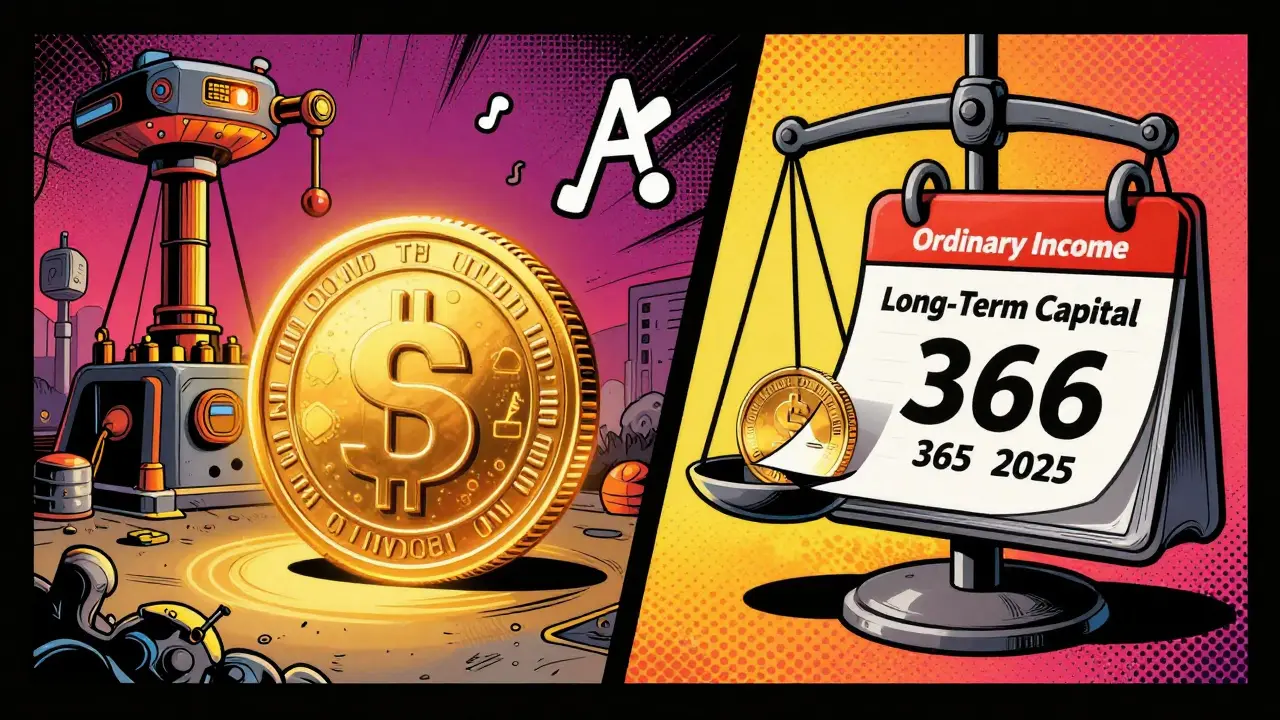
Ordinary Income vs. Capital Gains
One of the biggest points of confusion is when a crypto event is a "gain" and when it's "income." In the eyes of the law, they are very different.
Ordinary Income occurs when you first receive the asset. If you mine Bitcoin, earn Ethereum through staking, or get a surprise airdrop, that's treated as income at the fair market value on the day you received it. For example, if you earned 1 SOL through staking and it was worth $100 at the time, you owe income tax on that $100, even if you never sell it.
Capital Gains happen when you swap or sell that asset. If you hold that same 1 SOL and sell it a year later for $200, you have a capital gain of $100 (the difference between the income value and the sale value). This is where the holding period becomes critical. If you sell in 364 days, you pay your normal income tax rate. Wait until day 366, and you qualify for the long-term rate, which could be as low as 0% depending on your total yearly income.
Calculating Your Cost Basis: The Math That Matters
Your cost basis is essentially the "price you paid" for your crypto. Getting this number right is the only way to lower your tax bill legally. Since most of us buy assets at different prices over time, you need a strategy to track them.
The American Institute of CPAs (AICPA) suggests a few common methods:
- First-In, First-Out (FIFO): This is the default. You assume the first coin you bought is the first one you sold. This is usually the simplest for the IRS.
- Specific Identification: If you can prove exactly which coin you sold (using wallet addresses and timestamps), you can pick the one with the highest cost basis to minimize your taxable gain.
- Average Cost Basis: You take the total amount spent on all units of a specific coin and divide it by the total number of coins owned.
Be careful with wallet-to-wallet transfers. A common horror story in crypto communities involves users transferring BTC from Coinbase to Kraken, only for both exchanges to report the transfer as a "sale." This creates a phantom gain on your tax return that you'll have to spend hours debunking with a CPA.

Common Pitfalls and How to Avoid Them
Many traders assume that "HODLing" is the only tax-free move. While it's true that simply holding an asset isn't a taxable event, almost everything else is. A common mistake is forgetting that swapping one coin for another (e.g., trading ETH for SOL) is legally a sale of ETH and a purchase of SOL. You must calculate the gain or loss on the ETH at the moment of the trade.
Another blind spot is DeFi. If you're providing liquidity on a platform, you're dealing with complex movements. The IRS recently released Rev. Proc. 2025-18, which offers a "safe harbor" for liquidity providers who can prove a reasonable basis for their calculations. If you're deep in DeFi, don't guess-use software that can read your smart contract interactions.
The reality is that doing this by hand is a nightmare. Data shows that traditional stock investors spend about 2-5 hours on tax prep, while crypto investors often spend 10-20 hours just gathering data. Using a dedicated tool like TurboTax Crypto or CoinLedger can cut that time down, but always double-check the DeFi integrations, as some platforms still struggle with complex liquidity positions.
Do I have to pay tax if I didn't sell my crypto?
Generally, no, just holding your crypto is not taxable. However, if you earned that crypto through staking, mining, or airdrops, that is considered ordinary income at the time you received it, and you must report it regardless of whether you sold it.
What is the difference between short-term and long-term capital gains?
Short-term gains apply to assets held for 365 days or less and are taxed at your ordinary income tax rate (10% to 37%). Long-term gains apply to assets held for 366 days or more and benefit from lower tax brackets (0%, 15%, or 20%), depending on your total income.
Will the IRS know if I use a hardware wallet?
While the IRS cannot "see" into your private keys, they see the movement of funds from a centralized exchange (which knows your identity) to that wallet. If you later move funds back to an exchange to cash out, they can see the gap in value and may ask you to prove the source of the funds.
What is Form 1099-DA and why is it important?
Form 1099-DA is a new tax document used by crypto brokers to report the gross proceeds from your sales to the IRS. It means the government now has a direct record of your selling activity, making it much more likely that you will be audited if your reported gains don't match the exchange's data.
Can I deduct losses if my portfolio crashed?
Yes. If you sell an asset for less than you paid for it, you have a capital loss. You can use this loss to offset your capital gains. If your losses exceed your gains, you can generally use up to $3,000 of the remaining loss to offset your ordinary income each year.
Next Steps for Your Tax Strategy
If you're staring at a mountain of transactions, start by consolidating your data. Download your CSV files from every exchange you've used since the start of the tax year. If you've used more than three platforms, be extra careful; data shows error rates are 42% higher for multi-platform users.
For those with high-volume trades or complex DeFi positions, the cost of a professional (ranging from $285 to $1,200) is often cheaper than the cost of an IRS audit. If you're doing it yourself, start with the FIFO method unless you have the meticulous records required for specific identification. Remember, the goal is a clean audit trail-keep every screenshot, transaction hash, and trade confirmation you can find.




16 Comments
John and Lauren Busch
April 18 2026Oh great, more ways for the government to take a slice of the pie. Just what we all wanted.
Michelle Stanish
April 19 2026Private wallets are still fine.
Shantal Sanjur
April 20 2026Lol imagine believing the IRS is just "matching data." They've had backdoors into these systems since day one. It's a total trap to get everyone to admit they have assets so they can seize them later. Pure surveillance state nonsense!
Adedamola Oyebo
April 21 2026Use Koinly or CoinTracker!!! It saves hours of work!!!
Andrew Southgate
April 21 2026It is really important to keep a meticulous log of every single trade you make, even the small ones that seem insignificant at the time, because the IRS doesn't care about the amount, they care about the reporting accuracy. I've seen people get hammered with penalties for things that were basically rounding errors, so just set aside a few hours every weekend to sync your API keys with a tax software and sleep better at night knowing your cost basis is locked in for every single asset in your portfolio.
Shannon Kelly Smith
April 22 2026Get your records in order now people! 🚀 Don't wait until April to panic! 📈
Trudy Morse
April 23 2026Taxation is just a social contract we pretend to agree to.
Joshua Salwen
April 24 2026THIS IS ABSOLUTLY INSANE!! how do they even track the chains?? its a disaster!!
Saurav Bhattarai
April 25 2026Typical American panic over simple bookkeeping. In India, we deal with bureaucracy daily. This is amateur hour.
Jeff Barlett
April 25 2026Who cares? Just move everything to a cold wallet and hope for the best. The IRS is too slow to actually catch anyone who knows what they're doing anyway.
Mark Pfeifer
April 26 2026It is a fair point that transparency is increasing. We should discuss the legal ramifications of non-reporting without jumping to conclusions about total surveillance.
Keri Pommerenk
April 28 2026just keep a simple spreadsheet if you dont want to pay for software
siddharth narula
April 29 2026One must acknowledge that the pursuit of wealth is meaningless if one lacks the moral fortitude to contribute to the state. 🧘♂️
Adam Mann
April 29 2026I think it's actually a great time to get organized because once we all get through this learning curve, it'll be way easier for the next generation of investors to enter the space without the fear of the unknown. It's just a bit of a bump in the road, and if we all help each other out by sharing the best tools and methods for tracking gains, we can turn this stressful tax season into a really productive habit that helps us manage our wealth more effectively in the long run. Just stay positive and take it one step at a time, and you'll find that the process isn't as scary as the headlines make it seem when you actually sit down and do the work!
Gillian Kent
April 30 2026i think its fair to say that the govment just wants mor money they dont car about the rules
Mike Kempenich
May 1 2026Exactly! It's all about the long-term growth and staying compliant so we can keep building these amazing projects without worrying about a knock on the door. Keep pushing forward!