How Bitcoin Halving Impacts Price: Historical Trends and Future Forecasts
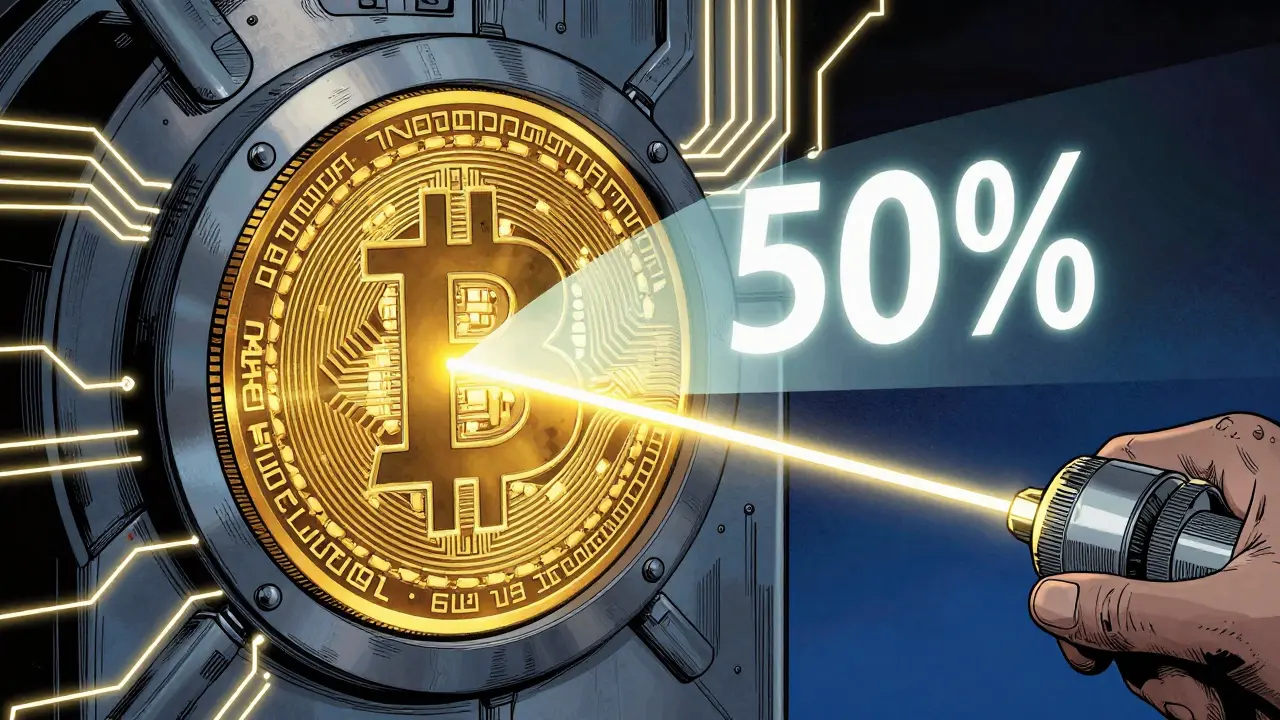
Imagine a world where the amount of money available is strictly capped, and every few years, the rate at which new money enters the system is slashed in half. That is exactly how Bitcoin halving is designed. It is not a random market event or a decision made by a CEO; it is a hard-coded rule in the software that fundamentally changes the supply side of the economy. For investors, this usually means one thing: a massive spike in price. But does the math actually hold up, or is it just a self-fulfilling prophecy?
The Quick Take: Halving Essentials
- What it is: A programmed reduction of the block reward for miners by 50% every 210,000 blocks (roughly every four years).
- The Goal: To prevent inflation and ensure a maximum supply of 21 million coins.
- Price Logic: Lower supply + steady or rising demand = upward price pressure.
- Miner Impact: Immediate revenue drop, often solved by price increases or better hardware.
The Mechanics of Scarcity
To understand the price action, you first have to understand the Block Reward. When a miner successfully processes a block of transactions, the network rewards them with new bitcoins. In the early days, this reward was 50 BTC. After the first halving, it dropped to 25, then 12.5, 6.25, and as of the April 20, 2024 event, it sits at 3.125 BTC.
This creates a predictable schedule of scarcity. Unlike Fiat Currency, where central banks can print trillions of dollars during a crisis, Bitcoin has a mathematical ceiling. This makes it a deflationary asset. When the flow of new coins into the market slows down, the existing coins become more valuable-assuming people still want to buy them.
Decoding the Historical Price Patterns
If we look back at the data, the halving has acted as a catalyst for some of the most aggressive bull runs in financial history. While the exact timing varies, the trajectory is remarkably consistent.
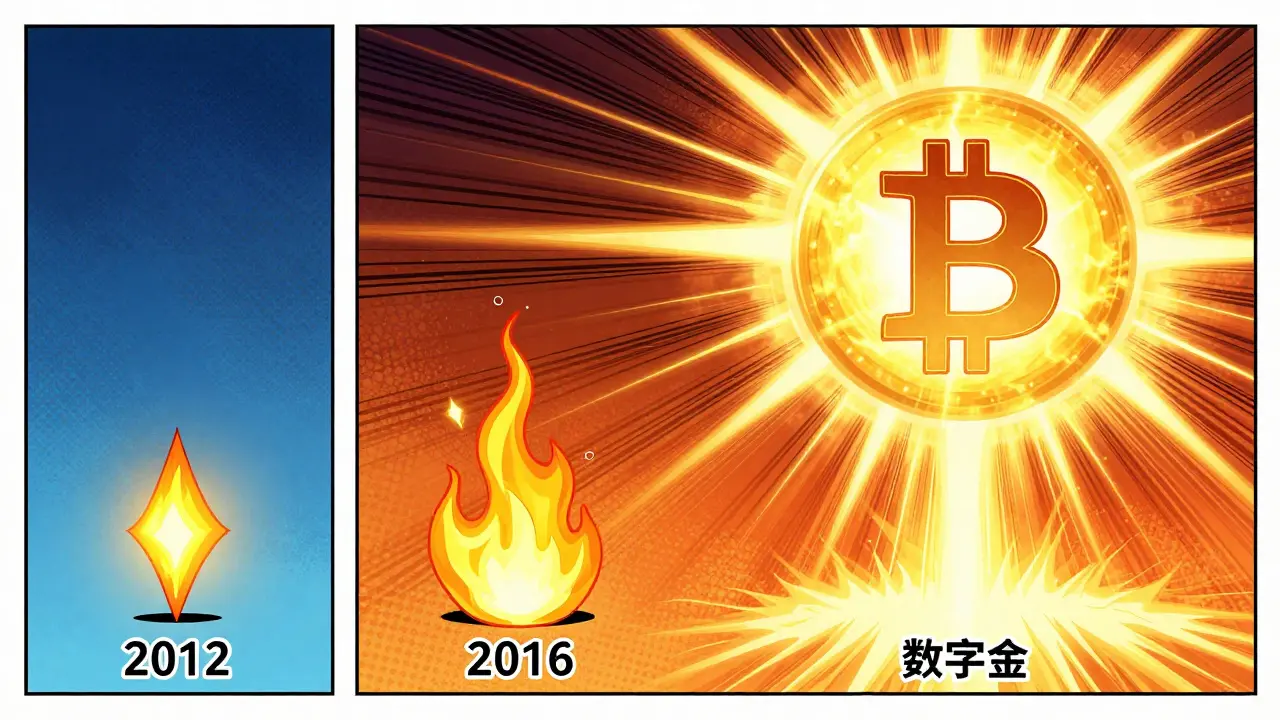
The 2012 halving was the first real test. Bitcoin was trading around $12. Within five months, it hit $229. That is an 1,800% increase. It proved that the network could survive the transition and that the scarcity narrative actually worked in the real world. Then came 2016, where the reward dropped to 12.5 BTC. This event happened just as the general public started noticing crypto. Bitcoin climbed from about $600 on halving day to a peak of nearly $20,000 by the end of 2017.
The 2020 event was different because it collided with a global pandemic. As governments pumped money into the economy to fight COVID-19, investors looked for a hedge against inflation. Bitcoin's reward dropped to 6.25 BTC, and the coin eventually rocketed past $60,000. It transitioned from a "tech experiment" to "digital gold." The most recent halving in April 2024 saw a reward of 3.125 BTC. While the immediate jump wasn't as wild as in 2012, it's largely because the market is now mature, with institutional players like ETFs absorbing the supply before the event even happens.
| Event Year | Block Reward | Approx. Price at Halving | Subsequent Peak / Trend |
|---|---|---|---|
| 2012 | 25 BTC | ~$12 | $1,100 (Late 2013) |
| 2016 | 12.5 BTC | ~$640 | ~$20,000 (2017) |
| 2020 | 6.25 BTC | ~$8,800 | ~$69,000 (2021) |
| 2024 | 3.125 BTC | ~$63,000 | Bullish trend toward $100k+ |
The Miner's Dilemma: Survival of the Fittest
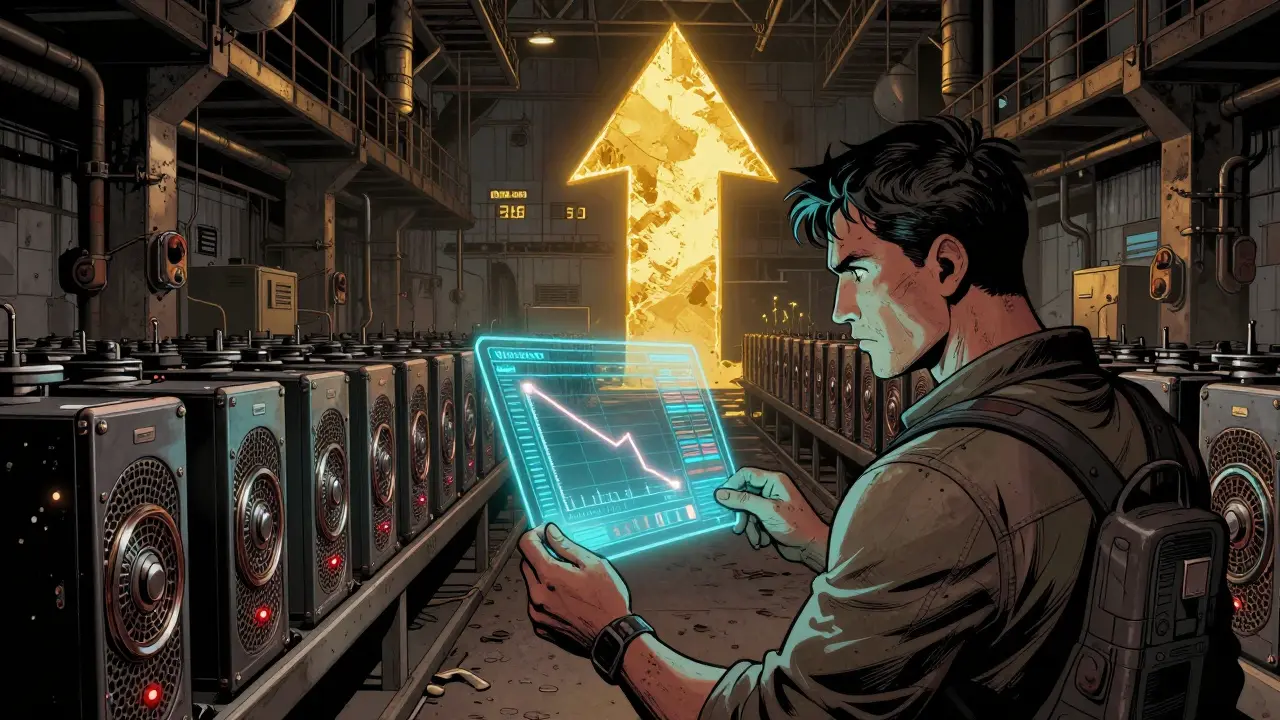
While investors cheer for the halving, miners often dread it. Imagine your salary being cut by 50% overnight, but your electricity bill stays exactly the same. That is the reality for Bitcoin Miners.
Immediately after a halving, the Hash Rate-the total computing power of the network-usually dips. This happens because inefficient miners, those using old hardware or expensive power, can no longer make a profit and are forced to shut down. However, this "shakeout" is actually healthy for the network. It clears the way for more efficient operators and forces the industry to innovate.
Historically, the price increase that follows the halving eventually compensates for the lost rewards. If the price of Bitcoin doubles, a miner earning 3.125 BTC makes the same amount of money they did when they earned 6.25 BTC at the old price. This creates a symbiotic relationship: the scarcity drives the price, and the price keeps the network secure.
Future Forecasts: Where Do We Go from Here?
Looking ahead to the window between 2025 and 2028, analysts are eyeing the $100,000 to $160,000 range. These predictions aren't just guesses; they are based on the intersection of the 2024 halving and macroeconomic shifts. For instance, if inflation stabilizes around 2% and central banks lower interest rates, more capital typically flows into "risk-on" assets like Bitcoin.
We also have to consider the role of institutional demand. With the arrival of spot ETFs and clearer regulations, the demand curve is no longer just driven by retail speculators. We are seeing a fundamental shift where corporations treat Bitcoin as a treasury reserve asset. When you combine a shrinking supply (due to the halving) with a growing pool of institutional buyers, the upward pressure becomes mathematically significant.
The next big event is expected in April 2028, when the reward will drop to 1.5625 BTC. By that point, the market will be even more efficient, and the price movements might be less volatile but more sustained.
Does the halving always guarantee a price increase?
While historical data from the last four halvings shows a strong correlation with price increases, it is not a mathematical guarantee. The halving only affects the supply. For the price to rise, demand must stay the same or increase. If people suddenly lose interest in Bitcoin, the price could drop despite the scarcity.
Why does the price usually peak months after the halving?
Markets rarely react instantly to a supply change. It takes time for the reduced issuance to impact the available liquidity on exchanges. Furthermore, the "halving trade" is often priced in early by speculators, leading to a period of volatility before the actual scarcity-driven bull run kicks in.
What happens when all 21 million bitcoins are mined?
Once the final bitcoin is mined (estimated around the year 2140), miners will no longer receive a block reward. Instead, they will be compensated entirely through transaction fees paid by users. This shifts the network's incentive from inflation (new coins) to a pure service-fee model.
Will the halving eventually stop affecting the price?
Yes, the impact diminishes over time. In the first halving, the reward dropped from 50 to 25 (a huge change in total supply). In the 2024 halving, it dropped from 6.25 to 3.125. Because so many coins are already in circulation, each subsequent halving has a smaller marginal effect on the total daily supply.
How can I track when the next halving will happen?
Halvings happen every 210,000 blocks. Since block times vary slightly based on the total mining power (hash rate), the exact date can shift. You can use a "block height explorer" to see how close the network is to the next 210k milestone.
What to Watch Next
If you are tracking the post-2024 cycle, don't just look at the price chart. Keep an eye on the Hash Rate; if it continues to climb despite the lower rewards, it means miners are becoming more efficient and the network is getting stronger. Additionally, monitor global inflation data. Bitcoin's appeal as a hedge is strongest when traditional currencies are losing value.
For those new to the space, the most important lesson from the last 14 years is that Bitcoin tends to reward patience over panic. The four-year cycle is a powerful tool, but it works best when you stop checking the price every hour and start looking at the supply schedule.

21 Comments
Suvoranjan Mukherjee
April 4 2026Spot on analysis of the supply-side dynamics! For those diving deeper into the technicals, the Hash Rate volatility usually creates a massive arbitrage opportunity for miners with low-cost energy solutions, basically forcing an industrial evolution of the network. This is a textbook example of programmatic scarcity meeting market demand and it's honestly an exhilarating time to be in the crypto space 🚀
Hugo Lopez
April 5 2026Really interesting perspective! I love how this breaks down the math behind the madness 😊
Bruce Micciulla Agency
April 6 2026the historical data provided is essentially a simplification of complex market psychology because most retail traders just buy the hype without understanding that the ETF absorption mentioned actually suppresses the volatility we saw in 2012 and 2016 making the 100k prediction more of a hopeful projection than a statistical certainty given the current macroeconomic headwinds and liquidity traps
Joshua Aldrich
April 7 2026totally agree with the point about miners. it's kinda like a natural selection process for hardware... only the most effcient survive. i always wondered if the energy waste is a bug or a feature and honestly maybe it's just the cost of trustless security in a world full of bad actors. thnx for the writeup!
vijendra pal
April 8 2026everyone knows halving is basic stuff!! 🙄 but you forgot to mention how layer 2 solutions make this even more bullish bc they handle the scale while BTC stays as the vault 💰💎
Sharhonda Walker
April 10 2026I think the most importe part here is the institutional buy in. if Blackrock is playin, the game has totally changed compared to 2012 when it was just a few nerds in a forum. the liquidity is just diffrent now
Manisha Sharma
April 10 2026Typical western centric view of economics lol. You people think you discovered scarcity? India has been dealing with real asset management for millennia while you play with digital coins. Such a basic explanation for something that is clearly just a glorified ponzi scheme for the elite 💅
Susan Wright
April 11 2026Actually, if you look at the transaction fee model mentioned for 2140, the network needs to see a massive increase in Layer 1 adoption or a very high fee per transaction to keep miners incentivized. That's why things like Ordinals or BRC-20 tokens are such a huge debate right now-they create artificial demand for block space to keep the network secure once the block reward is gone.
david head
April 12 2026so true!! 🚀🚀
Arwyn Keast
April 14 2026Absolute rubbish. The so-called 'mathematical ceiling' is just a psychological anchor for people who can't handle the reality of a volatile asset. It's all jargon-heavy nonsense designed to keep the herd buying into a system that produces zero tangible value for the British economy. Utterly pointless.
Emily 2231
April 15 2026The claim that this is just software is laughable. It is a tool for global surveillance and wealth redistribution by the shadow government. They want you to think the supply is capped while they manipulate the ETFs to control the exit points. Wake up. The 2028 date is just a distraction from the real collapse
Alexandra Lance
April 17 2026Oh wow, another a-ha moment about digital gold! How original 🙄. I'm sure the 'mathematical significance' will totally save us when the power grid fails and your coins become very expensive wallpaper 💅✨
alex rodea
April 17 2026Just keep holding. Long term wins.
June Coleman
April 17 2026Sure, let's just blindly trust a 'hard-coded rule' for the next 100 years. Because software never has bugs and people never find loopholes, right? Truly a foolproof plan 🙄
Krystal Moore
April 17 2026Honestly, it's just immoral to bet on the failure of fiat currencies while pretending this is some kind of savior. The volatility alone is a nightmare for anyone actually trying to use it for a living. It's just a casino for people who think they're smarter than the system!
Robert Coskrey
April 18 2026I concur with the general sentiment, however, the correlation between the halving and the price is perhaps more psychological than fundamental!!! The market anticipates the event, which is why the peaks often lag by several months!!!
Suzanne Robitaille
April 19 2026There is something almost poetic about the rhythmic breath of the network, expanding and contracting every four years like a cosmic heartbeat. It forces us to contemplate the nature of value itself-is it found in the utility of the thing or in the desperate longing for what is becoming rarer? It's a beautiful, dramatic dance of greed and hope that mirrors the human condition in the most visceral way possible.
Lauren Gilbert
April 21 2026I've always found it fascinating how we try to impose these rigid, mathematical cycles on a world that is inherently chaotic, and while the halving is a fixed point in the code, the way we react to it is purely a reflection of our collective anxiety and aspiration, which makes the price charts less about money and more about a psychological map of human desire over the last decade.
Sonya Bowen
April 21 2026Scarcity is a powerful tool. It transforms a utility into a store of value.
gladys christine
April 23 2026Omg the 2012 jump was literally insane!! imagine buying at 12 and just holding on for dear life... the absolute chaos of those early days was just a different vibe entirely
Taylor Meadows
April 23 2026You're all just chasing a ghost. The price doesn't matter if you don't have the spiritual discipline to handle the wealth. Most of you will sell at the first dip because you're emotionally bankrupt.