
How Moroccans Use Crypto for International Payments Despite the Ban
It’s 2025, and in Casablanca, a young entrepreneur named Samira sends $500 to her sister in Toronto every month. She doesn’t use Western Union. She doesn’t use banks. She uses Bitcoin.
Samira isn’t alone. Across Morocco, thousands of people are quietly bypassing the country’s official ban on cryptocurrency to send money abroad. The Central Bank of Morocco, Bank Al-Maghrib, outlawed all crypto transactions in November 2017. They called it a risk - no consumer protection, wild price swings, no legal recourse if something goes wrong. But for many Moroccans, the real risk isn’t crypto. It’s the bank.
Why the Ban Didn’t Stop Crypto
The ban was clear: no buying, no selling, no using Bitcoin, Ethereum, or any other digital currency. But enforcement? That’s another story. There are no crypto ATMs in Morocco. No licensed exchanges. No official apps. Yet, people still use it. How?It’s simple: they don’t need banks to send crypto. All you need is a phone, an internet connection, and someone who can receive it. A Moroccan living in Spain sends euros to a friend in Marrakech who then converts them into Bitcoin via a peer-to-peer (P2P) platform like LocalBitcoins or Paxful. That Bitcoin is then sent to a relative in Canada, who cashes it out through a local exchange. The whole process takes less than an hour. No paperwork. No 10% fees. No five-day waiting period.
Traditional remittance services like MoneyGram or Western Union charge up to 12% to send money from Europe to Morocco. Crypto? Often under 2%. For families relying on remittances - which make up nearly 8% of Morocco’s GDP - that difference isn’t just savings. It’s survival.
The Underground Network
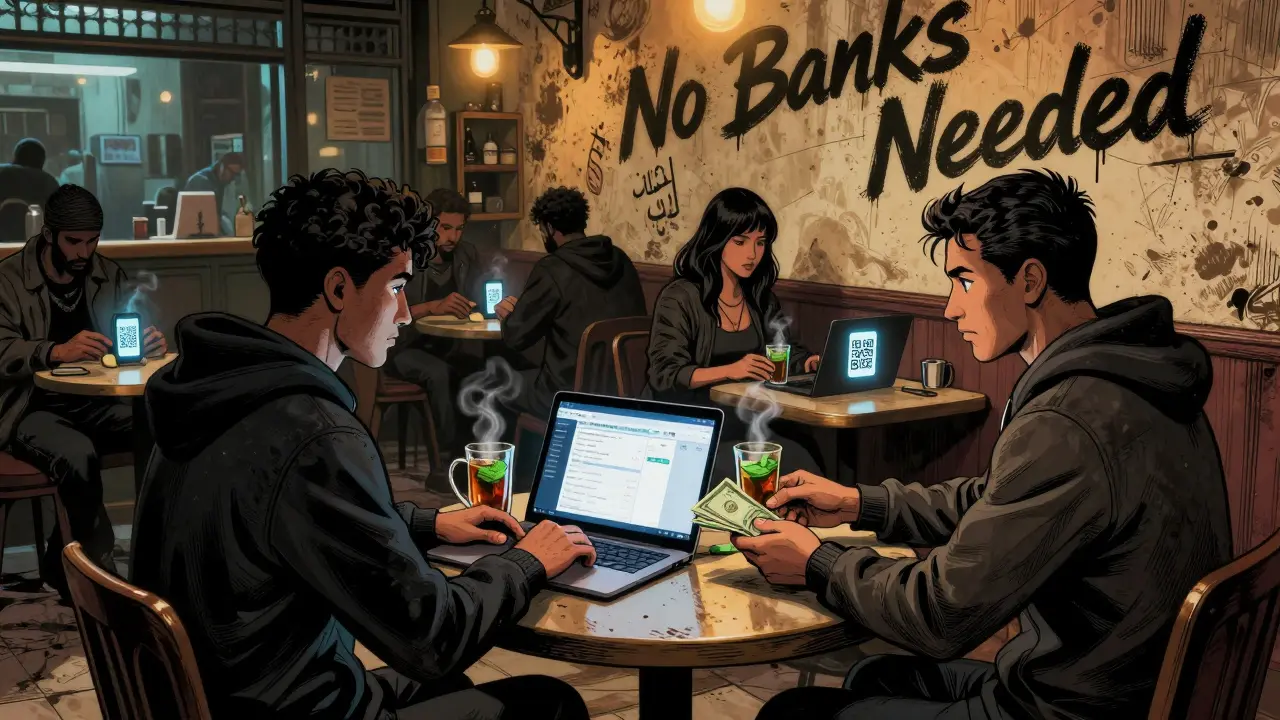
There’s no official data on how many Moroccans use crypto, but the numbers speak for themselves. Market projections estimate the Moroccan crypto market will hit $292.4 million by 2026. That’s not from legal exchanges. That’s from people trading in WhatsApp groups, Telegram channels, and hidden Facebook communities.People meet in cafes - not to chat, but to swap. A man walks in with a stack of euros. A woman sits across from him with her phone open to a crypto wallet. They agree on a rate. He gives her cash. She sends Bitcoin to his address. No receipts. No ID. No trace. It’s not perfect, but it’s reliable.
Some use crypto to pay for services abroad - online courses, software subscriptions, freelance work. A graphic designer in Fes gets paid in USDT (Tether) from a client in the U.S. He holds it for a few days, then sells it to a local buyer for dirhams. He doesn’t need a business account. He doesn’t need approval. He just needs a phone.
Why Crypto Beats the Bank
Morocco has strict foreign exchange controls. If you want to send money out of the country legally, you need permits, forms, and weeks of waiting. For small amounts, it’s not worth the hassle. For larger ones, the bureaucracy is a wall.Crypto cuts through that. No central authority. No currency limits. No government monitoring. Transactions settle on the blockchain in minutes. Once confirmed, they’re final. No chargebacks. No reversals. No frozen accounts.
Compare that to a traditional bank transfer: $1,000 sent from Morocco to France might take three days, cost $50 in fees, and get stuck because the recipient’s bank flagged it as “suspicious.” With crypto? Same amount. Same destination. Done in 15 minutes. $5 in fees. No questions asked.
And for Moroccans living abroad - there are over 5 million in Europe alone - crypto is the only way to send money home without losing half of it to fees and delays.
The Central Bank’s Dilemma
Bank Al-Maghrib isn’t ignoring the problem. They’re trying to solve it - on their own terms.In 2025, they announced a draft law to legalize and regulate cryptocurrencies. That’s a big shift. But it’s not about letting people trade Bitcoin freely. It’s about controlling it. The central bank wants to issue its own digital currency - a Central Bank Digital Currency (CBDC) - for international payments.
This CBDC would work like crypto: fast, digital, and global. But unlike Bitcoin, it would be fully controlled by the government. Every transaction tracked. Every user identified. No anonymity. No risk of fraud. No chance of money laundering.
They’re even working with Egypt and the World Bank to build a regional CBDC network for North Africa. The goal? Replace underground crypto with a government-approved version.
But here’s the catch: Moroccans don’t want control. They want freedom. They don’t want to be monitored. They want to send money without asking permission.
The Real Risk Isn’t Crypto - It’s the System
Bank Al-Maghrib warns about volatility, fraud, and theft. And yes, those are real risks. But so are the risks of the current system.How many Moroccans have lost money because their bank froze their account? How many small businesses can’t get paid because international payments get blocked? How many families wait weeks for money that could have arrived in minutes?
Crypto isn’t perfect. But it’s the only system that works for them.
People who use crypto aren’t criminals. They’re parents, students, freelancers, and small business owners. They’re not trying to evade taxes or launder money. They’re trying to survive a broken financial system.
What’s Next?
The draft law to legalize crypto could pass by mid-2026. But even if it does, it won’t kill the underground market. It’ll just change it.People will still use Bitcoin and Ethereum for cross-border payments - because those networks aren’t controlled by any government. But now, they might also use the new Moroccan CBDC for official remittances.
It’s not a choice between crypto and the bank. It’s a choice between control and freedom. And for now, most Moroccans are choosing freedom.
The future won’t be crypto vs. the state. It’ll be crypto and the state - coexisting, competing, and sometimes, working together.

How It Actually Works: A Real Example
Here’s how it works in practice:- A Moroccan in Paris needs to send 5,000 euros to his brother in Rabat.
- He uses a P2P app to sell euros for USDT (Tether) to a buyer in Morocco.
- He sends the USDT to his brother’s wallet - a simple copy-paste of a wallet address.
- His brother opens a local exchange app, sells the USDT for dirhams, and withdraws cash at a nearby shop.
- Total time: 20 minutes. Total fee: $3.
Compare that to a bank transfer: 5 business days, $75 in fees, and a 40% chance the transfer gets flagged and delayed.
Who Uses It and Why
- Students abroad: Pay tuition in the U.S. or Canada without bank restrictions. - Freelancers: Get paid in crypto from global clients without waiting for wire transfers. - Diaspora families: Send money home without paying 10% in fees. - Small importers: Pay suppliers in China or Turkey without dealing with Moroccan forex rules.It’s not about speculation. It’s not about gambling. It’s about access. Crypto gives people what the banking system refuses to: speed, control, and dignity.
The Future Is Already Here
Morocco’s crypto ban was meant to protect people. But it ended up protecting the system - not the users.As the central bank moves toward a CBDC, it’s not stopping crypto. It’s acknowledging it. The underground market won’t disappear. It’ll just get smarter.
For now, Moroccans are using crypto not because they hate banks - but because banks don’t work for them.
And until the system changes to serve real people - not just regulations - crypto will keep flowing.




18 Comments
Khaitlynn Ashworth
December 31 2025So let me get this straight - the government bans crypto because it’s ‘risky,’ but the banking system that charges 12% to send money to your own family? That’s *safe*? 🤡
Moroccans aren’t criminals. They’re just smarter than the people writing laws that don’t work for them.
rachael deal
December 31 2025This is honestly one of the most hopeful things I’ve read all year. People creating systems that work when the institutions fail? That’s resilience. That’s human ingenuity. Keep going, Moroccans. You’re showing the world how it’s done.
Elisabeth Rigo Andrews
January 1 2026The regulatory arbitrage here is textbook. Central bank issues CBDC to capture transactional data, monetize surveillance, and maintain monetary sovereignty - while the underground crypto ecosystem thrives on permissionless settlement and privacy-preserving value transfer. The state wants control. The people want autonomy. This isn’t a market failure. It’s a governance failure.
Bruce Morrison
January 2 2026I’ve seen this in other countries too. When the system fails the people, they build their own. No drama. No speeches. Just a phone, a wallet, and a shared trust in code. The banks didn’t lose because of crypto. They lost because they stopped listening.
nayan keshari
January 3 2026India banned crypto too. Then people used it anyway. Now the government wants to tax it. Same script. Different country. People don’t care about your laws if your system is broken.
Raja Oleholeh
January 4 2026Crypto is for weak economies. Real nations have strong banks. Morocco should fix its own system instead of stealing tech from the West. #MakeMoroccoGreatAgain
Prateek Chitransh
January 4 2026Funny how the same people who scream 'crypto is a scam' when it’s decentralized suddenly get quiet when it’s their cousin in Toronto getting paid in USDT instead of waiting 5 days for a wire.
It’s not about legality. It’s about utility. And utility wins every time.
Alex Strachan
January 6 2026Imagine if every country let people use tech that actually works instead of clinging to 1980s banking infrastructure 😅
Also - $3 to send money across continents? That’s the future. And it’s already here. 🚀
Rick Hengehold
January 8 2026The central bank is scared because crypto doesn’t need them. That’s the real threat. Not volatility. Not fraud. Independence.
Brandon Woodard
January 8 2026It is a profound irony that the institution tasked with safeguarding financial integrity has, in effect, become an impediment to economic dignity for its own citizens. The emergent informal network, while technically noncompliant, exhibits a higher fidelity to the ethical imperatives of financial inclusion than the formal apparatus ever has.
Antonio Snoddy
January 10 2026You know what’s really happening here? It’s not about money. It’s about sovereignty. The blockchain doesn’t care who you are. It doesn’t ask for your ID, your passport, your bank statement. It just moves value. And in a world where governments track your coffee purchases and your Spotify habits, this is the last place where you can still be anonymous. Where you can still be free. Where you can still just… exist. Without permission. Without surveillance. Without fear. That’s why it’ll never die. Not because it’s profitable. Because it’s sacred.
Ryan Husain
January 12 2026This is a classic case of regulatory lag. The state is trying to control a decentralized system with centralized tools. It’s like trying to stop the tide with a fence. The real question isn’t whether crypto will survive the ban - it’s whether the central bank will adapt or become irrelevant.
Rajappa Manohar
January 13 2026this is real life stuff man. no bs. just people findin a way
Jacky Baltes
January 15 2026There’s something deeply poetic about people using code to bypass bureaucracy. It’s not rebellion - it’s restoration. They’re not breaking the system. They’re rebuilding it with what they have. No permission needed. Just a phone and a will.
prashant choudhari
January 16 2026This is the future of finance. Fast cheap and borderless. Governments will try to regulate it but the technology will keep evolving. The people always win in the end
Willis Shane
January 18 2026While I acknowledge the pragmatic necessity of crypto adoption under restrictive regimes, I must emphasize that the absence of regulatory oversight introduces systemic vulnerabilities that could precipitate cascading financial instability among vulnerable populations. The ethical imperative to protect citizens must supersede convenience.
Jake West
January 19 2026Wow. So Moroccans are geniuses because they broke the law? Congrats. You’re a criminal with a smartphone. The bank isn’t broken - you’re just too lazy to fill out forms. #FirstWorldProblems
Shawn Roberts
January 21 2026this is wild 😍 people just building their own economy like it’s no big deal. no banks no permits no drama. just send the money. that’s it. 🙌🔥