
Is Crypto Regulated in India? The 2026 Legal & Tax Reality
You might be wondering if you can legally buy Bitcoin or Ethereum in India today. The short answer is yes, but with a major catch: the government treats it less like a currency and more like a taxable asset that they are watching very closely. As of mid-2026, crypto regulation in India has settled into a specific framework. It is not banned, but it is heavily taxed and strictly monitored. You won’t find a comprehensive "Crypto Act" on the books yet, but you will find a robust set of tax laws and anti-money laundering rules that dictate how you must operate.
If you are holding digital assets in an Indian bank account, you need to understand that the landscape changed dramatically between 2024 and 2025. The days of vague warnings from the Reserve Bank of India (RBI) have been replaced by concrete financial obligations under the Income Tax Department. This guide breaks down exactly where things stand right now, what the new laws mean for your wallet, and which agencies are keeping an eye on your transactions.
The Core Definition: What Is a VDA?
To understand the rules, you first need to know how the law defines what you own. In India, cryptocurrencies do not have their own unique legal category called "cryptocurrency." Instead, they fall under the umbrella term Virtual Digital Asset (VDA). This definition was formalized in the Income Tax Act, specifically Section 2(47A), and reinforced by the Income Tax (No. 2) Bill, 2025, which received presidential assent in August 2025.
A VDA is defined as any code, number, token, or piece of information created through cryptographic means. This is a broad net. It catches:
- Cryptocurrencies: Bitcoin (BTC), Ether (ETH), Solana (SOL), etc.
- Non-Fungible Tokens (NFTs): Digital art, collectibles, and ownership tokens.
- Stablecoins: Even tokens pegged to fiat currencies are VDAs unless they are actual government-issued fiat (like the Indian Rupee).
The key distinction here is that while these assets are legal to hold and trade, they are explicitly not recognized as legal tender. You cannot use Bitcoin to pay for groceries or settle a debt in India. Doing so could lead to complications with banking partners who are required to monitor such flows. The law recognizes them as assets-similar to gold or shares-but strips them of their function as money.
The Tax Regime: 30% Plus TDS
This is the part that affects your bottom line immediately. The Indian government decided early on that if it wasn't going to ban crypto, it would make sure it generated revenue from it. The current tax structure is one of the strictest in the world.
When you sell, swap, or transfer any VDA, you trigger a tax event. Here is how the math works:
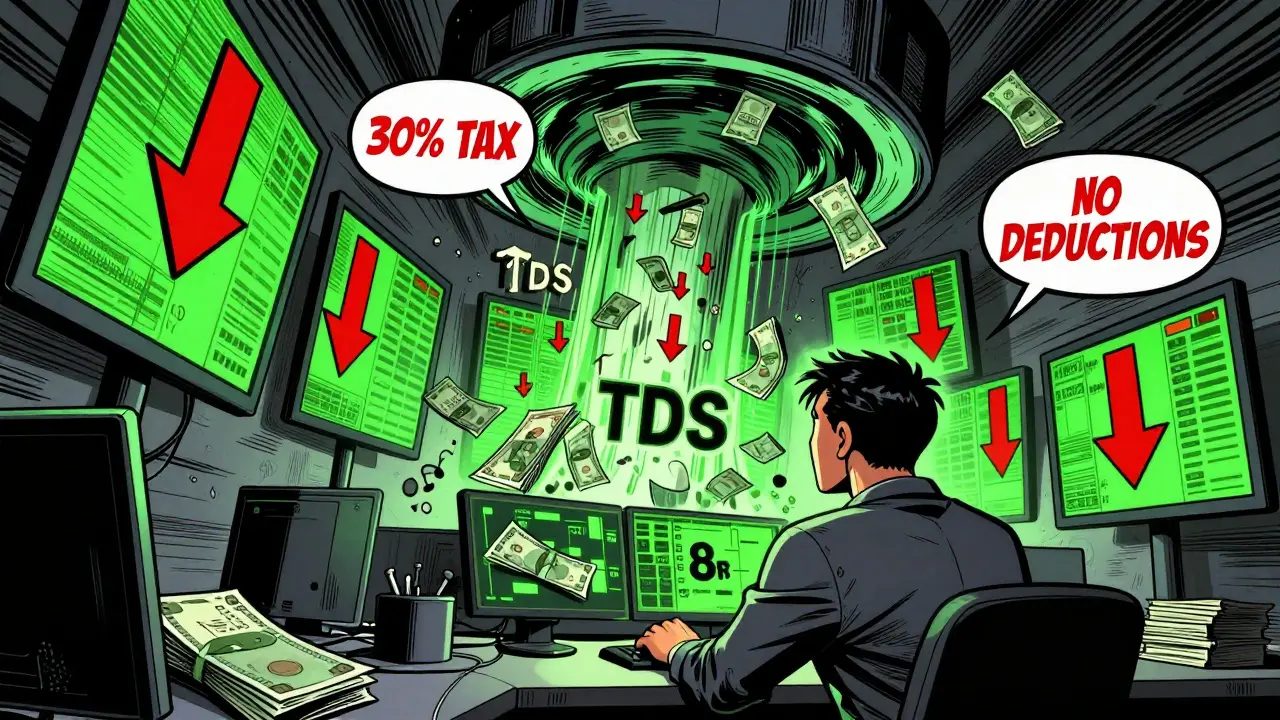
- Flat 30% Tax Rate: All gains from the transfer of VDAs are taxed at a flat rate of 30%. This applies regardless of your income slab. Whether you are a student or a high-net-worth individual, the rate is the same.
- No Deductions Allowed: Unlike stocks or real estate, you cannot claim expenses. If you paid for electricity, hardware wallets, or exchange fees, those costs do not reduce your taxable gain. Only the cost of acquisition (the price you bought the coin for) is deducted from the sale price to calculate the profit.
- No Set-Off Against Losses: This is crucial. If you made a ₹10 lakh profit on Bitcoin but lost ₹5 lakh on Ethereum, you cannot offset the loss against the profit. You still pay 30% tax on the full ₹10 lakh gain. The loss on Ethereum is ignored for tax purposes in that year.
- 1% TDS (Tax Deducted at Source): On every transaction above a certain threshold, exchanges must deduct 1% of the transaction value as TDS. This ensures the government gets its share upfront. If you trade frequently, this can significantly impact your liquidity because that 1% is locked up until you file your returns.
This regime was designed to discourage speculative trading while capturing revenue from serious investors. For many retail traders, the combination of no loss set-offs and high TDS has made active day-trading much less profitable than it was in previous years.
Who Is Watching? The Regulatory Agencies
There is no single "Crypto Commission" in India. Instead, oversight is shared among several powerful agencies, each focusing on a different angle of the ecosystem.
| Agency | Role & Responsibility | Impact on Users |
|---|---|---|
| Reserve Bank of India (RBI) | Monetary policy and banking stability. Views crypto as a macroeconomic risk. | Banks may restrict accounts involved in high-volume crypto transfers due to RBI guidelines. |
| Income Tax Department | Enforces tax compliance under the CBDT. Tracks undeclared income. | Sends notices for unreported crypto gains; cross-checks data with exchanges. |
| Financial Intelligence Unit India (FIU-IND) | Anti-Money Laundering (AML) enforcement. | Requires all crypto exchanges to register and report suspicious transactions. |
| Securities and Exchange Board of India (SEBI) | Regulates securities markets. Monitoring if crypto products qualify as securities. | May regulate initial coin offerings (ICOs) or tokenized securities in the future. |
The Financial Intelligence Unit India (FIU-IND) plays a particularly critical role. Since 2022, all cryptocurrency exchanges operating in India must register with the FIU-IND to comply with Anti-Money Laundering (AML) laws. This means your identity is verified, your source of funds is checked, and your transaction history is reported to the government. Unregistered offshore exchanges pose a higher risk because they may not adhere to these reporting standards, potentially leading to frozen bank accounts if the RBI flags unusual activity.
From Ban to Grey Area: A Brief History
Understanding the current state requires looking back at the rollercoaster ride India has taken since 2013. The journey explains why regulations are so cautious today.
In December 2013, the RBI issued its first public caution about Bitcoin, warning users of potential financial and security risks. By 2018, the central bank went further, issuing a circular that prohibited all regulated entities (banks and payment system operators) from providing services to virtual currency businesses. This effectively killed the crypto industry in India overnight. Exchanges shut down, and traders were left without banking access.
However, this ban was short-lived. On March 4, 2020, the Supreme Court of India struck down the RBI’s ban in the landmark case Internet and Mobile Association of India v Reserve Bank of India. The court ruled that the RBI did not have the authority to ban banks from dealing with crypto businesses. This decision revived the market, leading to a massive surge in adoption throughout 2021.
But the revival came with a price. The government responded not with a ban, but with the tax regime described earlier. Simultaneously, the Ministry of Finance drafted the Banning of Cryptocurrency & Regulation of Official Digital Currency Bill, 2019. While this bill aimed to prohibit private cryptocurrencies, it has never been introduced in Parliament as of 2026. This legislative silence keeps the market in a "grey area": legal to trade, but lacking clear protective laws for consumers or investors.
Global Context: G20 and International Standards
India does not regulate crypto in isolation. As the host of the 2023 G20 summit, India pushed for a unified global approach to digital asset regulation. This effort resulted in agreements on the Crypto-Asset Reporting Framework (CARF).
CARF is significant for Indian residents. It mandates standardized reporting of tax information on cryptocurrency transactions for automatic exchange between jurisdictions. In simple terms, if you hold crypto in an Indian exchange, that data can be shared with other countries if you have ties elsewhere. Conversely, if you use foreign exchanges, India expects to receive that data. This international cooperation closes loopholes that previously allowed investors to hide assets overseas.
The goal is to prevent illicit activities and ensure that cryptocurrencies do not undermine traditional financial systems. For the average user, this means greater transparency. The era of anonymous crypto trading is ending globally, and India is aligning itself with these stricter international norms.
What About CBDC? The Digital Rupee
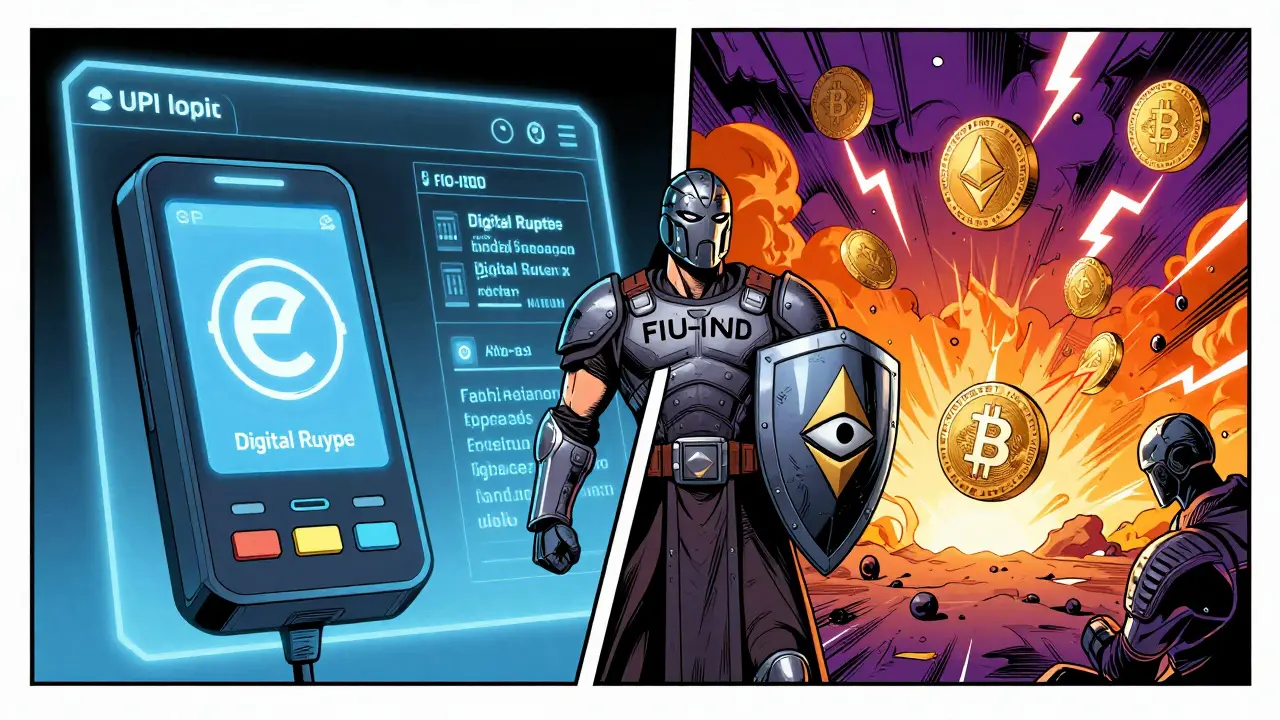
While regulating private crypto, the government is also building its own alternative. The Central Bank Digital Currency (CBDC), known as the e₹ (Digital Rupee), is being rolled out by the RBI. Unlike Bitcoin, the e₹ is a direct liability of the central bank and holds the same value as physical cash.
The existence of the Digital Rupee highlights the government's dual strategy: encourage the use of state-backed digital currency for payments while restricting private cryptocurrencies to investment assets only. You will likely see the e₹ integrated into UPI (Unified Payments Interface) for seamless daily transactions, whereas Bitcoin remains a volatile asset held in separate wallets.
Risks and Pitfalls for Investors
Navigating this environment requires caution. Here are the most common pitfalls:
- Using Offshore Exchanges: Trading on platforms not registered with FIU-IND increases the risk of your bank account being flagged for non-compliance. Stick to Indian-registered exchanges like CoinDCX, WazirX, or ZebPay to ensure proper KYC and tax reporting.
- Ignoring TDS Limits: The 1% TDS accumulates quickly. If you trade frequently, you may exhaust your annual TDS limit, requiring you to manually pay advance tax to avoid penalties. Keep track of your cumulative turnover.
- Misclassifying Income: Some users try to classify crypto gains as capital gains from stocks to benefit from lower rates. This is illegal. The IT department has specific codes for VDA income. Misreporting can lead to heavy penalties and scrutiny.
- Scams and Hacks: Because there is no investor protection fund for crypto (unlike insurance for bank deposits), if an exchange goes bankrupt or gets hacked, you lose everything. The regulatory framework does not currently provide recourse for such losses.
Future Outlook: What Changes in 2026 and Beyond?
As we move through 2026, the focus remains on enforcement rather than new legislation. The draft ban bill remains dormant, suggesting the government prefers the current tax-and-monitor model. However, expect tighter integration between banking APIs and crypto exchanges. Real-time reporting of transactions is likely to become standard, making tax evasion nearly impossible.
Additionally, SEBI may introduce clearer guidelines on tokenized securities. If a crypto project issues tokens that represent equity or debt, SEBI will likely classify them as securities, bringing them under stricter corporate governance rules. For pure cryptocurrencies like Bitcoin, the status quo of "taxable asset" is expected to continue.
The key takeaway for any participant in the Indian crypto market is compliance. The government is not trying to stop you from owning crypto, but it wants to ensure it knows about it and taxes it accordingly. Stay updated on FIU-IND registrations, maintain detailed records of all transactions, and consult a tax professional familiar with VDA rules before making large moves.
Is it illegal to buy Bitcoin in India?
No, it is not illegal to buy, sell, or hold Bitcoin in India. It is classified as a Virtual Digital Asset (VDA). However, it is not legal tender, meaning you cannot use it to pay for goods or services.
How much tax do I pay on crypto profits in India?
You pay a flat 30% tax on all gains from crypto transfers. Additionally, there is a 1% TDS on transactions above specified thresholds. No deductions for expenses are allowed, and losses cannot be set off against profits.
Can I use my bank account for crypto transactions?
Yes, you can use your bank account to deposit and withdraw funds from registered crypto exchanges. However, the RBI monitors these transactions, and excessive or suspicious activity may lead to account restrictions.
What happens if I don't declare my crypto income?
The Income Tax Department cross-checks data from exchanges. If you fail to declare income, you may face penalties, interest charges, and potential prosecution for tax evasion. The 1% TDS also provides a paper trail for authorities.
Will the government ban crypto in the future?
Currently, there is no active ban. The draft bill to ban private cryptocurrencies has not been passed. The government's current stance is to regulate and tax crypto rather than prohibit it, although this could change with new legislation.
Which exchanges are legal in India?
Exchanges must register with the Financial Intelligence Unit India (FIU-IND) to operate legally. Popular compliant exchanges include CoinDCX, WazirX, and ZebPay. Always verify an exchange's registration status before using it.
Does the Digital Rupee replace Bitcoin?
No, they serve different purposes. The Digital Rupee (e₹) is a stable, government-backed currency for payments. Bitcoin is a volatile, decentralized asset for investment. They coexist in the Indian financial ecosystem.




24 Comments
Suman Patil
June 14 2026Bro, this is the real tea. The VDA definition is super broad now so even if you hold some random meme coin or NFT, its all taxed same way. No set-off means if you lose on ETH but win on BTC, you still pay 30% on the BTC profit. It's brutal for active traders but at least we know the rules now instead of living in that grey area from 2021. Just stick to FIU-IND registered exchanges like CoinDCX or ZebPay to keep your bank account safe from RBI flags.
Kumaran sowkarpet
June 14 2026Nice summary bro :) I think many people still confuse Digital Rupee with Bitcoin. e-Rupee is for payments and stable while BTC is volatile asset. Govt wants us to use UPI for daily stuff not crypto. Also remember 1% TDS eats into liquidity fast if you trade often. Keep records properly else IT dept will send notice :)
Amit Thakur
June 15 2026The lack of loss set-off is absolute poison for portfolio management. You cannot hedge effectively when losses are ignored for tax purposes. This forces retail investors into a corner where they either stop trading or accept massive inefficiencies. The jargon here is correct but the impact is devastating for anyone trying to do serious arbitrage or options strategies. We need a proper regulatory body not just tax men watching wallets.
Josh Dodson
June 17 2026so true man i always forget about the tds part until i see my balance drop. its crazy how much it adds up. also dont use offshore exchages unless u want ur bank ac frozen lol. stay compliant guys.
ravi mahla
June 17 2026Haha yeah compliance is key but let's be honest most of us just hope our exchange doesn't rug pull since there is no insurance fund. The sarcasm in the post about 'watching closely' is understated. They are watching every penny. But hey, as long as we can buy BTC legally, I'm good. Just wish the tax rate was lower than 30%. That's basically confiscatory.
sreeja boora
June 17 2026It is imperative that citizens understand the gravity of these regulations. India has taken a firm stance against financial instability caused by unregulated assets. The classification of crypto as a Virtual Digital Asset rather than legal tender is a necessary step to protect the integrity of the Indian Rupee. Those who fail to declare income are not only breaking the law but undermining the national economic framework. Strict adherence to FIU-IND guidelines is mandatory for all residents.
Mauricio Contreras Loredo
June 18 2026Oh wow, another country turning crypto into a taxable nightmare. Just what we needed more bureaucracy. The G20 push for global standards is just code for 'let's make sure everyone pays taxes so we can fund our bloated governments.' Meanwhile the rest of the world is figuring out how to innovate. India chooses to monitor and tax. Typical.
Grace Newman
June 20 2026The implications of CARF are far more sinister than mere tax collection. This framework allows for unprecedented surveillance of individual financial activities across borders. When India shares data with other jurisdictions under the guise of anti-money laundering, it creates a panopticon where privacy is extinct. One must question why the government feels the need to track every transaction of a decentralized asset. It suggests a deeper agenda of control over monetary sovereignty.
Filbert Reeves
June 22 2026Everyone is sleeping on the fact that this whole setup is just a temporary measure before they ban it completely. Look at the draft bill from 2019. It never died, it just went dormant. The tax regime is a test to see how much revenue they can squeeze before pulling the plug. And don't get me started on the Digital Rupee. That is literally a tool for total surveillance. Every transaction tracked by the central bank. Crypto was supposed to be freedom but now it's just another line item for the IRS equivalent. I tell you the system is rigged to crush the little guy. They want you to use their digital slave currency.
Annemarie Fitzgerald
June 23 2026the existential dread of being watched by the state is palpable here. one wonders if the soul of commerce has been lost to the algorithmic gaze of the FIU. perhaps we should return to barter systems where the only witness to our transactions is the divine. anyway good info on the tax rates i guess
Danna Charris
June 25 2026Please read the section on offshore exchanges again. Using unregistered platforms is not 'smart', it is reckless. Your bank account will be flagged and likely frozen. There is no glory in getting caught ignoring AML laws. Stick to compliant exchanges.
Andrea Burd
June 25 2026ugh another boring tax post. nobody reads this stuff. just dump btc and run away to el salvador or something. too much reading for my brain today
Charles Pawlikowski
June 26 2026This is exactly why America leads. We have clear rules and innovation. India tries to copy but ends up creating a mess of taxes and restrictions. Sad to see such potential wasted on bureaucracy :( Maybe if they focused on growth instead of control they would succeed. But no, they choose to stifle their own people with 30% tax. Pathetic.
Abby Sivertsen
June 28 2026I feel for the traders dealing with this. It's really aggressive how they treat losses. If you lose money you can't offset it? That's harsh. I guess they want to discourage day trading. But honestly if you are holding long term maybe it's fine. Just scary if your bank freezes your account for no reason. Stay safe everyone.
Fede Faith
June 28 2026Great breakdown. For those new to this, the key takeaway is documentation. Keep every receipt. The 1% TDS is deducted automatically so you don't need to worry about paying it upfront but you do need to claim it back when filing returns. Make sure your accountant knows about VDA codes. Don't try to hide it as capital gains from stocks because the IT department matches data from exchanges. Compliance is the only way to survive here.
Benjamin Eisen
June 29 2026does this mean if i mine bitcoin at home i still pay 30% on the value when i sell it? or is mining considered income first? i am a bit confused about the cost of acquisition part. does electricity count? the post says no deductions allowed which sounds strict.
Fede Faith
June 29 2026Yes, mining rewards are treated as income at fair market value on the day received. Then when you sell later, any increase is taxed again at 30%. Electricity costs are NOT deductible. Only the initial value counted as income is your cost basis. It's very strict.
Kenneth Riley
July 1 2026the entire structure is flawed. taxing gains without allowing loss offsets is economically illiterate. it punishes risk taking and encourages stagnation. the drama of having your bank account frozen for using an offshore exchange is unnecessary fear mongering by banks who just want to avoid rbi scrutiny. meanwhile the rich find loopholes. typical broken system.
Sonya O'Brien
July 2 2026While I appreciate the detailed overview of the current regulatory landscape in India regarding virtual digital assets, it is important to consider the broader implications for international investors who may have ties to multiple jurisdictions due to the implementation of the Crypto-Asset Reporting Framework which facilitates automatic exchange of information between countries thereby reducing the ability to hide assets overseas and ensuring greater transparency in global financial markets which ultimately aims to prevent illicit activities and protect the stability of traditional financial systems although some may argue that this level of oversight infringes upon personal privacy rights.
Eric Scheinberg
July 4 2026The distinction between legal tender and taxable asset is critical. Many users mistakenly believe that because they can transact, it is currency. It is not. The RBI's stance remains consistent: crypto poses macroeconomic risks. Therefore banking partners are instructed to monitor flows. Users must adhere to KYC norms strictly. Non-compliance results in account restrictions. This is not punitive; it is regulatory necessity.
pankaj chawla
July 5 2026Agreed with the points on SEBI monitoring tokenized securities. If tokens represent equity they will fall under SEBI. Pure crypto like BTC stays as VDA. Important to differentiate. Don't mix them up in your portfolio strategy.
Jessica Lane
July 7 2026I found the section on risks particularly useful. The warning about scams and hacks is vital since there is no investor protection fund. Unlike bank deposits insured by DICGC, crypto losses are final. Please ensure you use hardware wallets and reputable exchanges. Do not leave large amounts on exchanges.
Mark Brunschwiler
July 7 2026Why do we need rules? Money should be free. The government is stealing our freedom with taxes. 30 percent is theft. I hate this. I want to trade without asking permission. The digital rupee is evil. It tracks everything. I am sad that crypto is becoming regulated. It loses its magic. I feel empty inside when I think about filling tax forms. Please stop regulating us. Let us be free. I cry for the future of finance.
Nick Rice
July 8 2026Stay strong traders. The market will adapt. Use the tools available. Learn the tax laws. Comply with FIU-IND. Success comes to those who prepare. Do not let the 30% tax scare you off entirely. Calculate your entry points carefully. Long term holds might be better given the no-loss-setoff rule. Keep learning and growing.