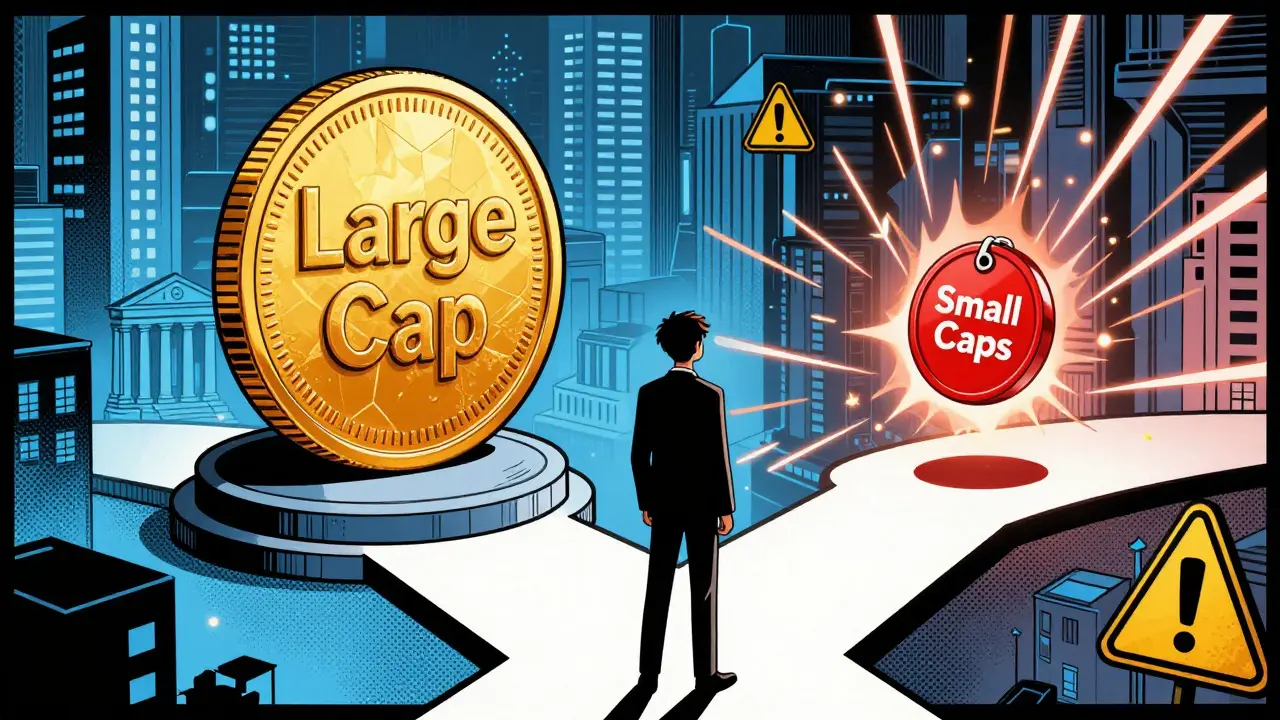
Large-Cap vs Small-Cap Crypto: Risk, Rewards, and Market Cap Categories Explained
Picture this: You find a shiny new cryptocurrency token. The price is $0.05. It looks cheap. You buy as many as you can afford, dreaming of it hitting $1.00 and making you rich overnight. But wait-before you click "buy," have you checked the market cap? If that coin has a supply of 10 billion tokens, its total value is already $500 million. To hit $1.00 per token, the project would need to become worth $10 billion-a massive leap requiring global adoption. This is why looking at price alone is a trap. Understanding market capitalization categories is the difference between gambling and investing.
In the world of blockchain and digital assets, we borrow a concept from traditional stock markets to classify coins by their size. Just like stocks are divided into large companies (like Apple or Microsoft) and smaller startups, cryptocurrencies are split into large-cap and small-cap segments based on their total circulating value. This classification isn't just about numbers; it tells you everything about risk, liquidity, and potential growth. Let's break down exactly how these categories work, where the lines are drawn, and how you can use this knowledge to build a smarter portfolio in 2026.
How Crypto Market Cap Actually Works
To understand the categories, you first need to know how the number is calculated. It’s simple math, but it’s often misunderstood. Market capitalization (or market cap) is determined by multiplying the current price of a single coin by the number of coins currently in circulation.
Formula: Current Price × Circulating Supply = Market Cap
Let’s look at Bitcoin as an example. If Bitcoin is trading at $70,000 and there are approximately 19.6 million BTC in circulation, the math looks like this: $70,000 × 19,600,000 = $1.37 trillion. That huge number represents the total market value of all existing Bitcoins. It doesn’t matter if one person holds 100 BTC or if ten thousand people hold 1 BTC each; the total value remains the same.
Here is where it gets tricky for beginners: Circulating Supply vs. Max Supply. Not all coins are created equal when it comes to availability. Some projects, like Bitcoin, have a hard cap on the maximum number of tokens that will ever exist (21 million). Others have no limit. When analyzing a coin, always check the circulating supply, not the total or max supply. Why? Because tokens that haven’t been released yet don’t affect the current market price. However, savvy investors also look at the Fully Diluted Valuation (FDV), which assumes all future tokens are in circulation. A low market cap with a massive FDV signals heavy future inflation, meaning the price could drop significantly as more tokens enter the market.
The Three Tiers of Crypto Assets
While there is no single universal law governing these definitions, major exchanges and analysts generally agree on three main tiers. These thresholds help you quickly gauge the maturity and stability of a project.
| Category | Market Cap Range | Characteristics | Risk Level |
|---|---|---|---|
| Large-Cap | > $1 Billion | High liquidity, established track record, widely adopted | Lower (Relative to crypto) |
| Mid-Cap | $50 Million - $1 Billion | Growing projects, moderate liquidity, higher volatility | Moderate |
| Small-Cap / Low-Cap | $1 Million - $50 Million | New or niche projects, thin order books, speculative | Very High |
Note that these ranges differ significantly from traditional stock markets. In equities, a "small-cap" company might be valued at $250 million to $2 billion. In crypto, anything under $50 million is considered small. This reflects the younger, more volatile nature of the digital asset ecosystem.
Large-Cap Crypto: The Blue-Chip Anchor
When people talk about "safe" bets in crypto, they are usually referring to large-cap cryptocurrencies. These are the giants of the industry-coins like Bitcoin, Ethereum, and Binance Coin. They typically have market caps exceeding $1 billion, though the top few are measured in the hundreds of billions or even trillions.
Why do investors flock to large caps? It comes down to liquidity and stability. Because so many people trade these assets, you can buy or sell millions of dollars worth without drastically moving the price. The order books are deep. Additionally, large caps have survived multiple market cycles. They have proven technology, active development teams, and widespread recognition. Institutional investors, who manage pension funds and endowments, primarily stick to this tier because it offers the most predictable exposure to the crypto sector.
However, "lower risk" does not mean "no risk." Large caps can still drop 20% or 30% in a bear market. The advantage is that they are less likely to go to zero. Their sheer size makes them harder to manipulate. For a coin with a $500 billion market cap to double in price, it needs to attract $500 billion in new investment-a monumental task. Therefore, while large caps offer safety, their percentage growth potential is naturally capped compared to smaller players.

Small-Cap Crypto: High Risk, High Reward
If large caps are the steady anchors, small-cap cryptocurrencies are the wild rockets. These are projects with market caps between $1 million and $50 million. They are often new launches, niche utility tokens, or experimental protocols. This is where the dream of turning $1,000 into $100,000 lives-but also where most retail investors lose money.
The primary characteristic of small caps is volatility. Because the market cap is small, a relatively modest amount of buying pressure can send the price soaring. Conversely, a small sell-off can crash the price by half in minutes. Liquidity is another major concern. Many small caps are listed on only one or two exchanges, and the order books are thin. This creates a phenomenon known as a "liquidity trap." You might see a coin priced at $1.00 on your screen, but when you try to sell 1,000 tokens, the lack of buyers forces the price down to $0.80, then $0.60, as you execute your trade. You exit the position at a significant loss, even though the chart looked good.
Investing in small caps requires intense due diligence. You aren't just betting on the price; you are betting on the team, the technology, and the community. Is there a real product? Are the developers active? Is the tokenomics sustainable? Without rigorous research, small-cap investing is indistinguishable from gambling. Many projects in this category fail entirely, leaving holders with worthless tokens.
Comparing Large-Cap vs Small-Cap: What Should You Choose?
The choice between large and small caps isn't about picking a winner; it's about defining your role in the market. Think of your portfolio like a sports team. You need a solid defense (large caps) to protect your capital, and a flashy offense (small caps) to score big points.
Liquidity: Large caps win here. You can enter and exit positions instantly with minimal slippage. Small caps may require patience and careful timing to avoid impacting the price against yourself.
Growth Potential: Small caps have the ceiling. A $10 million project growing to $100 million is a 10x return. A $1 trillion project growing to $2 trillion is only a 2x return. Mathematically, smaller bases allow for larger multipliers.
Risk Profile: Large caps are resilient. Even in a crash, they tend to recover. Small caps are fragile. If interest fades, funding runs out, or a better competitor emerges, small caps can disappear forever.
A balanced strategy often involves allocating the majority of funds (e.g., 70-80%) to large-cap assets for stability, and using a smaller portion (20-30%) for mid-to-small-cap plays to capture outsized gains. This way, if your small-cap bets fail, your core wealth remains intact. If they succeed, they boost your overall returns significantly.

Common Pitfalls to Avoid
Even experienced traders make mistakes when dealing with market caps. Here are three traps to watch out for:
- Ignoring Fully Diluted Valuation: A coin might have a $10 million market cap today, but if 90% of its tokens are locked and set to release next year, the effective valuation is much higher. When those tokens unlock, selling pressure will likely crush the price.
- Confusing Price with Value: A coin costing $0.01 is not necessarily "cheap" if it has a trillion-token supply. Always calculate the market cap before judging affordability.
- Neglecting Volume: Market cap tells you the size; volume tells you the activity. A high market cap with low daily trading volume suggests stagnation. Look for healthy volume-to-market-cap ratios to ensure the asset is actively traded.
Conclusion: Using Market Cap as a Compass
Market capitalization categories are not rigid rules, but they are powerful tools for navigation. They provide a quick snapshot of a project's maturity, risk, and liquidity. By understanding the distinction between the stability of large-cap blue chips and the explosive potential of small-cap gems, you can construct a portfolio that aligns with your personal risk tolerance. Remember, in crypto, size matters-not just for status, but for survival.
What is the safest crypto to invest in?
Generally, large-cap cryptocurrencies like Bitcoin and Ethereum are considered the safest options within the digital asset space. They have the highest liquidity, longest track records, and broadest institutional adoption. While no crypto is risk-free, large caps are less likely to suffer catastrophic failures compared to smaller, newer projects.
Can small-cap crypto go to zero?
Yes, it is very common for small-cap cryptocurrencies to lose most or all of their value. Due to lower liquidity, weaker development teams, and higher susceptibility to market sentiment, many small-cap projects fail to gain traction and eventually become worthless. This is why diversification is crucial.
What is the difference between market cap and fully diluted valuation?
Market cap is calculated using the current circulating supply (tokens available now), while Fully Diluted Valuation (FDV) uses the maximum possible supply (all tokens that will ever exist). FDV helps investors understand potential future inflation. If a coin has a low market cap but a high FDV, it means many tokens are yet to be released, which could dilute the price over time.
Is a low price per coin a good sign?
Not necessarily. A low price per coin can be misleading if the total supply is massive. For example, a coin priced at $0.001 with 100 billion tokens has a $100 million market cap. To reach $1.00, it would need a $100 billion market cap, which is extremely difficult. Always analyze the market cap rather than just the unit price.
How do I identify a legitimate small-cap project?
Look for transparency and activity. Check if the development team is public and verified. Review the code repository for regular updates. Analyze the tokenomics to ensure fair distribution and reasonable vesting schedules. Finally, assess the community engagement and whether the project solves a real-world problem. Avoid projects with anonymous teams and vague roadmaps.