Morocco Crypto Ban: How Underground Trading Works Despite Restrictions
Imagine trying to buy a coffee with Bitcoin in Casablanca. You can’t. In fact, if you try to use cryptocurrency for any payment there, you are breaking the law. Since November 2017, Morocco has enforced a strict nationwide ban on all cryptocurrency activities, including buying, selling, mining, and using digital assets like Bitcoin or Ethereum. The central bank, Bank Al-Maghrib, declared these transactions illegal to protect monetary sovereignty and prevent capital flight. Yet, walk into any tech hub in Rabat or Marrakech, and you will find a thriving, shadow economy where millions of dirhams change hands for digital coins every day.
This contradiction is what experts call the 'Crypto Paradox.' While the government says no, the people say yes. Underground adoption hasn’t just survived; it has exploded. Estimates suggest that around 1.2 million Moroccans have engaged with crypto since the ban began. That is roughly 3.2% of the entire population. They aren’t doing it through official banks. They are doing it through WhatsApp groups, Telegram channels, and peer-to-peer networks that operate entirely outside the legal framework. This isn’t just a niche hobby for tech geeks. It’s becoming a primary tool for remittances, speculation, and cross-border trade.
The Mechanics of the Shadow Market
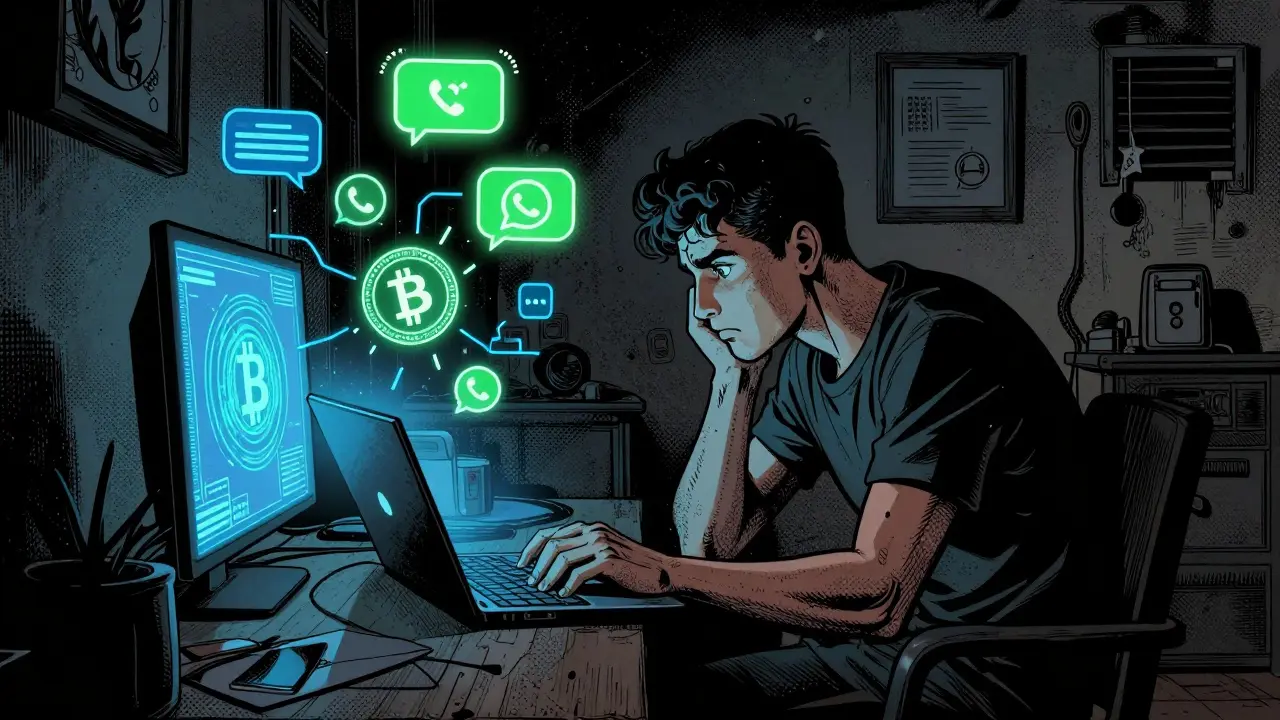
How do you trade something that is illegal? You go dark. The Moroccan underground ecosystem relies heavily on mobile-based peer-to-peer (P2P) transactions. According to recent data, about 82% of users access crypto through international exchange apps like Binance, Bybit, and OKX. But here is the catch: these platforms are often geo-blocked or restricted within the country. So, users rely on Virtual Private Networks (VPNs). Services like NordVPN or ExpressVPN cost between MAD 120 and MAD 180 monthly, but they are considered essential utilities for anyone serious about crypto in Morocco.
Once connected, the actual trading happens informally. There is no centralized Moroccan exchange. Instead, 68% of transactions occur through informal networks coordinated via messaging apps. Think of it as a decentralized bazaar. You join a WhatsApp group with 50 to 200 members. Someone posts they want to sell Bitcoin for Dirhams. You negotiate a price, which usually includes a premium due to the risk involved. Then, you transfer money via traditional bank transfer or mobile wallet, and the seller releases the crypto from their personal wallet to yours.
This process is slow and expensive. In regulated markets, transaction fees might be 0.1%. In Morocco’s underground market, fees average between 3.8% and 5.2%. Settlement times are also sluggish. While a regulated trade settles instantly, an OTC (Over-The-Counter) deal in Morocco takes an average of 72 hours to complete. Why? Because trust is scarce. Both parties are wary. Buyers fear sending money and getting nothing. Sellers fear releasing crypto and not getting paid. To mitigate this, larger transactions often require multi-person verification or the use of trusted local intermediaries who charge a 'network fee' of 1.5% to 2.5% per transaction.
Why People Ignore the Law
If the risks are high and the costs are steep, why do so many Moroccans participate? The answer lies in necessity and opportunity. The primary driver is international remittances. About 44% of crypto transactions in Morocco are used to receive money from abroad. For families receiving funds from relatives in Europe or North America, traditional banking channels can be slow, expensive, and subject to strict foreign exchange controls. Crypto offers a faster, albeit riskier, alternative. A survey by Morocco World News found that 41% of users consider crypto their primary method for receiving international payments.
Speculation is the second biggest motivator. With 31% of users engaging in trading, many young Moroccans see Bitcoin and Ethereum as investment vehicles similar to stocks, but with higher potential returns. The demographic profile of these traders is distinct: 68% are aged 18-35, 83% live in urban areas with populations over 500,000, and 72% earn more than MAD 10,000 monthly. These are educated, connected individuals who understand the technology and are willing to navigate the gray areas of the law to gain financial autonomy.
There is also a growing interest in stablecoins like USDT. Making up 15.8% of trading volume, stablecoins offer a way to store value without the extreme volatility of Bitcoin. For a country facing inflationary pressures, holding dollars in digital form provides a hedge against currency devaluation. This practical use case has helped sustain demand even when Bitcoin prices dip.
| Feature | Regulated Market | Morocco Underground Market |
|---|---|---|
| Transaction Fees | 0.1% - 0.5% | 3.8% - 5.2% |
| Settlement Time | Near-instant | Average 72 hours |
| Legal Status | Legal & Compliant | Illegal / Prohibited |
| Primary Access Method | Local Exchanges | International Apps + VPNs |
| Fraud Risk | Low (Insured/Regulated) | High (32% encounter scams) |

The Risks of Going Underground
Trading in the shadows comes with significant dangers. The most immediate threat is fraud. On Reddit’s r/CryptoMorocco community, which has over 12,000 members, users frequently share stories of bad experiences. Approximately 32% of participants report encountering fraud attempts, primarily non-delivery scams where a seller disappears after receiving payment. One user shared that after making 22,000 MAD in profit over three years, they lost 3,500 MAD in a single scam when a counterparty vanished.
Then there is the risk of account freezes. International exchanges are increasingly aware of their exposure to jurisdictions with strict bans. If Binance or Bybit detects suspicious activity linked to a Moroccan IP address or bank account, they may freeze your funds. About 12% of surveyed users have experienced this. Recovering those funds can be a nightmare, involving lengthy appeals processes and requests for documentation that proves the legality of your source of funds-a tricky proposition when the activity itself is technically prohibited.
Legal threats are another concern. While mass arrests of individual traders are rare, authorities do monitor large-scale operations. Nine percent of users reported facing legal threats or inquiries from officials. The government’s original rationale for the ban included concerns about money laundering and illicit financing. Although internal assessments show that only 4.3% of crypto-related crimes involve such activities, the stigma remains. Engaging in underground trading means you have no legal recourse if things go wrong. You cannot sue a scammer in court because your contract was based on an illegal activity.
The Shift Toward Regulation
But the landscape is changing. The prohibition model has failed to stop adoption. Instead, it pushed it underground, increasing risks for consumers and losing out on tax revenue. Recognizing this, the government has pivoted. In November 2024, Bank Al-Maghrib Governor Abdellatif Jouahri announced that a draft law to regulate cryptocurrency was in the final stages of adoption. This marks a historic shift from total ban to controlled integration.
The proposed regulatory framework addresses the core concerns that led to the 2017 ban. It introduces mandatory Anti-Money Laundering (AML) and Countering the Financing of Terrorism (CFT) compliance. All exchanges operating in Morocco will need licenses from Bank Al-Maghrib, with application costs estimated between MAD 150,000 and MAD 200,000. This creates a barrier to entry that filters out shady operators while allowing legitimate businesses to flourish.
Key components of the new law include:
- KYC Verification: Strict Know Your Customer protocols for all transactions to ensure identity transparency.
- Taxation: A 15% capital gains tax on crypto profits, bringing digital assets in line with other investment classes.
- Oversight: The Moroccan Capital Market Authority (AMMC) will oversee Initial Coin Offerings (ICOs) and security tokens.
- Commercial Restriction: Crucially, the law still prohibits using cryptocurrency for commercial payments and settlements. Businesses must continue using traditional banking channels for trade.
Dr. Fatima Zahra El Moudni, a professor of financial regulation at Mohammed V University, noted that this shift reflects a pragmatic recognition that prohibition had increased financial risks rather than mitigating them. With underground activity growing by an estimated 140% since 2017, regulation offers a path to safety. Industry analysts project that formal regulation could increase the market size by 35-40% within 18 months, potentially reaching USD 292.4 million by 2026. More importantly, it could reduce consumer risk exposure by 62%.
What This Means for Users
For the average Moroccan crypto enthusiast, the transition to regulation brings both relief and complexity. No more hiding behind VPNs for basic trades. No more fearing frozen accounts from international platforms. Licensed local exchanges will provide a secure environment with customer protection mechanisms. However, users will now face stricter scrutiny. Every transaction will be tracked. Profits will be taxed. The days of anonymous, cash-heavy deals are ending.
The learning curve for safe practices remains steep. New users currently take an average of 8.2 weeks to become proficient in navigating the underground market. Under regulation, this education will shift toward understanding compliance, tax obligations, and how to verify licensed providers. Trust will no longer be built solely on reputation within a WhatsApp group, but on institutional backing and legal accountability.
Morocco’s journey mirrors broader trends in North Africa. While neighbors Algeria and Tunisia maintain strict bans, Egypt launched a regulatory sandbox in late 2023, positioning itself as a fintech leader. Morocco aims to follow suit, transforming into a regional hub for digital finance. By embracing the reality of its citizens’ behavior, the government hopes to harness the innovation of blockchain technology while maintaining control over its monetary system. For the 1.2 million Moroccans already trading in the shadows, this light at the end of the tunnel represents a chance to finally bring their assets into the open.
Is it still illegal to own cryptocurrency in Morocco?
As of mid-2026, the strict ban enacted in 2017 is being replaced by a regulatory framework. While owning crypto is not explicitly criminalized for individuals, using it for commercial payments remains prohibited. The new laws focus on regulating exchanges and enforcing taxes, rather than punishing individual holders, provided they comply with KYC and AML rules.
How do Moroccans buy Bitcoin without a local exchange?
How do Moroccans buy Bitcoin without a local exchange?
Most users rely on international platforms like Binance or Bybit accessed via VPNs. Transactions are executed through Peer-to-Peer (P2P) networks where buyers transfer Dirhams directly to sellers' bank accounts or mobile wallets, and sellers release crypto from their personal wallets. This process is coordinated largely through WhatsApp and Telegram groups.
What are the main risks of trading crypto underground in Morocco?
The primary risks include fraud (with 32% of users reporting scam attempts), high transaction fees (3.8-5.2%), slow settlement times (average 72 hours), and the lack of legal recourse. Additionally, users face the risk of account freezes by international exchanges and potential legal scrutiny from authorities, although mass arrests of small traders are rare.
When will the new crypto regulations in Morocco take effect?
The draft law was announced in November 2024, with implementation targeted for Q3 2025. As of July 2026, the regulatory framework is in place, requiring exchanges to obtain licenses from Bank Al-Maghrib and imposing a 15% capital gains tax on profits.
Can I use cryptocurrency to pay for goods and services in Morocco?
No. Even under the new regulatory framework, the use of cryptocurrency for commercial payments and settlements remains prohibited. Businesses must continue to use traditional banking channels and the Moroccan Dirham for all domestic and international trade transactions.