North Korea Crypto Ban and State-Sponsored Hacking Operations
North Korea doesn’t allow its citizens to own cryptocurrency. That’s not because it fears volatility or scams - it’s because it wants to steal it all itself.
The Crypto Ban That Isn’t a Ban at All
North Korea officially bans its people from using Bitcoin, Ethereum, or any other digital currency. If you’re caught trading crypto inside the country, you face prison. But here’s the twist: the regime doesn’t care if its own hackers steal billions from exchanges overseas. In fact, they depend on it.The crypto ban isn’t meant to protect citizens. It’s a smokescreen. While ordinary North Koreans can’t touch crypto, the state has turned digital asset theft into a national priority - one that funds missiles, nuclear weapons, and covert operations around the world. This isn’t crime. It’s policy.
The ByBit Hack: A New Benchmark in Cyber Warfare
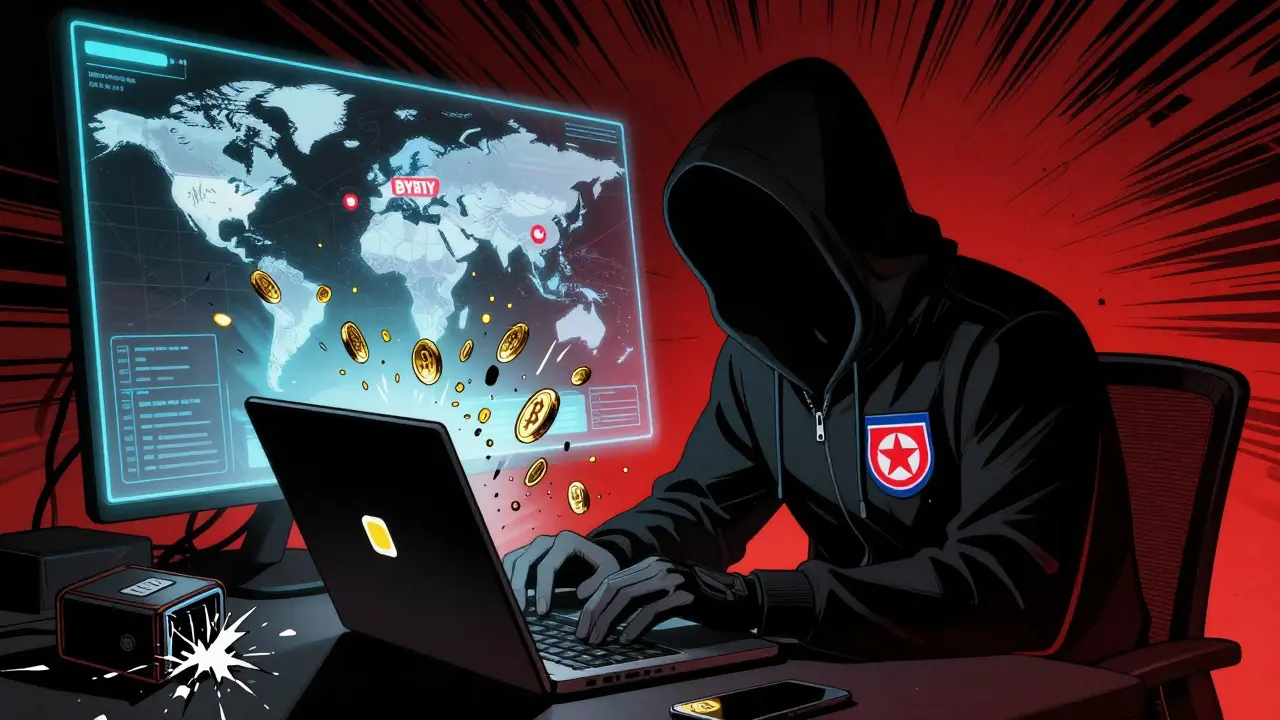
On February 21, 2025, the world’s largest cryptocurrency exchange, ByBit, was breached. The hackers didn’t break in through a weak password or a misconfigured server. They didn’t use malware or brute force. They used human error - the oldest trick in the book.The FBI labeled the operation "TraderTraitor." And it worked. Over $1.5 billion in crypto vanished - the biggest single theft in history. What made it shocking wasn’t just the amount. It was how they got in. ByBit stored most of its assets in "cold wallets" - hardware devices kept offline, disconnected from the internet, designed to be unhackable. Yet somehow, the attackers accessed these wallets. The only explanation? Someone inside the company, working remotely, was compromised.
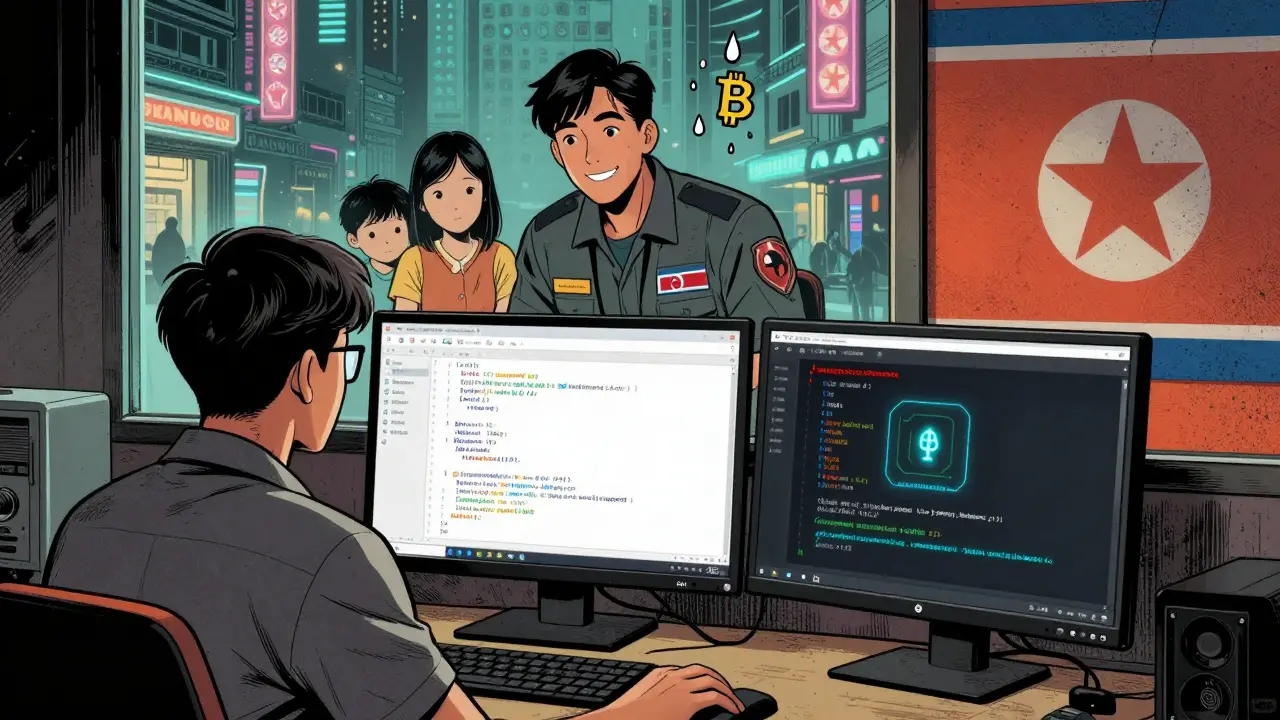
That someone was likely a North Korean IT worker posing as a freelancer from Vietnam, Poland, or Kenya. According to United Nations reports, over 10,000 North Koreans are embedded in foreign tech firms under fake identities. They work as developers, customer support agents, or DevOps engineers. They get paid in crypto. And when they’re not building apps, they’re planting backdoors.
How North Korea Turns Coders into Cash Machines
North Korea’s cyber army doesn’t just hack exchanges. It builds them.Think of it like a shadow corporation. The regime recruits young engineers, trains them in Pyongyang’s elite cyber academies, then sends them abroad under false passports. They apply for jobs on Upwork, Toptal, or LinkedIn. They build portfolios with stolen code. They pass interviews with flawless English. Once hired, they use their access to infiltrate networks, steal credentials, and quietly route funds to wallets controlled by the state.
The UN estimates these operations bring in $600 million a year. That’s not pocket change. That’s enough to buy 200 tons of uranium or fund a dozen missile tests. And because the payments are in cryptocurrency - untraceable, irreversible, decentralized - there’s no paper trail for banks to follow.
The Laundering Pipeline: Cambodia, Stablecoins, and Ghost Networks
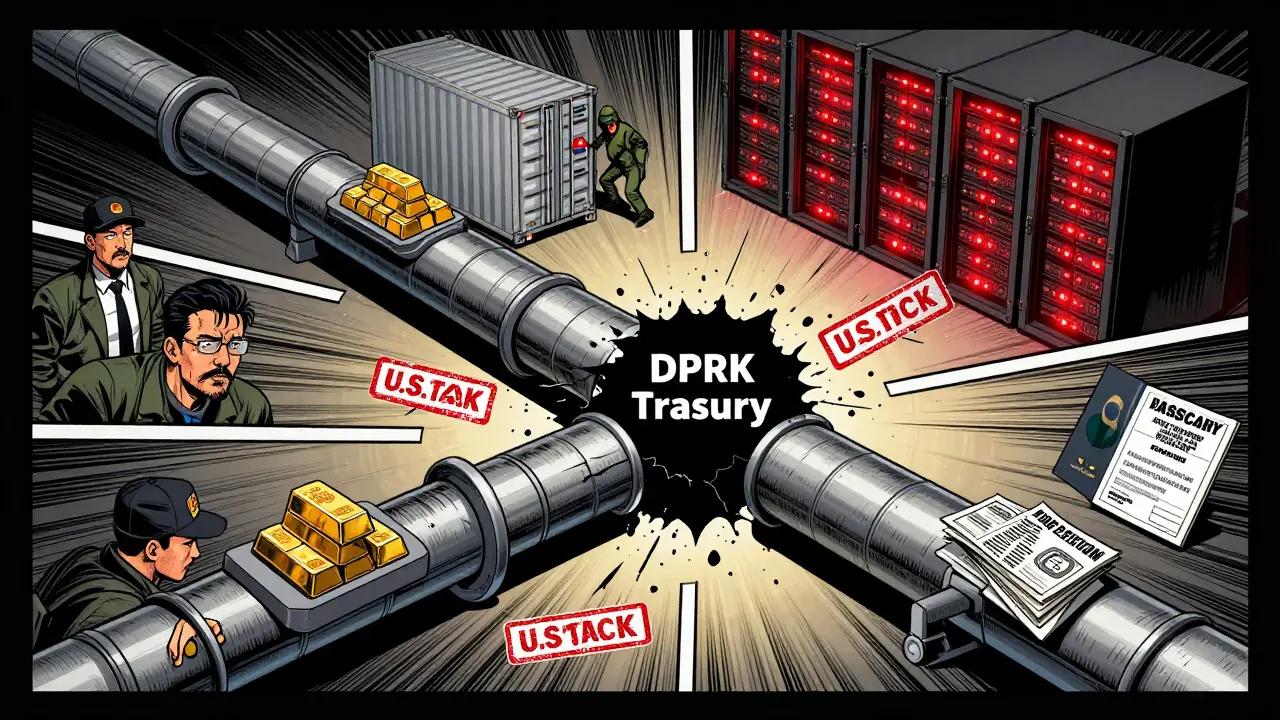
Stealing crypto is one thing. Turning it into cash is another. That’s where Cambodia comes in.In 2025, the U.S. Treasury’s FinCEN shut down the Huione Group - a Cambodian company with ties to North Korean operatives. Huione Crypto issued its own stablecoin, HuioneUSD, which couldn’t be frozen or tracked. It was perfect for laundering stolen funds. The stolen ByBit assets? Many flowed through Huione’s network. Then they were converted into real money - cash, gold, luxury cars - all while avoiding international sanctions.
This isn’t random. It’s a system. North Korea uses third countries as financial pipelines: Cambodia for laundering, China for hardware smuggling, Russia for server hosting, and Africa for fake identities. Each node in the chain is designed to break the link between the theft and the regime.
U.S. Response: Sanctions, Rewards, and a Growing Crisis
The U.S. government has responded with force. In March 2025, the Treasury Department sanctioned Korea Sobaeksu Trading Company - a front organization tied directly to DPRK cyber units. Three individuals were named: Kim Se Un, Jo Kyong Hun, and Myong Chol Min. Jo Kyong Hun, in particular, was identified as the IT team leader who coordinated crypto theft with Kim Se Un.The Department of Justice unsealed indictments against seven North Korean nationals for sanctions evasion. Meanwhile, the State Department offered rewards of up to $7 million for information leading to their arrest. Senators Elizabeth Warren and Jack Reed demanded answers: What’s being done to stop these attacks? Why are exchanges still vulnerable?
The answer? Not enough. Most crypto platforms still rely on outdated security models. They trust employee IDs. They assume remote workers are safe. They don’t verify location data. They don’t check for anomalies in login patterns. And North Korea? They’ve been studying those weaknesses for years.
Why This Isn’t Just About Money
This isn’t a cybercrime problem. It’s a national security emergency.Every dollar stolen from a crypto exchange goes toward funding North Korea’s weapons programs. The same hackers who broke into ByBit are likely the ones probing U.S. defense contractors, power grids, and satellite systems. The line between financial theft and cyberwarfare is gone.
And the world is still unprepared. Exchanges keep adding new coins. DeFi protocols launch without audits. Wallets get hacked because no one checks who’s really behind the screen. North Korea doesn’t need to break into a vault anymore. They just need to hire someone who already has the keys.
What Comes Next?
The scale of North Korea’s 2025 operations - over $2.17 billion stolen - proves one thing: traditional sanctions don’t work. You can freeze bank accounts. You can block wire transfers. But you can’t stop a hacker who’s sitting in a living room in Hanoi, using a laptop bought with stolen crypto.The solution isn’t more laws. It’s better tech. Exchanges need to implement zero-trust architectures. They need to verify every login with biometrics and device fingerprinting. They need to monitor for unusual patterns - like a developer logging in from a data center in North Korea while claiming to be in Toronto.
Governments need to share threat intelligence faster. Right now, the FBI knows about a malicious wallet. The European Union doesn’t. By the time they find out, the money’s already gone.
And until the world treats this like the war it is - not just a crime - North Korea will keep winning. Not because they’re the best hackers. But because everyone else is still pretending this is a technical problem.
Why does North Korea ban crypto for its citizens but steal it globally?
North Korea bans crypto for its citizens to prevent them from accessing outside financial systems or learning about the global economy. But the regime sees crypto theft as a strategic tool - a way to bypass sanctions and fund its military programs without using traditional banking. It’s not a contradiction. It’s a tactic.
How did hackers breach ByBit’s cold wallets?
Cold wallets are designed to be offline and secure. But the ByBit hack didn’t target the wallets directly. Instead, attackers compromised an employee with access to the system - likely a North Korean worker posing as a remote contractor. They used stolen credentials and malware to trigger transfers from the cold storage, bypassing security by exploiting human trust, not technical flaws.
Are North Korean hackers the only ones stealing crypto?
No. Criminal gangs, ransomware groups, and rogue actors steal billions every year. But North Korea is the only state actor that does it systematically, at scale, and with direct ties to weapons programs. While others steal for profit, North Korea steals for survival.
Can cryptocurrency exchanges stop these attacks?
Yes - but only if they stop treating security like a checkbox. Most exchanges still rely on outdated methods like two-factor codes and IP whitelisting. To stop North Korean hackers, they need zero-trust frameworks, behavioral analytics, real-time geolocation checks, and mandatory third-party audits. It’s expensive. But cheaper than losing $1.5 billion.
What role does China play in North Korea’s crypto theft?
China doesn’t officially support North Korea’s crypto operations, but its border regions - especially in Yunnan and Liaoning - serve as key transit points for laundering. North Korean hackers use Chinese crypto ATMs, underground exchanges, and peer-to-peer networks to convert stolen assets into yuan or cash. Enforcement is weak, and corruption is common. Without Chinese cooperation, global efforts to trace these funds will continue to fail.
Is there any way to trace stolen crypto from North Korea?
Yes - but it’s slow. Blockchain analytics firms like Chainalysis and TRM Labs have mapped hundreds of wallets linked to North Korean operations. The FBI tracks transactions across Ethereum, Bitcoin, and Solana. But once funds move through mixers, bridges, or stablecoins like HuioneUSD, tracing becomes nearly impossible. The real challenge isn’t finding the money - it’s stopping it before it leaves the exchange.
What happens if North Korea steals more than $3 billion in 2026?
If thefts hit $3 billion, it will trigger a global financial crisis. Major exchanges may freeze withdrawals. Regulators could shut down entire DeFi protocols. Central banks might ban crypto entirely. And the U.S. and allies may launch cyber counterstrikes - not just to recover funds, but to destroy infrastructure. The next phase won’t be about tracking wallets. It will be about disabling the hackers’ tools.




14 Comments
lori sims
February 26 2026Can we just take a second to appreciate how terrifyingly elegant this whole operation is? North Korea doesn’t need to crack a vault-they just hire someone who already has the keys. It’s like a heist where the security guard walks in and says, ‘Here, take the safe, I’m on break.’
And the best part? They’re not even trying to hide it. They’re openly building shadow corporations with fake identities, training coders like soldiers, and turning tech jobs into state-sponsored crime syndicates. It’s not hacking. It’s corporate espionage with a side of nuclear ambition.
I keep thinking about the kid in Pyongyang who spent 10 years learning Python just to slip into a DevOps role in Hanoi. What’s their life like? Do they ever get to use crypto themselves? Or is it all just a performance for the regime?
And yet, here we are, still treating crypto exchanges like they’re just ‘tech companies’ with ‘IT departments.’ We’re not even asking the right questions. Who hires these remote workers? Who verifies their location? Who checks if their laptop was bought with stolen Bitcoin?
It’s not about stronger passwords. It’s about systemic delusion. We built this world where trust is default, and North Korea just… won. Not because they’re better hackers. Because we’re too lazy to stop pretending this is a technical problem.
I’m not even mad. I’m impressed. And terrified.
Reggie Fifty
February 26 2026This is why we need to nuke North Korea. Not because they steal crypto. Because they’re a cancer on humanity. Every dollar they take goes into missiles aimed at our cities. And we sit here debating ‘zero-trust architectures’ like it’s a TED Talk. We don’t need better tech. We need a missile strike on their cyber academies. And then we bomb the whole damn country until they stop pretending they’re a nation and not a criminal cult with nukes.
Kristi Emens
February 28 2026It’s fascinating how the regime uses the ban as a psychological tool-keeping its own people in the dark while weaponizing their skills abroad. It’s a perfect control mechanism: no access, no awareness, no dissent. Meanwhile, the hackers are living double lives-building apps by day, siphoning funds by night.
I wonder if any of them ever feel guilt. Or if they’ve been so thoroughly indoctrinated that they see it as patriotism. Either way, it’s a chilling example of how authoritarian systems turn human potential into a resource to be exploited.
The real tragedy? The global tech industry is complicit. We hire remote workers without verification. We trust identities we can’t validate. And we call it ‘innovation.’
Deborah Robinson
March 2 2026I just want to say thank you for writing this. It’s so easy to scroll past headlines about crypto thefts and think, ‘Oh, rich people lost money.’ But this? This is about survival. About children being trained to hack so their country can afford bombs. I didn’t realize how deeply interconnected this is-how every stolen Bitcoin funds a missile that could kill my neighbor. We need to treat this like a war. Not a crime. A war.
Michelle Mitchell
March 3 2026so like… north korea bans crypto but steals it? lol. that’s kinda funny. like a kid who says ‘i’m not allowed candy’ then steals all the candy from the house. but idk man. maybe they just wanna be edgy. also, why is cambodia involved? is it because they have good wifi? 🤔
Kaitlyn Clark
March 3 2026I’m literally crying. Not because I lost money. Because I realized how naive we’ve been. We treat crypto like a game. We post memes about ‘moon missions’ and ‘diamond hands.’ Meanwhile, North Korean hackers are sitting in Hanoi, using stolen credentials to drain cold wallets like they’re ATMs. And we’re still using 2FA? Really? 🤦♀️ We need biometrics. We need device fingerprints. We need AI that screams ‘THIS GUY IS FROM PYONGYANG’ when he logs in from ‘Toronto.’ And if exchanges don’t act? We boycott them. I’m done being a sucker.
christopher luke
March 5 2026I know it sounds dramatic, but this is actually one of the most hopeful things I’ve read in a long time. Why? Because it proves that the system is breaking. North Korea is desperate. They’re not winning because they’re powerful-they’re winning because we’re asleep. And if we wake up? We can fix this. It’s not magic. It’s engineering. We’ve got the tools. We just need the will.
Mary Scott
March 6 2026This is all a CIA psyop. The ByBit hack was staged by the U.S. to justify more surveillance. The ‘North Korean hackers’? Probably just freelance devs from Ukraine. And Cambodia? That’s where the U.S. runs its crypto laundering operations. Don’t fall for the fear narrative. The real enemy is the surveillance state. They want you scared so they can track every transaction. Wake up.
Shannon Holliday
March 7 2026I’ve been to Cambodia. The streets in Phnom Penh are full of young people with laptops, working remotely. I met one guy who said he coded for a ‘Canadian startup.’ He smiled so much. I never asked where he was from. Now I wonder… was he one of them? It’s heartbreaking. These kids are just trying to survive. But the regime turns them into weapons. We need to help them escape-not just punish the hackers.
Jeremy buttoncollector
March 7 2026From a systems theory standpoint, this is a textbook case of emergent adversarial optimization. The DPRK has effectively co-opted the global labor arbitrage model by weaponizing credential obfuscation and identity fragmentation. The ‘crypto ban’ is not a policy-it’s a zero-sum signaling mechanism designed to externalize risk while internalizing reward.
Their operational architecture leverages distributed node exploitation via proxy labor, wherein human agents function as asymmetric attack vectors within ostensibly legitimate corporate ecosystems. This is not hacking. It’s structural infiltration at the ontological layer.
And until we reframe cybersecurity as a geopolitical sovereignty issue-not a technical vulnerability-we’ll keep losing. The blockchain doesn’t care who you are. But the people behind the keyboards? They’re the vulnerability.
Michelle Xu
March 8 2026Thank you for this incredibly thorough breakdown. I work in cybersecurity compliance, and what you’ve outlined is exactly what we’ve been warning about for years.
Exchanges still rely on ‘trusted’ remote contractors without geolocation verification, behavioral analytics, or mandatory third-party audits. It’s like letting someone into your house because they ‘seem nice’ on Zoom.
The fix is simple: zero-trust architecture, biometric device binding, real-time anomaly detection, and global threat-sharing. It’s not expensive-it’s cheaper than $1.5 billion. The problem is inertia. And bureaucracy.
If you’re reading this and work at an exchange? Please, push for this. Your users’ safety depends on it.
Ryan Burk
March 9 2026You’re all overthinking this. They steal crypto because they’re broke. They ban it because they’re scared of their people finding out how poor they are. It’s not deep. It’s not a war. It’s a dictatorship with bad internet and worse morals. Stop making it sound like a Marvel movie. It’s just theft. With nukes.
Sriharsha Majety
March 10 2026i read this and i just feel so sad. these hackers are probably just kids from north korea who were forced into this. they dont even get to use the money. its all for the regime. i hope one day they can escape. or at least someone helps them. crypto is not the problem. the system is.
Tabitha Davis
March 11 2026OKAY BUT WHAT IF THE WHOLE ‘NORTH KOREA HACKERS’ THING IS A LIE? WHAT IF IT’S THE FBI WHO’S STEALING THE CRYPTO AND BLAMING NORTH KOREA TO JUSTIFY MORE CYBER WARFARE? I’M NOT SAYING IT’S TRUE BUT WHAT IF? DID YOU EVEN THINK ABOUT THAT? 🤯