OpenSwap (Harmony) Review: Is It Still Active in 2026?
You click on a link to trade tokens on the Harmony blockchain, expecting fast transactions and low fees. You land on OpenSwap, which was once pitched as a "state of the art deflationary token burning Decentralised Exchange". But when you look at the charts, they are empty. The volume is zero. The data is missing. If you are asking whether OpenSwap is still a viable place to swap your crypto in 2026, the short answer is no. It appears to be inactive, untracked by major data aggregators, and likely abandoned by its developers.
This isn't just about one bad day of trading. This is a platform that has vanished from the active DeFi landscape. Before you connect your wallet or risk your funds, you need to understand what happened to this project, why it failed, and where you should actually go if you want to use the Harmony network today.
The Rise and Fall of OpenSwap
To understand why OpenSwap is dead, we have to look back at how it started. Launched around May 10, 2021, OpenSwap rode the wave of the massive DeFi boom. At that time, everyone was looking for alternatives to Ethereum because gas fees were skyrocketing. The Harmony blockchain offered a solution with its Effective Proof-of-Stake (EPoS) consensus mechanism, promising transaction speeds of roughly two seconds and fees that were reportedly 100 times lower than Ethereum.
OpenSwap positioned itself as a smart play on this infrastructure. Its unique selling point was its tokenomics. It promised a deflationary model. Here is how it worked:
- Trading Fees: Users paid a standard 0.3% fee on every swap.
- Burning Mechanism: Half of those collected fees were permanently burned. This meant the supply of the native token decreased over time, theoretically increasing value.
- Liquidity Incentives: To get people to start trading, they distributed 13 million tokens to liquidity providers in the first month.
- Minting Schedule: They continued minting 1 million tokens per month to reward users, with no hard cap on total supply.
On paper, this looked like a sustainable ecosystem. However, the projected circulating supply was estimated to reach approximately 100 million tokens after six years. While the burning mechanism was innovative, it created a conflict. As the token supply grew through minting, the burning of fees had to be substantial enough to offset it. Without massive trading volume, the burn rate couldn't keep up with the inflation, leading to diluted value for holders.
Current Status: Untracked and Inactive
If you check CoinMarketCap or other major tracking sites today, you will find OpenSwap listed under "Untracked Listings." This is not a minor technical glitch. It means the platform does not meet the minimum requirements for tracked volume reporting. Specifically, it falls into the lowest tier of exchange listings according to standard criteria.
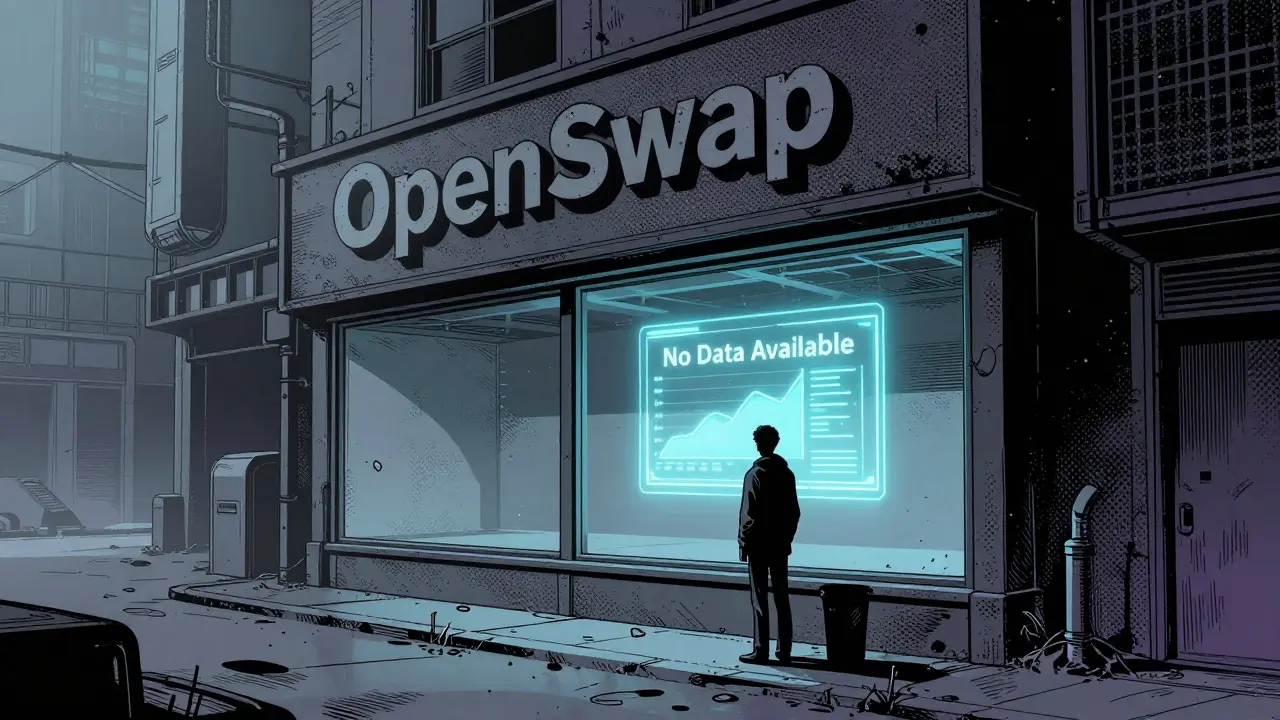
What does this mean for you? It means there is no reliable data on trading pairs. When you visit the site, you see "No data is available now." There is no visible liquidity. There are no active markets. In the world of decentralized finance, liquidity is life. Without it, you cannot buy or sell assets without suffering extreme slippage-or worse, losing your money entirely to a broken contract.
The absence of recent development updates, partnerships, or roadmap items confirms that the team behind OpenSwap has likely moved on. In the crypto space, silence usually equals abandonment. Unlike established protocols that push regular code updates and security patches, OpenSwap has been silent for years. This lack of maintenance poses a significant security risk. Smart contracts that are not updated can become vulnerable to new exploit vectors as hacking techniques evolve.
Why OpenSwap Failed Compared to Competitors
It wasn't just bad luck. OpenSwap faced stiff competition from both within the Harmony ecosystem and from broader multi-chain platforms. Let's look at the players that survived and thrived while OpenSwap faded away.
| Platform | Status (2026) | Key Advantage | Volume/Liquidity |
|---|---|---|---|
| OpenSwap | Inactive / Abandoned | Deflationary burn model (historical) | Untracked / Zero |
| SushiSwap | Active | Multi-chain support, strong brand | High / Consistent |
| OpenOcean | Active | Aggregator technology for best rates | Very High |
| Binance (CEX) | Active | Massive user base, fiat on-ramps | Highest |
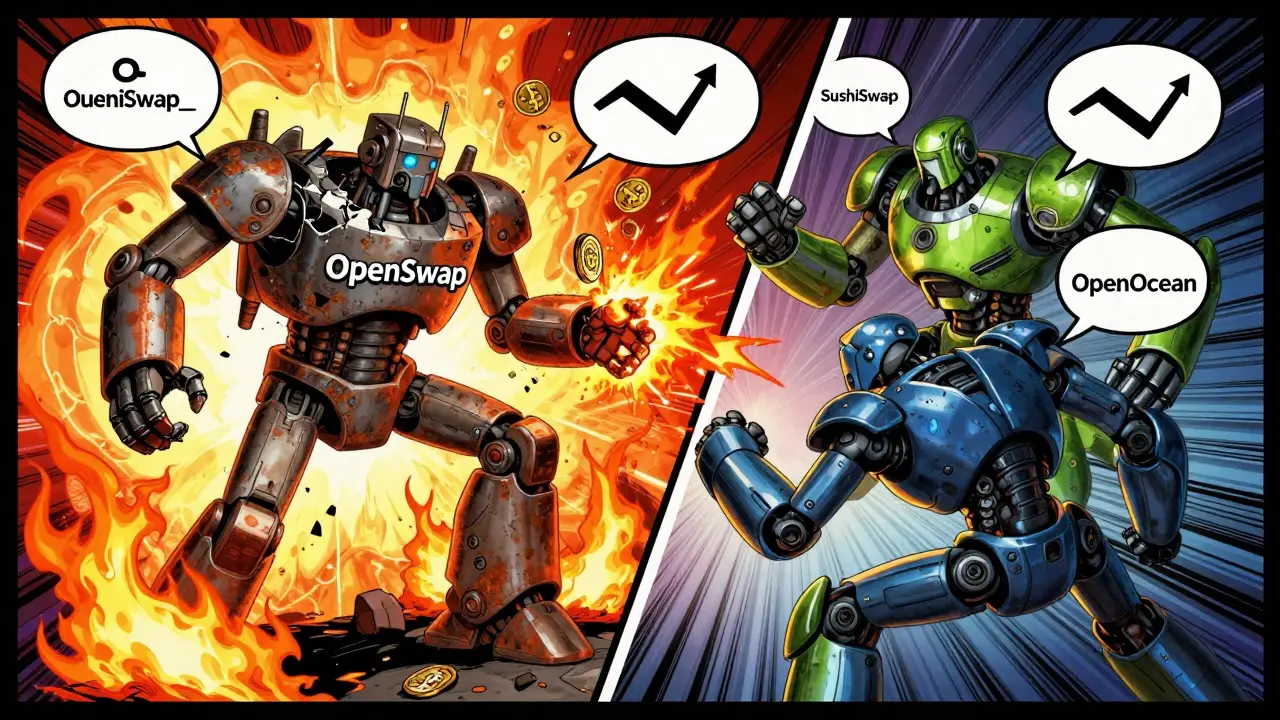
SushiSwap, for example, expanded to multiple chains including Harmony and maintained consistent trading volumes by leveraging its existing user base. OpenOcean became the go-to aggregator, pulling liquidity from various sources to ensure users got the best price. These platforms benefited from continuous development and community engagement. OpenSwap lacked this momentum. Once the initial hype of the 2021 DeFi summer faded, users migrated to platforms with deeper liquidity and better interfaces.
Furthermore, the broader market shifted. Layer-2 solutions like Arbitrum and Optimism, along with other Layer-1s like Solana and Avalanche, began capturing the attention of developers and users who wanted low fees. Harmony's market share declined, and projects built exclusively on Harmony without cross-chain bridges struggled to attract new users. OpenSwap did not adapt to this changing landscape.
Risks of Using Abandoned DeFi Protocols
You might be thinking, "Maybe I can still find some hidden liquidity or an old pair that works." Please don't. Interacting with an abandoned protocol carries severe risks.
- Smart Contract Vulnerabilities: Without active developers, any bug in the code remains unfixed. Hackers constantly scan for dormant contracts with known vulnerabilities. If someone exploits the contract, your funds could be drained instantly.
- Impermanent Loss Amplification: Even if there were tiny amounts of liquidity left, the volatility would be extreme. You could lose a significant portion of your capital simply by providing liquidity to a dead pool.
- No Support or Recourse: If something goes wrong, there is no customer support, no Discord channel to ask questions, and no team to compensate losses. You are on your own.
- Phishing Risks: Sometimes, scammers create fake websites that look like popular but inactive exchanges. They hope you will connect your wallet, thinking you are using the real interface, only to drain your assets. Always verify URLs carefully.
The deflationary tokenomics model that once sounded attractive may have actually contributed to its downfall. If token burning reduced incentives for market makers and liquidity providers over time, the pool dried up faster. Market makers need rewards to stay engaged. When the rewards diminish and volume drops, they leave. Once they leave, the exchange becomes unusable for regular traders.
Where to Trade on Harmony Today
If you hold ONE tokens or other assets on the Harmony network, you still have options. The Harmony ecosystem is not dead; it just evolved. Here are safer, more active alternatives for your DeFi needs.
1. Official Harmony Staking: If you are looking for yield, the most straightforward option is often staking your ONE tokens directly. The official Harmony staking system offers APY returns typically ranging from 9% to 10.5%. This is a secure way to earn passive income without the complexity of swapping on a DEX. You lock your tokens to help secure the network, and in return, you receive rewards. This method avoids the risks associated with third-party smart contracts entirely.
2. SushiSwap on Harmony: For actual swapping, SushiSwap remains a robust choice. It supports the Harmony chain and maintains deep liquidity pools for major pairs like ONE/USDC or ONE/WETH. Because SushiSwap operates across many chains, it attracts a larger user base, which translates to better prices and less slippage. You can access it via their web interface or mobile app, connecting with wallets like MetaMask or Trust Wallet.
3. OpenOcean: If you want the absolute best price, use an aggregator like OpenOcean. It scans multiple DEXs on Harmony, including SushiSwap and others, to find the optimal route for your trade. This ensures you aren't getting ripped off by poor liquidity on a single platform. It’s particularly useful for trading smaller or more obscure tokens on the network.
4. Centralized Exchanges (CEX): Sometimes, the simplest solution is to use a centralized exchange. Platforms like Binance, HitBTC, and HTX support ONE token trading. These exchanges offer high liquidity, instant execution, and customer support. While they don't give you the non-custodial benefits of DeFi, they are far safer than interacting with an abandoned DEX like OpenSwap. Use these for buying, selling, or moving large amounts of capital efficiently.

How to Verify Exchange Safety
Before you put money into any new DeFi project, run through this quick checklist. It will save you from falling for the next "next big thing" that turns out to be a ghost town.
- Check Volume Data: Look at CoinMarketCap or CoinGecko. Is the volume tracked? Is it consistent? If it says "untracked" or shows near-zero volume for weeks, walk away.
- Review Recent Activity: Check the project's GitHub repository. Are there recent commits? Check their Twitter or Telegram. Are they posting updates, or is it just bots spamming links?
- Audit Reports: Did reputable firms audit the smart contracts? An audit is not a guarantee of safety, but the lack of one is a huge red flag.
- Community Sentiment: Search Reddit and Crypto Twitter. Are real people talking about positive experiences? Or is there silence? Silence is suspicious.
- Team Transparency: Do you know who runs the project? Anonymous teams are common in crypto, but doxxed teams with track records are generally safer bets.
OpenSwap fails almost all of these checks today. It serves as a cautionary tale of the DeFi boom-and-bust cycle. Many projects launch with great ideas but fail to execute long-term strategies. They rely on hype rather than utility. When the hype dies, so does the project.
Final Thoughts on OpenSwap
The crypto market moves fast. What was hot in 2021 is irrelevant in 2026. OpenSwap was a product of its time-a deflationary DEX on a rising alternative chain. But it didn't survive the shift toward multi-chain aggregators and more mature ecosystems. Trying to use it now is like trying to buy tickets at a movie theater that closed five years ago. The building might still stand, but nobody is inside.
Stick to established platforms with proven track records. Whether you choose to stake your Harmony tokens for steady yields or swap them on SushiSwap for flexibility, you'll have peace of mind knowing your funds are in an active, maintained environment. Don't let nostalgia or curiosity lead you into the dark corners of abandoned DeFi protocols.
Is OpenSwap on Harmony still working in 2026?
No, OpenSwap appears to be inactive and abandoned. Major data aggregators like CoinMarketCap list it as "untracked" with no available volume data, indicating a lack of trading activity and likely cessation of operations.
What happened to OpenSwap's deflationary token model?
OpenSwap originally burned half of its 0.3% trading fees to reduce token supply. However, due to low trading volume and continuous minting of rewards, the burn rate likely never kept pace with inflation, leading to diluted value and eventual loss of interest from users and liquidity providers.
Can I still provide liquidity to OpenSwap?
It is highly discouraged. Providing liquidity to an inactive or abandoned pool carries extreme risks, including total loss of funds due to smart contract vulnerabilities, impermanent loss, and the inability to withdraw assets if the contract is compromised.
What are the best alternatives to OpenSwap on Harmony?
For swapping, SushiSwap and OpenOcean are active and liquid options on the Harmony network. For earning yield, the official Harmony staking system offers competitive APYs. For general trading, centralized exchanges like Binance support ONE tokens securely.
Why did OpenSwap fail compared to other DEXs?
OpenSwap failed to maintain liquidity and user adoption. It lacked the multi-chain presence of competitors like SushiSwap, did not innovate beyond its initial tokenomics, and suffered from the broader decline in Harmony's market share against other Layer-1 and Layer-2 solutions.
Is it safe to connect my wallet to OpenSwap?
No. Connecting your wallet to an abandoned or inactive smart contract exposes you to potential security risks. Since the code is not being maintained, it may contain unpatched vulnerabilities that hackers can exploit to drain your funds.
When was OpenSwap launched?
OpenSwap was launched on May 10, 2021, during the peak of the DeFi boom on alternative blockchains. It aimed to leverage Harmony's low-cost infrastructure to offer a deflationary trading experience.