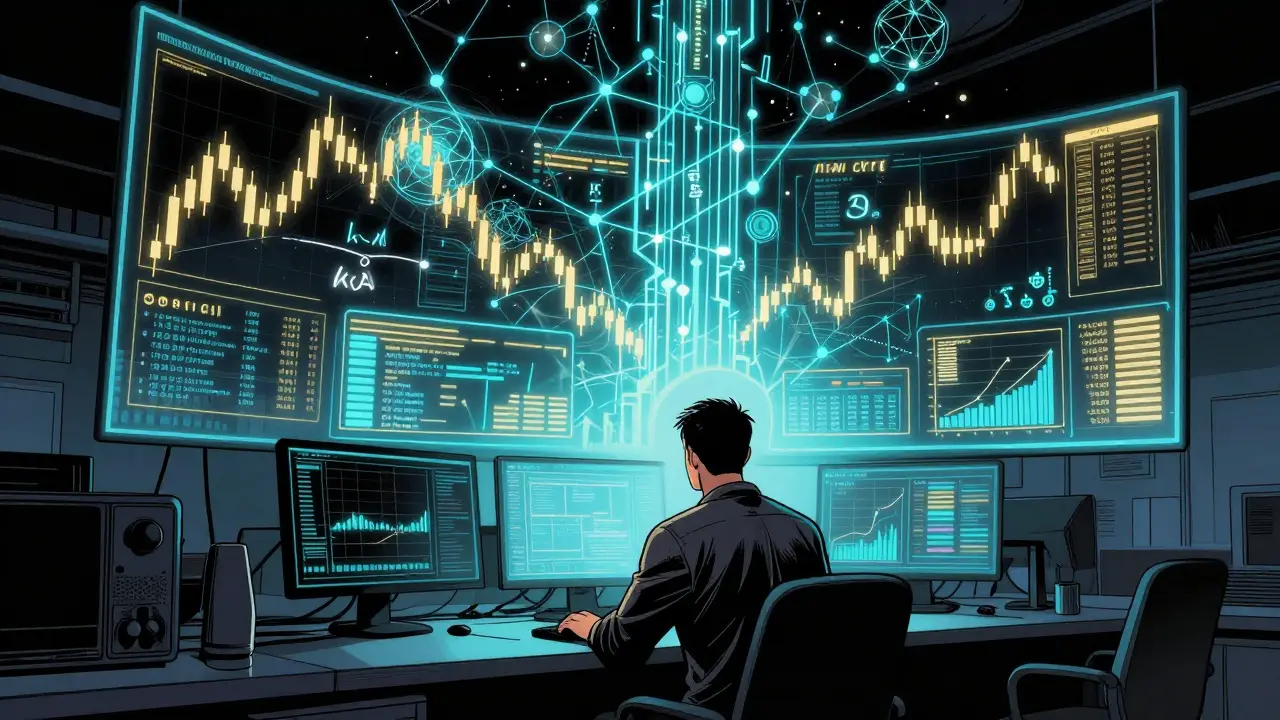
The Future of AI in Technical Analysis: Beyond Chart Patterns
The Shift from Static Indicators to Dynamic Intelligence
Traditional technical analysis relies on static rules. For example, if a 50-day moving average crosses a 200-day average, a trader might see a "Golden Cross" and buy. The problem? These rules are rigid. They don't account for sudden volatility or the fact that a pattern that worked in 2010 might be a trap in 2026. Machine Learning is changing this by introducing dynamic adjustment. Instead of a fixed period, AI tools can now shift indicators in real-time based on current market volatility.
Platforms like TradeStation and Tickeron have already integrated predictive analytics that do the heavy lifting. These systems don't just identify a "head and shoulders" pattern; they calculate the probability of that pattern completing based on thousands of similar historical occurrences. This removes the guesswork. When an AI tells you there is an 82% probability of a breakout based on current volume and price action, you're making a decision based on data, not a hunch.
Merging AI with the Elliott Wave Principle
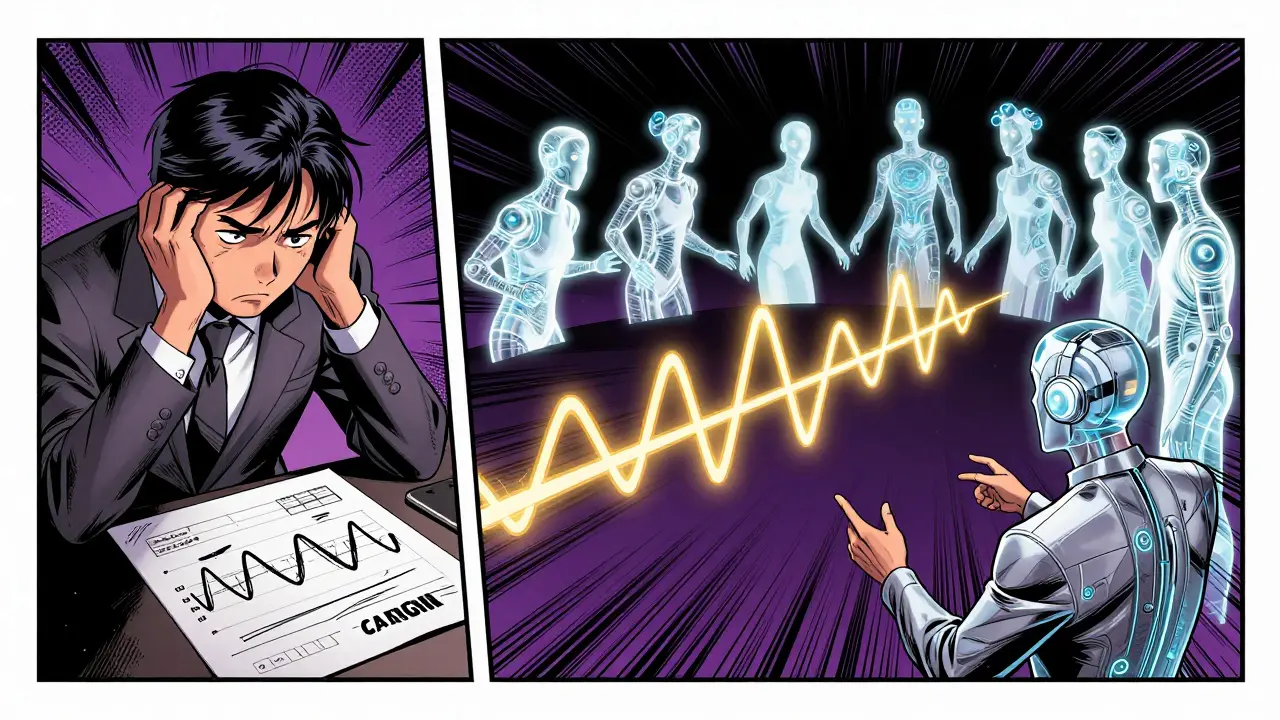
One of the most exciting developments is the integration of complex human theories with AI. Take the Elliott Wave Principle, which suggests market prices move in repetitive cycles. Traditionally, counting waves is highly subjective-two traders can look at the same chart and see completely different wave counts. This is where multi-agent systems come into play.
Recent research, such as the ElliottAgents system, uses Large Language Models (LLMs) to bridge the gap between natural language understanding and mathematical forecasting. By using a multi-agent framework, the AI can simulate different "analyst' perspectives," debate the wave count, and arrive at a consensus that is far more reliable than a single human analyst. This proves that AI isn't just replacing old methods; it's refining them to be more interpretable and accurate.
| Feature | Traditional Analysis | AI-Enhanced Analysis |
|---|---|---|
| Data Processing | Manual / Limited to a few assets | Automated / Thousands of assets simultaneously |
| Indicator Nature | Static (Fixed timeframes) | Dynamic (Adjusts to volatility) |
| Pattern Recognition | Subjective human interpretation | Probabilistic matching via algorithms |
| Sentiment Integration | Anecdotal / Manual news reading | Real-time Sentiment Analysis of social media/news |
The Blockchain Synergy: A New Data Frontier
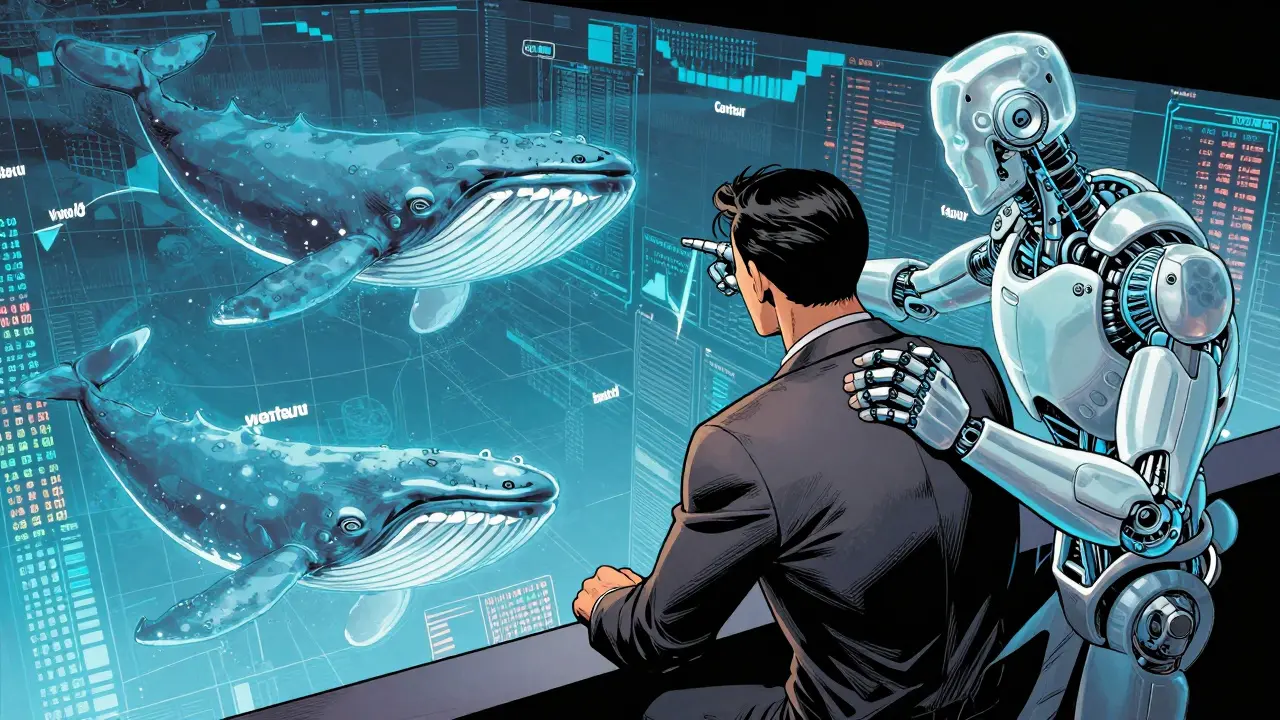
For those in the Blockchain space, the future is even more interesting. Until now, technical analysis mostly looked at price and volume (the "what"). By integrating On-Chain Data, AI can now look at the "why." Imagine an AI that sees a bullish chart pattern forming but notices that large "whale" wallets are quietly moving assets to exchanges to sell. The AI would flag this as a divergence, warning the trader that the chart is a fake-out.
Combining historical price action with real-time blockchain metrics-like hash rates, active addresses, and smart contract interactions-creates a 3D view of the market. This level of synergy allows AI to detect anomalies and potential fraud long before they appear on a price chart. We are moving toward a state where the blockchain acts as the single source of truth, and AI acts as the master interpreter.
The Rise of Autonomous Trading Bots
We've moved past simple "grid bots" that buy low and sell high. The next generation of trading bots is autonomous and adaptive. These bots don't just follow a script; they learn from their own mistakes. If a specific strategy fails during a high-inflation period, the bot identifies the failure, adjusts its parameters, and optimizes its approach for the new economic environment.
These sophisticated bots are now handling the entire trade lifecycle-from scanning for a setup to execution and regulatory reporting. This drastically reduces operational costs and eliminates the "fat-finger" errors that can wipe out an account in seconds. For institutional players and hedge funds, this means a shift from reactive trading to predictive positioning, where the system manages risk autonomously based on real-time probability shifts.
Managing the Risks: The Human-AI Balance
It would be naive to say AI is a magic money printer. There are real dangers, most notably Overfitting. This happens when an AI model is so perfectly tuned to historical data that it "memorizes" the past rather than learning the underlying logic. When a new, unprecedented market event occurs-like a sudden regulatory crackdown-an overfitted model can fail spectacularly because it has never seen that specific scenario before.
There is also the issue of data quality. AI is only as good as the data it consumes. If it's fed manipulated volume data from low-tier exchanges, it will produce flawed predictions. This is why the most successful traders are using a "centaur" approach: combining the raw processing power of AI with human intuition and strategic oversight. Humans are still better at understanding "Black Swan" events and geopolitical shifts that no algorithm can predict.
Can a beginner trader rely entirely on AI tools?
Not recommended. While AI tools reduce the learning curve for spotting patterns, relying on them without understanding the underlying market mechanics is risky. Beginners should use AI as a confirmation tool rather than a primary signal generator. Understanding why a signal is generated is more important than the signal itself.
How does sentiment analysis actually affect technical analysis?
Sentiment analysis scans millions of social media posts and news articles to gauge the mood of the crowd. In technical analysis, this acts as a leading indicator. For instance, if the price is consolidating (neutral) but sentiment is spiking positively, it often foreshadows a bullish breakout before the price action actually confirms it.
What is the risk of 'overfitting' in AI trading?
Overfitting occurs when a model is too closely aligned with past data, making it unable to adapt to new market conditions. It's like memorizing the answers to a specific test instead of learning the subject. When the market changes, the overfitted model continues to apply old rules that no longer work, leading to significant losses.
Will AI completely replace human technical analysts?
Unlikely. AI excels at pattern recognition and data processing, but humans excel at strategic reasoning and understanding complex geopolitical nuances. The future is collaborative; AI will handle the data crunching, while humans will make the final strategic calls on risk and capital allocation.
How does blockchain integration improve AI forecasts?
Blockchain provides transparent, immutable data. AI can analyze "on-chain" metrics like wallet movements, exchange inflows, and network growth. This adds a layer of fundamental truth to the technical price charts, allowing the AI to see if price movements are backed by actual network activity or just speculative noise.
Next Steps for Traders
If you're looking to integrate AI into your workflow, start small. Don't hand your entire portfolio to an autonomous bot on day one. Instead, use AI-powered scanners to filter your watchlist. Look for tools that provide "confidence scores" rather than simple buy/sell signals. If you're trading crypto, start incorporating on-chain analytics tools to verify the price action you see on the charts. The goal isn't to let the AI trade for you, but to use AI to make you a more informed, data-driven trader.




19 Comments
Yuhan Mo
April 21 2026The integration of multi-agent systems for Elliott Wave analysis is a real game changer for reducing cognitive bias in technical setups. It basically optimizes the alpha generation process by smoothing out the variance in manual wave counting.
Very clean breakdown of the current landscape.
Shantal Sanjur
April 23 2026Oh sure, because we can totally trust a "black box" algorithm to handle our money while the elites use these same tools to front-run every single retail trade. It's just another way to keep us in the dark while the AI pretends to be our little helper.
Good luck with your 82% probability until the system "glitches" and your account hits zero.
Michelle Stanish
April 24 2026Charts are just drawings. AI doesn't change that.
Ian Chait
April 26 2026Absolute rubbish. The whole thing is a front for central bank manipulatons. They use these AI-driven "patterns" to lul you into a false sense of security before the big reset.
The on-chain data is just as rigged as the price action, mate. Totaly fake news to keep the sheep shearing.
Joshua Salwen
April 26 2026WAIT A MINUTE!! You're tellng me I couldve just used an AI and not spent three years staring at RSI lines until my eyes bled??!! This is absolute madness! I've basically been a caveman trading in a space-age world and I'm actually shaking right now because of how much money I've probably left on the table!!
Prachi Bhadarge
April 28 2026Imagine thinking a bot can predict a Black Swan event. Cute.
But yeah, the on-chain stuff is actually useful if you know how to read a ledger without needing a robot to hold your hand.
Chintu Parikh
April 30 2026It is truly inspiring to witness the convergence of human intuition and computational power. We should all strive to embrace these technological advancements with an open heart and a collaborative spirit, for it is in the synergy of man and machine that we shall find the most sustainable paths to prosperity.
Let us support one another in learning these new tools to ensure no trader is left behind in this digital revolution.
Gaurav Undirwade
April 30 2026It is a grave moral failing to outsource one's intellectual rigor to a machine. To trade without understanding the visceral struggle of the market is to gamble without a soul.
You speak of "efficiency," but I speak of the discipline and character built through manual analysis. Those who rely on bots are merely shortcuts to spiritual and financial bankruptcy.
Alex Long
May 1 2026Whatever. Just more tools for people to lose money faster. Boring.
Jeff Barlett
May 2 2026The irony is that the more "predictive" these bots get, the more they'll just create a massive feedback loop that crashes the whole market in five seconds.
Everyone's using the same AI, so everyone buys the same "82% probability" dip, and then boom, we're all bankrupt because the bot decided to hallucinate a bull market.
Andrew Southgate
May 2 2026I really think the part about the "centaur" approach is the most vital piece of advice here because, while I've spent years refining my own strategies and seen the beauty in a well-formed chart, the sheer speed of today's high-frequency environments makes it nearly impossible to keep up without some level of automated assistance. If you can just use the AI to filter out the noise and then apply your own seasoned judgment to the remaining signals, you're essentially giving yourself a superpower that wasn't available to traders twenty years ago. I've personally found that combining sentiment analysis with traditional volume profiles helps me avoid a lot of the traps that usually snag a manual trader, and it's just wonderful to see how this technology is becoming more accessible to the average person rather than just the big hedge funds.
Trudy Morse
May 4 2026Actually, the real secret is that the market is just a mirror of human psychology.
AI is just a faster way to measure that psychology, but it can't actually "understand" fear or greed. It's just math pretending to be emotion.
Vicky Duffala
May 4 2026This is so exciting! 🚀 The idea that we can blend the spiritual flow of Elliott Waves with the raw power of LLMs is just mind-blowing. It's like we're finally learning to speak the language of the market in real-time! Keep pushing the boundaries everyone! ✨
Kevin Lư
May 6 2026Hey, just keep it real, if the bot makes a mistake, don't come crying to us.
But yeah, it's pretty cool how it handles the fat-finger errors, cause I've definitely accidentally bought 100x more of a coin than I intended once or twice lol.
nikki krinkin
May 6 2026I appreciate the cautious approach mentioned at the end. It's important to remember that these are tools, not magic wands.
Sean Douglas
May 7 2026The absolute sheer agony of watching a bot execute a perfectly logical trade only for a random tweet from a billionaire to incinerate the entire setup is a level of psychological torture I wouldn't wish on my worst enemy!
It's a shimmering, digital mirage of stability that shatters the moment reality decides to intervene with a sledgehammer!
Ankit Sindhu
May 8 2026For those starting out, just remember that consistency is key. Use these tools to learn, not to skip the hard work.
nathan jones
May 8 2026Pretty interesting stuff. I've seen some similar things in other markets too.
Nishant Goyal
May 10 2026Nice overview. Very helpful for the community.