Uniswap v2 vs v3: A Practical Guide to AMM Designs
Choosing between Uniswap v2 and Uniswap v3 isn't just a technical preference; it's a strategic decision that directly impacts your returns. If you are looking for simple, passive income with minimal management, v2 is likely your best friend. But if you want to squeeze every drop of yield out of your capital and don't mind active management, v3 offers a significant edge in capital efficiency. Understanding the core differences in how these Automated Market Maker (AMM) designs handle liquidity is essential for maximizing your DeFi strategy.
The Core Difference: Uniform vs. Concentrated Liquidity
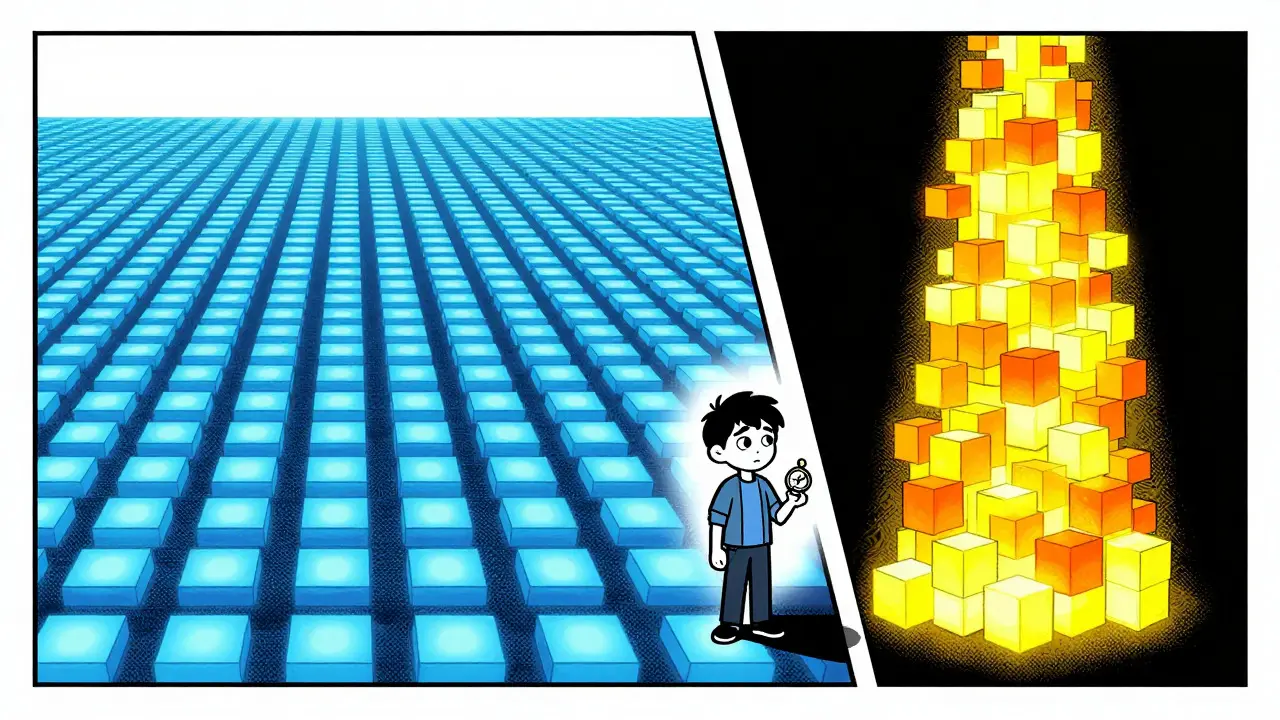
To understand why one version might be better for you, we first need to look at how they distribute capital. Uniswap v2 uses a constant product formula where liquidity is spread uniformly across the entire price curve, from zero to infinity. This means whether the price of ETH is $1,000 or $10,000, your capital is working across that massive range. It’s simple, but inefficient because most of your funds are sitting idle in price ranges where no trades are happening.
Uniswap v3 changes this game entirely with concentrated liquidity. Here, you choose a specific price range for your assets. For example, if you think ETH will stay between $3,000 and $4,000, you only deploy your capital within that window. This allows for up to 20,000x greater capital efficiency compared to v2. Your tokens are always in the 'action zone,' earning fees whenever a trade occurs within your chosen range. However, if the price moves outside that range, your position becomes inactive until you rebalance it.
Comparing Key Features: Fees, Tokens, and Oracles
Beyond liquidity distribution, the two protocols differ in several critical technical aspects that affect user experience and integration. The table below highlights the main distinctions between the two versions.
| Feature | Uniswap v2 | Uniswap v3 |
|---|---|---|
| Liquidity Model | Uniform (0 to Infinity) | Concentrated (Custom Ranges) |
| Fee Structure | Fixed 0.30% | Selectable Tiers (0.01%, 0.05%, 0.30%, 1.00%) |
| Liquidity Token Type | Fungible ERC-20 | Non-Fungible ERC-721 (NFT) |
| TWAP Oracle | Arithmetic Mean | Geometric Mean |
| Management Effort | Passive / Low | Active / High |
The fee structure is a major differentiator. While v2 locks you into a standard 0.30% fee, v3 lets you pick the tier that matches the volatility of your pair. Stablecoin pairs like USDC/DAI often use the lower 0.01% or 0.05% tiers because they have high volume but low price movement. Volatile pairs might stick with 0.30% or even 1.00%. This flexibility allows LPs to optimize their exposure based on market conditions.
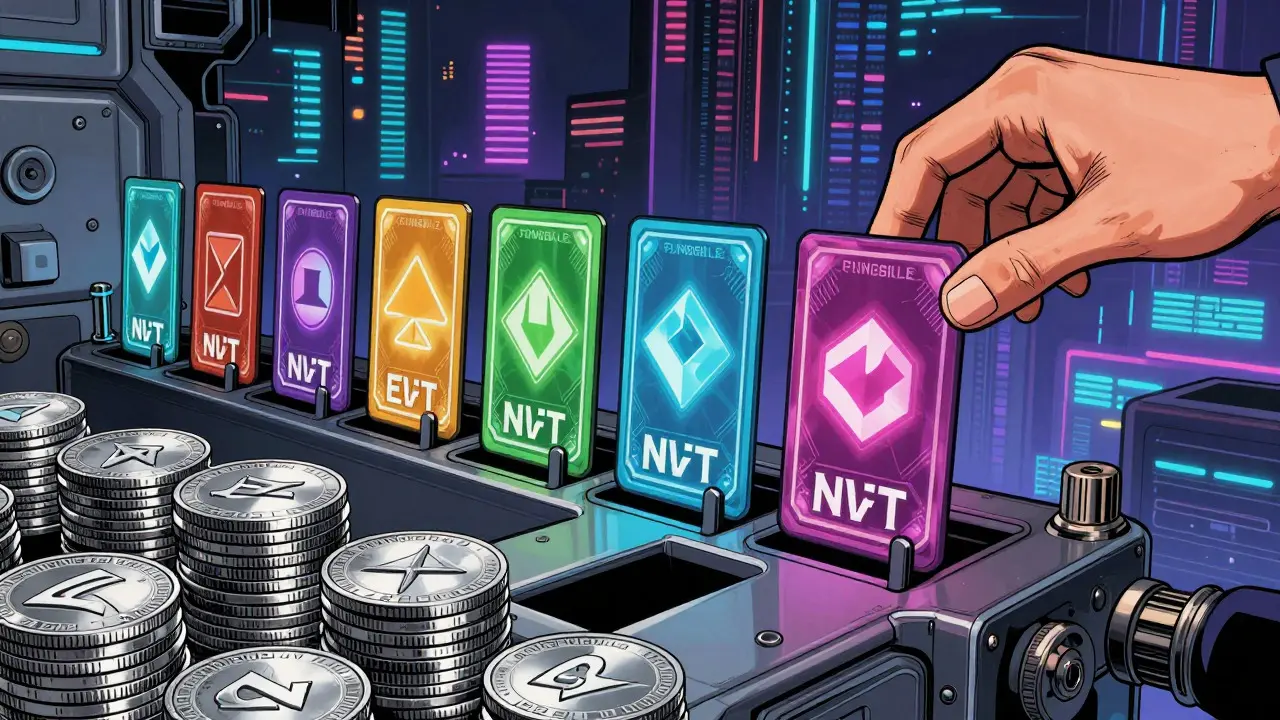
Token standards also matter. In v2, your liquidity position is a fungible ERC-20 token. You can easily split it, send it to a friend, or use it as collateral in other DeFi protocols. In v3, each position is a unique NFT (ERC-721). This makes positions harder to manage manually because you can't simply split them; you have to close and reopen positions to adjust amounts. However, this granularity allows for precise control over each specific range.
Who Should Use Which Version?
Your choice largely depends on your trading style and the assets you are providing liquidity for. Let's break down the ideal user profiles for each protocol.
Choose Uniswap v2 If:
- You are a beginner: The interface is straightforward. You deposit equal value of two tokens, and that's it. No need to calculate price ranges or monitor charts constantly.
- You hold volatile assets: If you are providing liquidity for highly volatile tokens (like meme coins or new launches), predicting a price range is difficult. V2's uniform distribution ensures you earn fees regardless of where the price swings wildly.
- You prefer passive income: If you don't want to spend time rebalancing, v2 is the clear winner. You set it and forget it.
- You need composability: Because v2 LP tokens are fungible ERC-20s, they integrate seamlessly into lending markets and yield aggregators without complex wrappers.
Choose Uniswap v3 If:
- You are an experienced trader: You understand impermanent loss and can analyze price action to select effective ranges.
- You provide stablecoin liquidity: Pairs like USDC/USDT or DAI/USDC move very little. Concentrating liquidity in a tight range (e.g., ±5%) dramatically boosts your annual percentage yield (APY).
- You want higher capital efficiency: You want to earn more fees per dollar deployed. Professional LPs report significantly higher yields on v3 for stable pairs compared to v2.
- You use automation tools: Services like Gamma Strategies or Balancer allow you to automate v3 management, reducing the manual effort while keeping the efficiency benefits.
Real-World Performance and User Experiences
Data from recent months shows a clear trend. As of late 2025, Uniswap v3 accounts for roughly 72% of total Uniswap volume, indicating that the majority of activity has shifted to the newer protocol. However, this doesn't mean v2 is dead. It still processes about 28% of volume, primarily driven by retail traders and volatile pairs.
User sentiment reflects the complexity gap. On platforms like Reddit, many users with smaller portfolios (under $10k) express frustration with v3's learning curve. One common complaint is setting ranges too narrow, which leaves capital idle when prices move unexpectedly. In fact, analytics show that 28% of new v3 LPs initially set ranges so tight that 63% of their capital sat idle during their first month. This highlights the importance of starting wider and narrowing down as you gain confidence.
On the other hand, professional market makers and large LPs favor v3. Data suggests that 87% of professional market makers now use v3 for stablecoin pairs. They have the resources to monitor positions and rebalance frequently, capturing the maximum yield. For them, the extra effort is worth the 30-40% higher returns seen in optimized positions.

Navigating Complexity: Tips for New V3 Users
If you decide to try Uniswap v3, here are some practical tips to avoid common pitfalls.
- Start with Wider Ranges: Don't aim for perfection immediately. Start with a range that covers expected volatility (e.g., ±10-15% for volatile pairs, ±5% for stables). You can always tighten it later.
- Use Fee Tier Logic: Match the fee tier to the asset's nature. Stablecoins = low fees (high volume). Volatile assets = higher fees (lower volume, higher risk).
- Monitor Impermanent Loss: In v3, if the price exits your range, you stop earning fees, but you also stop accumulating impermanent loss from further divergence. This can actually protect you in some scenarios compared to v2.
- Consider Automation: Look into third-party dashboards that track your positions and alert you when rebalancing is needed. This reduces the time commitment significantly.
- Keep Some Capital in V2: A dual-protocol strategy is often recommended. Keep stable, passive positions in v2 and use v3 for optimized, active positions.
The Future of AMM Designs
With the launch of Uniswap v4 in early 2025, the landscape is evolving again. V4 introduces hooks and dynamic fees, addressing some of the rigidity in v3. However, both v2 and v3 remain actively supported. Governance proposals have passed to maintain v2 infrastructure, ensuring it won't be deprecated soon. Analysts predict that v3 will continue to dominate institutional and professional liquidity provision, while v2 will remain the go-to for casual users and highly volatile assets. The key takeaway? There is no single 'best' version. The right choice depends on your assets, your time availability, and your tolerance for complexity.
Is Uniswap v3 better than v2 for beginners?
Generally, no. Uniswap v2 is simpler and requires less active management, making it more suitable for beginners. Uniswap v3 offers higher potential returns but requires understanding price ranges and active monitoring, which can be confusing for new users.
What is the main advantage of Uniswap v3?
The main advantage is capital efficiency. By allowing liquidity providers to concentrate their capital within specific price ranges, v3 can generate up to 20,000x more efficient fee earnings compared to the uniform distribution of v2.
Can I use Uniswap v2 and v3 together?
Yes, many users adopt a dual-protocol strategy. They keep passive, low-maintenance positions in v2 for volatile assets and use v3 for stablecoin pairs where they can actively manage ranges for higher yields.
Why are Uniswap v3 liquidity positions NFTs?
Each v3 position is unique because it has a specific price range, amount of token 0, and amount of token 1. This uniqueness is represented by non-fungible ERC-721 tokens, unlike v2's fungible ERC-20 tokens which represent identical shares of a pool.
Which fee tier should I choose in Uniswap v3?
Choose the fee tier based on the volatility of the pair. Stablecoin pairs typically use 0.01% or 0.05% due to high volume. Standard volatile pairs use 0.30%. Highly speculative or low-volume pairs may use 1.00%.




16 Comments
Patrick Pat
August 21 2026Oh, the classic 'concentrated liquidity' debate. I've been watching this space since the v3 whitepaper dropped and honestly? The math checks out, but the UX is still a mess for the average Joe.
Most people think they are 'trading' when they are actually just gambling on a price range without any real edge. It's like trying to catch rain with a sieve made of hope.
If you aren't using an automation bot or at least a decent dashboard, you're basically donating your gas fees to the protocol developers. Don't get me wrong, the capital efficiency is real, up to 4000x in tight ranges, but that comes with a risk profile that would make a conservative banker faint.
I stick to v2 for my long-term holds because I don't want to be refreshing my phone every time ETH dips below $3k. Simplicity has its value, even if it means leaving yield on the table.
Claudio Perrone
August 22 2026they say v3 is better but its just more work for no real reason
i put my money in v2 and forgot about it for 6 months and got paid
why complicate life when simple works?
Aaron Morrissey
August 23 2026It is rather presumptuous to suggest that simplicity equates to superiority in a domain governed by complex mathematical constants and dynamic fee structures.
The notion that one should merely 'forget' their assets implies a passive acceptance of suboptimal capital allocation, which, in the rigorous study of DeFi economics, is tantamount to negligence.
While the interface of Uniswap v2 is certainly more accessible to the layperson, the true elegance lies in the precision of v3, where every unit of liquidity is deployed with surgical intent within a defined price corridor.
To dismiss active management as 'complication' is to misunderstand the fundamental trade-off between risk and reward; one does not become a master chef by simply boiling water, one must tend to the fire, adjust the heat, and season the dish with meticulous care.
Therefore, the choice is not merely technical, but philosophical: do we seek the comfort of mediocrity, or the exhilarating challenge of optimization?
Zothana Pachuau
August 24 2026Hey everyone, nice breakdown in the OP. Just wanted to add a quick note from someone who started with v2 and moved to v3 last year.
The biggest hurdle isn't the tech, it's the mindset shift. In v2, you're an LP. In v3, you're essentially a market maker with limited inventory. That changes how you look at charts.
Sarcastic take: If you can't handle the stress of watching your position go out of range, maybe crypto wasn't for you anyway. But seriously, start wide. Really wide. Like, wider than you think makes sense. You can always tighten it later once you see how the pair behaves over a few weeks.
Also, don't ignore the fee tiers. Putting stablecoins in the 0.30% tier is like paying premium gas prices for a car that only goes 10mph. Use the 0.01% or 0.05% for stables, save yourself some headaches and boost your APY significantly.
Shawn Schaerer
August 26 2026Let us examine the underlying axioms of this discussion with the rigor they deserve.
The transition from uniform to concentrated liquidity represents a paradigm shift in how we conceptualize capital efficiency, moving from a static distribution model to a dynamic, user-defined optimization problem.
However, we must not overlook the second-order effects of this concentration. By clustering liquidity in narrow bands, we introduce new forms of systemic fragility, particularly during periods of high volatility where price discovery becomes erratic.
Furthermore, the NFT structure of v3 positions, while elegant in its granularity, introduces friction into composability that was previously seamless in the ERC-20 world of v2. This is not merely a technical detail; it is a structural impediment to the broader DeFi ecosystem's potential for deep integration.
Thus, the question is not simply which version yields more, but which version best serves the long-term stability and composability of the decentralized finance stack.
Hicham Mounir
August 26 2026I totally get why people are frustrated with v3, I was too at first. It feels like you're supposed to have a PhD in quantitative finance just to set up a basic pool.
But here's the thing that changed my mind: once you find the right range, the feeling of seeing those fees roll in is unmatched. It's like having a personal income stream that scales with your effort.
My advice? Be gentle with yourself. Don't try to nail the perfect range on day one. Treat your first few months as a learning phase. Make mistakes, learn from them, and slowly refine your strategy.
And please, use a tool like Gamma or DefiLlama to track your positions. Trying to remember which ranges you have open across different pairs is a nightmare. Automation isn't cheating, it's just being smart.
You've got this. The learning curve is steep, but the view from the top is worth it.
Ami Elizabeth
August 27 2026v3 is cool i guess but the ui is kinda annoying
i prefer v2 for stuff that moves a lot
just my two cents tho
Walker Perry
August 29 2026They are trying to control the narrative again. V2 is the true American way of doing business, simple and direct. V3 is just another layer of complexity designed to confuse the common man so the elites can keep taking their cut. Look at the fee structures, they are rigged. The 0.01% tier is a trap for the unwary, they will drain your liquidity before you know it. Wake up people, stop letting these tech bros tell you what is best for your money. Stick to what you know, stick to v2, and protect your sovereignty.
Evelyn Kula
August 29 2026Finally, someone addresses the elephant in the room! Most of these 'guides' are written by people who have never actually managed a v3 position outside of a testnet. The reality is much messier. You need to understand that the 'capital efficiency' claim is often misleading if you don't account for the opportunity cost of rebalancing. I've seen plenty of pros lose more on gas fees and slippage than they gained in extra yield. It's all about execution, and most retail investors lack the discipline. But hey, if you're going to play, at least do it with the right tools. Don't be a sheep following the herd into a cliff. We need more critical thinking, less hype. #DeFi #RealityCheck
manish jha
August 30 2026The path to enlightenment in DeFi is clear. Abandon the false idols of complexity. V2 is the pure form. It requires no thought, no action, no ego. Just deposit and wait. This is the way. V3 is a distraction, a test of your patience and humility. Do not be seduced by the promise of higher yields, for they come at the cost of your peace of mind. Sit in silence. Watch the candles. Accept the impermanent loss as part of the journey. Only then will you find true contentment in your portfolio.
Mohamed Shoaeb
August 31 2026Nice post overall. I think the section on who should use which version is really helpful for beginners. I personally use both. V2 for my meme coin bags because they swing so hard it would be impossible to stay in range on V3. V3 for my USDC/ETH pair where I can predict the range pretty well. Its a good balance. Also the tip about starting wide is solid advice. I learned that the hard way after my first month of constant rebalancing.
Sonia Gomez Gomez
August 31 2026Okay so I'm not super technical but I read this and I'm confused 😕 Why can't we just split our v3 positions like we did in v2? Seems so unnecessary to make them NFTs. Isn't that just making things harder for no reason? I feel like the devs are overthinking this. I just want to earn some passive income without having to manage a whole spreadsheet. Can someone explain why this is actually a good thing? Or am I missing something obvious? 🤔
SHIV SHANKAR KANTA
September 1 2026The soul of the trader is tested not by the wind of the market but by the rigidity of his own expectations. When you fixate on a range you are already dead inside for you have bound your spirit to a number. Let the price flow let the liquidity breathe. The NFT is not a chain it is a key to a door you haven't opened yet. Embrace the chaos. Embrace the idle capital. It is resting. It is dreaming. And when the moment comes it will strike with the force of a thousand suns. Do not fear the silence between the trades for that is where the truth resides. 🌊🔥
Quang Thai Tran
September 2 2026One must observe the current state of affairs with a degree of skepticism. The data presented suggests a migration to v3, yet the underlying infrastructure remains fragile. Consider the implications of the geometric mean oracle versus the arithmetic mean; the former is susceptible to manipulation in low-volume pools, a vulnerability that has been exploited repeatedly. Furthermore, the reliance on third-party dashboards for management introduces a single point of failure, contrary to the decentralized ethos we purport to uphold. Until these issues are resolved, v3 remains a promising but unproven experiment. Proceed with caution, and verify all sources independently. The truth is rarely as straightforward as the marketing materials suggest.
Tasha Davis
September 3 2026OMG this post is so helpful!! I've been wanting to try v3 but was scared of messing up. Thanks for the tips about starting wide! I think I'm going to try it with my stablecoins next week. Fingers crossed I don't lose everything lol. Keep up the great work writing these guides!
Leah Humphrey
September 5 2026Typical surface-level analysis. You're conflating capital efficiency with net yield, ignoring the drag from rebalancing costs and the non-linear relationship between range width and fee capture. The 20,000x figure is a theoretical maximum under idealized conditions that rarely exist in practice. Moreover, the composability argument for v2 is overstated; most DeFi protocols now support v3 positions via wrappers, albeit with added latency. The real issue is the cognitive load required for optimal strategy selection, which creates a barrier to entry that effectively centralizes liquidity provision among sophisticated actors. A more nuanced approach would involve modeling the expected value of different range strategies under varying volatility regimes, rather than offering binary advice based on user persona. But sure, 'set it and forget it' works fine if you don't mind underperforming the market by 15-20% annually.