
Ethereum Sharding Implementation: From Original Plans to Danksharding Reality
For years, the crypto community held its breath for Ethereum sharding. The promise was seductive: a network that could process hundreds of thousands of transactions per second by splitting its workload into manageable pieces. It was supposed to be the silver bullet for Ethereum’s congestion and high gas fees. But if you look at the blockchain today in 2026, you won’t see the original sharding architecture we were promised back in 2020. Instead, you’ll see something different, more efficient, and arguably better suited for the current landscape. So, what happened to the original plan? And how does the new reality of Danksharding actually work?
The Original Vision: Splitting the Network
To understand where we are now, we have to look at where we started. The initial concept of Ethereum sharding was designed to solve a fundamental problem: as Ethereum grew, every single node on the network had to process every single transaction. This created a bottleneck. If you want to scale, you can’t just make one computer faster; you need to add more computers working in parallel.
The original technical specification proposed dividing the Ethereum network into exactly 64 separate chains, known as shards. Imagine a massive highway with only one lane. Traffic jams are inevitable. Now, imagine splitting that highway into 64 lanes. Each lane (or shard) handles its own traffic independently. According to the early designs, each shard would maintain its own state-meaning it would store specific account balances and smart contract data-and process a portion of the total network transactions.
This wasn't just about speed. The goal was horizontal scaling. By distributing the workload across multiple nodes, the system could handle significantly higher volumes of activity without degrading performance. The Beacon Chain, introduced during the transition to Proof-of-Stake, was meant to act as the central coordinator. It would manage validator registration and ensure that all 64 shards remained synchronized and secure. In this model, an attacker would face a theoretical one-in-a-trillion chance of controlling two-thirds of the validators in any single shard, thanks to pseudorandom assignment protocols that reshuffled validators every epoch (roughly 6.4 minutes).
Why the Plan Changed: The Pivot to Layer 2
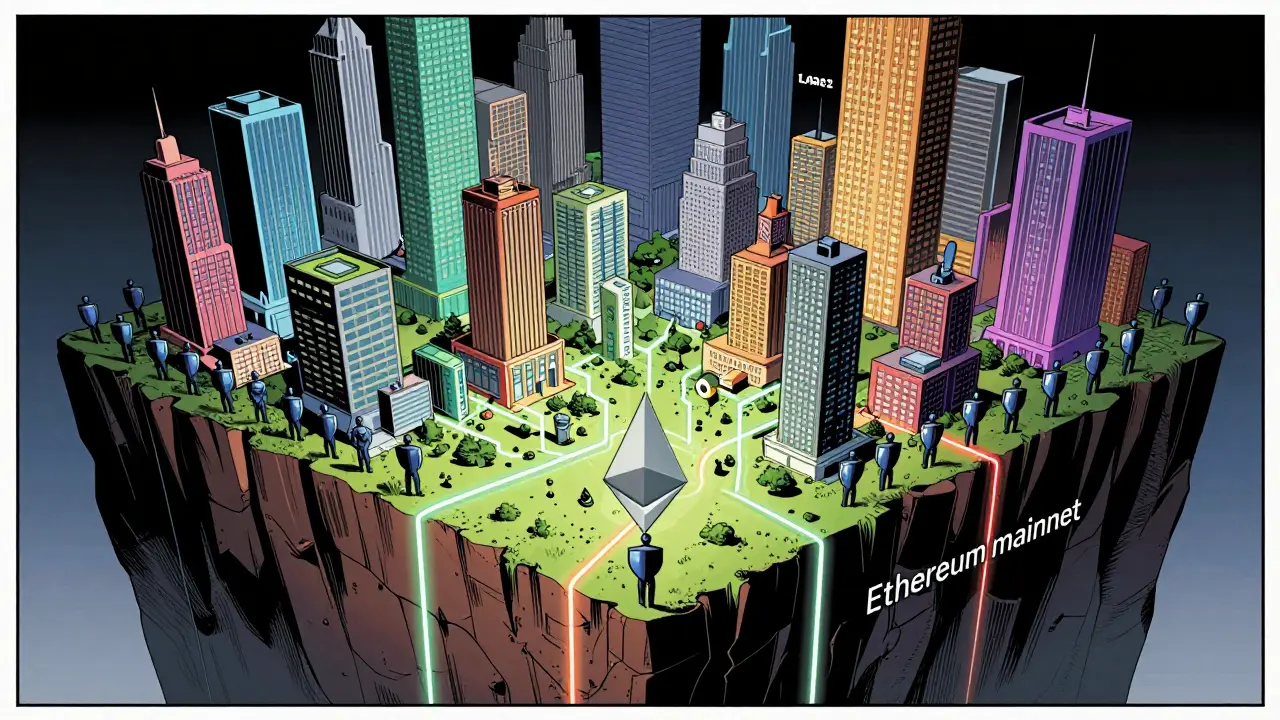
Here is the twist: the Ethereum community largely abandoned the original implementation of state-carrying shards. Why? Because the landscape changed. While developers were planning the complex cross-shard communication mechanisms required for independent shards, Layer 2 solutions like Optimism and Arbitrum matured rapidly. These rollups offered a way to scale Ethereum without fundamentally altering the base layer’s security model.
Core developers realized that building full-featured shard chains was incredibly complex and risky. Cross-shard communication-the ability for a dApp on Shard A to talk to a dApp on Shard B-introduced significant technical hurdles regarding consistency and integrity. Meanwhile, Layer 2s were already processing millions of transactions by batching them together and posting compressed data back to the main Ethereum chain.
This strategic pivot allowed the team to prioritize "The Merge," which successfully transitioned Ethereum from Proof-of-Work to Proof-of-Stake. Once consensus was secured, the focus shifted from creating new chains to making the existing chain cheaper and more efficient for Layer 2s to use. This led to the birth of a new concept: Danksharding.
Danksharding: The New Reality
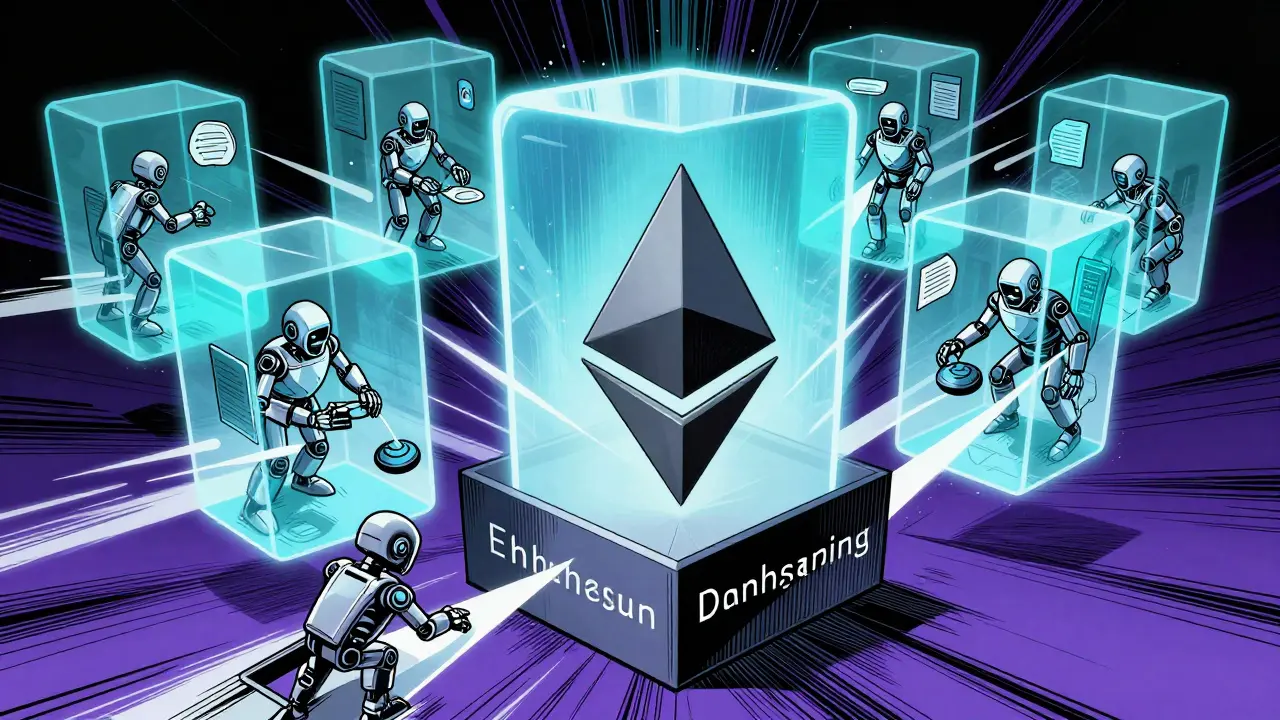
If traditional sharding is about splitting the computation, Danksharding is about splitting the data. Named after Ethereum researcher Protolambda (Dankrad Feist), this approach simplifies the problem significantly. Instead of creating 64 independent chains that run their own smart contracts, Danksharding turns Ethereum into a data availability layer.
In this model, the shards do not execute transactions. They simply store data. This is crucial because execution is hard; data storage is relatively easy. By providing cheap, reliable space for Layer 2 rollups to post their transaction data, Ethereum enables those rollups to scale massively. The rollups do the heavy lifting of computation, while Ethereum ensures the data is available and cannot be censored or lost.
The implementation of Danksharding relies on a technique called "availability sampling." This allows nodes to verify that data from shards is available without needing to download the entire contents of every shard. This reduces bandwidth requirements and makes it easier for regular users to run nodes, preserving the decentralization of the network. Essentially, Ethereum becomes the ultimate settlement and data layer, while Layer 2s become the execution environments.
Performance Projections and Real-World Impact
Let’s talk numbers. The original sharding proposal projected a jump from roughly 27 transactions per second (TPS) to over 100,000 TPS. While Danksharding doesn’t execute these transactions directly, it enables Layer 2 networks to achieve similar throughput levels by drastically reducing the cost of posting data to Ethereum. Before the introduction of proto-danksharding (via EIP-4844), Layer 2s had to pay high gas fees to store their data on the mainnet. With danksharding, that cost drops by up to 90%.
This efficiency translates directly to user experience. When you swap tokens on a Layer 2 like Base or Arbitrum, the fees are pennies rather than dollars. This is the indirect result of sharding technology. The network can handle a much larger volume of activity simultaneously because the data is distributed across multiple blobs (binary large objects) within the block space, rather than being squeezed into standard calldata fields.
| Feature | Original Sharding Plan | Danksharding (Current Path) |
|---|---|---|
| Primary Function | Execution & State Storage | Data Availability Only |
| Shard Independence | High (Independent Chains) | Low (Data Blobs on Mainnet) |
| Cross-Shard Comms | Complex & Risky | Not Required (L2s Handle Logic) |
| Security Model | Validator Distribution per Shard | Shared Security via Mainnet Consensus |
| Implementation Status | Abandoned | Partially Live (Proto-Danksharding) |
How Validators Fit Into the Picture
You might wonder, how does this affect the people securing the network? In the original plan, validators would be assigned to specific shards, meaning they only needed to track the state of their assigned shard. This lowered hardware requirements but increased complexity in management.
With Danksharding, the role of the validator remains closer to the current model. Validators still propose and attest to blocks on the main beacon chain. However, they now also handle "blobs" of data associated with Layer 2 transactions. The pseudorandom selection protocol ensures that no single group of validators can collude to censor data. The constant reshuffling of duties prevents long-term targeting of specific nodes. For the average staker, this means the infrastructure requirements have increased slightly due to the additional data volume, but the security guarantees remain robust.
Comparative Context: Other Blockchain Approaches
Ethereum isn’t the only project experimenting with sharding. NEAR Protocol, for instance, implemented a sharding protocol called Nightshade. Unlike Ethereum’s planned approach, NEAR’s shards are not separate chains. Every NEAR block contains information about transactions from all shards, and every validator tracks all shards. This is known as "chunk-only producers."
NEAR launched Phase 0 of Nightshade in November 2021, splitting the state into four shards. By September 2022, they moved to Phase 1, sharding both transaction processing and state. The key difference is that NEAR maintains a unified global state, whereas Ethereum’s original plan envisioned fragmented states. Ethereum’s choice to pivot to a data-layer-first approach reflects a belief that fragmentation of execution is less critical than fragmentation of data costs.
Challenges and Future Roadmap
Despite the progress, challenges remain. Full Danksharding is not yet complete. What we have today is often referred to as "proto-danksharding," introduced via EIP-4844. This update added blob-carrying transactions, which are cheaper and expire after a certain period, freeing up permanent storage space. The next steps involve increasing the number of blobs per block and optimizing the encoding schemes to maximize throughput.
There is also the issue of data expiry. Since blobs are temporary, Layer 2s must archive old data themselves or rely on third-party archivers. This introduces a slight trust assumption compared to permanent on-chain data. Developers are actively working on solutions to ensure historical data remains accessible without burdening the main network indefinitely.
Another consideration is the complexity of the client software. As Ethereum evolves, the codebase becomes increasingly intricate. Maintaining multiple client implementations (like Geth, Nethermind, and Lighthouse) requires rigorous testing to ensure compatibility with new sharding features. Any bug in the data availability layer could have catastrophic consequences for Layer 2 security.
Conclusion: A Different Kind of Scale
The story of Ethereum sharding is not one of failure, but of adaptation. The original vision of 64 independent execution chains was too complex and redundant given the rise of Layer 2s. By pivoting to Danksharding, Ethereum has positioned itself as the foundational data layer for a scalable ecosystem. You don’t need to understand the intricacies of shard chains to benefit from this. Whether you’re using Uniswap on Arbitrum or sending USDC on Base, you’re experiencing the effects of this architectural shift. Lower fees, faster confirmations, and a more sustainable network are the direct results of this evolution. The future of Ethereum isn’t just about one big chain; it’s about a coordinated network of layers, anchored by robust data availability.
What is the difference between sharding and Danksharding?
Traditional sharding involves splitting the blockchain into independent chains that handle both execution and state storage. Danksharding focuses solely on data availability, turning Ethereum into a layer for storing transaction data efficiently so that Layer 2 networks can scale without paying high fees for calldata.
Is Ethereum sharding fully implemented yet?
No, full Danksharding is not yet live. However, "proto-danksharding" was implemented via EIP-4844 in March 2024. This update introduced blob-carrying transactions, which significantly reduce costs for Layer 2s. Full implementation will involve increasing the number of blobs and optimizing data encoding further.
Why did Ethereum abandon the original sharding plan?
The original plan was deemed too complex and risky due to the challenges of cross-shard communication and maintaining security across independent chains. The rise of effective Layer 2 solutions made a data-centric approach (Danksharding) more practical and efficient for achieving scalability goals.
How does Danksharding affect gas fees?
Danksharding reduces the cost of posting data to Ethereum by up to 90%. Since Layer 2 networks rely on Ethereum for data availability, this reduction translates directly to lower gas fees for users interacting with dApps on Layer 2 platforms like Optimism, Arbitrum, and Base.
What is the role of the Beacon Chain in sharding?
The Beacon Chain serves as the central coordination layer for the Ethereum consensus mechanism. In the context of sharding, it manages validator registration, distributes validators across shards (in the original plan), and ensures overall network security and synchronization through its proof-of-stake consensus protocol.