WagyuSwap Review: Is This Velas DEX Worth Your Time in 2026?
Remember the hype around Velas? Back in 2021 and 2022, it was pitched as the 'Solana of EVM,' promising lightning-fast speeds at a fraction of Ethereum's cost. WagyuSwap is the primary decentralized exchange (DEX) built on the Velas Network blockchain. It launched as the flagship trading platform for this ecosystem, aiming to attract traders tired of high gas fees on Ethereum or Binance Smart Chain.
But crypto moves fast. We are now in mid-2026. The landscape has shifted dramatically. While giants like Uniswap and PancakeSwap have cemented their dominance, niche chains often struggle to maintain liquidity. So, what’s left of WagyuSwap? Is it still a viable place to trade, or is it a ghost town with low volume and risky tokens? Let’s cut through the noise and look at the hard data.
The Core Value Proposition: Speed vs. Reality
To understand WagyuSwap, you first need to understand its home base: the Velas Network. Velas markets itself as an EVM-compatible blockchain that uses Solana’s consensus mechanism. On paper, this sounds perfect. You get the developer familiarity of Ethereum Virtual Machine (EVM) standards but with transaction finality measured in milliseconds and costs near zero.
WagyuSwap leverages this infrastructure. Its core promise is simple: execute trades faster and cheaper than any other major DEX. If you are swapping small amounts of tokens, paying $5-$20 in gas fees on Ethereum feels absurd. WagyuSwap aims to solve that friction.
However, there is a catch. In decentralized finance (DeFi), speed means nothing without liquidity. Liquidity is the fuel that allows swaps to happen at fair prices. Without deep liquidity pools, even the fastest blockchain suffers from high slippage. This is where WagyuSwap faces its biggest challenge in 2026.
Tokenomics and Market Performance of WAG
Every DEX needs a governance and utility token. For WagyuSwap, that is WAG. Looking at the numbers today paints a stark picture of how much the market sentiment has cooled since the project's inception.
| Metric | Value / Status |
|---|---|
| Current Price Range | $0.000138 - $0.000164 (highly volatile) |
| Market Capitalization | ~$7K - $20K (Micro-cap status) |
| Circulating Supply | ~46.78 Million WAG |
| Max Supply | 500 Million WAG |
| All-Time High (ATH) | $2.94 (November 2021) |
| All-Time Low (ATL) | $0.000103 (June 2025) |
| Global Ranking | #10,545+ (Outside top tier) |
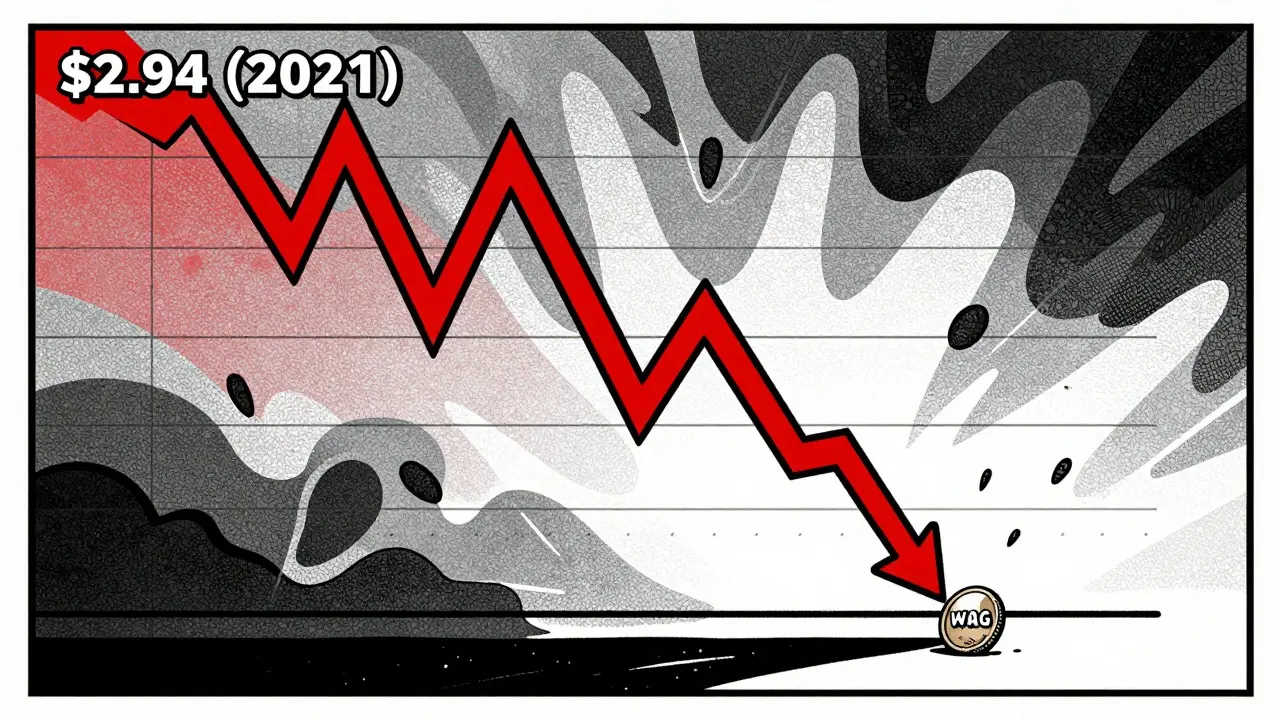
Look closely at that All-Time High. WAG traded at nearly $3.00 in late 2021. Today, it hovers around fractions of a penny. That is a decline of over 99%. While the broader crypto market has seen cycles of boom and bust, this specific trajectory indicates a significant loss of investor confidence and active participation.
The market cap is particularly telling. A market capitalization under $20,000 places WagyuSwap in the "micro-cap" category. This means the token is highly susceptible to manipulation. A single large buy or sell order can swing the price by double digits. For a serious trader, this volatility isn't an opportunity; it's a risk factor that makes entry and exit difficult.
Liquidity and Trading Volume: The Elephant in the Room
If you want to use WagyuSwap, you need to know what you’re getting into regarding liquidity. Data from multiple aggregators shows 24-hour trading volumes that are often negligible-sometimes reported as effectively zero on certain days.
Why does this matter? Imagine you want to swap $100 worth of USDT for WAG. On a platform like Uniswap, you’d get a precise rate with minimal slippage. On WagyuSwap, due to thin order books and shallow liquidity pools, that same $100 swap might result in you receiving significantly fewer tokens because your trade moves the market price against you.
This lack of volume creates a vicious cycle. Traders avoid platforms with low liquidity because of slippage. Because traders avoid it, liquidity remains low. Consequently, WagyuSwap struggles to compete with established ecosystems like Ethereum, Arbitrum, or even newer L2s like Base or Blast, which have successfully aggregated massive user bases.
How WagyuSwap Compares to Industry Leaders
You wouldn’t drive a car without comparing it to others. Here is how WagyuStack stacks up against the titans of the DEX world.
| Feature | WagyuSwap | Uniswap (Ethereum/L2s) | PancakeSwap (BNB Chain) |
|---|---|---|---|
| Primary Blockchain | Velas Network | Ethereum & Layer 2s | Binance Smart Chain |
| Transaction Cost | Ultra-low (near zero) | High on Mainnet, Low on L2s | Low |
| Liquidity Depth | Very Low | Extremely High | High |
| User Base | Niche / Minimal | Massive Global Adoption | Large Global Adoption |
| Slippage Risk | High | Low | Low |
| Best For | Speculative micro-trades | Serious trading & DeFi yield | Cost-effective mainstream trading |
Uniswap and PancakeSwap offer something WagyuSwap currently cannot: trust through volume. When millions of dollars change hands daily, the price discovery mechanism works efficiently. WagyuSwap is better suited for users who are already deeply embedded in the Velas ecosystem and need to move assets between native Velas tokens quickly, rather than for general-purpose crypto trading.
Security and Smart Contract Risks
In DeFi, security is paramount. WagyuSwap operates on smart contracts deployed on the Velas chain. While Velas claims robust security features inherited from its hybrid architecture, the age of the code matters. Older projects sometimes lag behind in adopting the latest security patches unless actively maintained.
There have been no major publicized hacks of WagyuSwap specifically in recent years, but the silence can be deceptive. With such a small community, vulnerabilities might go unnoticed until they are exploited. Always check if the smart contracts have been audited by reputable firms like CertiK or Hacken. If you cannot find recent audit reports, treat the platform with extreme caution. Never invest more than you can afford to lose, especially on micro-cap platforms.
User Experience and Accessibility
Getting started with WagyuSwap requires a few steps that might frustrate newcomers:
- Wallet Setup: You need a wallet compatible with the Velas Network. MetaMask works, but you must manually add the Velas network RPC details. This adds a layer of technical complexity compared to clicking a link on a mobile app.
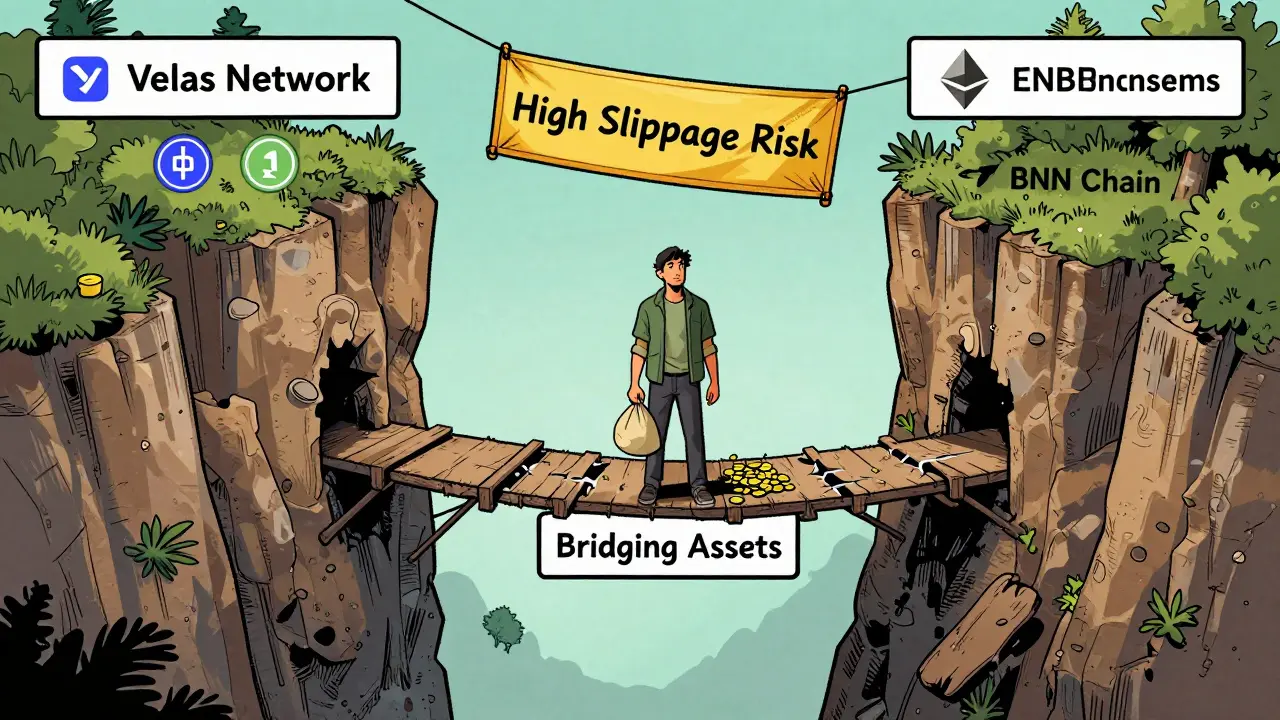
- Bridging Assets: To get funds onto Velas, you likely need to bridge them from Ethereum or BNB Chain. Bridging introduces additional time delays and potential failure points. If the bridge is congested or down, your funds are stuck in limbo.
- Interface Simplicity: Once connected, the interface is standard for AMM (Automated Market Maker) DEXs. You select your input token, output token, and swap. However, due to low liquidity, you will often see warnings about high price impact before confirming a trade.
The documentation is sparse. Most information comes from the broader Velas ecosystem page rather than dedicated, comprehensive guides for WagyuSwap. This suggests that the development team may be prioritizing network-level upgrades over user-facing improvements for the DEX.
Future Outlook: Can WagyuSwap Recover?
Price predictions for WAG in 2025 and 2026 have been largely bearish. Services like LiteFinance and WalletInvestor projected average prices hovering around $0.00012, indicating a plateau or slow decline. The Fear & Greed Index for the broader market may fluctuate, but WagyuSwap’s specific metrics suggest it is not benefiting from general crypto bull runs.
For WagyuSwap to recover, several things need to happen:
- Velas Network Growth: The underlying blockchain must attract new dApps and users. If Velas remains stagnant, WagyuSwap has no reason to exist.
- Liquidity Incentives: The protocol would need to burn treasury funds to incentivize liquidity providers, similar to how early-stage protocols bootstrap themselves.
- Partnerships: Strategic alliances with larger exchanges or DeFi protocols could bring external volume.
Without these catalysts, WagyuSwap risks becoming a relic-a functional but empty platform serving only die-hard believers in the Velas vision.
Final Verdict: Who Should Use WagyuSwap?
Be honest with yourself about your goals. Are you looking for a reliable place to park stablecoins or trade major assets? If so, stick to Uniswap, PancakeSwap, or Curve. They offer depth, security, and ease of use.
Use WagyuSwap only if:
- You already hold assets on the Velas Network and need to swap between native tokens.
- You are an advanced trader comfortable with high slippage and bridging risks.
- You are speculating on the WAG token itself, understanding the extreme volatility and low market cap.
For the average crypto user in 2026, WagyuSwap offers little advantage over established competitors. The low fees are tempting, but the hidden costs of slippage and liquidity risk often outweigh the savings. Proceed with caution, do your own research, and never let FOMO drive your decisions on micro-cap platforms.
Is WagyuSwap safe to use in 2026?
While there have been no major reported hacks, safety in DeFi depends on liquidity and smart contract audits. WagyuSwap operates on the Velas Network, which is generally secure, but the platform's extremely low market cap and liquidity make it risky for large transactions. Always verify current audit statuses and start with small amounts to test the waters.
What is the minimum amount I can trade on WagyuSwap?
Technically, you can trade very small amounts since transaction fees on Velas are near zero. However, due to low liquidity, trading small amounts might still result in poor exchange rates (slippage). It is recommended to check the price impact warning before confirming any swap, regardless of size.
How do I get WAG tokens?
You can purchase WAG tokens on centralized exchanges like KuCoin or Bybit, though liquidity may vary. Alternatively, you can swap directly on WagyuSwap using other ERC-20 or BEP-20 tokens that have been bridged to the Velas Network. Note that buying on CEXs usually offers better pricing due to higher order book depth.
Why is the WAG token price so low compared to its ATH?
The WAG token peaked at $2.94 during the 2021 bull run when hype around new EVM-compatible chains was high. Since then, the market has consolidated, and many smaller projects lost relevance. The drop to fractions of a penny reflects reduced demand, lower trading volume, and a shift in user preference toward more established ecosystems like Ethereum Layer 2s.
Can I provide liquidity on WagyuSwap?
Yes, WagyuSwap functions as an Automated Market Maker (AMM), allowing users to provide liquidity pairs. However, given the low trading volume, fee earnings may be minimal. Additionally, you face impermanent loss risk, especially if the WAG token continues to depreciate against paired assets like USDT or ETH.