
What is Peepo (PEPO) Crypto: Ticker Confusion, Tokenomics & Risk Guide
You might have seen the ticker PEPO on a price tracker and assumed it was one single coin. In reality, you are likely looking at a naming collision that confuses even experienced traders. The "Peepo" brand in crypto isn't just one asset; it’s a tangled web of tokens on Ethereum and Base with wildly different supplies and contract addresses.
If you are holding or thinking about buying PEPO, knowing exactly which token you are looking at is the first step to avoiding a costly mistake. This guide breaks down the differences between the main variants, explains their technical setup, and helps you understand why this specific meme coin sits in such a risky corner of the market.
The Core Identity: What is Peepo?
Peepo (PEPO) is a community-focused meme cryptocurrency token built on the Ethereum network using the ERC-20 standard. It launched in 2023, riding the wave of meme culture inspired by the iconic Pepe the Frog character. Unlike utility coins designed to solve specific technical problems, PEPO relies heavily on its branding and community engagement to maintain value.
The project positions itself as a decentralized ecosystem where the token facilitates transactions and participation in various applications. However, for most users, it functions primarily as a speculative asset. The core appeal lies in its "fair launch" narrative and the ultra-low price per unit, which allows investors to hold millions or billions of tokens in their wallets-a psychological tactic common in meme coins.
Critical Distinction: PEPO vs. PEEPO
This is the most important part of understanding this asset class. There is significant confusion between Peepo (PEPO) and Peepo (PEEPO). They are distinct entities with different networks and supplies.
- PEPO (Ethereum): This is the primary token discussed in most general contexts. It runs on the Ethereum mainnet. Its total and maximum supply is approximately 420.69 billion tokens. The number 420 is a deliberate reference to meme culture.
- PEEPO (Ethereum): A separate ERC-20 token also on Ethereum, launched on April 23, 2023. It has a much larger supply of 69.42 trillion tokens. Its smart contract address is 0xaADA04204e9e1099DaF67cf3D5D137E84E41CF41.
- PEEPO (Base): Variants exist on the Base blockchain, a Layer 2 solution. These are marketed as utility tokens for low-cost transactions within the Base ecosystem.
Mixing these up can lead to buying the wrong token entirely. Always check the ticker symbol and the network before executing a trade.
| Attribute | PEPO (Ethereum) | PEEPO (Ethereum) | PEEPO (Base) |
|---|---|---|---|
| Network | Ethereum Mainnet | Ethereum Mainnet | Base L2 |
| Total Supply | 420.69 Billion | 69.42 Trillion | Varies by contract |
| Token Standard | ERC-20 | ERC-20 | ERC-20 / NFT Compatible |
| Primary Use | Meme / Speculation | Meme / Speculation | Utility / Transactions |
| Launch Year | 2023 | 2023 | 2023-2024 |
Technical Infrastructure and Security
Since PEPO is an ERC-20 token, it does not have its own blockchain. Instead, it leverages the security and scalability of the Ethereum network. This means transaction validation is handled by Ethereum's Proof-of-Stake consensus mechanism. You do not need to run a node to verify PEPO transactions; the underlying Ethereum network handles that heavy lifting.
For the Base-chain variants, the infrastructure relies on Base, a Layer 2 scaling solution developed by Coinbase. Base offers faster transaction times and significantly lower gas fees compared to Ethereum mainnet. If you are interacting with PEEPO on Base, your wallet must be configured to switch networks from Ethereum to Base to ensure the correct contract address is recognized.
One key technical detail is that these tokens are non-mineable. You cannot generate new PEPO or PEEPO through mining hardware. Acquisition happens exclusively through swapping on Decentralized Exchanges (DEXs) or purchasing on Centralized Exchanges (CEXs).
Tokenomics and Market Cap Reality
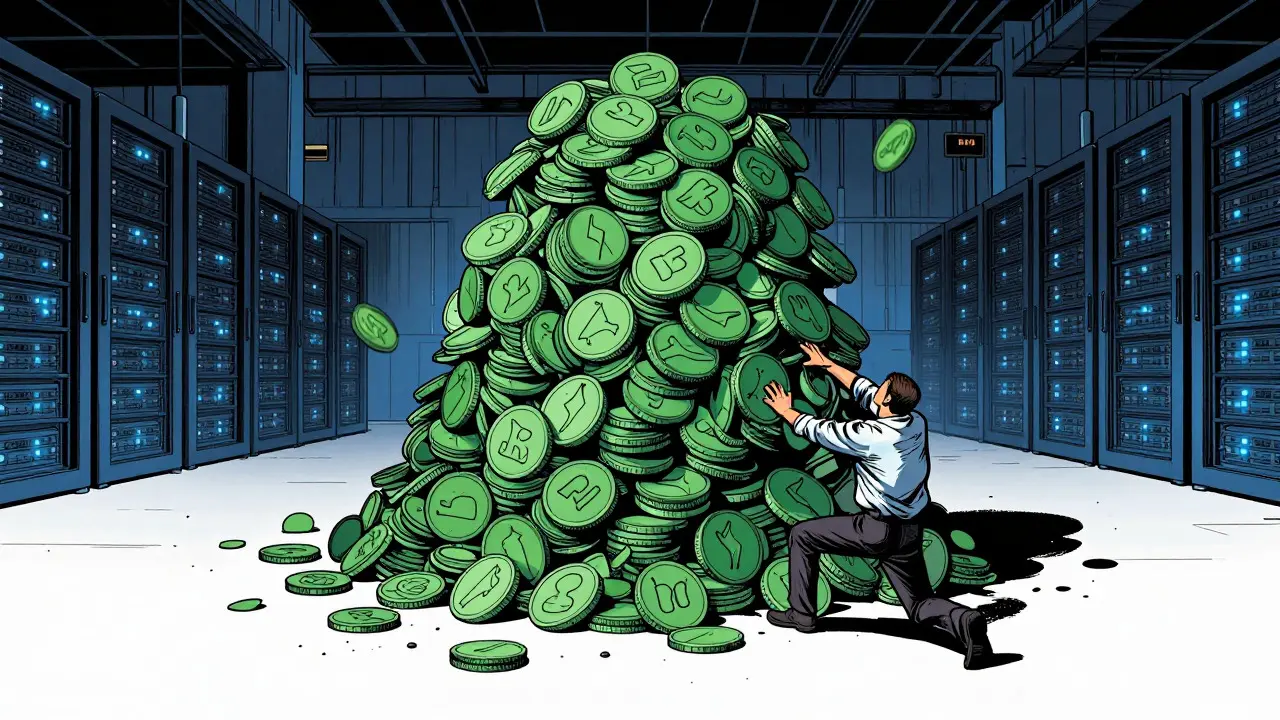
The tokenomics of PEPO are designed around high volume and low unit price. With a circulating supply of nearly 420 billion tokens, the price per token is extremely small. As of mid-2026, PEPO trades in the range of $0.0000017 to $0.000002 USD. This results in a market capitalization typically hovering in the low six-figure USD range, often below $500,000.
To put this in perspective, top-tier cryptocurrencies like Bitcoin or Ethereum have market caps in the hundreds of billions. PEPO sits in the "long tail" of the crypto market, ranked around #7,000 globally. This ranking indicates that while the token is active, it commands a tiny fraction of the total market liquidity.
Liquidity is another critical factor. Daily trading volumes for PEPO can be modest, sometimes dropping below $10,000 on certain days. For large position sizes, this low liquidity means that buying or selling can cause significant price slippage, moving the price against you before the trade even completes.
Where to Buy and Trade
Accessing PEPO requires navigating both centralized and decentralized platforms. Here is how you can typically find it:
- Decentralized Exchanges (DEXs): Uniswap is the primary venue for Ethereum-based PEPO. You will need an Ethereum-compatible wallet like MetaMask or Trust Wallet. For Base-chain PEEPO, you may use DEXs native to the Base network.
- Centralized Exchanges (CEXs): Platforms like HTX, Crypto.com, and Binance track or list PEPO. Note that some platforms may only provide price tracking rather than direct spot trading pairs. Always verify if a buy button is available or if you need to swap via a partner service.
- Wallet Integration: Coinbase tracks the asset, but availability for direct purchase may vary by region. Check your local exchange options carefully.
When trading on DEXs, always double-check the contract address. Because multiple tokens share the "Peepo" name, fake clones are common. Verify the address against reputable aggregators like CoinGecko or CoinMarketCap before connecting your wallet.

Risk Factors and Future Outlook
Investing in PEPO comes with high risk. The primary risks include:
- Brand Dilution: Multiple tokens use similar names (PEPO, PEEPO), fragmenting community attention and liquidity.
- Anonymous Team: No major aggregator lists named founders or a core development organization. This lack of transparency makes accountability difficult.
- Low Liquidity: Thin trading volumes make it hard to exit large positions without impacting the price.
- No Clear Roadmap: Unlike established projects, PEPO lacks widely documented technical upgrades or long-term milestones in major data sources.
As of August 2026, the token remains active but unremarkable in terms of fundamental growth. It continues to be traded, generating daily volume, but it has not broken out into higher market cap tiers. For holders, the strategy is often purely speculative, relying on community hype cycles rather than product adoption.
Frequently Asked Questions
Is Peepo (PEPO) a good investment?
Like all meme coins, PEPO is highly speculative. It has no inherent utility beyond its ecosystem and relies on community sentiment. With a low market cap and anonymous team, it carries high volatility and risk. Only invest what you can afford to lose.
What is the difference between PEPO and PEEPO?
PEPO is an Ethereum token with a supply of 420.69 billion. PEEPO is a different token, also on Ethereum, with a supply of 69.42 trillion. There are also PEEPO variants on the Base network. They have different contract addresses and should not be confused.
Can I mine Peepo (PEPO)?
No. PEPO is an ERC-20 token, which means it is not mineable. You acquire it by buying it on exchanges or swapping it on decentralized platforms.
Where can I buy PEPO safely?
You can buy PEPO on centralized exchanges like HTX or Crypto.com, or on decentralized exchanges like Uniswap. When using DEXs, always verify the official contract address to avoid counterfeit tokens.
Who created Peepo (PEPO)?
The founders are not publicly listed in major data aggregators. The project appears to be community-driven with an anonymous or pseudonymous team, which is typical for many small-cap meme coins.



1 Comments
Laine Van Sickle
August 26 2026ugh this is so confusing why do they all have to be named the same thing it makes me want to cry 😭
like who even cares about the difference between peepo and peepeo it's just a frog right?
i tried to buy it last week and ended up with the wrong one because i didn't check the contract address
now i'm sitting on 420 billion tokens that are worth basically nothing lol
the article says its risky but honestly everything in crypto feels like a scam to me these days
just another way for whales to dump on us little guys
i hope someone fixes this naming disaster before more people get hurt