What is Pesabase (PESA)? A Guide to Africa's Blockchain Remittance Coin
Sending money across borders often feels like a rip-off. If you've ever tried to send funds to family in East Africa, you know the drill: exorbitant fees, days of waiting, and a mountain of paperwork. This is where Pesabase is a blockchain-based financial platform and cryptocurrency token designed to slash the cost and time of international money transfers. By bypassing old-school banking corridors, it aims to make digital remittances accessible to everyone, even those without a traditional bank account. It isn't just another speculative coin; it's a tool built to solve a specific, real-world problem in underserved regions.
How the PESA Token Actually Works
At the heart of the ecosystem is the PESA token is the native utility asset of the Pesabase platform, launched in 2022 and operating on the BNB Smart Chain (BEP20) . Unlike Bitcoin, which people often hold as "digital gold," PESA is designed to power a remittance engine. To keep the system lean, it uses a fixed supply model. There are exactly 60 million tokens in existence, with no more ever being minted. This scarcity is a key part of its economic design.
The tokenomics here are particularly interesting because they are deflationary. Instead of just sitting in wallets, the token is tied to the actual activity of the platform. Every time someone sends money to a relative or a business partner through Pesabase, a portion of that transaction fee is used to buy PESA tokens from the open market. Those bought tokens are then "burned"-permanently removed from circulation. In simple terms: the more people use the app to send money, the more tokens disappear, which theoretically puts upward pressure on the price for remaining holders.
Solving the "Last Mile" Problem in Africa
The biggest hurdle for crypto in Africa isn't the technology; it's how to actually get the money into a person's hand. Pesabase solves this by integrating with Mobile Money is a technology that allows users to store and transfer money using a mobile phone, bypassing the need for a bank account . This is huge for countries like South Sudan and other East African nations where bank branches are rare but mobile phones are everywhere.
When you use the platform, you aren't limited to just a digital wallet. You can send funds through three main channels:
- The Pesabase App: Direct digital transfers for those with smartphones.
- SIM Card Integration: Sending money directly to a mobile number, making it instantly available as mobile credit or cash.
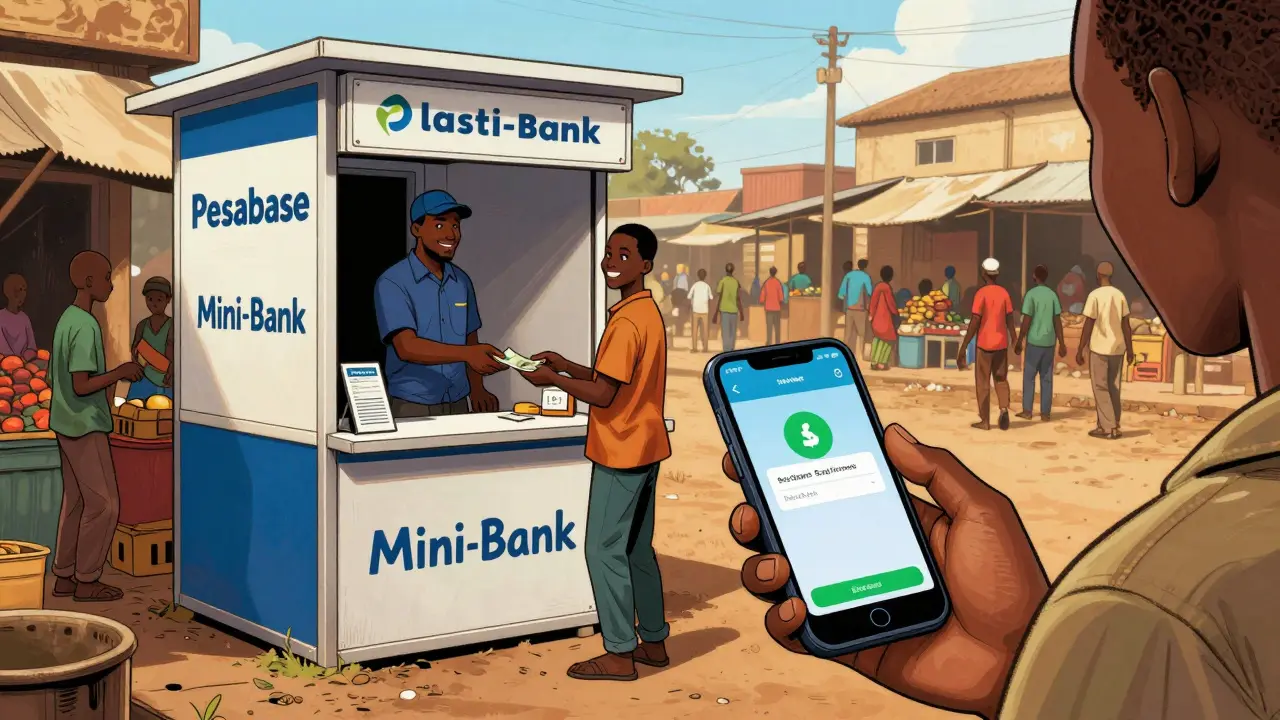
- Agent Network: A physical web of Pesabase Agents and "Mini-Banks" scattered across East Africa where users can cash out their digital funds into local currency.
By combining Stablecoins is cryptocurrencies pegged to a stable asset, like the US Dollar, to minimize price volatility with the PESA token and mobile infrastructure, the platform removes the volatility risk that usually scares away non-crypto users.
Pesabase vs. Traditional Remittance Services
If you compare Pesabase to a giant like Western Union or MoneyGram, the difference is mainly in the "middleman." Traditional services rely on a chain of correspondent banks, each taking a small cut. Pesabase uses the BNB Smart Chain is a blockchain network that provides fast and low-cost smart contract functionality, serving as the foundation for PESA to settle transactions almost instantly.
| Feature | Traditional Services | Pesabase (PESA) |
|---|---|---|
| Transfer Speed | Hours to Days | Nearly Instant |
| Average Fees | High (often 5-15%) | Up to 90% Lower |
| Requirement | Bank Account/ID | Mobile Phone / SIM Card |
| Settlement Layer | Central Bank Systems | BNB Smart Chain (BEP20) |
Staying Legal: AML and Compliance
One of the biggest red flags for any crypto project is a "move fast and break things" attitude toward the law. Because Pesabase handles real money for real people in sensitive regions, they've focused heavily on Anti-Money Laundering (AML) is a set of laws and regulations intended to stop the practice of generating income through illegal actions compliance. They aren't trying to hide from regulators; they are positioning themselves as a legal, transparent alternative to the black market exchanges that often plague underserved regions.
By implementing these checks, they ensure that the platform remains viable for businesses and enterprises, not just individual users. This institutional focus is what allows them to scale faster than a simple "community coin." They are essentially building a compliant financial bridge between the global crypto market and the local East African economy.
How to Get and Use PESA
If you're looking to acquire PESA, you won't find it at your local bank. Since it's a BEP20 token, you'll need a compatible wallet. Many users utilize the Binance Web3 Wallet is a decentralized wallet integrated into the Binance ecosystem that allows users to interact with dApps and hold BEP20 tokens to hold their assets. You can fund this wallet with stablecoins from a central exchange and then swap them for PESA on decentralized exchanges (DEXs).
It is worth noting that the project recently performed a 1:1 contract swap. If you held old PESA tokens, they had to be migrated to the new contract to maintain their value. This is a common occurrence in the crypto world when a project upgrades its security or changes its technical parameters to improve efficiency.
What is the current price of the PESA token?
As of recent data, PESA is trading around $0.03 USD, though cryptocurrency prices fluctuate constantly based on market demand and platform usage.
Is Pesabase safe for sending money to South Sudan?
Pesabase is specifically designed for underserved regions like South Sudan, leveraging AML compliance and a physical network of agents to ensure funds reach their destination safely and legally.
How does the "burn" mechanism work in PESA?
Every time a user makes a money transfer, a portion of the fee is used to buy PESA tokens from the market and permanently destroy (burn) them. This reduces the total supply over time, which can potentially increase the value of the remaining tokens.
Do I need a bank account to use Pesabase?
No. One of the core benefits of Pesabase is that it works with mobile money and SIM cards, allowing unbanked populations to receive and send funds without a traditional bank account.
Which blockchain does PESA use?
The PESA token operates on the BNB Smart Chain (BSC) using the BEP20 token standard, which allows for fast transactions and low gas fees.
Next Steps for New Users
If you're new to the ecosystem, the best way to start is by downloading the Pesabase app and exploring the remittance options. If you're an investor, keep a close eye on the adoption rates in East Africa; because the token is deflationary, the real value isn't in hype, but in how many people actually use the service to send money.
For those already holding tokens, ensure you are using the most recent contract address following the 1:1 swap. If you're sending money for the first time, start with a small test transaction to verify the recipient's mobile money details before sending larger sums. This is a standard safety practice in any digital financial transaction.

17 Comments
Findlay Duncan Lyon
April 22 2026Game changer for East Africa!
Greg Reynolds
April 23 2026The claim that this solves the "last mile" problem is a bit optimistic. Most of these systems still rely on local agents who take their own unofficial cuts, effectively replacing one middleman with another, just in a different form.
Sarah Fisher
April 25 2026It is fascinating to think about how decentralized finance can bridge the gap for those who have been historically excluded by the traditional banking architecture. There is something profoundly hopeful about using code to ensure a family in South Sudan can receive support without losing half of it to fees.
Benjamin Forg
April 25 2026dont trust the burn mechanism its just a way to trick you into holding while the devs dump on your head probably just another front for the globalists to track every cent you move in africa
Robert Mosolygo
April 26 2026The deflationary model is a transparent attempt to manufacture scarcity. If the utility doesn't grow exponentially, the burn rate is irrelevant. We are seeing the same tokenomic playbook used in a hundred failed projects over the last three years.
Alex Wan
April 28 2026Oh my goodness!! This is truly a revelashun for the unbanked! We must embrace these technoligis to lift up our global brothers and sisters in a most gratious manner!! 🌟
Lisa Camp
April 29 2026Stop overanalyzing the tokenomics and just look at the impact! Get in or get out of the way because this is actually helping people!
Sara Ellis
April 29 2026money is just a vibe anyway so why not use a coin that actually does something useful for people who dont have banks
Yvette P
May 1 2026Oh honey, let me enlighten you on the actual plumbing here. We are talking about a BEP20 implementation leveraging a high-throughput sidechain to avoid the L1 congestion that usually kills these niche remittance plays, which is just adorable if you think a simple app solves the systemic liquidity crisis in the region. You've got your smart contracts and your automated market makers, but the real magic is the off-ramp infrastructure, though honestly, the sarcasm of calling it a "bridge" when it's basically a digital toll booth is just too rich for my blood. It's cute that we think a burn mechanism compensates for the inherent volatility of the BNB chain, but hey, who cares about systemic risk when you can have a flashy app on your phone and feel like a venture capitalist while sending twenty bucks home to grandma in Juba, right?
Jason M
May 1 2026I am absolutely floored by the potential here! This is exactly the kind of empowerment we need to see in the world! Imagine the lives changed when a mother can get funds instantly!
Mary Tawfall
May 2 2026It's really heartening to see technology being used for such a noble purpose. I hope the adoption grows steadily and safely for everyone involved.
debashish sahu
May 3 2026The focus on AML is a very sensible approach to ensure long term sustainability in these markets.
Matthew Morse
May 4 2026too many words in this post honestly just tell me if it's a rug or not
Mike Word
May 5 2026I'm curious about how the agent network is vetted. If they are using a physical web of mini-banks, there must be a strict onboarding process to keep it compliant.
Kyle Bush
May 5 2026USA should be leading this tech not some random chain! 🇺🇸🇺🇸 We need to dominate the financial world with our own systems! 🚀💥
Candace Sherrard
May 7 2026When we look at the flow of capital through these digital corridors, we are essentially witnessing a shift in the sociology of trust, moving away from the institutional trust of a brick-and-mortar bank and toward the algorithmic trust of a distributed ledger. It's a quiet revolution that doesn't happen with a bang, but rather with the soft click of a mobile app in a rural village, slowly eroding the necessity of the traditional financial gatekeepers who have profited from inefficiency for centuries. I find it meditative to consider how a simple 1:1 swap or a token burn is actually a manifestation of a larger desire for financial autonomy in regions that the West has largely ignored until it became profitable to digitize them.
jill huyo-a
May 7 2026I'm sure the project is doing its best to help, though I wonder if the technical barrier might still be a bit high for some people.