
What is Yieltra (YLT)? A Deep Dive into the Passive Income Token
Imagine owning a digital asset that puts money in your pocket without you having to lift a finger. No locking your funds in a vault, no complex staking contracts, and no waiting for a monthly payout. That is the core promise of Yieltra is a DeFi-native token designed to deliver automated passive income in USDC directly to its holders. Also known as YLT, it operates as a self-sustaining economic engine on one of the fastest blockchains in the world.
How Yieltra Actually Works
Most people are used to the idea of staking, where you lock up your coins to earn a reward. Yieltra flips this script. It uses a smart contract to handle rewards automatically. If you hold YLT in your wallet, you earn. There is no need to connect your wallet to a complicated dashboard or trust a centralized platform to manage your funds.
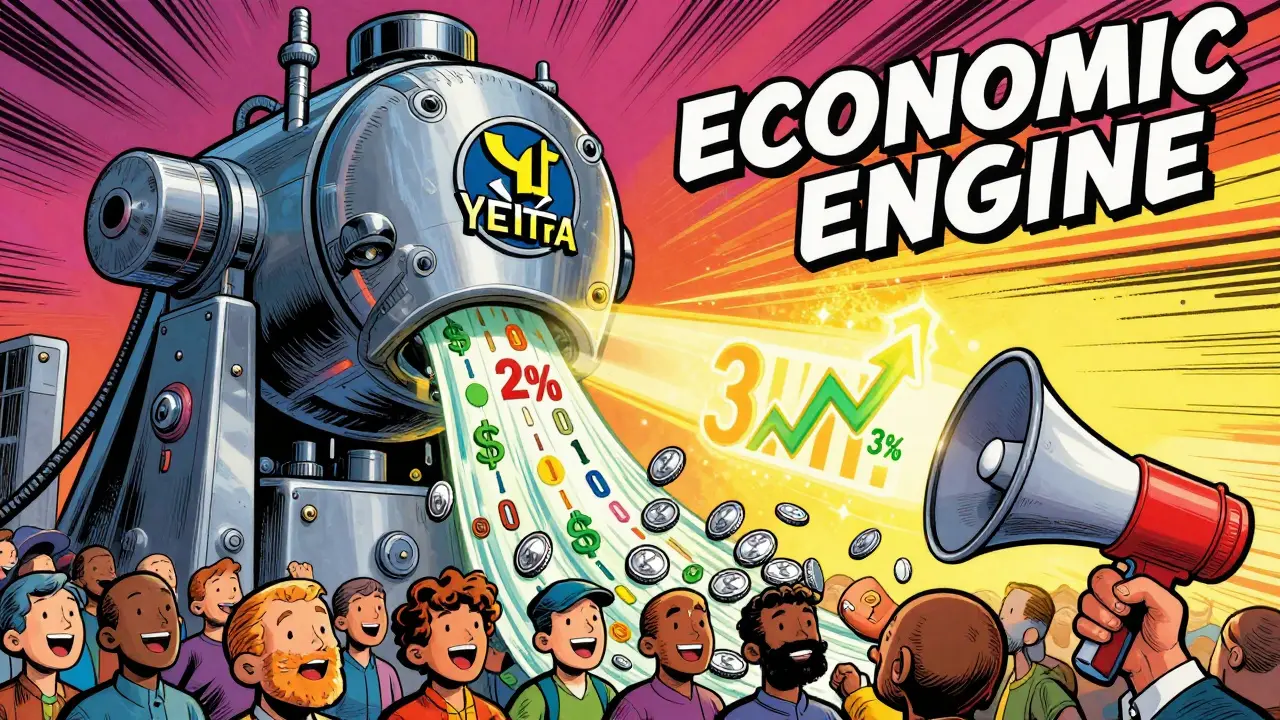
The secret sauce is in the transaction fee structure. Every time someone buys or sells YLT, a 5% fee is triggered. Here is where that money goes:
- 2% for Holders: This portion is converted and distributed as USDC (a stablecoin pegged to the US Dollar). This means your rewards are in a stable currency, protecting you from the volatility of the token itself.
- 3% for Growth: This goes into the MARFT system, which the project uses for marketing and expanding its user base.
By leveraging the Solana blockchain, Yieltra ensures that these micro-distributions happen almost instantly and for a fraction of a cent in fees. Without Solana's high throughput, a system that pays out on every single trade would be too expensive to maintain.
The Technical Specs and Supply
When looking at a new coin, the numbers usually tell the real story. Yieltra has a very strict supply cap to prevent the kind of hyperinflation seen in some newer DeFi projects. The total supply is fixed at 30 million tokens, and 100% of these are available for sale. There are no secret "team wallets" that could suddenly dump millions of coins onto the market and crash the price.
| Attribute | Value |
|---|---|
| Blockchain | Solana |
| Total Supply | 30,000,000 YLT |
| Reward Currency | USDC |
| Transaction Fee | 5% (2% Rewards / 3% Marketing) |
| Primary Exchange | Raydium |
Market Performance: Reading the Mixed Signals
If you check different tracking sites, you might notice that YLT's price looks different depending on where you look. For example, CoinGecko often shows prices around $0.01, while CoinMarketCap has reported lower figures near $0.004. Why the gap? In the world of low-cap DeFi tokens, this usually happens because different platforms track different liquidity pools or update their data at different speeds.
Historically, the token has seen significant swings. It hit an all-time high (ATH) in late 2025, though the exact peak varies by source. More recently, it hit a low in February 2026 before bouncing back. This volatility is typical for a YLT crypto coin, as its value is heavily tied to trading volume-more trades mean more USDC rewards for holders, which in turn creates more demand for the token.
Beyond the Token: The Tourism Vision
It would be a mistake to think of Yieltra as just a "reward coin." The project is positioning itself as a utility tool for global tourism. The goal is to integrate YLT as a primary payment method for travel experiences. Imagine booking a boutique hotel or a guided tour in a foreign city and paying with YLT to unlock exclusive rewards or discounts.
This shift from a purely financial tool to a real-world application is what the project calls its "economic engine." By connecting DeFi rewards with a tangible industry like travel, they aim to move away from speculative trading and toward actual utility. If they can get travel providers to accept YLT, the demand for the token would shift from people wanting passive income to people needing the token to travel.
How to Get and Trade YLT
Since Yieltra is decentralized, you won't find it on a traditional brokerage. It lives on Raydium, the most popular decentralized exchange (DEX) on Solana. The most common way to trade it is through the YLT/SOL pair.
If you are looking for real-time charts and deep liquidity analysis, tools like DexScreener are the gold standard for this. Because the protocol is designed to be accessible, you don't need to go through a rigorous KYC process; you just need a Solana-compatible wallet (like Phantom) to interact with the liquidity pools.

Risks and Realities of YLT
No investment is without risk, and DeFi tokens are particularly spicy. The primary risk with Yieltra is its dependence on volume. If people stop trading YLT, the 2% reward mechanism slows down. If the trading volume drops to zero, the "passive income" effectively stops.
Additionally, the price discrepancies between major trackers suggest that the token is still in a high-volatility phase. Small-cap coins can be manipulated by "whales"-investors with huge holdings who can move the price significantly with a single trade. Always remember that while the USDC rewards provide a safety net, the value of the YLT tokens themselves can still fluctuate wildly.
Do I need to stake my YLT tokens to earn USDC?
No, that's the main draw of Yieltra. There is no staking required. The rewards are distributed automatically to all holders via the smart contract based on the transaction fees collected from trades.
Where can I buy Yieltra (YLT)?
YLT is primarily traded on decentralized exchanges on the Solana blockchain, with Raydium being the most active platform for the YLT/SOL pair.
What is the maximum supply of YLT?
The total supply is capped at 30 million tokens. According to the project, 100% of these tokens are available for sale, meaning there are no locked team allocations.
Is Yieltra related to travel?
Yes. While it functions as a DeFi token, the project's long-term roadmap focuses on global tourism, intending to use YLT as a payment method for travel experiences and exclusive benefits.
Why are the prices different on CoinGecko and CoinMarketCap?
Price discrepancies are common for smaller tokens. They usually stem from different data update frequencies, the specific liquidity pools being tracked, or the timing of the data snapshot.
Next Steps for Potential Holders
If you are considering YLT, your first step should be setting up a Solana wallet. Once you have that, you can explore Raydium to see the current liquidity and trading volume. If you're a long-term believer in the tourism angle, you might be less worried about daily price swings and more focused on the accumulation of USDC rewards.
For those who are more cautious, start by tracking the token on DexScreener for a week. Look for patterns in the volume-since the rewards depend on trades, a steady increase in trading activity is a much better sign than a sudden, singular price spike.


18 Comments
James Bone
April 11 2026Typical DeFi ponzi structure where the "passive income" is just a redistribution of entry fees. It's essentially a game of musical chairs where the last person holding the bag loses everything while the early whales feast on the USDC. People love to call this "innovation" but it's just basic math wrapped in a shiny Solana wrapper. The tourism angle is a blatant pivot to distract from the fact that the token has zero intrinsic value without constant trading volume. Wake up and stop chasing these ghost coins before you get rugged by a smart contract that probably has a backdoor.
Adam Auksel
April 12 2026This looks like a great way to get into passive income! 🚀 I love how it doesn't require locking funds. Very beginner friendly! ✨
Aaliyah BROTHERS
April 14 2026SURELY this is just another plot by the globalists to track our travel!!! Who really controls the MARFT system??? Probably some shadow government in a bunker!!!! Absolute madness that people believe this without seeing the deep-state connections!!!! Totally rigged!!!!
Heather Warren
April 15 2026The automated USDC distribution is a very helpful feature for those who avoid the complexity of staking. It simplifies the process for everyone.
Jason Davis
April 17 2026Solana is defenitely the right choice here. The low fees make these micro-payments actually viable. If this was on Eth it would be way too expensiv for the average person to even bother.
James Bone
April 19 2026Imagine thinking
James Bone
April 19 2026Imagine thinking low fees make a bad economic model a good one. You're just losing money faster and more efficiently. 🙄
Swati Sharma
April 20 2026The liquidity pool variance between CoinGecko and CMC is a classic slippage and API lag issue. It's basically just an oracle latency problem. If you're looking for the true spot price, you gotta stick to the DEX charts because the aggregators can't keep up with the high-frequency volatility of low-cap Solana assets. Just a bit of slippage in the reporting, nothing to worry about if you're playing the long game with your portfolio!
Jessie Tayaban
April 22 2026omg the travel part sounds so cool!!! i cant wait to book a trip and just pay with my coins haha!! hope it works out 💖
Amanda Faust
April 24 202630 million supply is tiny compared to most projects so inflation isnt the issue here. its all about the volume
Emily H
April 25 2026The integration of a stablecoin like USDC for rewards is a commendable decision. It provides a necessary hedge against the inherent volatility of the YLT token itself, ensuring that holders receive a consistent value regardless of market fluctuations. This approach demonstrates a thoughtful consideration of risk management for the user base.
Jonathan Chamma
April 26 2026It is quite a refreshing change to see a project avoid the usual locked team wallets. That transparency builds a lot of trust right from the jump. It feels like a more honest way to launch a token without the fear of a sudden dump from the creators.
Tyler Webb
April 26 2026I'm a bit nervous about the volume dependency but the idea is pretty neat. Hope everyone stays safe with their investments! 🛡️
Prasanna Shembekar
April 26 2026i just want my USDC payouts every day haha its so easy
Rebecca Violette
April 27 2026i lost so much money on other coins i really hope this one actully works for once i just want a win lol
Scott Fenton
April 28 2026One must exercise extreme caution regarding the reliance on trading volume for reward generation. While the mechanism is technically proficient, it creates a symbiotic relationship between price speculation and income, which may not be sustainable in a bearish market environment. I would advise thorough due diligence on the liquidity depth of the YLT/SOL pair before committing significant capital.
Artavius Edmond
April 29 2026Everything sounds pretty chill so far. I'm just going to hold a little and see where the travel utility goes. If they can actually get hotels on board, that's where the real growth is!
Mikayla Murphy
April 29 2026It is interesting to see how they want to bridge the gap between digital assets and the tourism industry. If handled with respect to local travel providers, this could really open up new ways for people to explore the world while benefiting from their holdings.