Crypto Taxation in India: The 30% Rule, TDS, and New GST Hurdles (2026 Guide)
Buying Bitcoin or Ethereum in India used to feel like a wild west adventure. You bought, you held, you hoped. But since April 1, 2022, the government has drawn a hard line in the sand. If you hold Virtual Digital Assets (VDAs), which is the official term for cryptocurrencies in India, you are playing by a very specific set of rules.
The core problem for most investors isn't just that taxes exist-it's that they are high, rigid, and layered with new compliance hurdles like the recent Goods and Services Tax (GST) changes. As we move through 2026, understanding these restrictions is no longer optional; it’s essential to keep your profits from vanishing into bureaucratic friction. This guide breaks down exactly how the 30% tax works, why you can’t claim losses easily, and what the new platform fee taxes mean for your wallet.
What Counts as a Virtual Digital Asset?
Before worrying about rates, you need to know if your asset falls under this law. The Finance Act 2022 defined VDAs broadly. It’s not just Bitcoin.
- Cryptocurrencies: Bitcoin, Ethereum, Litecoin, Dogecoin, Ripple, Polygon (Matic).
- NFTs: Non-Fungible Tokens are treated the same as crypto tokens.
- Stablecoins: Even assets pegged to fiat currencies like USDT or USDC are included.
- Mining Rewards: Coins earned through mining or staking are taxed as income upon receipt.
However, gift cards and vouchers are explicitly excluded. If you’re trading standard digital tokens on an exchange, you are dealing with VDAs. The definition covers any data or code stored digitally using blockchain or similar technology.
The Double Hit: 30% Tax Plus 1% TDS
India’s approach to crypto taxation is unique because it hits you twice. First, there is the direct tax on your profit. Second, there is a withholding tax at the source. Here is how the math works in practice.
1. The 30% Capital Gains Tax
When you sell a VDA for a profit, you pay a flat 30% tax on that gain. This applies regardless of whether you held the asset for one month or ten years. There is no distinction between short-term and long-term capital gains for crypto.
Crucially, you cannot claim indexation benefits. In traditional equity investments, inflation adjustments help lower your taxable profit. With crypto, that door is closed. Furthermore, you can only deduct the actual acquisition cost. No other expenses-like gas fees, transfer costs, or software subscriptions-are deductible against this capital gain.
Don’t forget the cess. On top of the 30%, you must pay a 4% health and education cess. This brings the effective tax rate to 31.2%. If you made ₹1,00,000 in profit, you owe ₹31,200 in tax alone.
2. The 1% TDS (Tax Deducted at Source)
This is where many traders get caught off guard. Under Section 194S of the Income Tax Act, every time you transfer a VDA, the recipient (or the exchange) must deduct 1% TDS if the transaction value exceeds ₹50,000 in a financial year. For specified persons (those who file under certain sections), this threshold drops to ₹10,000.
This TDS is not an extra tax; it is an advance payment toward your final tax liability. However, it creates cash flow issues. If you trade frequently, 1% gets deducted from every sale. You have to track these deductions carefully to claim them back when filing your annual return. If the exchange fails to deposit this TDS, the burden often falls on you to resolve discrepancies with the Income Tax Department.
| Component | Rate / Threshold | Key Restriction |
|---|---|---|
| Capital Gains Tax | 30% + 4% Cess | No indexation; no expense deductions |
| TDS (Section 194S) | 1% on transfers > ₹50k | Deducted at source; requires reconciliation |
| GST on Platform Fees | 18% on service charges | Applies to all exchange fees (spot, margin, withdrawal) |
The New Hurdle: 18% GST on Exchange Fees
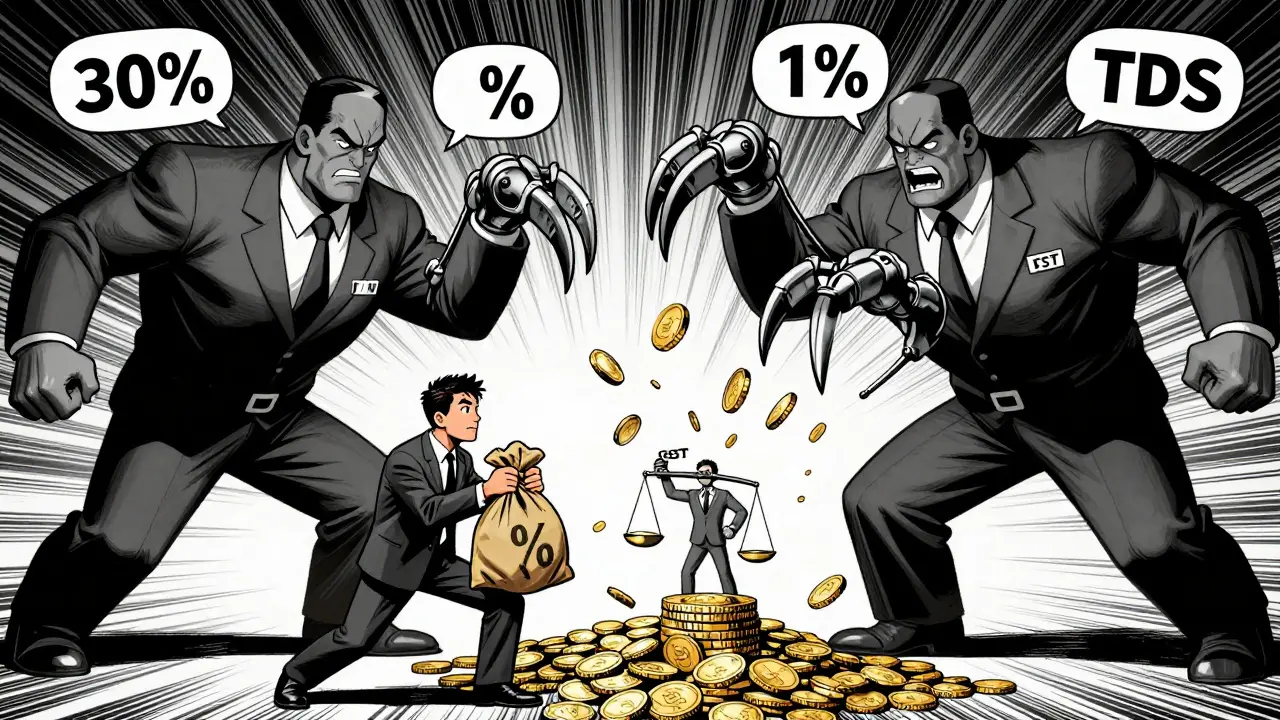
In July 2025, the Central Board of Indirect Taxes and Customs (CBIC) clarified that cryptocurrency platforms are "Online Service Providers." This means the 18% Goods and Services Tax now applies to all service fees charged by exchanges to Indian users.
This doesn’t mean 18% tax on your crypto purchase price. It means 18% tax on the fees you pay to the platform. If an exchange charges a 0.1% trading fee, that fee amount is now subject to 18% GST. While this seems small per transaction, it adds up for active traders. Exchanges are likely to pass this cost onto users by increasing their base trading fees, effectively raising your cost of entry and exit.
Platforms are now required to issue GST-compliant invoices and register for GST regardless of their turnover. This formalizes the industry but increases operational costs, which ultimately trickle down to you.
Losses: The Silent Profit Killer
Here is the most painful restriction for retail investors: you cannot offset crypto losses against other income. If you lose ₹10,00,000 on Bitcoin and make ₹10,00,000 profit on Ethereum, you still pay 30% tax on the Ethereum profit. The Bitcoin loss stays in a separate bucket.
You can only carry forward crypto losses to set off against future crypto profits for eight assessment years. This rule discourages day trading and hedging strategies that work well in traditional markets. Many investors find themselves paying tax on gross profits while ignoring significant unrealized or realized losses elsewhere in their portfolio.
Reporting and Compliance: What You Must Do
The Income Tax Department has integrated VDA data into the Annual Information Statement (AIS). This means the government already knows about your transactions if they happened on registered exchanges. Ignorance is not a defense.
- Track Every Transaction: You need a record of every buy, sell, swap, and transfer. Include timestamps, wallet addresses, and the INR value at the time of the transaction.
- Calculate Cost Basis: Since FIFO (First-In, First-Out) is the standard method, ensure your software tracks which specific batch of coins you sold. Volatile prices make this critical.
- Reconcile TDS: Check Form 26AS and AIS annually. Ensure the TDS deducted by exchanges matches what was deposited. Discrepancies here trigger scrutiny notices.
- File ITR Correctly: Report VDA gains in Schedule VDA of your Income Tax Return. Failure to report can lead to penalties and increased audit risk.
Using specialized tax software like KoinX or CoinTracker is highly recommended. Manual calculation for even moderate trading activity takes 8-12 hours per quarter. Software reduces this to a few hours and ensures accuracy in cost basis determination.
The Government Stance: Risk at Your Own Cost
It is important to understand the philosophy behind these laws. Commerce Minister Piyush Goyal has stated clearly: "We don't encourage or discourage. We only tax it." The government views unbacked cryptocurrencies as high-risk assets without sovereign guarantee.
This stance explains the lack of incentives. There are no tax holidays, no lower rates for long-term holders, and no integration with mainstream banking for crypto businesses. The Reserve Bank of India (RBI) continues to promote the e-Rupee (CBDC) as the safe, state-backed alternative. The heavy taxation serves as a deterrent rather than a revenue-generating measure for growth.
Despite this, adoption remains high. India has the second-highest crypto adoption globally. However, the user base has shifted. Retail participation dropped from 82% to 57% between 2021 and 2024, while institutional players gained ground. The market is stabilizing, but it is a mature, regulated market now, not a speculative playground.
Can I offset my crypto losses against salary income?
No. Losses from Virtual Digital Assets can only be set off against profits from other VDAs. They cannot be adjusted against salary, house property, or business income. You can carry forward these losses for eight years to offset future crypto gains.
Is the 1% TDS an additional tax?
No. The 1% TDS is an advance payment toward your total tax liability. When you file your annual return, you can claim credit for the TDS already paid. If your total tax liability is less than the TDS paid, you may be eligible for a refund.
Do I need to pay tax on crypto gifts or mining rewards?
Yes. If you receive crypto as a gift, mining reward, or staking yield, the fair market value at the time of receipt is treated as income. It is added to your total income and taxed according to your applicable income slab rates, not the 30% VDA rate.
How does the 18% GST affect my trading costs?
The 18% GST applies to the service fees charged by crypto exchanges, not the value of the crypto itself. For example, if you pay a ₹100 trading fee, you will also pay ₹18 in GST. Exchanges may increase their base fees to cover this cost, indirectly raising your trading expenses.
Will the crypto tax rules change in 2026?
While the Joint Committee on Virtual Digital Assets submitted recommendations in early 2026, the core structure of 30% tax and 1% TDS remains intact. Any changes are likely to focus on clarifying DeFi protocols and cross-border transactions rather than lowering rates significantly.