
FBAR Violations for Crypto Accounts: $100,000 Penalties Explained
You might think that because your Bitcoin or Ethereum sits on a digital exchange in Europe or Asia, the IRS can’t see it. That assumption is dangerous. The Foreign Bank Account Report, known as FinCEN Form 114, is a mandatory annual disclosure form required by the U.S. Department of the Treasury for individuals with foreign financial accounts exceeding $10,000. For years, cryptocurrency held in foreign exchanges existed in a regulatory gray area. But that ambiguity is vanishing fast. With new rulemaking notices from FinCEN and aggressive enforcement campaigns by the IRS Large Business and International division, failing to report these assets can trigger penalties up to $100,000 per violation-or even 50% of your account balance.
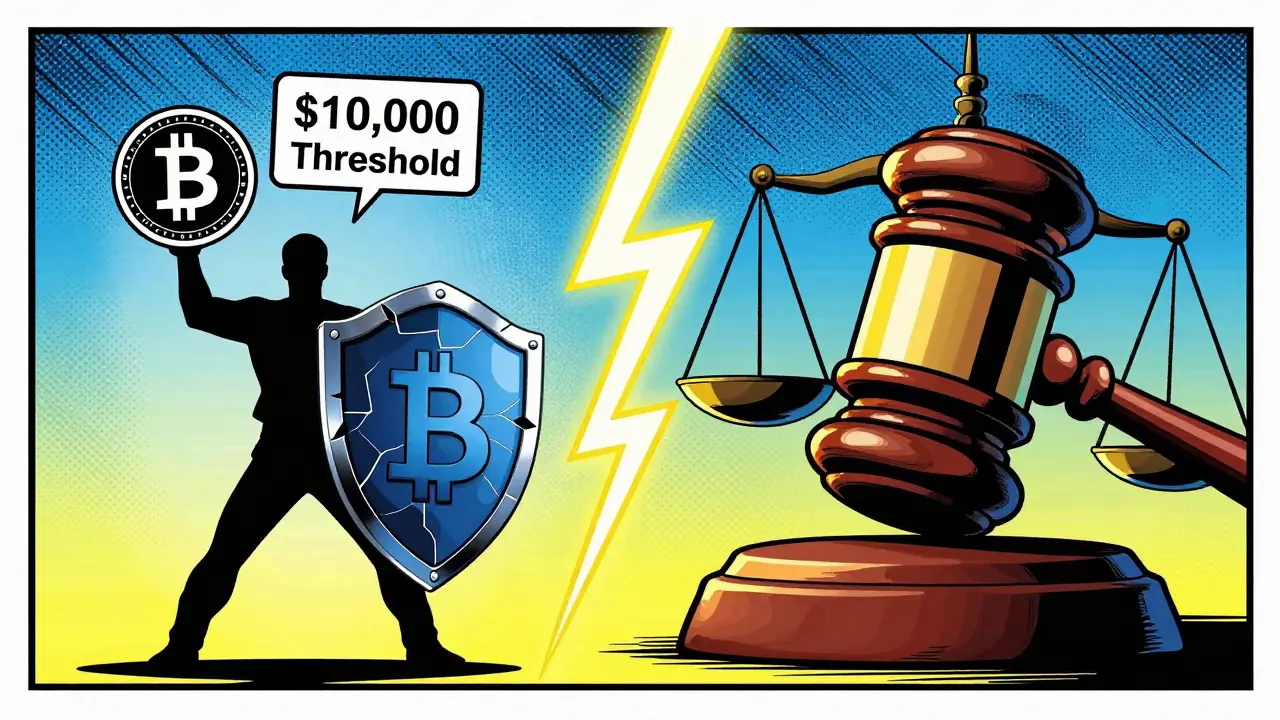
The $10,000 Threshold: When Do You Need to File?
The rule is simple but strict. If you are a U.S. person-which includes citizens, residents, green card holders, and certain trusts-you must file an FBAR if the aggregate value of all your foreign financial accounts exceeds $10,000 at any point during the calendar year. This isn’t just about your bank savings account in London. It includes securities accounts, insurance policies with cash value, and increasingly, cryptocurrency holdings.
Here is where many people trip up. The $10,000 limit is not per account. It is the total of all foreign accounts combined. Let’s say you have $6,000 in a foreign bank account and $5,000 worth of Bitcoin on a foreign exchange like Kraken EU or Binance International. Your total is $11,000. You are required to file. If you ignore this because “it’s just crypto,” you are risking severe financial consequences.
The deadline for filing is April 15 each year, with an automatic extension to October 15. There is no paper filing option; everything must be submitted electronically through the BSA E-Filing System. Missing this window starts the clock on potential penalties.
Willful vs. Non-Willful: Understanding the Penalty Structure
Not all mistakes are treated equally, but the stakes remain high regardless of intent. The IRS categorizes violations into two main buckets: non-willful and willful. Understanding which category you fall into can mean the difference between a manageable fine and financial ruin.
| Violation Type | Penalty Amount (2023 Base) | Inflation-Adjusted Cap (2025) | Key Definition |
|---|---|---|---|
| Non-Willful | $10,000 | $16,536 | No intent to evade; often due to ignorance or reasonable cause. |
| Willful | $100,000 OR 50% of account value | $165,353 OR 50% of account value | Knowing failure to file; disregard of legal duty. |
For non-willful violations, the penalty is capped. In 2023, that cap was $10,000 per report. By 2025, inflation adjustments pushed this to approximately $16,536. While painful, this is predictable. The real danger lies in willful violations. If the IRS determines you knowingly failed to file-perhaps because you heard rumors that crypto didn’t count and chose to ignore them-the penalty jumps to $100,000 per year, or 50% of the highest account balance, whichever is higher. And here is the kicker: these penalties apply for each year you didn’t file. Three years of unreported crypto could mean $300,000 in fines.
Tax attorney David Klasing notes that under recent Supreme Court interpretations, specifically the *Bittner v. United States* decision, penalties are typically assessed per report rather than per unreported account. This is a crucial distinction. If you had three different foreign crypto exchanges but only filed one FBAR (incorrectly), you aren’t penalized three times for the same year. However, if you filed nothing for three consecutive years, you face three separate penalty assessments.
The Regulatory Shift: Crypto Is No Longer Invisible
For a long time, taxpayers operated under the belief that FBAR rules applied only to traditional banks. That mindset is now obsolete. In June 2023, FinCEN published a rulemaking notice explicitly intending to amend the Bank Secrecy Act to include virtual currency held in overseas accounts. This wasn’t a subtle hint; it was a clear signal that the era of ignoring foreign crypto holdings is over.
The IRS has already begun enforcing this stance. In January 2024, the first known criminal case involving FBAR penalties for unreported cryptocurrency, *USA v. John Doe*, was filed in the Northern District of California. The government sought $100,000 in penalties for unreported Binance holdings. This case serves as a warning shot to every U.S. taxpayer holding digital assets abroad.
Why the sudden crackdown? Data sharing. Through FATCA treaties, the U.S. now automatically receives financial data from over 110 countries. Major exchanges like Binance, Coinbase International, and Kraken EU have implemented enhanced verification processes for U.S. customers since 2022. According to Chainalysis’ March 2024 Exchange Compliance Report, 67% of major cryptocurrency exchanges now collect U.S. taxpayer identification numbers. The IRS can cross-reference this data with your tax returns. If they see a large transaction on a foreign exchange but no corresponding FBAR, they will investigate.
Common Mistakes That Trigger Audits
Most people who get hit with FBAR penalties didn’t set out to commit fraud. They made honest mistakes based on common misconceptions. Avoiding these pitfalls is your best defense.
- Not Filing At All: This is the most critical error. Assuming crypto doesn’t count until the final rule is passed is risky. The IRS argues that existing regulations already cover foreign financial accounts, and crypto exchanges qualify as such institutions.
- Misvaluing Assets: Cryptocurrency is volatile. You must report the maximum value held during the year, not the average or year-end value. Using incorrect exchange rates can lead to inaccurate reporting, which itself can be flagged as suspicious.
- Ignoring Aggregation: As mentioned earlier, the $10,000 threshold applies to the sum of all foreign accounts. Don’t look at your crypto wallet in isolation. Combine it with your foreign bank accounts, brokerage accounts, and trust funds.
- Using Personal Wallets Incorrectly: Self-custody wallets (like hardware wallets) are generally not considered foreign financial accounts because you hold the keys directly. However, if you use a custodial service or an exchange, it counts. Confusing these two scenarios leads to under-reporting.
A survey by TaxAudit found that 43% of cryptocurrency users with foreign exchange accounts were unaware of potential FBAR requirements. Ignorance is not a valid legal defense, though it may help argue for "reasonable cause" to reduce penalties later.

How to Comply: A Step-by-Step Guide
Filing an FBAR for cryptocurrency requires precision. Here is how to do it correctly to avoid triggering an audit.
- Identify All Foreign Accounts: List every exchange, broker, or platform outside the U.S. where you hold digital assets. Include dormant accounts with zero balances if they had activity during the year.
- Determine Aggregate Value: Track the USD value of each account daily or weekly throughout the year. Identify the single highest date when the total across all accounts exceeded $10,000. Use reliable exchange rates from reputable sources, as mandated by IRS Revenue Ruling 2019-24.
- Gather Documentation: Screenshots of account balances, transaction histories, and proof of the exchange’s jurisdiction are essential. Keep these records for at least seven years.
- File Electronically: Submit FinCEN Form 114 via the BSA E-Filing System. Ensure you enter the correct account numbers and the name/address of the foreign exchange.
- Consider Professional Help: Given the complexity, hiring a CPA specializing in crypto tax is wise. Fees range from $350 to $600 per hour, but software solutions like CoinLedger offer automated FBAR reporting for $99-$299 per year.
If you missed previous years, don’t panic. You can file amended FBARs for past years. Including a "reasonable cause" statement explaining your lack of knowledge or reliance on incorrect advice can significantly reduce or eliminate penalties. Many users report success using this approach after discovering their obligations late.
The Future of Crypto Compliance
The landscape is shifting toward greater transparency. The Treasury Department plans to integrate cryptocurrency data into the Common Reporting Standard by 2025, automating data sharing further. The OECD’s Crypto-Asset Reporting Framework update also signals global coordination against tax evasion.
As of 2026, penalty collections for FBAR violations are projected to rise sharply, from $340 million in 2023 to nearly $890 million by 2026. The IRS has identified cryptocurrency as a "high-risk compliance area" in its strategic plan. This means more audits, more data matching, and less tolerance for errors.
Don’t wait for a letter from the IRS to start complying. Review your foreign holdings today. If you’ve been holding crypto on international exchanges, take proactive steps to file. The cost of compliance is a fraction of the potential penalty.
Do I need to file an FBAR if my crypto is stored in a personal hardware wallet?
Generally, no. Personal hardware wallets (like Ledger or Trezor) where you control the private keys are not considered foreign financial accounts because there is no third-party custodian. However, if you use a custodial service, exchange, or online wallet provider located outside the U.S., those accounts must be reported if the aggregate value exceeds $10,000.
What happens if I forgot to file FBAR for previous years?
You should file amended FBARs for those years immediately. Voluntary disclosure before the IRS contacts you is crucial. Include a detailed "reasonable cause" statement explaining why you didn’t file (e.g., misunderstanding the rules). This can help mitigate or eliminate penalties, especially if deemed non-willful.
Is the $100,000 penalty applied per account or per year?
Following the Supreme Court’s decision in *Bittner v. United States*, the penalty is assessed per report (per year), not per individual account. So, if you had multiple unreported foreign crypto exchanges in one year, you would face one penalty assessment for that year, not multiple.
How does the IRS know I have foreign crypto accounts?
Through international data-sharing agreements like FATCA and the Common Reporting Standard. Major exchanges collect U.S. taxpayer IDs and share transaction data with the IRS. Additionally, blockchain analysis firms help authorities track large transactions linked to identifiable entities.
Can I use tax software to file my FBAR for crypto?
Yes. Software providers like CoinLedger, TurboTax, and TaxAct now offer modules specifically designed to calculate and report FBAR requirements for cryptocurrency. These tools automate valuation and aggregation, reducing the risk of human error.