Governance Attacks and Token Voting Vulnerabilities in DeFi Protocols
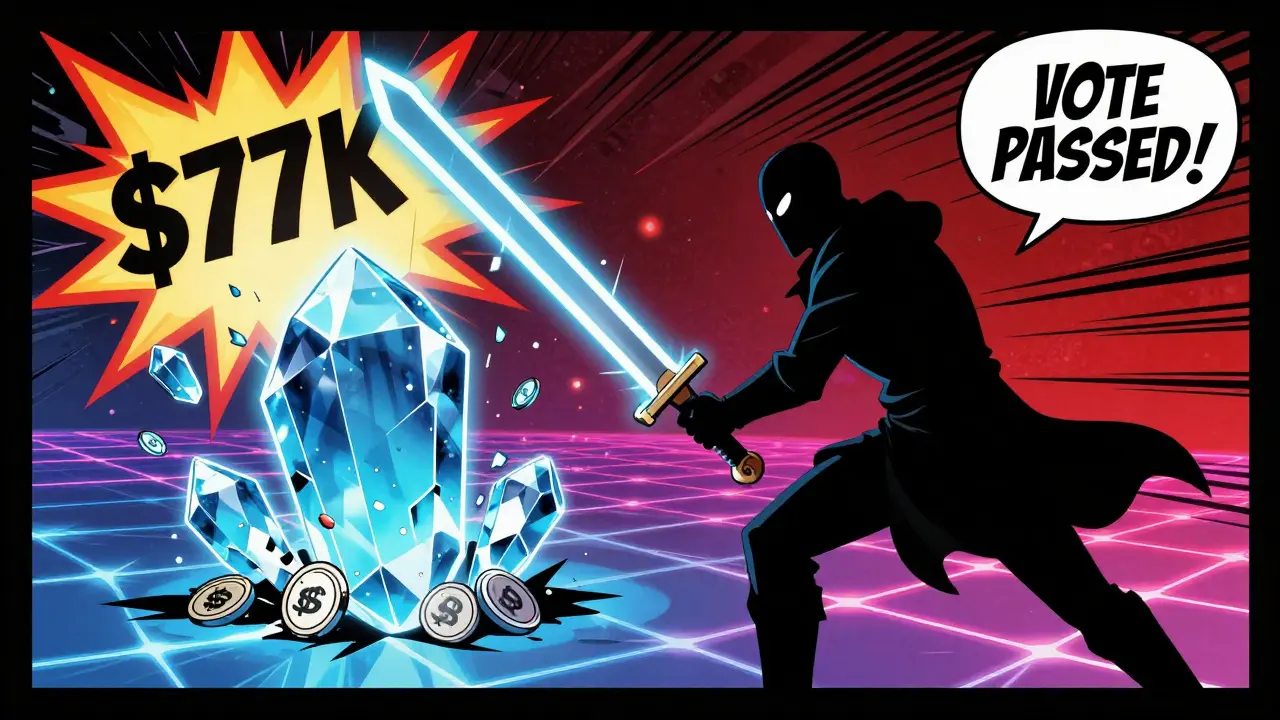
Imagine a voting system where anyone can buy enough votes to pass any rule they want - even if they’ve never contributed to the project. That’s not a dystopian novel. That’s how many DeFi protocols work today. In early 2022, a hacker used a $1 billion flash loan to buy enough BEAN tokens to take control of the Beanstalk DAO. In a single transaction, they approved a proposal that drained $77 million from the protocol’s liquidity pools. No hacks. No exploits. Just smart contracts obeying the rules - rules that were never designed to stop this.
How Token Voting Gets Broken
Token-based governance sounds fair: the more tokens you hold, the more say you have. It’s like shareholder voting, but on blockchain. The problem? Tokens are tradable. And they’re often cheap to buy in bulk - especially with flash loans. Flash loans let you borrow millions in crypto with zero collateral, as long as you pay it back in the same block. Attackers use them to temporarily buy up governance tokens, vote on malicious proposals, and then sell everything before the loan is repaid. The protocol loses money. The attacker walks away with a profit. And because the vote happened on-chain, it’s legally binding - even if it was never meant to be. This isn’t rare. In July 2023, a group called the Golden Boys pushed through Compound Proposal 289, which moved $24 million from Compound’s treasury to their own yield farm. They didn’t break any code. They just outbid everyone else. And they’d tried twice before. The third time, they won. The real issue isn’t the attackers. It’s the system. Most DAOs have fewer than ten active voters. Less than 1% of token holders control over half the voting power. Meanwhile, over 96% of token holders never vote at all. That’s not democracy. That’s plutocracy with smart contracts.Other Ways Attacks Happen
Token voting isn’t the only vulnerability. There are at least four other common attack vectors:- Proposal hijacking: An attacker submits a proposal that looks legitimate - say, a fee adjustment - but secretly includes code that transfers control of locked tokens. In one case, a malicious proposal for Tornado Cash deployed a fake contract at the same address as the real one, locking up $1 million in TORN tokens.
- Sybil attacks: Attackers create hundreds of fake wallets to spread voting power thin. When turnout is low, even a few fake accounts can swing a vote. Stanford researchers confirmed that even quadratic voting, meant to prevent this, still fails if enough fake identities are created.
- Multi-chain exploits: As protocols expand across Ethereum, BNB Chain, and others, inconsistent voting rules become a nightmare. In January 2026, Cream Finance was hit when an attacker exploited a 24-hour voting window on BNB Chain versus a 72-hour window on Ethereum, passing a malicious proposal before defenders could react.
- Validator collusion: On smaller blockchains, if a majority of validators collude, they can censor votes or even fork the chain to reverse unfavorable outcomes. This breaks the myth that blockchain = immutable.
These aren’t edge cases. They’re predictable. And they keep happening because the economic incentives are too strong.

What’s Being Done to Fix It
Some protocols are waking up. A16z crypto laid out a clear framework: reduce token liquidity, add time locks, and build veto powers. Here’s what works - and what doesn’t:- Time locks: Tokens can’t be used for voting until 48 hours after they’re transferred. This blocks flash loan attacks. As of late 2025, 68% of the top 50 DeFi protocols now use this. It’s not perfect, but it raises the cost of attack.
- Execution delays: Even if a vote passes, the action can’t execute for 24-72 hours. This gives the community time to spot bad proposals and rally opposition. MakerDAO uses a 72-hour delay for all governance actions.
- Multi-sig emergency overrides: Compound didn’t fix its voting system after the Golden Boys attack. Instead, it threatened to use its centralized multisig to freeze the attacker’s voting power or fork the protocol. It worked. The proposal was reversed. But it also proved that full decentralization is a myth - at least for now.
- Snapshot and off-chain voting: Some protocols use off-chain tools like Snapshot to tally votes. This reduces gas costs and lets more people participate. But it’s not on-chain, so it’s not binding. It’s a band-aid, not a cure.
There’s also a new standard: ERC-7202, finalized in November 2025. It requires all new governance tokens to include a 48-hour voting period and a mandatory execution delay. It’s a step forward. But adoption is slow. Many small protocols still don’t use it.
The Human Problem
Technology isn’t the only issue. People are the weak link. Most token holders don’t understand governance. They bought a token to speculate, not to vote. Even when they do care, the process is confusing. Proposals are written in dense legal jargon. Voting interfaces are clunky. And there’s no reward for participating - just risk. Compound’s voting participation rate? Under 2%. The average DAO? Less than 3.2%. That means a few whales - or a single flash loan - can override thousands of small holders. And when attacks happen, the community splits. On Reddit after the Compound attack, 87% of comments called token voting “fundamentally broken.” Others argued that the fact Compound could still intervene showed the system had resilience. Both are right. The system is broken. But it’s not dead.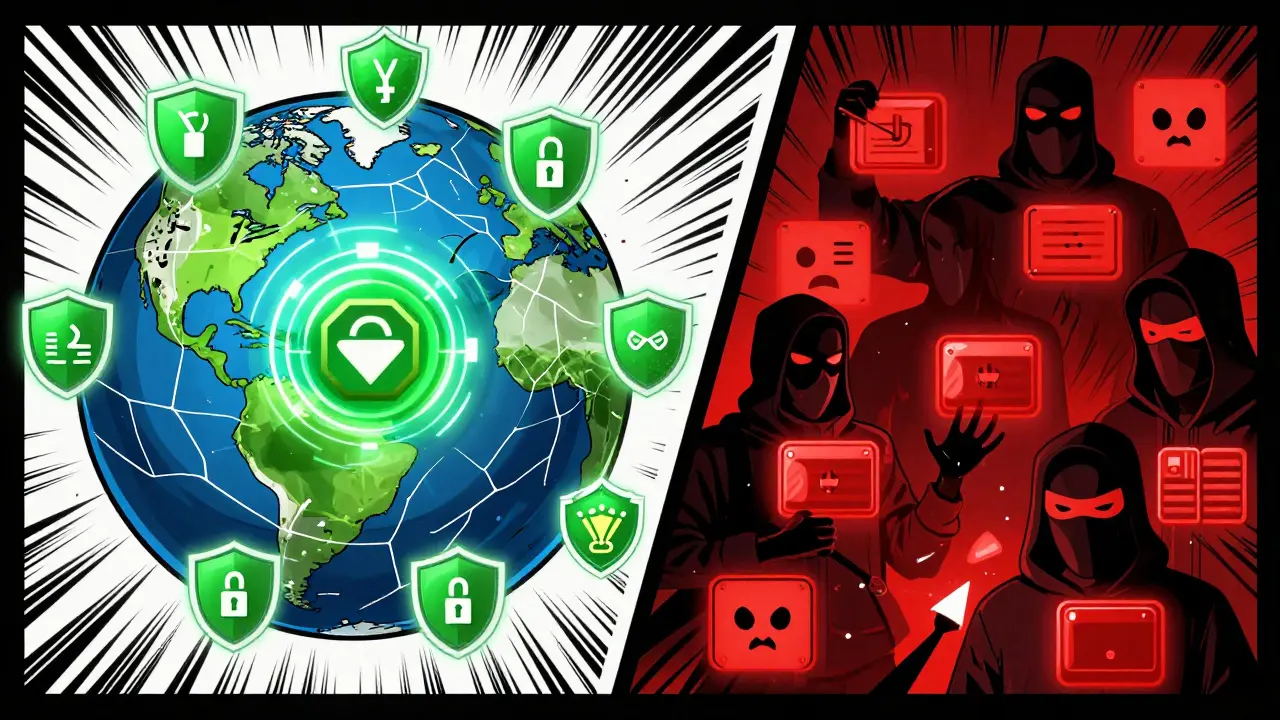
What’s Next?
The market is responding. Governance security is becoming a $2.3 billion industry by 2027, according to Delphi Digital. Startups now sell specialized tools to monitor proposals, detect suspicious token movements, and auto-alert communities of potential attacks. Some are exploring alternatives. Quadratic voting, where each additional vote costs more than the last, reduces whale dominance. Reputation systems, like those used by Gitcoin, reward long-term contributors over token hoarders. But these are still experimental. Most protocols stick with simple token voting because it’s easy to implement. Vitalik Buterin believes reputation-based systems will eventually win. OpenZeppelin says current models are fundamentally flawed without deep architectural changes. The truth? There’s no silver bullet. The best protocols are layering solutions: time locks + multi-sig + off-chain alerts + community education.What You Can Do
If you hold governance tokens, don’t ignore them. Here’s what to do:- Check if the protocol uses a time lock or execution delay. If not, be cautious.
- Look at the voter turnout. If less than 5% of tokens are voted in recent proposals, the system is vulnerable.
- Join the protocol’s Discord or forum. Read proposals before voting. Many attacks succeed because no one reads them.
- Delegate your vote to someone you trust - if the protocol allows it. MakerDAO’s delegate system has kept governance stable for years.
- Don’t assume decentralization means safety. It just means no single company controls it. The rules still need to be smart.
Governance attacks aren’t going away. They’re getting smarter. But so are the defenses. The future of DeFi won’t belong to the protocol with the most code. It’ll belong to the one that understands that security isn’t just about cryptography - it’s about economics, incentives, and people.
What is a governance attack in DeFi?
A governance attack happens when someone uses their control over governance tokens to manipulate a DAO’s voting system and force through malicious proposals - like stealing funds or changing protocol rules. These attacks exploit the fact that voting power is tied to token ownership, and tokens can be bought quickly using flash loans or other means.
Can flash loans really be used to steal from DAOs?
Yes. Flash loans allow attackers to borrow millions of dollars in crypto without collateral, as long as they repay it within the same blockchain transaction. They use this to buy enough governance tokens to control a vote, pass a malicious proposal, and then sell the tokens and repay the loan - all in under 15 seconds. The Beanstalk attack in April 2022, which stole $77 million, used this exact method.
Why do so few people vote in DAOs?
Most token holders bought their tokens to speculate, not to participate. Voting is time-consuming, confusing, and often requires technical knowledge. There’s no financial reward for voting, and the impact of a single vote is tiny. As a result, over 96% of token holders never vote, leaving the system open to manipulation by a small number of large holders.
Are time locks effective against governance attacks?
Yes, but they’re not foolproof. Time locks prevent tokens from being used for voting immediately after being bought or transferred. This blocks flash loan attacks because the attacker can’t use the tokens within the same block. As of late 2025, 68% of top DeFi protocols use time locks. However, they slow down legitimate governance and don’t stop Sybil attacks or proposal hijacking.
Is full decentralization possible in DAO governance?
Not yet. Even the most decentralized protocols rely on centralized backups - like multisig wallets or emergency freezes - to respond to attacks. The Compound team used its multisig to reverse a malicious vote in 2023. True decentralization means no one can intervene, even to stop theft. In practice, most protocols accept a trade-off: they’re mostly decentralized, but keep a safety net. That’s not a flaw - it’s a necessity.

21 Comments
Gurpreet Singh
January 28 2026Been watching this space for years. The real issue isn't the tech-it's that people think crypto is about democracy when it's really about who has the deepest pockets. No amount of time locks fixes that.
Just got my first governance token last week. Took me 3 hours just to understand how to vote. No wonder 96% don't bother.
mary irons
January 29 2026Of course it’s broken. The same people who told you ‘code is law’ are now scrambling to add multisigs like it’s a backdoor in their IKEA furniture. Classic. They never wanted true decentralization. They wanted control without accountability.
And don’t get me started on ‘reputation systems’-that’s just Wall Street with a DAO sticker on it.
Wayne mutunga
January 30 2026I think the real problem is we’re trying to force human systems onto machine logic. Voting isn’t a math problem. It’s a social one.
Maybe we need to treat governance like a community garden-not a stock exchange.
Gavin Francis
January 31 2026Time locks are a start but not enough 😅
Also-why are we still using tokens for voting? That’s like letting people vote on your neighborhood rules based on how many Walmart gift cards they own. 🤦♂️
Gary Gately
January 31 2026lol i just bought some tokens cause the chart was pumpin and now i gotta vote? i dont even know what a proposal is. send help 🥲
Brandon Vaidyanathan
January 31 2026Oh wow. Another ‘decentralized’ project that’s just one flash loan away from becoming a meme. This is why I don’t touch anything without a multisig. You people are playing with fire and calling it innovation.
And yes, I told you so in 2021. Again. Still waiting for the apology.
Gareth Fitzjohn
February 2 2026It’s not complicated. If voting power is tied to ownership, and ownership is liquid, then the system will always be vulnerable. The only solution is to separate ownership from governance.
Simple. Elegant. Unpopular.
Dahlia Nurcahya
February 4 2026Hey, if you hold tokens, please don’t just ignore the votes. Even if it feels pointless, showing up matters. I’ve seen small communities turn things around just by getting 10% more people to vote.
It’s not about winning. It’s about not letting the noise take over.
Dylan Morrison
February 4 2026Imagine if your vote in a country was based on how much money you spent at Walmart. 🤔
That’s token voting. And we’re surprised when the richest person wins?
Also, why are we still using emojis in governance discussions? 🤷♀️
William Hanson
February 5 2026This is why I don’t trust anything that calls itself ‘DAO’. It’s a scam wrapped in a whitepaper. The only thing decentralized is the incompetence.
Every single one of these ‘solutions’ is just a band-aid on a severed artery. And the devs are still celebrating their ‘milestone’.
josh gander
February 7 2026Look-I’ve been in this space since 2017. I’ve seen the hype, the crashes, the scams, the ‘revolutionary’ tokens that turned into dust.
But here’s the thing: governance isn’t broken because of flash loans. It’s broken because we treat it like a product feature instead of a living system. People need to feel heard. They need to see impact. They need to know their tiny vote isn’t just noise.
Time locks? Nice. But what about recognition? What about rewards for participation? What about making the process feel human?
It’s not about code. It’s about culture. And right now, our culture is toxic. We reward hoarders. We punish the curious. We laugh at the newbies.
Fix the culture first. The tech will follow.
Tom Sheppard
February 8 2026my dude i just got into crypto last month and i thought voting was like… clicking a button and getting free money 😅
now i know its like… trying to win a chess match while blindfolded and someone keeps stealing your pieces with a loan
can someone send me a 5-min video on how to not get scammed? 🙏
Will Pimblett
February 10 2026They say ‘code is law’ but then they slap on multisigs like it’s a cheat code. So which is it? Is it decentralized or just… legally ambiguous?
Also-why is everyone pretending this is new? We’ve had this exact debate since 2016. Nobody listens. Nobody changes. We just build faster.
Christopher Michael
February 11 2026Let’s be real: the real vulnerability isn’t the flash loan-it’s the fact that 96% of token holders don’t even know what a governance proposal is. That’s not a technical flaw. That’s a communication failure.
Most DAOs treat governance like a tax form. They need to treat it like a conversation. Simple language. Clear examples. Maybe even memes.
Parth Makwana
February 13 2026Token-based governance is a structural anomaly in the context of modern economic theory. The concentration of voting power correlates inversely with network participation entropy, thereby inducing systemic fragility. Flash loans merely exploit the Nash equilibrium failure inherent in the mechanism design.
ERC-7202 is a syntactic band-aid. We need a paradigm shift toward stake-weighted reputation vectors.
Elle M
February 13 2026Of course Americans think this is a ‘problem’-you can’t even vote in your own elections without a driver’s license, but you think crypto should be ‘fair’? 🤡
Let the market decide. If you’re dumb enough to buy a token and not vote, you deserve to get robbed.
Rico Romano
February 15 2026Look, if you’re still using token voting, you’re basically running a Ponzi with a GitHub repo. ERC-7202? Cute. It’s like putting a seatbelt on a horse-drawn carriage and calling it ‘progress’.
Real innovation? None of this. Just people pretending they’re building the future while recycling 2018 ideas.
Crystal Underwood
February 16 2026Y’all are so naive. The ‘community’? The ‘DAO’? It’s all just a front for VCs to launder money under the guise of ‘decentralization’. They don’t care about you. They care about their exit.
And you? You’re just the sucker holding the bag while they flip the token. Wake up.
Raymond Pute
February 16 2026Okay but what if… we just… didn’t have governance at all?
What if the protocol just… ran itself? Like a toaster? No votes. No proposals. No drama. Just… code doing what it’s supposed to.
Why are we trying to make blockchain into a town hall? It’s not a democracy. It’s a ledger.
Jack Petty
February 18 2026Flash loans? Pfft. The real hack is believing this system was ever meant to work. You’re not being attacked-you’re being outsmarted by the fact that humans are greedy and lazy. And the system? It’s designed to reward exactly that.
christal Rodriguez
February 18 2026This whole thing is a farce.