How to Compare Crypto Projects Fundamentally: A Practical Guide for 2026
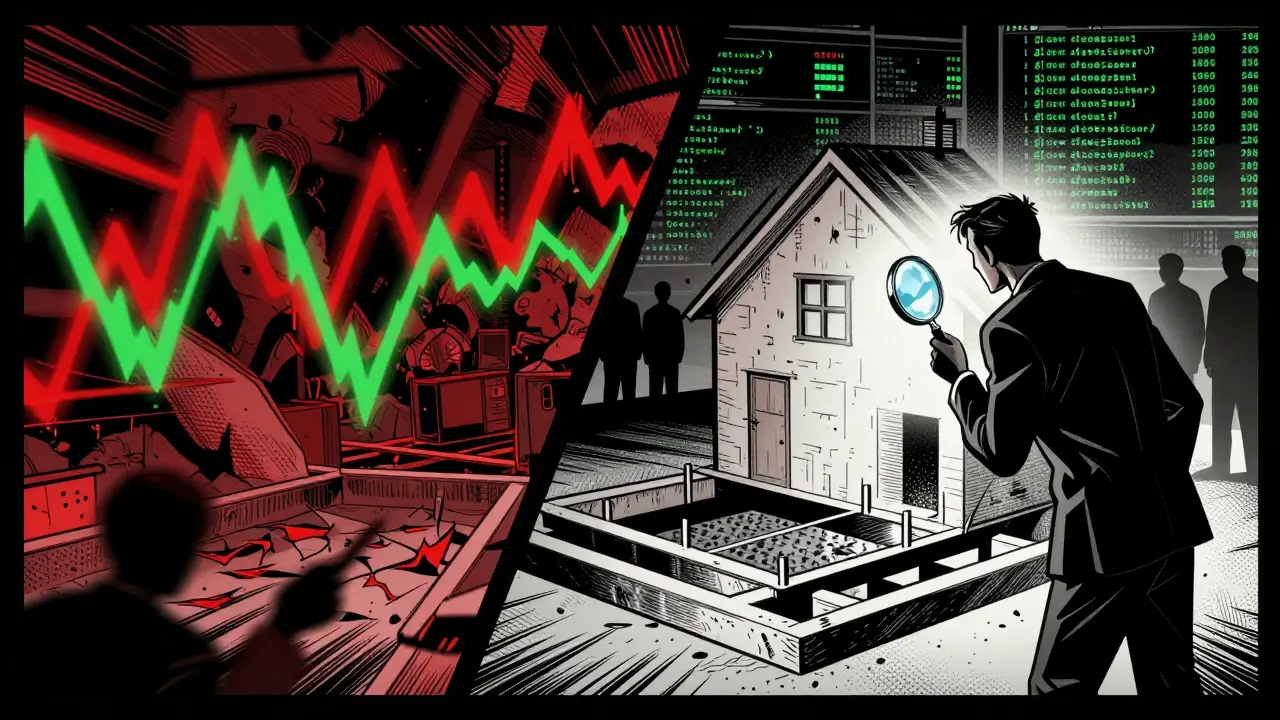
Most people look at a green chart and buy. They see a red line and panic sell. If you want to survive in the crypto market past the next bull run, you need to stop looking at price action as your primary data point. Price is just the noise. The signal lies in the fundamentals.
Fundamental analysis in cryptocurrency isn't about reading tea leaves or trusting influencer tweets. It’s a systematic way to evaluate a digital asset based on its actual utility, technology, team competence, and economic model. Think of it like buying a house. You don’t just look at the paint color (the price). You check the foundation (technology), the neighborhood (community/ecosystem), and the property taxes (tokenomics). If the foundation is cracked, no amount of fresh paint will save you when the storm hits.
In this guide, we’ll break down how to compare crypto projects side-by-side using concrete metrics that matter. We aren’t guessing here; we’re building a framework that separates viable long-term projects from short-lived hype cycles.
The Core Pillars of Crypto Fundamental Analysis
When you strip away the marketing jargon, every crypto project rests on four main pillars. To compare two projects effectively, you must score them against these same criteria. This removes bias and forces you to look at hard data.
Technology & Infrastructure is the underlying code, consensus mechanism, and scalability solutions that power the network. Does the project solve a real problem? Is it built on a proven stack like Ethereum or Solana, or is it a custom Layer-1 with untested security assumptions?
Tokenomics is the economic model governing the supply, distribution, and utility of the token. This includes inflation rates, vesting schedules for investors, and whether the token actually needs to exist for the protocol to function.
Team & Governance is the group of developers, advisors, and community members responsible for the project's direction. Are they doxxed (publicly known)? Do they have a track record of delivering software, or are they just good at selling dreams?
Market Position & Adoption is the project's current user base, total value locked (TVL), and competitive moat. Numbers don’t lie. Active wallets and transaction volume are far more telling than social media followers.
Step-by-Step: How to Compare Two Projects
Let’s say you are deciding between two Decentralized Finance (DeFi) lending protocols. One is established, the other is new and promising higher yields. Here is how you conduct a fair comparison without falling for the "higher yield" trap.
- Define the Use Case: What exactly does the project do? If Project A is a decentralized exchange (DEX) and Project B is a stablecoin issuer, you cannot compare them directly. You must compare Project A to other DEXs. Context is king.
- Analyze the Token Utility: Why do you hold the token? In some projects, the token grants voting rights. In others, it captures fees. If a token has no utility other than speculation, it carries higher risk. Check if the token is essential for the ecosystem or just an added bonus.
- Check the Supply Dynamics: Look at the circulating supply versus the total supply. If only 5% of tokens are in circulation and 95% are locked up for future release, expect massive inflation later. This dilutes your holdings. Tools like TokenUnlocks is a platform that tracks vesting schedules and unlock events for crypto tokens can help you visualize this pressure.
- Evaluate Security Audits: Has the code been audited by reputable firms like CertiK or Trail of Bits? More importantly, have there been any hacks? A project that was hacked but recovered transparently might be safer than one that has never been tested because it hasn’t launched yet.
- Measure Real Activity: Don’t look at market cap alone. Look at Daily Active Users (DAU) and Total Value Locked (TVL). High TVL with low fees suggests users are stuck or incentivized artificially. Healthy growth shows steady increases in both users and revenue.
Decoding Tokenomics: The Hidden Risks
Tokenomics is where most investors lose money. A beautiful app means nothing if the economics are broken. When comparing projects, create a simple table to track these key metrics.
| Metric | What It Means | Red Flag |
|---|---|---|
| Circulating Supply | Tokens currently tradable | Very low compared to total supply |
| Total Supply | Maximum tokens that will ever exist | Infinite or undefined supply |
| Vesting Schedule | When early investors/team get their tokens | Large cliffs (sudden unlocks) in the next 6 months |
| Buyback/Burn Mechanism | Does the protocol reduce supply over time? | No mechanism to counteract inflation |
| Revenue Share | Do holders get a cut of protocol fees? | Token has no claim on protocol revenue |
For example, consider Ethereum is a leading smart contract platform that introduced EIP-1559 to burn a portion of transaction fees. Since the introduction of fee burning, ETH has often been deflationary during high usage periods. Compare this to a newer meme coin with infinite minting capabilities. The fundamental difference is clear: one has a mechanism to increase scarcity based on demand, while the other relies purely on new buyers to offset endless supply expansion.

Technical Moats and Competitive Advantage
In traditional business, we talk about "moats"-barriers that protect a company from competitors. In crypto, moats are harder to build because code is open source. Anyone can copy a project’s whitepaper and GitHub repository. So, what creates a sustainable advantage?
Network Effects: The more people use a platform, the more valuable it becomes. Uniswap is a dominant decentralized exchange that benefits from deep liquidity and first-mover advantage holds a massive moat not because its code is unique, but because it has the deepest liquidity pools. Traders go where the liquidity is, which attracts more traders. New competitors struggle to replicate this depth without spending millions in incentives.
Brand and Trust: After several high-profile hacks, trust is a currency. Established projects like Bitcoin is the original cryptocurrency that serves as a store of value and digital gold benefit from years of uninterrupted uptime and decentralization. No single entity controls Bitcoin. Compare this to a centralized stablecoin issuer that requires regular reserve audits. The risk profile is fundamentally different.
Developer Activity: A project with an active developer community is alive. Check GitHub repositories. Are commits being made regularly? Are multiple contributors involved, or is it one person pushing code? High developer activity signals long-term commitment and adaptability.
Tools for Fundamental Research
You don’t need to be a coder to do deep research. Several platforms aggregate the data you need to make informed comparisons.
- CoinGecko & CoinMarketCap: Start here for basic data. Market cap, volume, and circulating supply. Use their "Categories" feature to find similar projects for direct comparison.
- Glassnode: For on-chain analytics. This tool shows you wallet behavior, exchange inflows/outflows, and miner reserves. It helps you understand if big players are accumulating or distributing.
- Dune Analytics: Community-built dashboards that provide granular insights into specific protocols. You can find dashboards tracking unique users, revenue, and loan-to-value ratios for DeFi projects.
- DefiLlama: The go-to for Total Value Locked (TVL) across chains. It allows you to compare the growth trajectories of different protocols objectively.
Using these tools together gives you a 360-degree view. CoinGecko tells you the price story. Glassnode tells you the holder behavior. DefiLlama tells you the adoption story. If all three align, you have a strong fundamental case.

Common Pitfalls to Avoid
Even with great tools, biases creep in. Watch out for these common mistakes:
Survivorship Bias: We study successful projects like Ethereum and assume their path is repeatable. But for every Ethereum, there are hundreds of failed smart contract platforms. Always ask: "Why did this project succeed? Was it luck, timing, or genuine innovation?"
Recency Bias: Just because a project launched six months ago and pumped 10x doesn’t mean it’s fundamentally sound. Often, early pumps are driven by speculation, not utility. Wait for the dust to settle before evaluating fundamentals.
Ignoring Regulatory Risk: A project might be technically perfect but legally risky. Stablecoins tied to opaque reserves face regulatory scrutiny. Privacy coins face delisting pressures. Factor in the legal environment of the jurisdictions where the team operates.
Putting It All Together: A Decision Framework
To make this practical, create a simple scoring sheet for each project you evaluate. Rate each pillar from 1 to 10.
- Technology: Is the code secure and scalable? (Score)
- Tokenomics: Is the supply model sustainable? (Score)
- Team: Is the team credible and experienced? (Score)
- Adoption: Are real users generating real value? (Score)
Add up the scores. A project with a total of 35/40 is fundamentally stronger than one with 20/40, even if the latter has a higher price momentum today. Remember, fundamental analysis is about long-term viability, not short-term gains. By consistently applying this framework, you shift from gambling to investing. You start seeing the crypto market not as a casino, but as a complex ecosystem of technologies competing for user attention and capital. And in that competition, only the strongest fundamentals survive.
What is the difference between technical analysis and fundamental analysis in crypto?
Technical analysis focuses on price charts, patterns, and trading volume to predict future price movements. Fundamental analysis evaluates the intrinsic value of a project based on its technology, team, tokenomics, and real-world adoption. Technical analysis is useful for timing entries and exits, while fundamental analysis helps determine whether a project is worth holding long-term.
How important is the team behind a crypto project?
The team is critical. Crypto projects require continuous development, security updates, and community management. A doxxed team with a track record of successful deliveries reduces risk significantly. Anonymous teams are not inherently bad, but they carry higher uncertainty regarding accountability and long-term commitment.
What should I look for in tokenomics?
Look for a clear utility for the token, a reasonable circulating supply relative to total supply, and transparent vesting schedules for investors and the team. Avoid projects with infinite supply or large upcoming token unlocks that could flood the market and drive prices down.
Can a project with a small market cap have strong fundamentals?
Yes. Many innovative projects start with small market caps. Strong fundamentals include a working product, growing user base, active development, and a sustainable economic model. Small market cap projects offer higher growth potential but also come with higher risk due to lower liquidity and less established track records.
How do I verify if a crypto project is secure?
Check for independent security audits from reputable firms. Review the project’s history for any hacks or exploits. Examine the transparency of their codebase on GitHub. Additionally, look for bug bounty programs, which indicate a proactive approach to identifying and fixing vulnerabilities before they are exploited.




13 Comments
Hazel Fruitman
July 11 2026its so easy to get scammed when u just look at charts lol. people need to stop being greedy and actually read the whitepapers before throwing money at random tokens. its not rocket science but everyone acts like they are.
Autumn Story
July 13 2026This is such a helpful guide!!! I really appreciate how you broke down tokenomics because that part always confused me so much! I’m going to start using DefiLlama right away, thank you for sharing this!! 😊
Mark Tuason
July 15 2026I find the section on technical moats particularly insightful. While code is open source, the network effects created by early adoption create significant barriers to entry for competitors. It is interesting to see how liquidity depth serves as a primary defense mechanism for established protocols like Uniswap.
Ella Collinson
July 17 2026The fundamental flaw in this analysis is the assumption that market efficiency exists in crypto. You are ignoring the alpha generated by insider trading and wash trading which skews DAU and TVL metrics entirely. Most 'adoption' is fake volume from bots. The only real metric is hash rate or validator stake concentration which you failed to mention.
Ray Arney
July 18 2026Good points. I usually just stick to the big ones but looking at vesting schedules makes sense now.
Andrew Schneider
July 19 2026Oh wow, another boring guide about 'doing your own research' 🙄 Like we haven't heard this a million times? Just buy the dip and pray to the moon gods! 🚀🌕 Why make it complicated when gambling is fun?
Eric Braddock
July 20 2026You think this is about fundamentals? Wake up. This is all scripted by the central banks to track your wallet addresses. They want you to believe in 'tokenomics' while they prepare the CBDC rollout. The 'audits' are just stamps of approval from compromised firms who are paid off. Trust nothing.
Nick G
July 20 2026I completely understand why this topic can feel overwhelming for newcomers, and I truly appreciate the effort put into simplifying these complex concepts for everyone to grasp more easily in their daily lives.
Nick Wengel
July 21 2026Nice summary. I use CoinGecko mostly but will check out Dune Analytics next time.
Alicia Hull
July 22 2026I must ask, however, how one effectively quantifies 'team competence' without relying solely on LinkedIn profiles which can be fabricated? There seems to be a lack of rigorous verification methods for the individuals behind anonymous projects which poses a significant risk to investors seeking transparency.
Johan Otto
July 23 2026Boring stuff. Just give me the ticker symbol already! 😡
Anuj Kashyap
July 25 2026Fundamental analysis is merely a comforting narrative we tell ourselves to justify our greed 🧘♂️ In the end, price is the only truth that matters, regardless of the underlying tech or team vibes.
Tracy Marshall
July 26 2026this whole industry is built on lies and corruption. you cant trust any of these audits because the auditors are bought by the same corrupt elites running the show. stay safe out there (or dont)