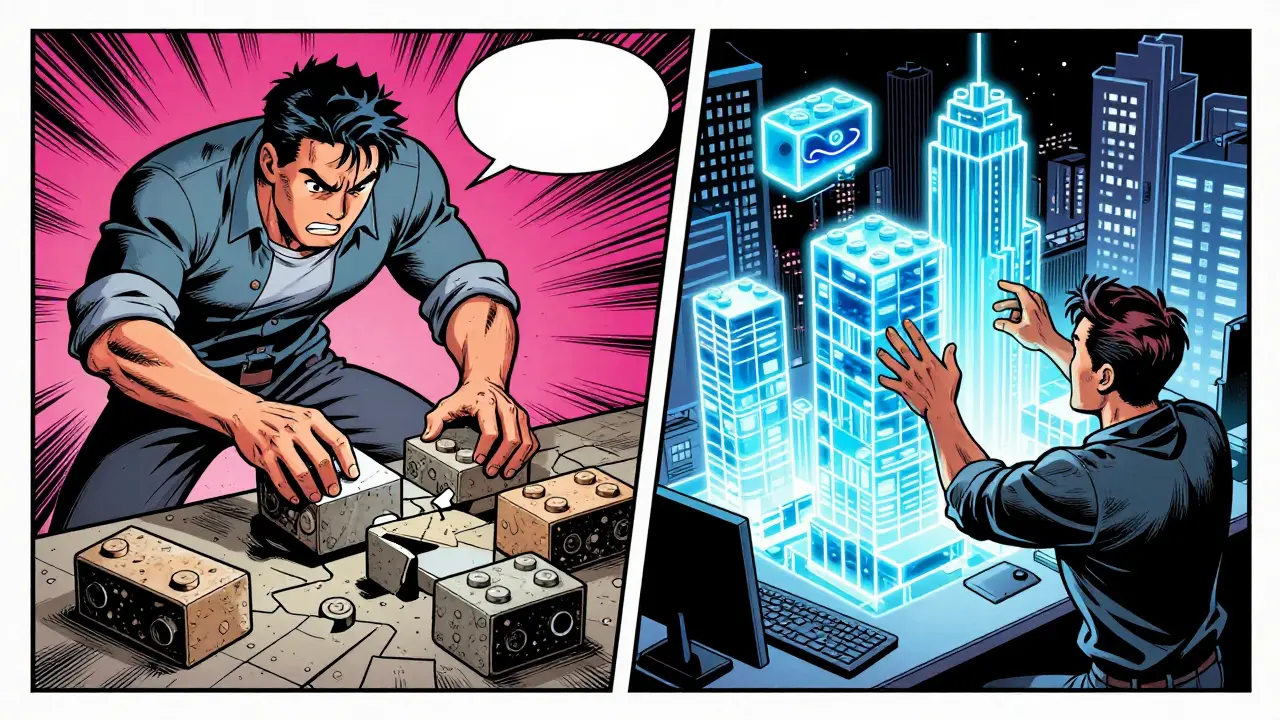
Smart Contract Composability Standards: Building the LEGOs of Web3
Imagine trying to build a city where every single brick had to be custom-molded from scratch just to fit next to another one. You'd spend all your time making bricks and no time actually building the city. That is exactly how traditional software integration often feels. In the blockchain world, we have a better way: Smart Contract Composability is a design principle that allows different smart contracts to be reused and combined like LEGO blocks to create complex applications without rewriting core logic. By treating contracts as public APIs, developers can stack functionalities-like swapping a token and lending it in one go-without needing permission from the original creators.
The Three Pillars of Composable Design
For a system to be truly composable, it can't just be "open." It needs to follow a specific architectural philosophy. If you're building a dapp today, you're likely relying on three core rules that make this possible.
- Modularity: Each contract should do one thing and do it well. Instead of building a "mega-contract" that handles everything from payments to governance, developers create small, focused modules. This ensures that if you only need a payment gateway, you can plug that specific piece into your project without dragging along a bunch of unnecessary code.
- Autonomy: A composable contract must be self-sufficient. It shouldn't break just because a secondary system is offline or undergoing an update. This independence allows a contract to execute its logic based on the inputs it receives, regardless of who is calling it.
- Discoverability: Because blockchain code is public by default, anyone can find a contract's address and its functions. This openness is what allows a developer to "fork" a codebase or integrate a library they found on a block explorer, turning the entire network into a giant, shared sandbox.
How it Works: Contracts as Public APIs
In the traditional web, if you want to use another company's data, you need an API key and a partnership agreement. In Web3, the blockchain is the API. When a developer deploys a contract to Ethereum, they are essentially publishing a set of functions that anyone-human or machine-can trigger.
To make this work without chaos, the industry relies on standardized interfaces. Think of these as the "studs" on a LEGO brick that ensure they click together. The most famous of these are the ERC standards. For example, the ERC-20 standard defines exactly how a fungible token should behave. Because almost every token follows this rule, a decentralized exchange doesn't need to write new code for every new coin; it just knows how to interact with any ERC-20 contract.
| Feature | Traditional APIs | Composable Smart Contracts |
|---|---|---|
| Integration | Requires keys, docs, and permissions | Permissionless; just need the contract address |
| Availability | Can be taken offline by the provider | Permanently available on-chain |
| Modification | Often requires custom wrappers/glue code | Seamless integration via shared standards |
| Development Speed | Slow (build or negotiate) | Rapid (stack existing blocks) |
The DeFi Engine: Real-World Examples
Nowhere is this more evident than in DeFi (Decentralized Finance). Most "new" DeFi protocols aren't actually inventing new math; they are just combining existing blocks in a clever way. Consider Uniswap. Because its liquidity pools are composable, other developers can build "aggregators" that scan multiple exchanges to find the best price for a user, all without Uniswap having to build that feature themselves.
Similarly, lending protocols like AAVE and Compound exist because they can interact with thousands of existing tokens. They don't need to ask a token creator for permission to accept a coin as collateral; they just write a contract that recognizes the ERC-20 standard. Even in the world of digital art, the ERC-721 and ERC-1155 standards allow marketplaces like OpenSea to list millions of different NFTs from different creators using a single, unified interface.
Beyond the Code: Ecosystem Benefits
Why should a business care about composability? It's not just about saving a few hours of coding. It's about network effects. When you build a composable tool, you aren't just building a product; you're contributing to a library that other people will use to build their products. This attracts a wider audience and creates a gravitational pull for users.
For an enterprise, this means they can launch a loyalty token and know instantly that it will work with existing wallets, tracking tools, and decentralized exchanges. They don't have to build a whole ecosystem of supporting apps because that ecosystem already exists. They just plug into it. This significantly lowers the barrier to entry for companies moving into Web3, allowing them to bootstrap a community by leveraging tools that are already trusted by millions.
The Risks of "Money Legos"
If everything is connected, what happens when one brick breaks? This is the primary danger of composability. When protocols are stacked, a bug in a base-layer contract can cause a domino effect. If a primary lending pool has a vulnerability, every single app that relies on that pool for liquidity is suddenly at risk.
To fight this, development companies are moving toward more advanced testing frameworks and upgradable contracts. Instead of deploying a static piece of code, they use a proxy pattern. This allows the logic of a contract to be updated to fix a bug while keeping the contract address-and therefore the composability-intact. It's a balancing act between the permanence of the blockchain and the need for security agility.
Where Composability is Heading
The next big frontier is cross-chain interoperability. Right now, most composability happens within a single network (like Ethereum). But as we move toward a multi-chain world, the goal is to make a contract on one chain as easily accessible as a contract on another. This would allow a user to provide collateral on one blockchain and borrow against it on another in a single transaction.
We are also seeing the rise of more sophisticated governance models. As these "LEGO" structures become more complex, managing the shared risks requires decentralized decision-making. The future of the web isn't a collection of isolated silos, but a fluid, interconnected web of services that evolve together. By sticking to strict modular standards, the industry is ensuring that the next great innovation doesn't have to start from zero, but can stand on the shoulders of everything that came before it.
What is the simplest way to explain smart contract composability?
Think of it as "Money Legos." It's the ability for different blockchain applications to plug into one another. Because the code is open and follows standard rules, a developer can use a piece of a lending protocol and a piece of an exchange to build a brand new financial app without writing the core logic from scratch.
Why are ERC standards important for composability?
ERC standards (like ERC-20 for tokens or ERC-721 for NFTs) act as a universal language. They ensure that any wallet or exchange knows exactly how to interact with a token, regardless of who created it. Without these standards, every app would need custom code for every single token it wanted to support, which would kill innovation.
Does composability make smart contracts less secure?
It can create "systemic risk." Because contracts are interconnected, a failure in one popular contract can affect all the other apps built on top of it. This is why rigorous auditing and the use of upgradable proxy contracts are critical for maintaining security in a composable ecosystem.
Can any smart contract be composable?
Technically, yes, because almost all smart contracts are public. However, for a contract to be effectively composable, it must follow the principles of modularity (doing one specific task), autonomy (operating independently), and discoverability (using standard interfaces).
How does composability help non-developers?
For the end-user, it means a much smoother experience. Instead of jumping between five different apps to manage their assets, they can use a single interface (like a DeFi aggregator) that interacts with multiple protocols in the background to get the best rates or services.





20 Comments
Iestyn Lloyd
May 1 2026The focus on ERC standards is spot on. In my experience, the sheer predictability of the interface is what actually drives adoption for institutional players who can't afford the risk of custom, non-standard implementations.
Robert Smith
May 2 2026Cool concept 🚀
April D Thompson
May 2 2026Oh my god, the metaphor of the city is just so poetic! It really captures the existential struggle of developers trying to break free from the silos of Web2. We are literally architecting a new digital consciousness where cooperation is baked into the very atoms of the code. It is absolutely breathtaking to think about the ripple effects this will have on how we perceive ownership and value in a decentralized society. I feel like we are standing at the precipice of a total paradigm shift. The sheer scale of this interconnectivity is enough to make anyone dizzy. Imagine a world where every financial tool just clicks into place like magic! It is truly a digital renaissance. I love how this frames the technical side as a philosophical journey toward total openness. We are not just writing scripts; we are writing the laws of a new world. The emotional weight of this transition is immense. It is about liberation from the gatekeepers of the old web. Truly transformative stuff!
VIVEK SINGH
May 3 2026Right, because imagining that 'rigorous auditing' actually prevents a systemic collapse is just adorable. We've seen enough 'audited' protocols get drained in five minutes to know that the house of cards is held together by hopes and dreams. But sure, let's just keep stacking those legos until the whole tower falls over and we all pretend it was a learning experience.
Ralph Espinosa
May 3 2026The proxy pattern is absolutely critical here!!! Without the ability to upgrade logic, a single bug would literally be permanent... which is terrifying!!! Great breakdown of the risks involved!!!
Arun Prabhu
May 4 2026Typical simplistic prose. Calling this 'innovation' is a stretch when it's essentially just a glorified version of object-oriented programming that we've had for decades, yet somehow the masses treat it like a divine revelation. Truly pathetic.
Chloe Fletcher
May 5 2026This is so helpful for anyone starting out! 🌟 Keep pushing for these standards, it makes the whole ecosystem so much friendlier for new devs! 🌈✨
Lex Harley
May 7 2026i think the cross-chain stuff is gonna be the real bottleneck tho... the bridging solutuons are still kinda janky and the liveness risk is high when u deal with multi-sig relayers across diff vms
Bevon Findley
May 8 2026Pure elegance. 🥂
Kristi Swartz
May 10 2026It is clear that most people do not understand that security is a binary state. Either the code is secure or it is not. These proxy patterns are simply delaying the inevitable failure of poorly written software
Arti Jain
May 11 2026Indian devs are leading this charge. Pure excellence.
Alex Mazonowicz
May 11 2026This is such an optimistic view of the future!!! I can't wait to see what the next wave of dapps looks like!!! Keep building!!!
Harvey Alford
May 11 2026My portfolio died because of this.
Emily A
May 11 2026The author fails to mention that the 'permanent' nature of the blockchain is often a bug, not a feature, when dealing with logic errors. One must be precise about the trade-offs between immutability and the necessity of patching critical vulnerabilities.
Lloyd I
May 12 2026I love the way this is explained! It makes the complex world of smart contracts feel accessible to everyone. Let's keep collaborating to make Web3 more inclusive!
Veronica Bago
May 13 2026Really chill explanation, thanks for sharing this!
Gabby Puche
May 14 2026Exactly! The aggregator model is such a win for the average user 💖
Felix Eduardo Velasquez
May 15 2026The systemic risk mentioned is essentially a problem of tight coupling in a distributed system. When you have a dependency chain three or four levels deep, you are no longer just trusting one team, but the collective competence of every single developer in that chain. It is a fascinating social experiment in trust.
Mitali Rajvanshi
May 16 2026Agreeing with the point about modularity. Keeping things small and focused is the only way to actually maintain these projects long term.
Tony Phan
May 18 2026Yoo this is wild! Like totally crazy how you can just plug in a contract address and boom! Instant integration. The liquidity pools are just insane for the UX flow. Total game changer for the TVL growth!