
What is DPRating (RATING)? A Deep Dive into the Crypto Rating Agency
Imagine trying to pick a stock without any financial reports, industry ratings, or balance sheets. It sounds like a nightmare, right? Yet, for years, that's exactly how most people have approached the wild west of the crypto market. This is where DPRating is a quantitative crypto rating agency that provides standardized assessments for blockchain projects. Also known as DPRating Agency, it aims to bring the same level of rigor to digital assets that agencies like Moody's or S&P bring to corporate bonds. While many investors chase the latest hype, this project focuses on the plumbing-the audits, the code quality, and the actual viability of a project's roadmap.
How DPRating Actually Works
DPRating doesn't just guess if a coin is "good" or "bad." They use a quantitative approach, meaning they rely on hard data rather than opinions. The agency provides a suite of services designed to protect investors from the common pitfalls of the blockchain space. They handle everything from due diligence investigations to full-scale code audits. If a project claims to have a revolutionary new consensus mechanism, DPRating's team digs into the code to see if that claim is actually true.
One of their most notable early contributions was the SmartICO, which was the first comprehensive rating model specifically for Initial Coin Offerings. By analyzing a project's team, whitepaper, and tokenomics, they provided a score that gave investors a benchmark for risk. Today, they've expanded this into proprietary indexes like the DPC and BVIX, which help track the health of specific sectors within the crypto ecosystem.
The Three Stages of Project Evaluation
Not every crypto project is at the same stage. A startup with a whitepaper and a dream shouldn't be judged by the same metrics as a project with a live mainnet and millions of users. To solve this, DPRating uses three distinct rating models tailored to the project's lifecycle:
- Embryo: This model is for early-stage projects. It focuses on the strength of the idea, the background of the founders, and the theoretical feasibility of the technology.
- Growth: Once a project has a beta product or an early community, this model kicks in. It looks at actual development progress, community engagement, and the ability of the team to hit their roadmap milestones.
- Mature: For established projects, the focus shifts to market adoption, liquidity, network security, and how the project handles real-world scaling challenges.
Understanding the RATING Token
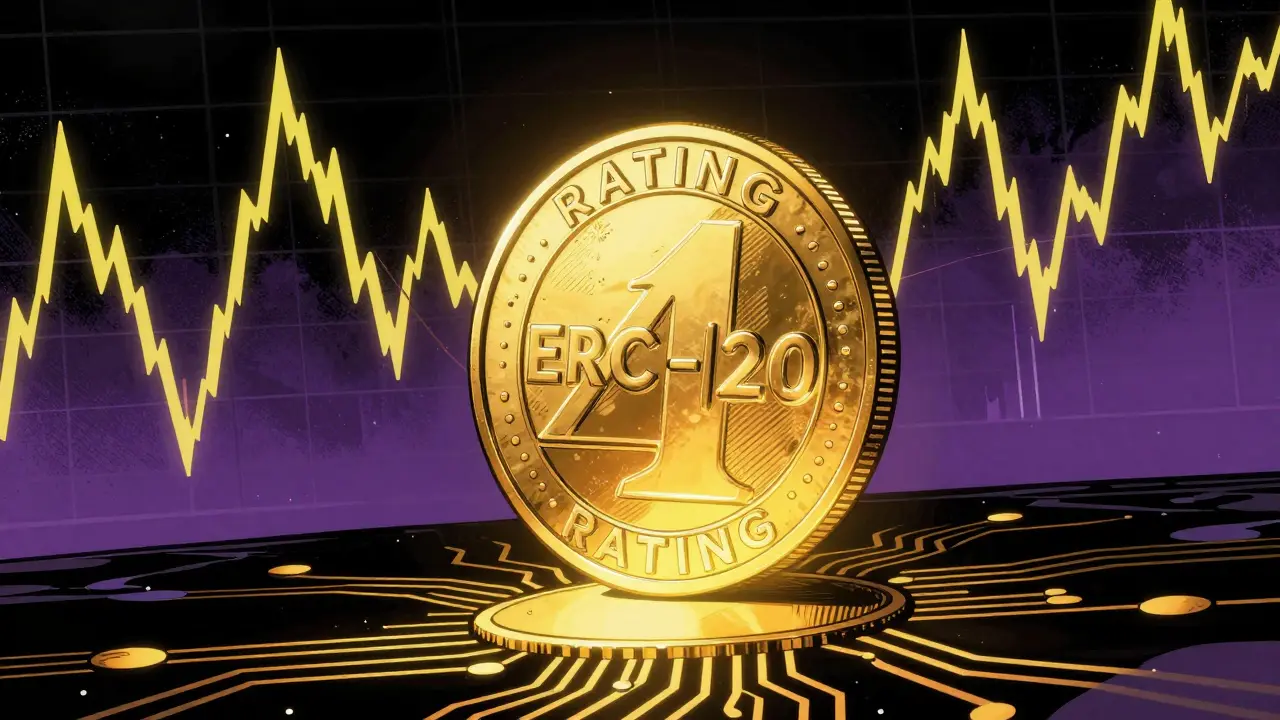
While the agency provides the service, the RATING token is the utility asset that powers the ecosystem. It is an ERC-20 token built on the Ethereum blockchain. Essentially, the token acts as the glue connecting the rating services with the users who need them.
When looking at the tokenomics, the numbers are quite large. There is a maximum total supply of 10 billion tokens, with about 4.4 billion currently circulating in the market. For those tracking the value in Bitcoin terms, the fully diluted valuation (FDV) sits around BTC 6.1654. However, it's important to realize that the token's value is closely tied to the adoption of the agency's rating services.
| Attribute | Value |
|---|---|
| Blockchain Platform | Ethereum (ERC-20) |
| Circulating Supply | 4.4 Billion RATING |
| Max Total Supply | 10 Billion RATING |
| Current Price Range | $0.000071 - $0.0002792 USD |
| All-Time High (ATH) | ~$0.0032 USD |
| Primary Trading Venue | Gate.io |

Market Reality: Price and Performance
If you're looking at RATING token from a purely financial perspective, the chart is a bit sobering. The token has seen a massive decline of about 97.76% from its all-time high of $0.0032. This isn't uncommon in the crypto world, but it does highlight a gap between the utility of the service (which has existed since May 2017) and the market value of the token.
Liquidity is another point to consider. You won't find RATING on major platforms like Coinbase. Instead, most of the action happens on Gate.io. With 24-hour trading volumes often hovering between $10,000 and $60,000, it's a low-liquidity asset. This means large buys or sells can swing the price significantly, making it a volatile choice for a casual trader.
Is a Crypto Rating Agency Actually Necessary?
You might ask, "Why do we need a rating agency when we have CoinMarketCap or CoinGecko?" The answer is that those platforms provide market data (price, volume, market cap), but they don't provide fundamental analysis. Knowing a coin has a $1 billion market cap doesn't tell you if the code is buggy or if the founders are anonymous.
DPRating fills this void by acting as a third-party auditor. By providing a structured score based on the Embryo, Growth, and Mature models, they give investors a way to compare a DeFi project in London with a GameFi project in Seoul using the same set of rules. It turns "I have a feeling about this coin" into "This project has a high score in technical execution but a low score in tokenomics."
Potential Pitfalls and Risks
Investing in a niche service provider comes with specific risks. First, the "trust' factor. For a rating agency to work, the market has to trust that the ratings are unbiased. If a project pays for a better rating, the entire value proposition collapses. Second, there is the risk of obsolescence. As more transparent on-chain data tools emerge, the need for a centralized agency to "tell" us if a project is good might decrease.
Finally, the token's performance shows that a long history doesn't always equal market dominance. Despite operating for nearly nine years, DPRating remains a niche player. For a user, the primary risk is the low liquidity, which can make it difficult to enter or exit large positions without affecting the price.
What exactly does DPRating do?
DPRating is a quantitative agency that evaluates cryptocurrency projects. They provide code audits, due diligence, and quantitative ratings based on the project's stage of development (Embryo, Growth, or Mature) to help investors assess risk and potential.
Which blockchain does the RATING token use?
The RATING token is built on the Ethereum blockchain as an ERC-20 token.
Where can I buy RATING coins?
The most active trading for RATING occurs on the Gate.io exchange. It is not available on Coinbase.
Is DPRating a new project?
No, it is quite established in crypto terms. The organization was founded in May 2017, meaning it has been operating for nearly nine years as of 2026.
What is the total supply of RATING tokens?
The maximum total supply is 10 billion RATING tokens, with approximately 4.4 billion currently in circulation.
Next Steps for Interested Users
If you're looking to use DPRating's services or hold the token, your path depends on your goal:
- For the Researcher: Look into their SmartICO model or their current project ratings to see if their quantitative approach aligns with your investment strategy.
- For the Trader: Check the order books on Gate.io. Given the low liquidity, avoid using market orders for large amounts; stick to limit orders to prevent slippage.
- For the Long-term Holder: Monitor the project's adoption rates. The key to RATING's recovery will be whether more exchanges or venture capital firms begin using their rating models as a standard for listing.

22 Comments
Charlie Queen
April 24 2026This is such a cool way to bring some order to the chaos of crypto! 🚀 I love seeing projects that try to make things safer for everyone. Hopefully, more people start using these ratings to avoid the scams! ✨
Robert Mosolygo
April 26 2026The sheer arrogance of believing a centralized "agency" can quantify trust in a decentralized space is laughable. Who audits the auditors? It is a closed loop designed to create a facade of legitimacy for projects that have already been bought and paid for by the elites. This is just another layer of manipulation to keep the retail investors trapped in a curated ecosystem while the whales exit their positions. The 97% drop in token price is the only honest metric here; it tells you exactly how much the market actually values this "rigor." Do not be fooled by the professional terminology used to mask a failing business model.
Mike Krasner
April 27 2026imagine thinking a rating agency actually helps lol its just more noise
Kathleen Bergin
April 28 2026Actually, the Embryo and Growth models are basic common sense. Anyone who knows how VC funding works understands that you can't judge a seed stage project by its liquidity. It's pretty simple stuff.
Miranda Jamieson
April 29 2026Wake up and look at that chart. A 97% crash isn't a "gap in utility," it's a total failure. If you're still holding this garbage, you're just gambling with a fancy name attached to it. Pathetic.
Alex Hunter
May 1 2026It's worth noting that for those just starting out, learning how to read a whitepaper is still the best bet, but tools like this can provide a helpful second opinion if you're feeling overwhelmed.
Greg Reynolds
May 2 2026The comparison to Moody's is fundamentally flawed because corporate bonds are backed by legal frameworks and physical assets. Crypto ratings are essentially opinions on code that could be changed in a single commit. It's a category error to apply traditional finance metrics to volatile digital assets.
Matthew Morse
May 3 2026who cares about ratings when the price is dead
Larry Yang
May 5 2026Tbh the liquidity on Gate.io is a joke... try selling 50k worth of this and watch the price crater in seconds. Typical low cap trash that thinks it's a "systemic" solution 🙄
Sarah Fisher
May 6 2026It's interesting to think about whether trust can ever truly be quantified. Maybe the value isn't in the rating itself, but in the process of forcing a project to be transparent enough to be rated.
Jennifer Taylor
May 7 2026These agencies are all run by the same group of people anyway. They just rate their friends' coins high so they can dump on us. Don't trust any "score" from a company that has its own token to pump.
Benjamin Forg
May 9 2026everything is a lie the rating token is just a honey pot for the masses while they control the flow of info behind the scenes
Tony Gurley-Ward
May 9 2026The sheer audacity of trying to standardize the wild west is almost poetic in its futility! It's like trying to put a leash on a hurricane. Still, I'll bet on the chaos over a spreadsheet any day.
Paige Raulerson
May 11 2026The writing in this piece is far too optimistic about the token's recovery. One does not simply "monitor adoption" when the asset is functionally illiquid and ignored by the major exchanges. It's a ghost town.
praveen subbiah
May 12 2026Actually, these kinds of quantitative models are exactly what we need to bring global prestige to the sector! India is leading the way in tech and we need these standards to compete globally! 🇮🇳
Gary Lingrel
May 12 2026Typical... another project claiming to solve a problem they probably created themselves :/
Guy Bianco
May 12 2026I believe that a disciplined approach to risk management is always beneficial for the community. (^_^) A structured evaluation can prevent many costly mistakes for novice investors.
Ellie Drews
May 13 2026I think it's great that there are different levels for the projects. It's a lot more fair to judge a startup differently than a giant like Ethereum.
Keith Garcia
May 14 2026The olfactory stench of desperation wafting from that token's chart is simply exquisite. 🤡 Imagine calling a 97% haircut a "sobering" perspective. It's an absolute bloodbath, you delightful amateurs!
Sara Ellis
May 15 2026it's just numbers on a screen anyway
Kyle Bush
May 16 2026Who cares about the ratings when you can just follow the hype? 🚀🚀💸 Get in, get out, and let the rating agencies keep their spreadsheets while I make bank! 🤑
jill huyo-a
May 17 2026I wonder if there are other agencies that do this? It would be so helpful to compare two different ratings for the same project just to see where they disagree!