
FATF Travel Rule for Crypto: Global Implementation Status and Impact in 2026
Imagine sending a Bitcoin transaction to a friend across the border. In the early days of crypto, that was just two addresses and a signature. Today, it’s a data exchange between banks, regulators, and exchanges. The FATF Travel Rule is a global standard requiring Virtual Asset Service Providers (VASPs) to collect and share originator and beneficiary details for crypto transfers above specific thresholds. It’s not just a suggestion; it’s the backbone of modern crypto regulation, designed to stop money laundering without killing the innovation that made digital assets popular in the first place.
As we move through 2026, the landscape has shifted dramatically. What used to be a confusing patchwork of local rules is now a coordinated global effort. But does it actually work? And how does it affect you, whether you’re a casual user or a compliance officer at an exchange? Let’s break down where things stand, who’s playing by the book, and what this means for the future of your digital wallet.
The Core Mechanics: How the Travel Rule Works
At its heart, the rule is simple but technically demanding. If you send more than a certain amount, your exchange (the VASP) must capture your name, account number, and address. They then pass that info to the receiving exchange, which does the same for the recipient. This mirrors how traditional wire transfers have worked since the 1990s.
The key difference here is speed and interoperability. In traditional finance, SWIFT messages handle this. In crypto, we use standards like the Travel Rule Protocol (TRP). As of late 2025, about 63% of compliant VASPs adopted TRP, making it the de facto language for these data exchanges. Without this common language, every exchange would need custom integrations with every other exchange-a logistical nightmare that would slow down transactions significantly.
- Data Points Shared: Sender name, account ID, physical address or DOB; Recipient name and account ID.
- Thresholds: Vary by region (e.g., $3,000 in the US, €1,000 in the EU).
- Timing: Must happen before or during the transfer, not after.
Global Implementation: Who Is Compliant?
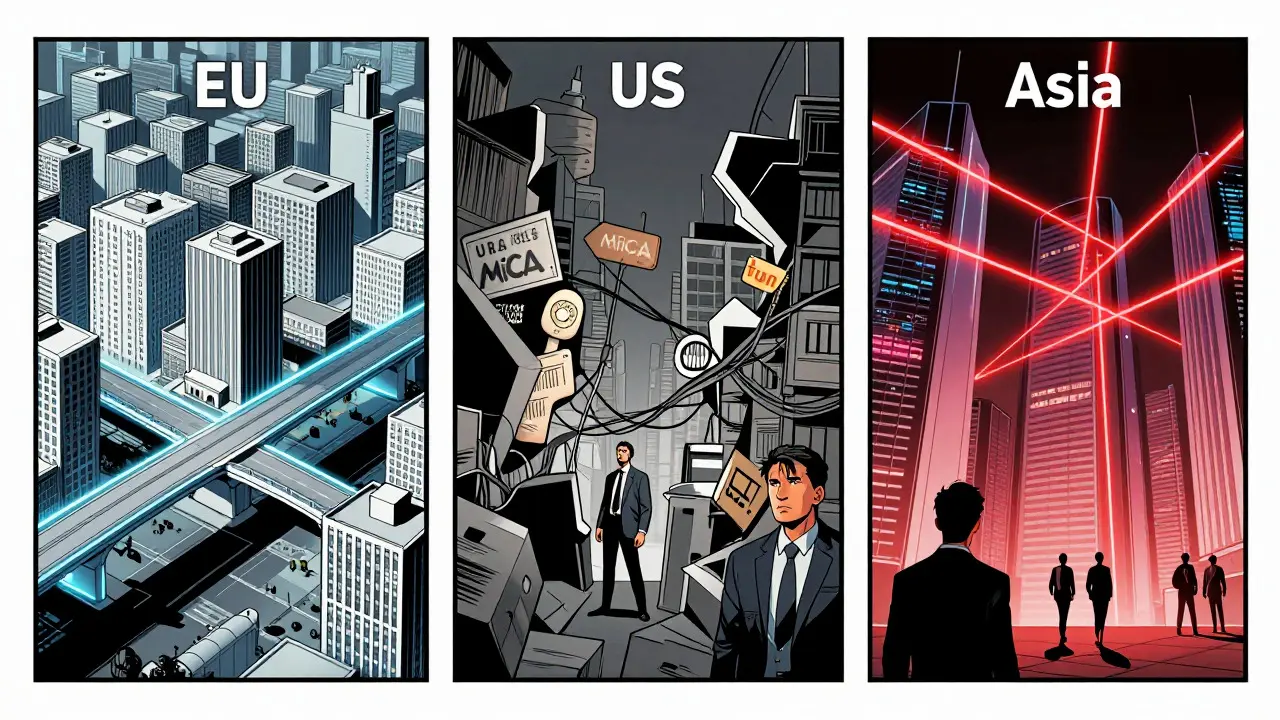
You might think the US leads the way because of its large market, but the reality is more nuanced. The European Union has arguably built the most cohesive framework. Under the Markets in Crypto-Assets (MiCA) regulation, all 27 member states follow a unified rule. The threshold there is lower-just €1,000-which means more transactions are tracked, but the process is standardized. If you send crypto from Berlin to Paris, the data flow is identical to sending it from Madrid to Rome.
In the United States, the situation is fragmented. FinCEN sets the federal baseline at $3,000, but state regulators add their own layers. This creates a compliance maze for US-based exchanges. According to recent surveys, over half of US VASPs report confusion about exactly which rules apply to cross-border transfers. Meanwhile, Asia shows diverse approaches. Japan requires KYC for amounts over ¥30,000 and full Travel Rule data for transfers over ¥100,000. South Korea goes further, mandating real-time monitoring for all significant transactions.
| Jurisdiction | Regulatory Body | Threshold | Implementation Status (2026) |
|---|---|---|---|
| United States | FinCEN | $3,000 USD | Active, but fragmented with state-level variations |
| European Union | EBA / MiCA | €1,000 EUR | Fully harmonized across 27 member states |
| Japan | FSA | ¥100,000 JPY | Active with strict KYC integration |
| United Kingdom | FCA | £1,000 GBP | Comprehensive enforcement since 2023 |
| Australia | AUSTRAC | AUD 1,000 | Active with risk-based approach |
The User Experience: Friction vs. Trust
Does the Travel Rule make life harder for regular users? For many, yes. Sending a small amount of ETH from Coinbase to a Korean exchange might get blocked if the data doesn’t match perfectly. Users on forums often complain about delays-sometimes taking days to resolve if the receiving side flags incomplete information. It’s annoying, sure. But there’s a flip side.
Trust is up. A survey of 5,000 crypto users found that platforms with robust Travel Rule compliance saw a 37% increase in user trust metrics. Why? Because when you know your funds can be traced, you feel safer. Scams and rug pulls become harder to execute without leaving a paper trail. For institutional investors, this is non-negotiable. Over 80 Fortune 100 companies now maintain Travel Rule-compliant crypto operations, largely because they need that audit trail for their own accounting departments.
However, privacy advocates argue we’re going too far. Dr. Richard Turrin, a prominent critic, points out that 68% of small transactions below the threshold are still subject to unnecessary data collection due to overly broad implementation. If you’re sending $50 worth of stablecoins to pay for coffee, do you really need to share your home address? Probably not. This tension between security and privacy is the central debate of 2026.
Technical Challenges and Costs for Exchanges
For VASPs, compliance isn’t free. Implementing the necessary infrastructure costs an average of $487,000 for medium-sized exchanges, with ongoing maintenance running around $183,000 per year. That’s a huge chunk of budget for smaller players. The biggest headache? Interoperability. Not every exchange uses the same software. Some use Chainalysis, others use Notabene, and some build proprietary solutions. Getting these systems to talk to each other smoothly is complex.
But technology is catching up. Modern compliance tools add only 0.8 seconds to transaction processing time, down from 4.2 seconds in 2022. To the user, it feels instant. The backend magic involves zero-knowledge proofs and other cryptographic techniques that allow data verification without exposing every detail to the public ledger. This is a game-changer for privacy-focused users who want compliance without total transparency.

What About DeFi and Stablecoins?
Decentralized Finance (DeFi) was originally seen as a loophole. If there’s no central company, who collects the data? FATF’s 2025 Targeted Update closed much of that gap. Now, decentralized applications that receive and send value can be classified as VASPs under certain conditions. This means even protocol developers might need to implement Travel Rule checks if they control the entry point to a liquidity pool.
Stablecoins are another hot topic. With the US Strategic Bitcoin Reserve established in 2025 and new executive orders pushing for clearer digital asset markets, stablecoin issuers are under intense scrutiny. The next major FATF update in June 2026 will likely focus heavily on offshore VASPs and DeFi specifics. Expect tighter rules for any platform that lets you swap tokens without a middleman.
Future Outlook: Privacy Meets Compliance
Where are we heading? Gartner predicts that by 2027, 95% of major crypto transactions will be fully integrated with Travel Rule compliance. But it won’t look like the clunky forms of today. We’re moving toward “privacy-preserving compliance.” Imagine using zero-knowledge proofs to prove you’re not a sanctioned entity without revealing your exact location or identity to the whole world. This could reduce compliance costs by 63% while keeping user data secure.
For now, the best advice is to stay informed. Check which standard your favorite exchange uses. Ensure your KYC info is up to date. And if you’re building in this space, invest in interoperability early. The Travel Rule is no longer optional; it’s the price of admission to the global crypto economy.
What is the minimum amount for the FATF Travel Rule in the US?
In the United States, FinCEN requires VASPs to collect and share travel rule data for transactions exceeding $3,000. However, individual states may have additional requirements, so always check local regulations.
Does the Travel Rule apply to DeFi protocols?
Yes, partially. Since the 2025 Targeted Update, decentralized applications that act as intermediaries for value transfer may be classified as VASPs. Purely autonomous smart contracts without a controlling entity remain in a gray area, but regulation is tightening.
How long does a Travel Rule compliant transaction take?
With modern technology, the added delay is minimal, typically around 0.8 seconds. Older systems could add several seconds, but current standards ensure near-instant processing for users.
Can I avoid the Travel Rule by using private coins?
Not easily. Most major exchanges have delisted or restricted highly private coins to simplify compliance. If you use a private coin on a compliant exchange, you’ll still face KYC checks at the point of entry or exit.
Who enforces the Travel Rule globally?
The Financial Action Task Force (FATF) sets the standards, but enforcement is local. In the US, it’s FinCEN; in the EU, it’s national authorities guided by EBA; in Japan, it’s the FSA. Each region has its own penalties for non-compliance.





15 Comments
Dave Worth
August 28 2026They are watching you 🕵️♂️. It is all a big conspiracy to track every satoshi you own. The banks and the government want to know where your money goes so they can take it when they feel like it. You think this is about money laundering? No, it is about control. Total surveillance state in crypto form. Wake up people! 👁️
Ellie Brooks
August 28 2026Omg Dave, you are always so intense but honestly I get why you worry because I was just trying to send some ETH to my cousin in London and it took like three days because their exchange didn't have my full address format right which is super annoying but then again if we didn't do this who knows how many scams would be out there stealing from regular folks like us so maybe it's worth the little bit of friction if it means we can actually trust that our digital wallets aren't going to vanish into thin air or get frozen by some random court order without us knowing anything about it until it's too late right?
Rajni Mathur
August 29 2026One must observe that the fragmentation in the US market is a testament to regulatory inefficiency 😐. While the EU has achieved harmonization under MiCA, American entities continue to suffer from a patchwork of state-level variations that hinder seamless cross-border transactions. This lack of a unified federal approach creates unnecessary compliance costs for VASPs operating within the United States. Furthermore, the reliance on disparate software solutions such as Chainalysis versus proprietary systems exacerbates interoperability issues. Until a singular standard is enforced at the federal level, the promise of global crypto integration remains largely theoretical for US-based players.
nic c
August 29 2026You guys are missing the boat entirely here. It’s not just about the rules, it’s about the sheer, unadulterated mess of trying to make two completely different worlds talk to each other. We’re talking about the rigid, bureaucratic beast of traditional finance trying to shake hands with the wild, decentralized jungle of crypto, and it’s like trying to teach a cat to use a computer mouse while simultaneously juggling chainsaws. The fact that we’re only at 63% adoption of TRP is actually kind of shocking if you stop and think about how much money is flowing through these pipes. Every second that passes without a universal language is a second where a transaction could get stuck in limbo, bouncing between servers like a ping-pong ball in a hurricane. And don’t even get me started on the cost. Four hundred eighty-seven thousand dollars? That’s a small house in most places. Just to make sure your name matches your account number? It’s absurd, it’s beautiful, and it’s the price we pay for living in the future.
David Powell
August 30 2026Of course, if one is not accustomed to the finer nuances of global regulatory frameworks, the concept of 'fragmentation' might seem overly dramatic. But for those of us who understand the elegance of a standardized system, the US situation is simply embarrassing. 🙄
Valentine Okpala
August 30 2026It is what it is 🍃. I live in the UK so the £1,000 threshold hits a lot of my smaller trades. But honestly, since 2023 enforcement has been pretty smooth. No drama. Just data moving quietly in the background. I guess that's the point. It should be invisible if it's working. Though I do miss the days when sending coins felt like magic rather than filling out a form. But then again, magic usually comes with a price tag. 😌
Rachel Etheridge
September 1 2026oh my god i cant believe everyone is acting like this is such a bad thing. yes its annoying to type your address but did you know that before this stuff happened half the time you sent money to a scammer and never saw it again?? i had a friend lose 2k bucks because she typed one zero wrong and there was no way to trace it back. now at least if something goes wrong the exchanges can talk to each other and maybe, just maybe, you get your money back. its not perfect but its better than the dark ages of 2017. stop complaining and start being grateful for the safety net!! 💖
Sam Ariafar
September 1 2026While gratitude is a virtue, one must also consider the privacy implications. If we accept total transparency for the sake of security, where does it end? Today it is your address, tomorrow it is your spending habits, and the day after, your political donations. The moral high ground is often built on sand. We must tread carefully, lest we trade liberty for convenience without realizing the cost.
Trista Dennis
September 3 2026Sam, you're really stretching it there. Privacy advocates love to paint a picture of dystopia, but let's look at the facts. The rule only kicks in above certain thresholds. If you're buying coffee with stablecoins, you're mostly fine. The real issue isn't that they're spying on your lunch orders; it's that the implementation is sloppy and over-collects data for small transfers. It's not a conspiracy, it's just bad engineering. Fix the code, stop whining about Big Brother. 😒
Jillian Pye
September 4 2026( ˘ ³˘)♥ I think the key here is balance. We need enough info to catch the bad actors, but we don't need to turn every user into a file in a government database. The zero-knowledge proofs mentioned in the article sound promising for this exact reason. Prove you're clean without showing your ID card to the whole world. That feels like the right path forward to me.
Ashwini Chaskar
September 5 2026you people dont get it the problem is not the rule the problem is the companies implementing it. they charge fees for everything and then act surprised when users complain. also india is still figuring out its own stance so if you are trading across borders you are basically gambling on which regulator wakes up first. its chaotic and messy and nobody wants to admit that the system is still broken in so many ways. just keep your eyes open and don't trust any platform that doesn't show you exactly where your data is going. ( ͡° ͜ʖ ͡°)
Ian Munro
September 6 2026Agreed. The tech is ready. The laws are catching up. The main hurdle now is cultural acceptance among retail users who prefer anonymity. Once the UX becomes seamless, the resistance will fade. Concise and clear.
Kevin Payette
September 8 2026"Cultural acceptance." Sure. Let's wait for the masses to understand cryptography. By then, the whales will have moved all their liquidity to offshore havens that ignore FATF entirely. The gap between compliant VASPs and the gray market will only widen. It's a race to the bottom for privacy, and the regulators are running with blinders on. Don't hold your breath for fairness. 📉
Rebecca Springer
September 9 2026I appreciate the different perspectives here. As someone who works with international clients, I see both sides daily. For our business partners in Europe, the MiCA framework is a blessing-it simplifies everything. But when we deal with US counterparts, it's a constant negotiation. The best advice I can give is to diversify your custody options. Don't put all your eggs in one basket, especially if that basket is subject to shifting local regulations. Stay flexible, stay informed, and always keep a backup plan for your assets. 🌏
Matt Reckdenwald
September 11 2026This thread has been surprisingly civil given the topic. It’s fascinating to watch how a technical protocol like TRP ends up shaping social behavior and trust metrics. We often forget that technology is never neutral; it encodes values. In this case, the value encoded is accountability. Whether you love it or hate it, the era of the "wild west" is officially closing. Welcome to the age of verified digital identity. It’s a profound shift, and we’re all navigating it together, whether we like it or not. Beautifully complex. ✨