What is HTX (HTX) Crypto Coin? The Full Breakdown of HTX Token and Exchange
The HTX coin, officially called HTX a native token of the HTX cryptocurrency exchange platform, is not just another cryptocurrency. It’s the backbone of one of the world’s largest digital asset platforms - the same platform that was once known as Huobi Global. If you’ve heard of Huobi, you’re already halfway there. In September 2023, the exchange rebranded to HTX, and with it came a renewed focus on decentralization, community governance, and ecosystem growth - all centered around the HTX token.
Where Did HTX Come From?
HTX didn’t appear out of nowhere. It evolved from Huobi, a crypto exchange founded in China in 2013. Back then, Huobi quickly became the biggest Bitcoin trading platform in the country, handling over 1.7 trillion yuan in volume by late 2016. That’s more than 60% of the global Bitcoin trading market at the time. When China banned crypto exchanges in 2017, Huobi shifted its operations overseas, eventually settling its headquarters in the Seychelles.
In 2022, Justin Sun - the founder of TRON - bought Huobi. He didn’t just take over. He transformed it. In 2023, he dropped the old name and launched HTX. The new name? A blend of Huobi (H), TRON (T), and Exchange (X). It wasn’t just a rebrand. It was a statement: this platform now ties together three major forces in crypto - trading infrastructure, blockchain innovation, and user-driven governance.
What Is the HTX Token Actually Used For?
The HTX token isn’t just a tradable asset. It’s a utility token with real, daily functions inside the HTX ecosystem. Here’s what holders can actually do with it:
- Pay reduced trading fees - Users who hold HTX get discounts on trading fees. For example, the standard maker fee is 0.02%, but HTX holders can drop it to 0.01% or lower depending on their VIP tier.
- Access VIP services - Higher HTX holdings unlock priority customer support, exclusive trading tools, and early access to new listings.
- Earn rewards - HTX is used in the Ecological Trading Zone, where users get cashback and bonus tokens for trading activity.
- Participate in governance - Every HTX holder can vote on platform proposals through HTX DAO. This includes changes to fees, new features, and how revenue is distributed.
- Get liquidity incentives - HTX DAO encourages users to lock up their tokens as liquidity for DeFi protocols. In return, they earn extra rewards and influence ecosystem development.
One of the most unique features? Twenty percent of HTX’s total revenue goes straight into buying back and burning HTX tokens. That means every quarter, millions of tokens are permanently removed from circulation. This isn’t a marketing gimmick - it’s a structural mechanism designed to reduce supply and increase scarcity over time.
HTX Token Stats (As of March 21, 2026)
Here’s the current snapshot of HTX:
| Attribute | Value |
|---|---|
| Current Price | $0.05168 |
| 24-Hour Trading Volume | $19,969,506 |
| Total Supply | 999.99 trillion HTX |
| Circulating Supply | 916.53 trillion HTX |
| All-Time High | $0.053589 (Dec 3, 2024) |
| All-Time Low | $0.0068026 (Aug 5, 2024) |
| Market Cap | $1,558,090,684 USD |
| Market Rank | #203 (CoinMarketCap) |
| Token Holders | 75,210 |
That massive supply - nearly a quadrillion tokens - might sound alarming. But remember: most of these tokens are locked in ecosystem roles, not freely traded. The real circulating supply is under 1 trillion, and with the burning mechanism, that number is slowly shrinking.
What Is HTX DAO?
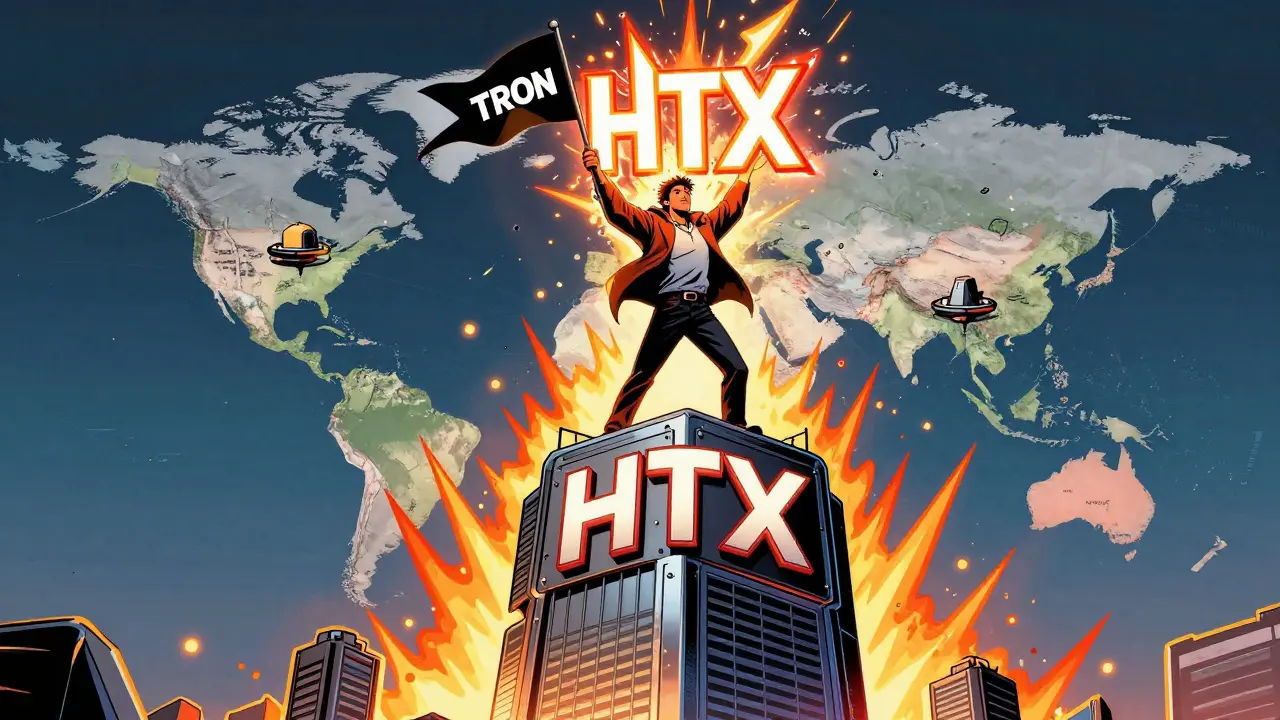
If HTX is the fuel, then HTX DAO is the engine. HTX DAO stands for Decentralized Autonomous Organization. It’s not a company. It’s not a legal entity. It’s a group of token holders who make decisions together - without a CEO or board.
Here’s how it works:
- All HTX holders can submit proposals for changes to the platform.
- Proposals are voted on-chain using smart contracts - no third parties, no manipulation.
- Each HTX token equals one vote. The more you hold, the more influence you have.
- Decisions are binding and automatically executed on the platform.
One standout initiative is the Ecosystem Liquidity Pledge. HTX DAO asks users to voluntarily lock their tokens into liquidity pools for DeFi projects. In return, they earn additional rewards and help fund new tools, apps, and integrations. This isn’t charity - it’s mutual growth. The more liquidity there is, the more developers build on HTX, and the more value flows back to token holders.
HTX DAO also plans to integrate liquidity from Poloniex, another major exchange, creating a cross-platform ecosystem that’s bigger than any single exchange.
How Does HTX Compare to Other Exchanges?
HTX isn’t just another exchange. It’s a hybrid. It blends centralized efficiency with decentralized control. Here’s how it stacks up:
| Feature | HTX | Binance | Coinbase | Kraken |
|---|---|---|---|---|
| Trading Fees (Maker/Taker) | 0.02% / 0.04% | 0.02% / 0.04% | 0.40% / 0.60% | 0.16% / 0.26% |
| HTX Token Discount | Yes (up to 50% off) | Yes (BNB discount) | No | No |
| DAO Governance | Yes (on-chain voting) | Yes (limited) | No | No |
| Revenue Burning | 20% of revenue burned | 20% of BNB revenue burned | No | No |
| Staking APY (USDC) | 5% | 4.5% | 3.5% | 4% |
| Regulatory Presence | Hong Kong, Dubai, Lithuania, Australia | Global (limited in US) | US-focused | US, EU, Canada |
HTX stands out because it gives users real power - not just lower fees. While Binance uses BNB for discounts and limited governance, HTX DAO is fully open. Anyone with HTX can propose, vote, and shape the future of the platform. That’s rare.
How to Buy HTX Coin
Buying HTX is straightforward:
- Create an account on htx.com (the official exchange).
- Complete KYC verification (ID and proof of address).
- Deposit fiat (USD, EUR, JPY) or crypto (BTC, ETH, USDT).
- Go to the HTX/USDT or HTX/BTC trading pair.
- Place a market or limit order.
You can also buy HTX on other major exchanges like KuCoin, Gate.io, and Bybit. But buying directly on HTX gives you the best fee discounts and immediate access to DAO voting.
Is HTX Safe?
HTX has faced criticism in the past - especially around its 2017 China exit and the controversial use of client funds. But since Justin Sun took over, security and transparency have improved dramatically.
Current security measures include:
- 95% of funds stored in cold wallets
- Multi-signature withdrawal systems
- Regular third-party audits
- Two-factor authentication (2FA) required for all accounts
- Insurance fund for asset protection
HTX is also licensed in Hong Kong, Lithuania, and Dubai - jurisdictions known for strict crypto regulations. This isn’t a fly-by-night operation. It’s a regulated global platform with real legal standing.
What’s Next for HTX?
HTX isn’t resting. The team is pushing hard on three fronts:
- DeFi Integration - More liquidity pools, yield farming, and cross-chain bridges are being built.
- Global Expansion - New offices in Australia and the UAE are opening, with plans to launch local fiat on-ramps.
- DAO Growth - The goal is to have over 1 million HTX holders participating in governance by 2027.
The vision? To become the first exchange that truly bridges centralized finance (CeFi) and decentralized finance (DeFi) - without forcing users to choose one.
Is HTX coin the same as Huobi Token?
Yes, HTX coin is the same asset as the old Huobi Token (HT). When the exchange rebranded from Huobi Global to HTX in September 2023, the token was renamed HTX but kept the same contract address and supply. All previous HT holders automatically became HTX holders. There was no airdrop or migration - it was a direct rename.
Why does HTX have such a huge total supply?
The total supply of 999.99 trillion HTX was set at launch to allow for massive distribution across the ecosystem - including rewards, liquidity incentives, and DAO grants. Most of these tokens are locked or reserved for future use. The circulating supply is only about 916 trillion, and 20% of platform revenue is burned every quarter. That means the real number of tokens in circulation is slowly decreasing over time.
Can I earn interest on my HTX coins?
Yes. HTX offers staking and savings products with fixed APY rates. For example, you can earn 5% APY on USDC, 3.05% on ETH, and 3.63% on SOL. HTX itself doesn’t pay interest directly on HTX tokens, but you can lock HTX in liquidity pools through HTX DAO to earn yield from trading fees and protocol rewards.
Is HTX a good long-term investment?
Whether HTX is a good investment depends on your goals. If you care about platform utility - like lower fees, governance power, and ecosystem growth - then holding HTX makes sense. The burning mechanism and DAO incentives create real demand. But if you’re looking for speculative gains, remember: HTX is tied to the success of the exchange. If HTX loses market share to Binance or Coinbase, the token’s value could drop. It’s a utility asset, not a pure store of value like Bitcoin.
How does HTX DAO differ from other crypto DAOs?
Most DAOs are small, underfunded, and disconnected from real products. HTX DAO is different because it’s backed by a $10+ billion exchange with real revenue. It doesn’t just vote on ideas - it funds them. Liquidity pledges from HTX and Poloniex mean real money flows into DeFi projects. That’s rare. HTX DAO turns governance into a profit-sharing system, not just a voting booth.
Final Thoughts
HTX isn’t just a coin. It’s a system. It’s the key to a platform that’s trying to fix the biggest problem in crypto: centralization disguised as decentralization. By tying token value directly to user participation, revenue sharing, and governance, HTX creates a feedback loop where users benefit when the platform grows. That’s not common. And it might just be the future.


18 Comments
Nicolette Lutzi
March 22 2026This is just another centralized exchange with a fancy DAO label. They're still holding all the keys. Don't be fooled by the 'decentralized' buzzwords. When they shut down your account tomorrow, who you gonna call? The blockchain? LOL. They're just Huobi with a new coat of paint and a PR team on steroids.
Domenic Dawson
March 23 2026I've been holding HTX since the rebrand and honestly? The fee discounts alone have saved me hundreds. The real win is being able to vote on new listings - last month we pushed through a new stablecoin pair that Binance wouldn't touch. It feels good to have a say.
Sam Harajly
March 24 2026The tokenomics here are actually quite thoughtful. 20% of revenue burned quarterly is a solid mechanism - it's not just marketing fluff like some other projects. The fact that the circulating supply is shrinking while demand grows creates a real economic incentive. It's not perfect, but it's one of the more sustainable models I've seen in CeFi-DeFi hybrids.
Alice Clancy
March 24 2026They're lying about the supply. 999 trillion? That's a scam. They printed it to dilute the old HT holders. I checked the contract - it's the same address but the decimals were changed. They stole our voting power. #HTXScam
kavya barikar
March 25 2026The burning mechanism is smart. Reducing supply over time while increasing utility creates natural demand. Simple math, really.
aravindsai pandla
March 25 2026HTX DAO’s integration with Poloniex could be a game-changer. Cross-exchange liquidity pools are rare and technically challenging. If executed well, this could set a new standard for exchange collaboration.
namrata singh
March 26 2026I didn't believe in DAOs until I voted on the new staking tier upgrade. I literally got a notification that my suggestion was implemented. It felt... personal. Like I mattered. I didn't know crypto could do that.
Andrea Zaszczynski
March 27 2026Wait so you're telling me you just trust some guy named Justin Sun? The same guy who got TRON in trouble for pump-and-dump schemes? I'm sorry but I'm not buying this 'reformed' narrative. This is just a new front for the same old playbook.
Cordany Harper
March 27 2026As someone from India, I appreciate that HTX has local fiat on-ramps coming. Most exchanges ignore us. Also, the 5% APY on USDC is way better than what my local bank offers. Real talk - I'm using this as a savings tool, not a gamble.
DarShawn Owens
March 27 2026I started with $200 in HTX last year. Now I'm in VIP 3, get priority support, and earn 2% cashback just for trading. It's like getting paid to use an exchange. No other platform does that. It's not hype - it's just good design.
Andy Green
March 28 2026Oh wow, another 'community-driven' project. Let me guess - the top 10 wallets hold 70% of the supply? Classic. You think you're voting, but you're just feeding the whales. HTX DAO is a puppet show with blockchain glitter on it.
Zion Banks
March 29 2026The fact that they're licensed in Lithuania? That's a red flag. That country's crypto regs are a joke. And why are they partnered with Poloniex? You think they're not sharing user data? This is all a front for surveillance capitalism. The blockchain doesn't lie - but the people behind it do.
Annette Gilbert
March 29 2026Oh sweetie. You really think a 0.01% trading fee discount is worth your life savings? Honey, I have a better idea - buy a toaster. At least it toasts bread. And you won't need a PhD in tokenomics to use it.
Jenni Moss
March 30 2026You guys are overthinking this. Just hold HTX, use the platform, vote when you can. It's not about getting rich overnight. It's about being part of something that actually listens. I didn't know I wanted that until I got it. Now I'm hooked.
Marie Mapilar
April 1 2026I've been in the space since 2017 and I've seen a lot of 'decentralized' projects fail. But HTX DAO? The way they fund liquidity pledges? That's legit. I staked 500 HTX in the ETH-USDC pool and got 12% APY + voting rights. It's not magic - it's mechanics.
Shelley Dunbrook
April 1 2026The comparison table is misleading. Binance’s BNB burn is more consistent and has more historical traction. HTX is trying to copy a model that already works. Innovation? Or just imitation?
Aman Kulshreshtha
April 2 2026In India, most people don't even know HTX exists. But if they did, they'd love the low fees. We're tired of paying 0.6% to Coinbase. This could change things here - if they localize the app.
Leona Fowler
April 3 2026I've been using HTX for staking and the customer support actually responded within 2 hours. On Binance, I waited 3 days. The DAO isn't perfect, but the platform is getting better. Small wins add up.